
What your skin reveals about your blood values
The key points at a glance
Less than the headline promises. The specialist sources associate specific deficiency states with signs in the skin, hair, and nails—in other words, they start with the deficiency, not the sign.
The reverse does not appear in any of the sources reviewed. Brittle nails do not yield a lab value, and dry skin does not yield a number.
You will read the quoted source verbatim, three common statements fact-checked, three documented facts, the actual associations at a glance, and why the reverse does not hold.
What to expect in this article
1. Why the question seems reasonable
2. The documented source
3. The direction in which to read the sources
4. Three statements fact-checked
5. What the sources actually associate
6. Three documented facts
7. The key point in one sentence
8. Why the reverse does not work
9. The associations at a glance
10. The measurement problem with zinc
11. When it is worth looking at the values
12. What a capillary blood panel can show
13. Limitations: what blood values leave unanswered here
14. What matters in this topic
Frequently asked questions
Sources
Why the question seems reasonable
Skin, hair, and nails have one characteristic that no blood value has: You see them every day.
That is why it seems plausible that they could indicate something. If a nail suddenly looks different than it did a year ago, you look for an explanation, and the idea that something is missing inside the body is one of the first that comes to mind.
This article examines what the specialist sources actually say about this. The result is less spectacular than the title suggests, but reliable.
First, the most important note: A visible change in the skin, hair, or nails that persists or worsens should be evaluated by a doctor or dermatologist. This article does not replace that step, nor is it intended to.
The documented source
The most revealing sentence on this topic is not about the skin, but about measurement.
Documented source
“Low albumin levels, which frequently occur with zinc deficiency, make determining the serum zinc level difficult.”
MSD Manual, Professional Edition
Zinc Deficiency, Larry E. Johnson, last reviewed May 2025
This sentence appears at the beginning because it breaks the entire chain many people expect.
The expected chain is: skin signs, then blood test, then answer. The source says that even the third step is not so simple, because the very value in question is difficult to determine.
That does not mean testing would be pointless. It means that here, a numerical value is not the clear answer one might hope for.
The direction in which to read the sources
When reviewing the specialist sources, a structure emerges that is easy to overlook.
The chapters are titled “Zinc Deficiency,” “Iron Deficiency,” or “Vitamin A Deficiency.” They begin with the deficiency and then list the signs that may occur with it. No chapter is titled “Brittle Nails” and then lists nutrient levels.
For zinc deficiency, the MSD Manual lists “alopecia,” “dermatitis,” and “delayed wound healing,” among other manifestations, alongside additional signs unrelated to the skin (Johnson, as of May 2025).
That is precisely the point. The skin signs do not appear on their own, but as part of a series alongside others. A single sign without the others is therefore a very weak indication.
Three statements in the fact check
These three statements circulate whenever skin and nutrients are discussed.
Checked against the evidence
Common
“Brittle nails mean iron deficiency.”
Documented
The source reads in the other direction: For iron deficiency, IQWiG lists, among other things, cracked skin at the corners of the mouth, brittle nails, and hair loss (as of April 19, 2023). It does not make the inference from an individual sign to the level.
Common
“A skin rash shows which nutrient is missing.”
Documented
The MSD Manual associates the sign “rash” with several possible causes: many vitamins, zinc, and essential fatty acids (as of August 2024). A sign that fits multiple causes does not identify any single one.
Common
“Then I’ll simply have my zinc level measured.”
Documented
The MSD Manual states: Low albumin levels, which often occur with zinc deficiency, make determining the serum zinc level difficult (Johnson, as of May 2025).
What the sources actually associate
There are documented associations, and they are worth reading carefully.
The MSD Manual presents an overview of signs and the nutrients associated with them. For skin appearance, it lists “rash” alongside many vitamins, zinc, and essential fatty acids, “rash on exposure to sunlight” alongside niacin, and “easy bruising” alongside vitamin C or vitamin K (as of August 2024).
For hair and nails, the same overview lists “Thin hair or hair loss” alongside protein, “Premature graying of the hair” alongside selenium, and “Spoon nails” alongside iron (as of August 2024).
For iron deficiency, IQWiG lists cracked skin at the corners of the mouth, brittle nails, and hair loss (as of April 19, 2023). Here too, the signs appear in a longer list and do not stand alone.
These lists are useful when read as intended: as descriptions of what may occur when a deficiency has been identified. They are not a reference guide for determining the deficiency from the sign.
Three documented facts
Three pieces of information from the reviewed sources. They provide context and do not constitute a diagnosis.
Documented information
3 causes
as of August 2024, the MSD Manual lists many vitamins, zinc, and essential fatty acids for the sign “rash” alone
9–140 µg/l
the ferritin reference range covers 18–360 µg/l for women over 18 and men over 18 (IQWiG, as of March 20, 2025)
0 reversals
the sources reviewed contain: No chapter starts with a skin sign and infers a laboratory value from it
The third piece of information is the most important in this article. It describes not what was found, but what does not appear in any source.
The core in one sentence
At this point, the topic can be brought together.
The sources describe what may be visible in the case of a deficiency. They do not describe what follows from what has been observed.
This difference is not a technicality. It determines whether you are allowed to derive a number from an observation.
You must not. What you may do is discuss a persistent change with a medical practice that can examine it and knows your medical history.
Why the reverse does not work
The reason can be explained without technical terms, and it has to do with frequency.
A sign such as brittle nails is common in the population. The conditions in which it can occur are much rarer. If a common sign is supposed to point to a rare condition, then in the vast majority of cases it points in the wrong direction.
There is also a second problem: In the sources, the same sign is associated with several different nutrients. A sign that fits many causes does not identify any one of them.
And third, there are causes that have nothing to do with nutrients. Nails and hair react to mechanical stress, care products, water and cold, and conditions that a dermatology practice can recognize but a laboratory report cannot.
Together, these three points explain why a sign does not lead to a laboratory value. They also explain why a consultation in a medical practice accomplishes more here than any list.
What is different in a medical practice
In a medical practice, something happens that a laboratory report cannot do: someone looks at the change. They see where it is located, what it looks like, whether it affects both hands or just one, and whether the nail plate or nail edge has changed.
The progression over time also matters. How long has the change been present? Has it increased? Was there a change beforehand? This information significantly narrows the range of possible causes, and none of it appears on a test result.
That is exactly what IQWiG means when it writes that a laboratory value must always be considered together with other values, symptoms, and findings from other examinations (as of April 2, 2025). For skin, hair, and nails, the examination provides most of the information—not the laboratory.
That is why the order matters. Have it examined first, then decide whether a value can actually help. Doing it the other way around produces a number that is of no use to anyone.
The assignments at a glance
The table reproduces which sources associate which signs with a deficiency and the direction in which that association applies. It provides context; it does not make a diagnosis.
| Deficiency | Signs involving the skin, hair, and nails | Does the conclusion apply? | Source |
|---|---|---|---|
| Iron deficiency | Cracked skin at the corners of the mouth, brittle nails, hair loss; the overview also includes spoon nails | No. The source starts from the deficiency, not the sign | IQWiG, as of April 19, 2023; MSD Manual, as of August 2024 |
| Zinc deficiency | Alopecia, dermatitis, delayed wound healing, along with several signs unrelated to the skin | No. In addition, the serum value is difficult to determine | MSD Manual, Johnson, as of May 2025 |
| Protein deficiency | Thinning hair or hair loss | No. The same sign also occurs with iron deficiency | MSD Manual, as of August 2024 |
| Other nutrients | Rash with many vitamins, zinc, and essential fatty acids; premature graying with selenium; easy bruising with vitamin C or K | No. Multiple causes for each sign rule out a definitive conclusion | MSD Manual, as of August 2024 |
The third column is the same in all four rows, and that is the table’s actual message.
Anyone who notices a persistent change therefore gains no course of action from this table. What they gain is the information that the question belongs in a medical practice, not on a laboratory report.
It is also striking how often the same signs appear in different rows. Hair loss is listed for both iron deficiency and protein deficiency, and skin is mentioned in three of the four rows. A table with this structure cannot be read backward without creating ambiguity.
The measurement problem with zinc
Zinc comes up particularly often in this context, and the measurement is especially tricky there.
The MSD Manual explains why: Low albumin levels, which frequently occur with zinc deficiency, make determining the serum zinc level difficult (Johnson, as of May 2025).
This is an uncomfortable situation: The very condition one wants to measure changes the conditions of the measurement. A numerical value is then not a simple yes or no.
This does not mean that zinc should not be measured. It means that a zinc value is interpreted only together with other information and that, on its own, it does not answer any question.
What this means for a test result
When a panel includes zinc and albumin together, the two numbers can be compared side by side. This is exactly the constellation described by the source.
What it does not replace is the interpretation. IQWiG generally states that an individual laboratory value is always only one component of an overall diagnosis (as of April 2, 2025).
And it does not change the direction. Even two numbers side by side do not explain a skin change; they merely describe two values.
When it is worth taking a closer look at the values
The comparison concerns whether documented values can contribute anything in your situation.
Useful for you if …
You have changed your diet and want to document values that may be affected by it.
You want to bring dated figures to a consultation.
You know that a value does not explain a skin change but still want to record it.
You want to establish a reference point so you can see a trend later.
Probably not if …
You have a persistent or worsening skin change. It should be assessed by a medical or dermatological practice.
You hope it will reveal the cause of a skin condition. No laboratory value can do that.
You want to take something based on the figures. This decision belongs in a medical practice.
You are already undergoing evaluation. In that case, the practice that started it should guide you.
What a capillary blood panel can show
A capillary blood self-test does not establish a diagnosis, explain a skin change, or replace dermatological evaluation. What it provides is documented figures with a date.
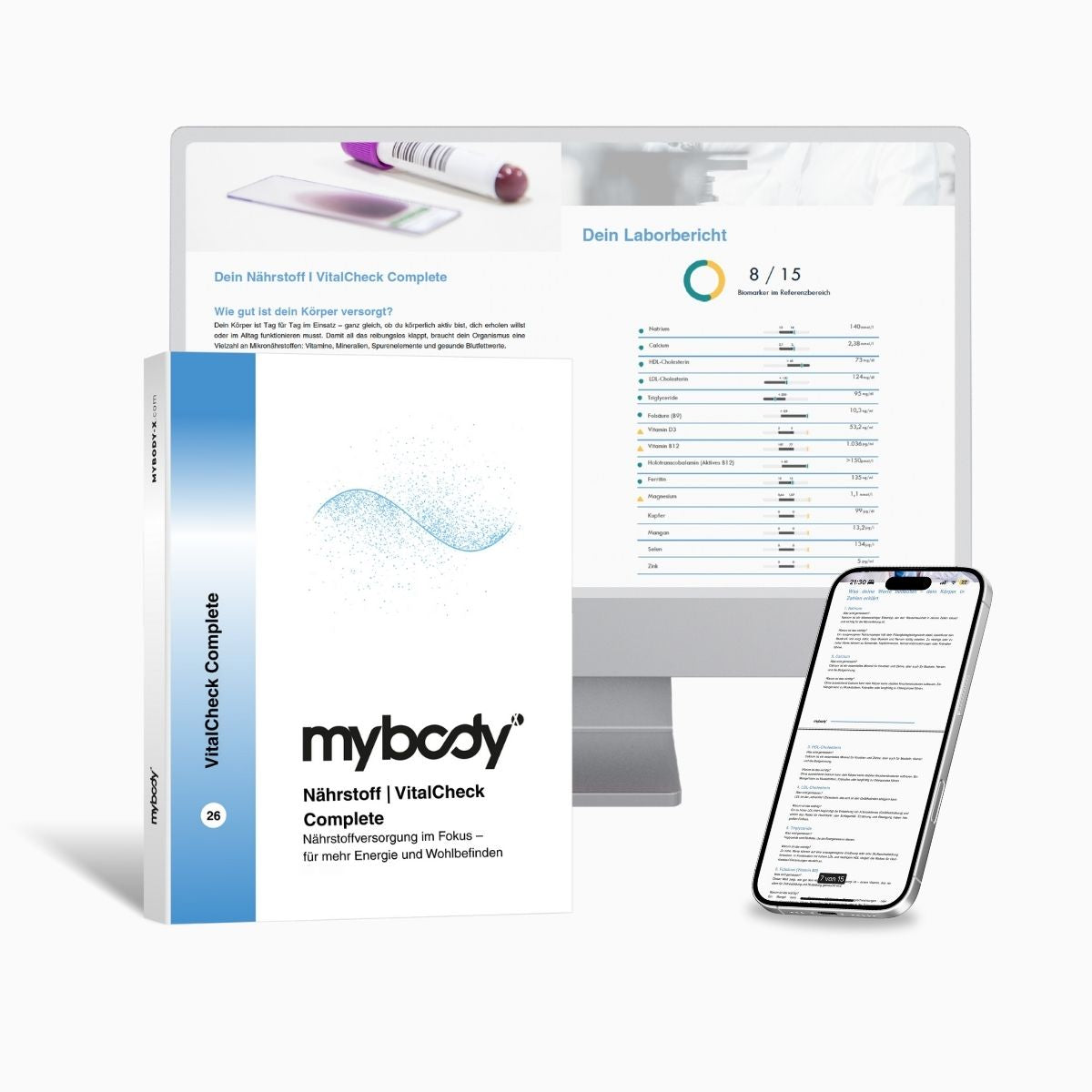
For this topic, one feature is of interest: the VitalCheck from mybody®x (MYBODY Lab GmbH) measures zinc and albumin from the same sample. This places side by side the two values whose relationship is described in the MSD Manual.
Capillary blood test
VitalCheck | Complete Nutrient & Mineral Test
Measures 18 values from the same sample, including zinc, albumin, selenium, ferritin, iron, transferrin, vitamin B12, folic acid, and 25-OH vitamin D3. What the test does not do: It does not explain a skin change or replace dermatological evaluation. It does not include a total protein profile or essential fatty acids. It does not establish a diagnosis.
Laboratory results 3–5 business days after receipt of the sample
Product page information, accessed August 19, 2026
Chapter at a glance
A panel provides dated figures and measures zinc and albumin from the same sample. It does not explain a skin change, replace dermatological evaluation, or establish a diagnosis. Regardless, a persistent change should be assessed by a medical professional.
Limitations: what blood values leave unanswered here
The first limitation is direction. The sources describe signs of a known deficiency. None of them supports inferring the level from the sign.
The second limitation is uniqueness. The same sign occurs with several nutrients: “rash,” for example, with many vitamins, zinc, and essential fatty acids (MSD Manual, as of August 2024).
The third limitation is the measurement itself. Low albumin levels make it difficult to determine the serum zinc level (MSD Manual, Johnson, updated May 2025).
The fourth limitation is other causes. Skin, hair, and nails react to mechanical stress, personal care products, weather conditions, and medical conditions that a dermatology practice can identify—not to a laboratory value.
The fifth limitation is diagnosis. All the assessments in this article provide context; they do not constitute a diagnosis. A single laboratory value is always only one component of an overall diagnosis (IQWiG, updated April 2, 2025).
What matters about this topic
If you take away just one thing from this article, let it be this: The expert sources reason from the inside out, not from the outside in.
They describe which signs can occur when a deficiency has been established. For iron deficiency, IQWiG mentions cracked skin at the corners of the mouth, brittle nails, and hair loss (updated April 19, 2023), while the MSD Manual associates the sign “rash” with several possible nutrients (updated August 2024).
The reverse does not work. Anyone who notices a persistent change should discuss it at a medical or dermatology practice. A laboratory report may be a possible supplement there, but it is never the first step.
Frequently asked questions
Can I tell from my skin which nutrient I am lacking?
No. The sources reviewed start with the deficiency and then list possible signs. The same signs appear there for several nutrients: “rash,” for example, is associated with many vitamins, zinc, and essential fatty acids (MSD Manual, updated August 2024). A sign that fits several causes does not identify any one of them.
What signs do the sources mention for iron deficiency?
IQWiG mentions, among other things, cracked skin at the corners of the mouth, brittle nails, and hair loss (updated April 19, 2023). In its overview, the MSD Manual additionally lists “spoon nails” (updated August 2024). Both sources thus describe what can occur when iron deficiency has been established, not what can be inferred from a sign.
Why is the zinc level difficult to determine?
The MSD Manual gives the reason: Low albumin levels, which often occur with zinc deficiency, make it difficult to determine the serum zinc level (Johnson, updated May 2025). The condition you want to measure therefore changes the conditions of the measurement. A zinc value is consequently interpreted only together with other information.
Can a blood test explain my skin problems?
No. A blood test provides values, not an explanation for the appearance of your skin. Skin, hair, and nails also react to mechanical stress, personal care products, weather conditions, and medical conditions that a dermatology practice can identify. A persistent or worsening change should be evaluated there.
When is a value actually meaningful?
For documentation, for example after changing your diet, or as preparation for a conversation at a medical practice. Not as an answer to an observation. IQWiG states: A single laboratory value is always only one component of an overall diagnosis (as of 2 April 2025).
Next step
Zinc and albumin side by side
VitalCheck measures 18 values from capillary blood, including zinc and albumin from the same sample. It does not explain any skin changes, replace dermatological evaluation, or provide a diagnosis.
Go to VitalCheckRead more
You might also be interested in
Why these two values are difficult to interpret.
What distinguishes the iron values from one another.
Sources
- MSD Manual, Professional Edition: Zinc Deficiency, Johnson LE (last reviewed May 2025) – msdmanuals.com
- MSD Manual, Professional Edition: Symptoms and Signs of Nutritional Deficiencies, overview table (as of August 2024) – msdmanuals.com
- Institute for Quality and Efficiency in Health Care (IQWiG): Iron deficiency and iron-deficiency anemia, as of 19 April 2023 – gesundheitsinformation.de
- IQWiG: Understanding laboratory values correctly, as of 2 April 2025 – gesundheitsinformation.de
- IQWiG: Ferritin, as of 20 March 2025 – gesundheitsinformation.de
The verbatim quotation concerning the difficulty of determining serum zinc levels and the manifestations of zinc deficiency mentioned are taken from source [1]. The associations of rash, rash following exposure to sunlight, easy bruising, thin hair, premature graying, and spoon nails are taken from [2]. The signs affecting the skin, nails, and hair mentioned in connection with iron deficiency are taken from [3]. The sentence about being one component of an overall diagnosis is taken from [4]. The ferritin reference ranges are taken from [5]. The statement that none of the sources reviewed draws the reverse conclusion from a sign to a laboratory value is based on a review of sources [1] to [3] on 19 August 2026. Information on price, values, sample type, and laboratory comes from the mybody®x product page, accessed on 19 August 2026; processing times follow the central specification for blood tests. All sources were accessed and reviewed on 19 August 2026.

mybody®x Editorial & Expert Team
Laboratory diagnostics Blood analysis interpretation Nutritional science Nutrigenetics
This article was created by mybody®x’s editorial and expert team. The team combines laboratory diagnostics, nutritional science, and the interpretation of blood analyses. Everyone who contributes to it is listed on the authors’ page.
Published on 19 August 2026 · Last updated on 19 August 2026
The content is intended for general information and does not replace medical advice, diagnosis, or treatment. Reference ranges depend on the laboratory, method, and age—your test report always takes precedence.




Share now:
Preparing for a blood test: what matters
Training in a calorie deficit is reflected in several metrics