
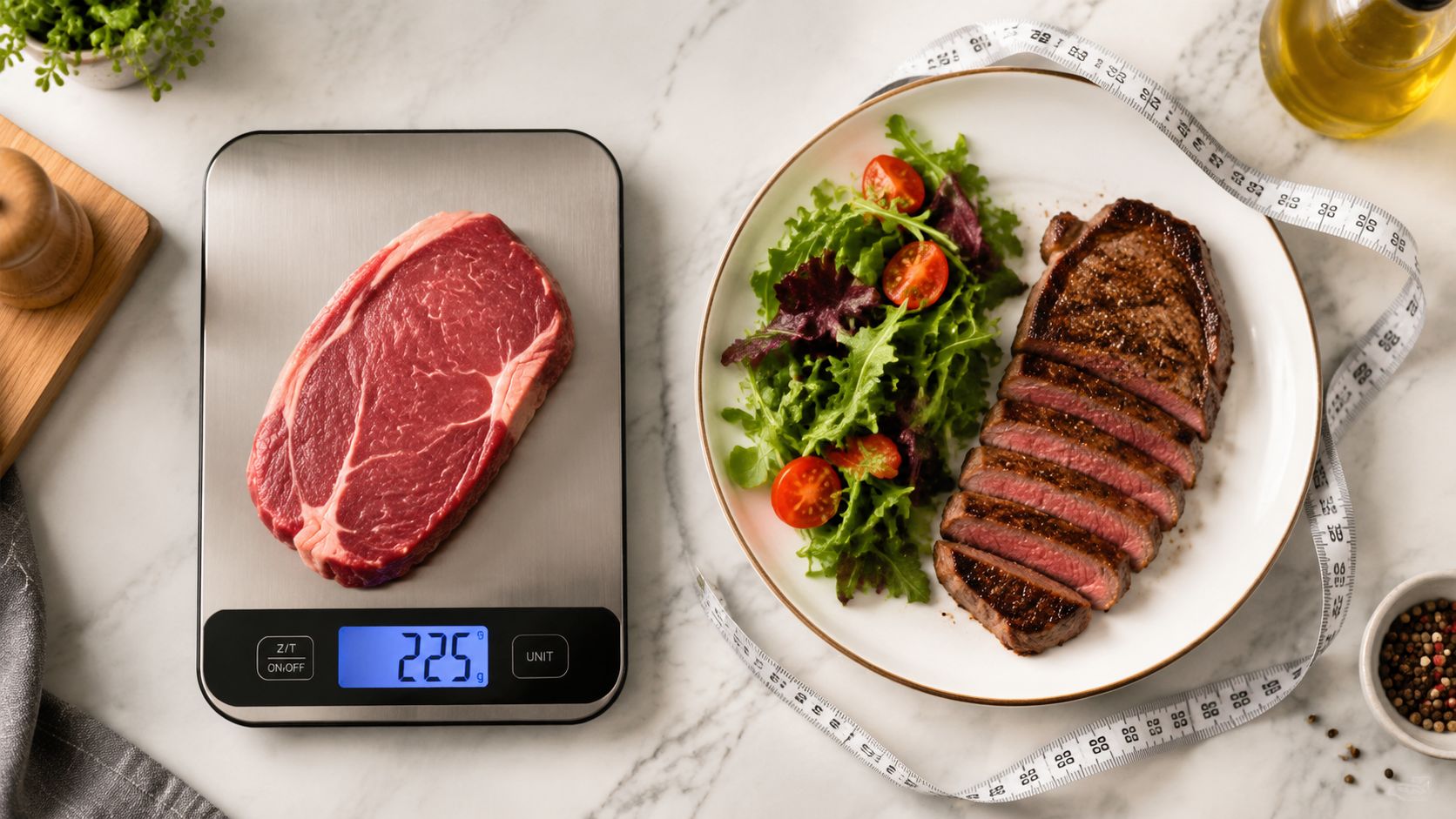
How much meat per person: The guide to your portion
For meal planning, you can often allow for 100 to 200 g of meat per person for a single dish. But for health, this figure is not enough as an answer, because in Germany there is also a recommendation of a maximum of 300 to 600 g of meat and sausage per week.
That is exactly where the confusion begins. Perhaps you are about to go shopping, plan a barbecue, or wonder whether your usual schnitzel is still within a reasonable range. The search query How much meat per person sounds simple. In practice, however, it conceals two completely different questions.
The first question is: How much do I need to ensure that everyone is full after the meal?
The second is: How much makes sense for my body?
The two are not the same. That is precisely why many old rules of thumb now seem outdated. They help with shopping, but tell you almost nothing about whether the amount also suits your metabolism, your everyday life, and your health goals.
The age-old question when cooking and grilling
When you cook for family or friends, you mainly want one thing: not to buy too little. No one wants to be standing by the grill and realize that the meat is already gone before everyone has eaten. That is why so many people search for a quick figure for how much meat per person.
For everyday life, this search is completely understandable. You need guidance when shopping. For goulash, sliced meat, or steak, you think in terms of portions. But when it comes to your health, you should think differently. What matters is not just the amount on your plate, but also how often you eat meat at all, which type you eat, and how your body reacts to it.
The kitchen question is not the health question
A common misconception is simple: people confuse planning quantity with optimal amount to eat. When you plan a meal, you want to make people feel full. When you want to nourish your body properly, you consider energy, protein, iron, digestibility, fat quality, and the tendency to cause inflammation.
Practical rule: The portion that makes sense for a barbecue is not automatically the portion that is ideal for your metabolism.
You can see this clearly when grilling. Three people may appear to eat the same amount, but their starting points are completely different. One person has just come from exercising, another has been sitting in the office for hours, and a third wants to maintain their weight and notices that they feel sluggish after high-fat meals.
Why the old rule of thumb falls short
The question “How much meat per person?” comes from a time when food was often viewed more simply: as long as it was filling, as long as there was enough. Today, many people take a closer look. They do not just want to feel full; they also want to understand what agrees with them.
Anyone who wants to eat more mindfully in everyday life is therefore better off using two levels: first the portion for cooking, then a look at personal tolerance. If you want to plan your meals in a more balanced way overall, you can also find helpful approaches for this practical perspective in the healthy cooking section of the mybody-x guide.
An overview of rules of thumb for the amount of meat
When planning a meal, you still need specific guidelines. The good news is that there are practical kitchen rules for this. The less good news is that they are often confused with health guidelines.
According to the guidelines compiled by Edeka, many kitchen portions are 100 to 200 g per person for one dish, while the nutrition-related recommendation in Germany is a maximum of 300 to 600 g of meat and sausage per week. These two figures therefore answer different questions, which many texts fail to distinguish clearly (Edeka on distinguishing between the amount needed for planning and the weekly recommendation).
Raw weight is not the same as a serving on the plate
Many misunderstandings begin with weighing. In stores, you usually buy meat raw. What ends up on your plate is cooked. There is also a difference between meat with bones, boneless meat, minced meat, and roasting cuts.
| Dish / type of meat | Amount per person (standard) | Amount per person (hearty eaters) |
|---|---|---|
| Fillet, schnitzel, steak without bones | 125 to 150 g | 150 to 200 g |
| Meat with bones | 150 to 250 g | 250 g |
| Minced meat | 100 to 150 g | 150 to 200 g |
| Goulash or sliced meat | 125 to 150 g | 150 to 200 g |
These figures are kitchen guidelines, not a statement about your ideal weekly consumption.
The mistake many people make
Anyone who plans 150 g of meat for lunch and eats a similar amount again in the evening can quickly fall into a pattern that is difficult to reconcile with a weekly recommendation. That is precisely why it is worth distinguishing between the portion per meal and the weekly budget.
Simply put:
- Planning portion: So you buy the right amount for one meal.
- Health portion: So your overall meat consumption fits your daily life.
- Individual portion: So your body gets what it actually needs.
If you also want to understand how meat fits into your overall protein needs, the article on daily protein requirements is a useful addition.
It’s not just about meat alone
A plate never consists of meat alone. If you include plenty of vegetables, legumes, potatoes, or grains, the appropriate amount of meat automatically changes. That is why general guidelines are always only the first step.
Some people also consider their general nutrient status in this context. The Vitamin D3 K2 Complex Shield from mybody®x combines high-dose D3 with K2 for optimal calcium utilization, bone health & immune system support. This is particularly relevant after a DNA or blood test has confirmed a deficiency, not as a substitute for good nutritional planning.
Factors that influence your ideal meat portion
Two people can eat the same meal and still react to it completely differently. That is precisely why searching for a single number for everyone is so unsatisfying.

Your daily routine changes your needs
Whether a portion suits you depends heavily on how you live. A physically active person with lots of training, long working days, and a high protein requirement assesses meat differently from someone who mostly sits and primarily wants to eat lighter meals.
Important influencing factors include, for example:
- Activity: People who train a lot or do physical work often plan meals differently from those with a sedentary daily routine.
- Goal: Muscle building, weight loss, satiety, or improved digestion do not lead to the same plate composition.
- Tolerance: Some people feel energized after high-fat meat meals, while others feel heavy and tired.
Side dishes matter
A classic misunderstanding: Many people judge only the amount of meat and ignore the rest of the plate. Yet it makes a big difference whether you eat a steak with herb butter, fries, and bread or a smaller portion of poultry with vegetables and legumes.
A sensible portion never exists in isolation. It results from the interplay of meat, side dishes, preparation, and your daily routine.
Therefore, a fixed number of grams is often too broad. If the side dishes are substantial, the meat portion can be smaller. If a meal is very light overall, the meat portion may look different.
Social change also plays a role
The debate is not new. Greenpeace puts meat consumption in Germany at 100 kilograms per person in 1987, just under 60 kilograms in 2019, and 52.7 kilograms per person in 2022, the lowest level to date. This shows a long-term decline, even though the figures have risen slightly again recently (Greenpeace on the development of meat consumption in Germany).
This is interesting because many people already eat more intuitively and selectively today. Less according to the old rule “the more, the better,” and more according to their feelings, health goals, and daily lives. Yet this feeling often remains imprecise. And that is precisely where the desire for a more personal answer begins.
The health perspective beyond quantity
From a health perspective, it is not only important how much meat you eat. Often more important is which meat you eat, how often, and as part of what dietary pattern.
Meat can be a useful part of a diet. It provides high-quality protein and important nutrients such as iron, zinc, and vitamin B12. At the same time, the category “meat” is not uniform from a health perspective. Lean poultry, beef, sausage products, and highly processed products do not have the same nutritional significance.
The type of meat makes a difference
In Germany, not only the total amount but also the mix of meat types is relevant. Per-capita consumption of beef and veal was recently 8.9 kg, while poultry consumption is increasing. This shift is interesting for metabolic approaches because beef often has a higher density of saturated fatty acids than poultry (Böll on the mix of meat types in Germany).
This does not mean that beef is categorically “bad” and poultry categorically “good.” It simply means that the health assessment does not hinge on a single number of grams. Two people can eat the same weekly amount and end up in very different health situations, depending on how that amount is composed.
The weekly recommendation is only a framework
The widely used guideline of 300 to 600 g of meat and sausage per week is a helpful framework. It protects against the common mistake of considering each individual meal in isolation. But this recommendation is still a broad generalization.
An everyday example:
One person rarely eats meat, but then deliberately chooses lean, minimally processed meat and combines it with vegetables. Another person may stay within the same weekly amount mathematically, but eat predominantly very fatty or heavily processed products. In purely gram-based terms, that would be similar. From a health perspective, it is not.
Anyone keeping an eye on their cholesterol or fat metabolism should assess meat not only by weight, but also by type, frequency, and preparation.
If this particular aspect interests you, you will find further practical connections in the article on nutrition and lowering cholesterol.
For people who do not want to estimate their diet only roughly but want to assess it more individually, the NutriCare INFINITY DNA Test may also be relevant. According to the product description, it analyzes genetic nutrient utilization, food intolerances, micronutrient requirements, and metabolic type. Data like this helps you view meat not just as a food group, but in the context of your own metabolism.
The personal factor: why your DNA knows the answer
The key weakness of blanket rules is simple: They do not see you. They know neither your metabolism nor your tendency toward inflammation, iron status, or protein requirements.
This is exactly where nutrigenetics gets interesting. It sounds complicated, but at its core it is relevant to everyday life. It refers to how your body reacts differently to food based on genetic factors. Some people do well with more fat and more animal protein. Others fare better with a different balance of carbohydrates, protein sources, and fat quality.

Why the same portion does not affect everyone in the same way
Imagine two people who eat meat every day. Both believe their amount is “normal.” Yet one person feels full, energetic, and stable. The other struggles with a feeling of fullness, fluctuating energy, or unfavorable blood values.
This is not a contradiction. It simply shows that nutrition is more personal than old standard rules suggest.
The content owner describes it this way:
- Fat-burning types with higher protein requirements often tolerate and need more high-quality meat.
- Carbohydrate-metabolizing types often need less.
- What matters is not gut feeling or trends, but data from DNA, blood tests, and metabolic markers.
A tangible example from practice
A customer’s example from the briefing makes this especially clear: She was 40 years old and ate 200 g of meat every day because she thought it was healthy. The DNA analysis showed an increased risk of inflammation from saturated fats. She then reduced her intake to 80 g per day, added more fish and legumes, and her CRP decreased measurably within 6 weeks.
The example does not show that 200 g is fundamentally too much. It shows something more important: The right amount is measurable, not something you have to guess.
If you rely only on general rules, you may happen to get it right. But you may also plan your diet around the wrong needs every day.
What personalized nutrition means in practice
In everyday life, this does not mean that you have to analyze every meal in a laboratory. It simply means looking more closely:
-
How do you respond to different types of meat?
Do you feel clear-headed and satisfied after a meal, or rather heavy? -
What is the state of your overall metabolism?
Do you need more protein, or do you do well with less animal protein? -
Which markers are relevant for you?
Iron levels, inflammation markers, and genetic indicators can help you make informed decisions instead of guessing.
Anyone who wants to explore the topic further will find a good introduction to the logic of personalized nutrition in the mybody-x DNA test blog. This is precisely where the old question, “How much meat per person?” becomes a more modern one: How much meat makes sense for my body?
Practical tips for your individual meat portion
Theory is good. In everyday life, you need decisions that work at breakfast, in the cafeteria at lunch, and while cooking dinner.

How to approach it sensibly in everyday life
- Clarify the occasion first: For guests, you can plan in kitchen-sized portions. For your own routine, the week matters more than a single meal.
- Consider the entire plate: Meat, side dish, vegetables, sauce, and snacking habits all belong together.
- Prioritize quality over habit: Choose consciously instead of automatically planning meat with every main meal.
- Pay attention to your sense of fullness: If you feel just as satisfied after a smaller portion, you may only need the larger one out of habit.
- See meat as part of the meal, not its centerpiece: In many meals, meat is enough as an accompaniment rather than the dominant main component.
Two everyday ways of thinking
Not everyone needs the same eating style. Two simplified examples make this easier to understand:
The protein-oriented type
This person trains regularly, tolerates protein-rich meals well, and feels full for a long time afterward. For them, a solid portion of lean meat in individual meals may be a good fit, as long as their overall diet remains balanced.
The more carbohydrate-friendly type
This person feels more comfortable with lighter mixed meals and tends to feel sluggish after meals that are very meat-heavy. For them, less meat combined with more legumes, fish, vegetables, and complex side dishes may work better.
Both approaches can make sense. The difference is not discipline but biology.
Small changes often achieve more than rigid rules
You do not have to change everything immediately. Simple steps are often enough:
Guess less, observe more. If you regularly notice the same patterns after meat-based meals, it is worth taking a closer look.
A good starting point is to pay closer attention to your meals for a few weeks. Not perfectly, but honestly. When does meat make you feel good, and when does it not? Which varieties suit you better? Which combinations leave you feeling full without slowing you down?
Conclusion: Stop guessing and start knowing
The question How much meat per person makes sense as a cooking question. As a health question, it is too broad. General guidelines help with cooking. Data helps with your body.
That is precisely the most important insight: A portion is not automatically optimal just because it seems customary. The right amount depends on your metabolism, your goal, the type of meat, your everyday life, and your individual response. General rules can help you when shopping. But they cannot measure what your body actually needs.
If you genuinely want to improve your diet, it is worth changing your perspective. Move away from estimating. Move toward understanding. Not “What do people usually eat?” but “What suits me?”
People who take this step often eat not only more consciously but also more calmly. Decisions become clearer when they align with their own data.
If you want to stop estimating your ideal portion of meat and instead assess it based on data, MYBODY Lab GmbH offers health analyses for DNA, metabolism, nutrient status, and other markers. The practical benefit is not a new blanket rule, but a personalized foundation for nutrition that may suit your body.


Share now:
How much does a DNA analysis cost? The 2026 cost guide
Self-diagnosis feature: Understand your health proactively