

CGM or HbA1c: what a sensor on your arm does not replace
The essentials
Continuous glucose monitoring sensors have moved from diabetes treatment into everyday life. This raises a question that no one had before: Does a sensor on the arm replace the long-term blood glucose measurement?
The answer is already contained in the definition. Continuous glucose monitoring systems estimate capillary blood glucose based on interstitial glucose measured by a subcutaneous sensor (MSD Manual, Professional Edition, updated December 2025). In other words, they do not measure in the blood but in the interstitial fluid.
You will first read about what a sensor actually measures. This is followed by the difference between tissue and blood, a comparison of the two methods, a fact check of three common statements, the question of accuracy, and the limitations of both approaches. This article recommends neither for nor against using a sensor.
What to expect in this article
1. What a sensor actually measures
2. Interstitial fluid is not blood
3. What a sensor was designed for
4. What HbA1c was designed for
5. The question of accuracy
6. Comparing the two methods
7. Three statements about sensors in a fact check
8. What a sensor shows in healthy people
9. Who each approach is suitable for
10. What a capillary blood test can show here
11. Limitations: what both approaches leave open
12. What matters when comparing them
Frequently asked questions
Sources
What a sensor actually measures
The term blood glucose sensor is widespread but inaccurate. The filament under the skin is not located in a blood vessel but in the underlying tissue.
Documented source
“Continuous glucose monitoring (CGM) systems estimate capillary blood glucose based on interstitial glucose measured by a subcutaneous sensor.”
Erika F. Brutsaert, MD
MSD Manual, Professional Edition, Diabetes Mellitus, updated December 2025
Three words in this sentence carry the entire message: estimating, interstitial, and subcutaneous.
Subcutaneous means under the skin. Interstitial glucose is the glucose in the fluid between the cells. And estimating means that the blood glucose level is calculated from this measurement rather than measured directly.
Interstitial fluid is not blood
There is a relationship between glucose in the blood and glucose in the interstitial fluid, but they do not change simultaneously.
Glucose moves from the blood into the tissue, and this process takes time. When blood glucose rises after a meal, the tissue glucose level rises after it with a delay. When it falls, the reverse applies.
For a steady trend, this makes little difference. With rapid changes, however, the sensor shows a curve that lags behind the actual blood glucose curve.
That is precisely why the definition uses the word “estimate.” The sensor calculates from one location to another, and the calculation is good—but it is still a calculation.
When the delay becomes noticeable
In everyday life, the lag usually goes unnoticed. It becomes noticeable precisely in situations where the blood sugar level is changing quickly.
For example, after a carbohydrate-rich meal, during physical exertion, or when a level is falling rapidly. In such cases, the curve on the screen shows a state that is already several minutes old.
That is factored into the warning function. The systems are designed to report rapidly changing glucose levels as well (MSD Manual, professional edition, as of December 2025), and a trend can still be detected despite the lag.
For interpreting individual numbers, however, it is relevant. Anyone comparing a sensor reading with a laboratory value is comparing two measurements from different body compartments and from slightly different points in time.
What a sensor was designed for
The purpose is stated in the same source, and it is considerably narrower than everyday use might suggest.
Continuous glucose monitoring systems provide real-time glucose data, including an alarm to warn of hypoglycemia, hyperglycemia, or rapidly changing glucose levels (MSD Manual, professional edition, as of December 2025).
The word “alarm” captures the essence. A sensor is an alert device for situations in which a blood sugar level can become dangerous in the short term.
Hypoglycemia means low blood sugar, and hyperglycemia means high blood sugar. Both are conditions that can occur in treated diabetes, and minutes matter when they do.
A device for one task, not for everything
This purpose explains the entire design. An alert device must measure continuously, detect trends, and respond before a value becomes critical.
What it does not need for this purpose is the accuracy of a single measurement. Whether an alert comes at 62 or 65 makes no difference to its function, as long as it comes in time.
That is precisely why applying it to the everyday lives of healthy people is not merely an expansion. The device is being used there for a question it was not designed to answer.
That is not an argument against curiosity. It is an argument for reading the results with the appropriate expectations—and those expectations are set out in the intended purpose.
What HbA1c was designed for
Long-term blood sugar answers the opposite question. HbA1c levels reflect glucose control over the past three months (as of December 2025).
It warns about nothing, raises no alarm, and says nothing about this morning. Instead, it describes a period that no sensor can reconstruct retrospectively.
How this value is generated and which interfering factors can shift it is discussed in the companion article HbA1c: which period the value reflects.
The question of accuracy
One point is rarely mentioned in sensor advertising and is clearly stated in the specialist literature.
The MSD Manual states that continuous glucose monitoring systems have less stringent accuracy requirements than capillary blood glucose meters (as of December 2025).
This is not a criticism of the devices, but a consequence of their purpose. A warning device must reliably detect a trend, and that requires a different level of accuracy than a single measurement used to make a treatment decision.
For everyday interpretation, this means that a curve on the screen looks more precise than it is. The line suggests an accuracy that comes from an estimated value.
The two methods compared
The table compares both methods according to the same five criteria, supplemented by the traditional single measurement.
| Criterion | Arm sensor | HbA1c | Single blood measurement |
|---|---|---|---|
| Where measurement takes place | In the tissue fluid under the skin; the blood value is estimated from it | In the red blood pigment in the blood | Directly in the blood |
| Time period covered | Now, continuously throughout the wearing period | The average over the past three months | A single point in time |
| What it is designed for | Warning of low blood sugar, high blood sugar, and rapid changes | Assessment and monitoring over several months | Diagnostics under defined conditions, such as fasting |
| Accuracy requirement | Less stringent than for capillary blood glucose meters | Laboratory method with its own interfering factors | Basis of the diagnostic criteria |
| What it replaces | Neither of the other two methods | Neither warning nor point-in-time measurement | Neither average nor warning |
The last line is the actual answer to the title question. None of the three methods replaces another, because each describes something different.
Three statements about sensors in a fact check
These three statements have regularly been heard since sensors began to be worn outside diabetes treatment. All three can be assessed against the available evidence.
Checked against the available evidence
Widespread
“The sensor measures my blood sugar.”
Documented
It estimates capillary blood glucose based on interstitial glucose detected by a sensor under the skin (MSD Manual, professional edition, as of December 2025). Measurement takes place in the tissue; the blood value is calculated from it.
Widespread
“Then I no longer need the long-term value.”
Documented
HbA1c is one of the criteria used to classify impaired glucose metabolism and diabetes, with its own thresholds (as of December 2025). A sensor curve does not appear in this criteria table.
Widespread
“The curve is more accurate than a laboratory value.”
Documented
Continuous glucose monitoring systems have less stringent accuracy requirements than capillary blood glucose meters (as of December 2025). The dense line shows many points, not greater accuracy.
The third point describes a perceptual trap that has nothing to do with medicine. A continuous curve seems more reliable than a single number, regardless of how it was generated.
What a sensor shows in healthy people
Sensors are increasingly being worn by people who do not have diabetes. This regularly leads to the same observation and the same uncertainty.
A sensor warns about what is happening now. A long-term value describes months. Neither replaces the other.
The observation is: The value rises after eating. This is not an abnormality, but the normal process for which the metabolism is designed.
The MSD Manual gives a treatment target of a peak value below 180 mg/dl one to two hours after the start of a meal, corresponding to below 10 mmol/l (as of December 2025). This figure is a treatment target, not an everyday benchmark for people without diabetes.
The companion article Interpreting blood sugar after eating explains what distinguishes normal post-meal spikes from persistently high values. This article focuses on comparing the methods.
Why a treatment target is not an everyday benchmark
The stated value of below 180 mg/dl comes from a specific context. It describes a treatment target for an existing case of diabetes, not a threshold for healthy people.
Anyone who reads this value as an everyday benchmark is taking a number from treatment into an area for which it was never intended. This regularly causes concern about values that mean nothing.
The diagnostic criteria apply instead when interpreting your own value, and they use other methods: fasting plasma glucose, an oral glucose tolerance test, and HbA1c (MSD Manual, professional edition, as of December 2025).
A sensor curve does not appear in this table. That is the factual core of the question in the title, and it is not a judgment about the device.
Who each approach is suitable for
Because the two methods answer different questions, the choice depends on the question. The comparison refers to the long-term value.
Useful for you if …
You want to know what blood sugar regulation looked like on average over several months, rather than what it looks like right now.
You want to set a baseline value with a date against which something can be compared in three to six months.
You want to know how individual meals affect you. A monthly average is not designed for that.
You are having additional values determined anyway and would like to include long-term blood glucose.
You want to bring a number to a consultation that is included in the diagnostic criteria.
Rather not if …
You want to know how individual meals affect you. A monthly average is not designed for that.
You need a warning about hypoglycemia. That is explicitly the purpose of a sensor, not of a laboratory value.
You have anemia, a hemoglobinopathy, or are pregnant. In that case, interpreting the long-term value is limited.
You want to adjust treatment. That belongs exclusively in a medical practice.
What a capillary blood test can show here
A capillary blood self-test is not an alternative to a sensor. It answers the third question, namely the one concerning the time period, and it does not provide a diagnosis.
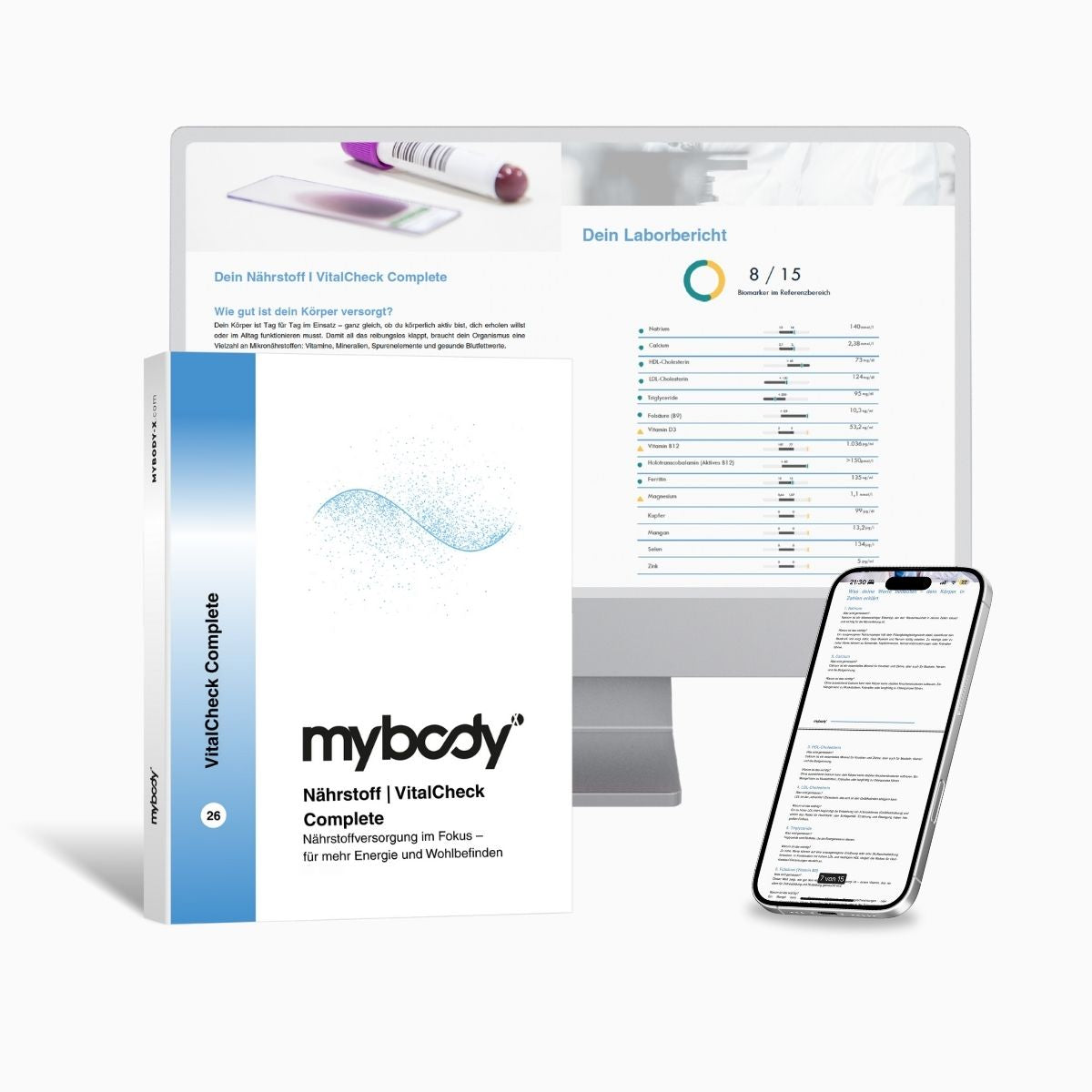
VitalCheck | Nutrient & Mineral Test Complete by mybody®x (MYBODY Lab GmbH)
Capillary blood test | VitalCheck
Nutrient & Mineral Test Complete
Kit shipping 1–3 working days
Certified medical laboratory
Product-page information, accessed 13 August 2026
Point 1
Clarify the question first
Distinguish tissue from blood
A sensor estimates the blood value from interstitial fluid.
Do not overinterpret curves
More data points do not necessarily mean more accurate data points.
Discuss anything unusual
Abnormal values belong in a medical practice, regardless of the method.
Chapter at a glance
A capillary blood self-test provides long-term blood glucose and does not replace a sensor, just as a sensor does not replace this value. The two answer different questions: one concerns now, the other the past few months. Four points are crucial: clarify the question first, distinguish tissue from blood, do not overinterpret curves, and discuss anything unusual.
Boundaries: what both approaches leave open
The first limitation concerns the sensor. It estimates the blood value from a different fluid and has less stringent accuracy requirements than a capillary blood glucose meter (MSD Manual, professional edition, as of December 2025).
The second limitation concerns the long-term value. It describes an average and conceals the fluctuations within it, and it has its own confounding factors related to red blood cells.
The third limitation is a gap in the sources. In the sources we reviewed, we found no reliable information on what sensor data say about the health of people without diabetes. That is why the text makes no statement on this.
The fourth limitation concerns diagnosis. It is based on several components in a medical practice, and neither a sensor curve nor a self-test can anticipate it.
What matters when comparing them
If you take away just one thing from this article, let it be this: a sensor and a long-term value are not in competition because they answer different questions.
One warns about what is happening right now and is designed for that purpose. The other describes what things looked like on average over several months and is therefore included in the diagnostic criteria.
It began with the question of whether a sensor replaces the long-term value. The answer is no, and that is not a weakness of the sensor. It is the difference between a warning device and a memory.
Frequently asked questions
What exactly does a glucose sensor measure?
Not blood glucose directly. Continuous glucose monitoring systems estimate capillary blood glucose based on interstitial glucose measured by a subcutaneous sensor (MSD Manual, professional edition, as of December 2025). In other words, the measurement is taken in the tissue fluid beneath the skin, and the blood glucose value is calculated from it.
Does a sensor replace the HbA1c value?
No. HbA1c is one of the criteria used to classify impaired glucose metabolism and diabetes, with its own thresholds (as of December 2025). It describes an average over approximately three months. A sensor provides real-time data over the duration it is worn and therefore answers a different question.
What is a sensor intended for?
For warnings. These systems provide real-time glucose data, including an alarm to warn of hypoglycemia, hyperglycemia, or rapidly changing glucose levels (MSD Manual, as of December 2025). Their purpose is therefore to detect critical situations in time, not to assess a period of time.
Are sensor readings more accurate than laboratory values?
The medical literature notes that continuous glucose monitoring systems have less stringent accuracy requirements than capillary blood glucose meters (as of December 2025). A dense curve shows many measurement points, not greater accuracy. The impression of precision comes from the display.
My level rises after eating—is that normal?
An increase after a meal is normal. The MSD Manual gives a peak value of under 180 mg/dl, equivalent to under 10 mmol/l, one to two hours after the start of a meal as a treatment target (as of December 2025). This information comes from diabetes treatment and is not a general benchmark for people without diabetes. Abnormal findings should be discussed with a doctor.
Next step
The question determines the method
If you want to know what your blood sugar regulation looked like over several months, VitalCheck measures long-term blood sugar together with 17 other values from capillary blood. It does not replace a sensor, provide a diagnosis, or replace medical evaluation.
Go to VitalCheckRead more
You may also be interested in
The long-term value in detail, including its confounding factors.
The existing article on the causes of elevated levels.
Sources
- MSD Manual, Professional Edition: Diabetes mellitus (DM), Brutsaert EF (as of December 2025) – msdmanuals.com
- MSD Manual, Professional Edition: Diagnostic criteria for diabetes mellitus and impaired glucose metabolism, table (as of December 2025) – msdmanuals.com
The verbatim quotation on how continuous glucose monitoring works, the information on real-time data and alerts, the note about less stringent accuracy requirements, the quotation on the three-month period for HbA1c, and the postprandial target value of under 180 mg/dl are taken from source [1]. The threshold values for the diagnostic criteria are taken from [2]. Regarding what sensor data says about the health of people without diabetes, we found no reliable information in the sources reviewed; therefore, the text makes no statement on this. Sensors are described exclusively as a method in this article; individual devices or providers are deliberately not named. Information on the price, values, sample type, and laboratory comes from the mybody®x product page, accessed on 13 August 2026; processing times follow the central specification for blood tests. All sources were accessed and reviewed on 13 August 2026.

mybody®x Editorial & Specialist Team
Laboratory diagnostics Blood analysis interpretation Nutritional science Nutrigenetics
This article was created by the mybody®x editorial and specialist team. The team combines laboratory diagnostics, nutritional science, and the interpretation of blood analyses. Anyone involved can be found on the authors’ page.
Published on 13 August 2026 · Last updated on 13 August 2026
The content is intended for general information and does not replace medical advice, diagnosis, or treatment. Reference ranges depend on the laboratory, method, and age; the information on your report is always authoritative.




Share now:
Exhaustion despite normal cortisol levels: what matters then
Cholesterol levels change more slowly than many people expect.