
Lowering cortisol levels: What diet can really do
The essentials at a glance
Diet can influence cortisol levels, but it is not the main switch. The best-supported influence is caffeine: it acts as a stimulant, and the German Federal Institute for Risk Assessment specifies concrete quantity limits. Everything else—meal timing, alcohol in the evening, and sleep—acts indirectly through the strain your body is exposed to.
This article distinguishes between what is supported by evidence on this topic and what is claimed online. It gives figures where figures are available and says so clearly where they are not. It also explains why a single cortisol measurement is not the same as a diagnosis.
First, you’ll learn what cortisol actually does in the body. Then come the three dietary levers with the strongest evidence, a look at two common misconceptions, and the question of how you can interpret your own level in the first place. The article concludes with the limitations—including those of testing.
What to expect in this article
1. What does cortisol do in the body—and when is there too much?
2. Caffeine: the lever with the strongest evidence
3. What has an effect in food—and what does not
4. Meal timing: why skipping meals causes stress
5. Alcohol and sleep: the underestimated detour
6. How do you know whether your cortisol is elevated?
7. How to measure your cortisol level at home
8. Who should consider testing—and who should not
9. Limitations: What diet cannot achieve
10. What matters in the end
Frequently asked questions
Sources
What does cortisol do in the body—and when is there too much?
Cortisol is a hormone produced naturally by the body in the adrenal cortex. It belongs to the group of glucocorticoids and regulates, among other things, how much energy your body makes available.
The Institute for Quality and Efficiency in Health Care summarizes the direction of its effect succinctly: stress hormones increase energy consumption. Cortisol therefore ensures that sugar is released from storage—useful when physical exertion is about to occur.
The level also follows a daily pattern. It is highest in the morning and declines over the course of the day. That is precisely what makes evaluating a single measurement challenging: without knowing the time, a cortisol level is difficult to interpret.
Cortisol is not a disruptive factor that needs to be eliminated. It keeps blood sugar moving, affects blood pressure, and dampens inflammatory responses. A body without cortisol would not be more relaxed, but unable to function. The question, therefore, is never whether cortisol is present, but whether its pattern fits the day.
The increase in the first few minutes after waking is the most noticeable part of this pattern. It prepares the body for the day, and it is why a blood sample taken early in the morning produces different figures from one taken in the afternoon. Anyone wanting to compare two measurements must therefore take them at the same time of day—otherwise they are comparing times of day, not conditions.
The difference between elevated and pathological
A persistently severely elevated cortisol level has a medical name. In Cushing’s disease, the body produces too much of it—this is a disease, not a question of diet.
“
“Cushing’s disease is a hormonal disorder in which the body produces too much cortisol. Cortisol is an endogenous steroid produced in the adrenal cortex.”
Institute for Quality and Efficiency in Health Care (IQWiG)
“Causes of obesity,” as of August 24, 2022
This distinction is the most important sentence in the entire article. Anyone with a hormonal disorder will not lower it with magnesium and less coffee. By contrast, someone under everyday stress, sleeping poorly, and consuming a lot of caffeine does have some levers they can use.
The difference is also evident in the severity. A pathologically elevated cortisol level is accompanied by clear physical changes that are hard to miss: marked weight gain in the trunk and face along with progressively weaker arms and legs, thin skin, and missed menstrual periods. Someone who simply feels drained and has trouble falling asleep is describing something else.
This does not mean that the second group is imagining it. It means that the answer there rarely lies in a single hormone level—and, conversely, it does not come from a single food either.
Key point
Diet can influence an elevated cortisol level caused by stress. It cannot lower a pathologically elevated level—that requires medical evaluation.
If you are looking for a broader overview of all the levers—including exercise, sleep, and relaxation techniques—you will find it in our article Naturally Lower Cortisol. This article deliberately focuses in depth only on the topic of nutrition.
Caffeine: the lever with the strongest evidence
Of all the dietary factors mentioned in connection with cortisol, caffeine is the one with the most specific figures. The German Federal Institute for Risk Assessment specifies amounts beyond which it no longer generally confirms safety.
According to the German Federal Institute for Risk Assessment (as of January 5, 2026), for habitual consumption, an intake of up to 400 milligrams of caffeine spread throughout the day is considered safe for healthy adults. For a single dose, the institute specifies up to 200 milligrams, corresponding to 3 milligrams per kilogram of body weight.
Source: German Federal Institute for Risk Assessment, as of January 5, 2026
Work this out for your own day. According to the same source, a 60-milliliter espresso contains 80 milligrams, as does a 250-milliliter energy drink. Four cups of filter coffee therefore already amount to around 360 milligrams—close to the stated daily amount, even though it feels like very little subjectively.
What stands out is how easily the single-dose limit is exceeded without it seeming excessive. Two espressos in a row already contain 160 milligrams, while a large 400-milliliter cup of filter coffee contains around 180 milligrams. The 200-milligram limit for a single dose specified by the Federal Institute is therefore not a theoretical figure, but something that is reached several times during a normal working day.
For people with lower body weight, the threshold is lower. The Federal Institute explicitly links the single dose to body weight: 3 milligrams per kilogram. At 55 kilograms, that amounts to around 165 milligrams—not even two large cups.
Why caffeine has a stronger effect on some people
How long caffeine remains effective varies from person to person. Some people drink an espresso in the evening and sleep without any problems; others can still feel the effects of an afternoon latte at midnight. These differences are real and are due, among other things, to the speed at which the body breaks down caffeine.
In practical terms, this means that the quantities specified by the Federal Institute are guidelines for healthy adults, not a personal upper limit. If you are one of the people who react sensitively to caffeine, your own limit is lower—and your sleep is a more reliable indicator than any table.
Not just how much, but when
When it comes to cortisol levels, timing is as interesting as quantity. Caffeine in the late afternoon noticeably prolongs the time it takes many people to fall asleep, and poor sleep is a strain to which the body responds with a stress response.
The practical consequence is unspectacular: Anyone who moves their coffee consumption to the first half of the day does not change the total amount, but does change the likelihood that it will disrupt their sleep. This is the most accessible adjustment discussed in this article.
Anyone who moves their coffee consumption to the first half of the day does not change the total amount, but does change the likelihood that it will disrupt their sleep.
What has an effect on eating—and what does not
Many recommendations circulate about individual foods and their effects on cortisol levels. Reliable figures are rare. That is why this chapter deliberately contains no percentage: for most of the common claims, there is simply no substantiated estimate of the magnitude of the effect.
What can be said reliably is more general and less exciting. A diet that keeps your blood sugar reasonably steady throughout the day spares the body recurring counterregulatory responses. And alcohol in the evening worsens sleep quality, even if it makes falling asleep easier.
Why blood sugar fluctuations matter at all
Cortisol is involved in making sugar available to the body. When blood sugar falls, counterregulation is one of the tasks of stress hormones. A diet that rapidly drives blood sugar up and then lets it crash produces more of these counterregulatory responses than one that keeps it steadier.
This does not result in a list of prohibitions, but rather a framework. A meal containing protein, fat, and fiber in addition to carbohydrates is digested more slowly than a croissant eaten between two appointments. The effect is unspectacular, but it repeats every day—and that is what matters when it comes to habits.
What guides say—and what actually holds up
Magnesium, omega-3 fatty acids, vitamin C, and ashwagandha are among the recommendations that appear in almost every text on the subject. There is nothing wrong with ensuring adequate intake of magnesium or omega-3 fatty acids—it is part of a wholesome diet and beneficial for other reasons.
The claim that a particular nutrient measurably lowers cortisol levels is a different matter. There are no reliable figures to support it, which is why we provide neither dosages nor expected effects. Any guide that gives specific percentages at this point should be asked where they came from.
This is not a refusal to provide information, but the more honest option. An invented number may read better than an explicit reference to a gap in research—but it will not help you.
The second common misconception concerns the relationship between cortisol and body weight. It is often presented as though elevated cortisol were the obvious explanation for stubborn belly fat.
Both misconceptions have the same underlying flaw: They turn a hormone into the sole explanation for a complex process. That is convenient, but it means that more obvious causes remain unchecked.
In brief
There are hardly any reliable figures on the effects of individual foods on cortisol levels. What is established, however, is that detox diets have no proven benefit and that a persistently high cortisol level is a medical finding. Anyone wanting to adjust their diet should therefore sensibly start with caffeine intake, meal timing, and alcohol—not individual superfoods.
Meal timing: why skipping meals causes stress
Skipping a meal does not eliminate the strain; it shifts it. The body keeps blood sugar within a narrow range, and when no food comes from outside, it draws on its own reserves. Cortisol is involved in precisely this process.
For everyday life, this does not mean that you would have to eat constantly. It means that a day with a skipped breakfast, a delayed lunch, and a large meal in the evening produces a different stress curve than a day with three predictable meals.
Energy expenditure provides a framework for this consideration. According to IQWiG, about 70 percent of total calorie requirements are accounted for by resting energy expenditure, about 20 percent by activity-related energy expenditure, and roughly the remaining 10 percent by the thermic effect of food. Most of your energy expenditure therefore occurs without you doing anything.
What about intermittent fasting?
Intermittent fasting is not the same as a chaotic day of eating. Anyone who eats as planned within a fixed time window has a rhythm—just a different one. The difference from unintentionally skipping meals lies in the predictability and in the fact that the total amount does not arise randomly.
Based on the available sources, it is not possible to quantify whether intermittent fasting affects cortisol levels favorably or unfavorably. However, anyone already suffering from sleep problems and exhaustion should not start an additional change precisely during this phase. Changing one thing at a time also makes sense because otherwise you will not know which change worked.
What a realistic day means
In practice, good intentions rarely fail because of a lack of knowledge; they fail because of the calendar. If you are sitting in a meeting at noon, you will not eat at noon. That is why the most useful adjustment is usually not the perfect meal, but a prepared one: something edible that will work even if the day does not go as planned.
Four adjustments that require no deprivation
- ✓ Have caffeine in the first half of the day—same amount, different time.
- ✓ Choose predictable meals instead of long gaps—the body has less need to compensate.
- ✓ Do not use alcohol as a sleep aid—it makes it easier to fall asleep and worsens the second half of the night.
- ✓ Do not make dinner the main meal—especially if you have eaten little during the day.
Highest daily level
Cortisol is highest in the morning. Caffeine fits best into the day here.
No long gaps
A predictable meal saves the body from having to compensate.
Caffeine cutoff
From this point on, caffeine disrupts the time it takes many people to fall asleep.
Protect sleep
Alcohol makes it easier to fall asleep and worsens the second half of the night.
Alcohol and sleep: the underestimated detour
In this context, alcohol is rarely thought of as a dietary factor, but it is one. It shortens the time it takes to fall asleep while simultaneously worsening the second half of the night. If you regularly use it to fall asleep, you lose precisely the part of the night when the body recovers.
The path to cortisol levels here runs through sleep, not through the metabolism of alcohol. Sleep deprivation is a physical strain, and the body responds to strain with a stress reaction. If you sleep poorly because you drank and need more coffee the next day to get through it, the cycle is complete.
This very interconnectedness makes dietary recommendations on cortisol so difficult to isolate. Caffeine, alcohol, meal timing, and sleep influence one another. Changing one factor also changes the others—for better or worse.
For everyday life, that is good news. You do not have to tackle all four points at once. Having your last coffee noticeably earlier or spending two alcohol-free evenings a week can affect several levers at the same time because they address the same point: recovery during the night.
How do you know whether your cortisol is elevated?
Fatigue, sleep problems, and lack of motivation are nonspecific. They can be consistent with an elevated cortisol level, but also with an underactive thyroid, iron deficiency, or simply a demanding phase of life. Without a measurement, it remains a guess.
There are essentially three ways to interpret the results, and they answer different questions. The following table compares them using the same criteria.
| Criterion | Single capillary blood measurement | Daily saliva profile | Medical evaluation |
|---|---|---|---|
| What is measured? | A cortisol level at the time of sample collection, together with other blood values | Multiple values measured throughout the day | Targeted functional tests following a suspected diagnosis |
| Sample type | Capillary blood collected at home with a finger prick | Saliva, several times a day | Venous blood, sometimes urine collected over 24 hours |
| Informative value | A snapshot that is useful when considered alongside the other values | Shows the daily rhythm, not the cause | The only way to confirm or rule out a disease |
| When is it useful? | As an initial snapshot alongside thyroid, blood lipid, and blood sugar levels | When the question specifically concerns the daily rhythm | For persistent or pronounced symptoms |
| In the mybody®x product range | Yes, as part of both hormone checks | No—we do not offer a salivary daily profile | No—this should be handled by a doctor |
The last row is intentionally included in the table. A provider that presents three options side by side while concealing that it does not actually offer some of them is not a helpful basis for making a decision.
What to keep in mind when collecting your sample
Because cortisol follows a daily rhythm, the time of sampling is not a minor detail. Make a note of it and, if possible, keep it consistent during a later check. A value from Tuesday morning and one from Sunday afternoon cannot be meaningfully compared.
The context is also part of the result. A night with four hours of sleep, an infection, or a very demanding week can change the picture. If you know you are currently in an exceptional situation, the result is not wrong—it simply describes that exceptional situation.
And the most important point: A single level is not a verdict. It is one data point that, together with the other results and what you know about your everyday life, forms a picture. That is precisely why the two tests in the next chapter measure cortisol not on its own, but as part of a broader panel.
How to determine your cortisol level at home
mybody®x (MYBODY Lab GmbH) offers two blood tests that measure cortisol—each embedded in a broader picture of hormone, metabolic, and blood lipid levels. You collect the sample at home with a finger prick, and it is analyzed in an ISO-certified laboratory in Germany.
The approach is deliberately broad. A single cortisol level rarely explains anything; only when considered alongside thyroid levels, long-term blood sugar, and blood lipids does it provide a meaningful snapshot.
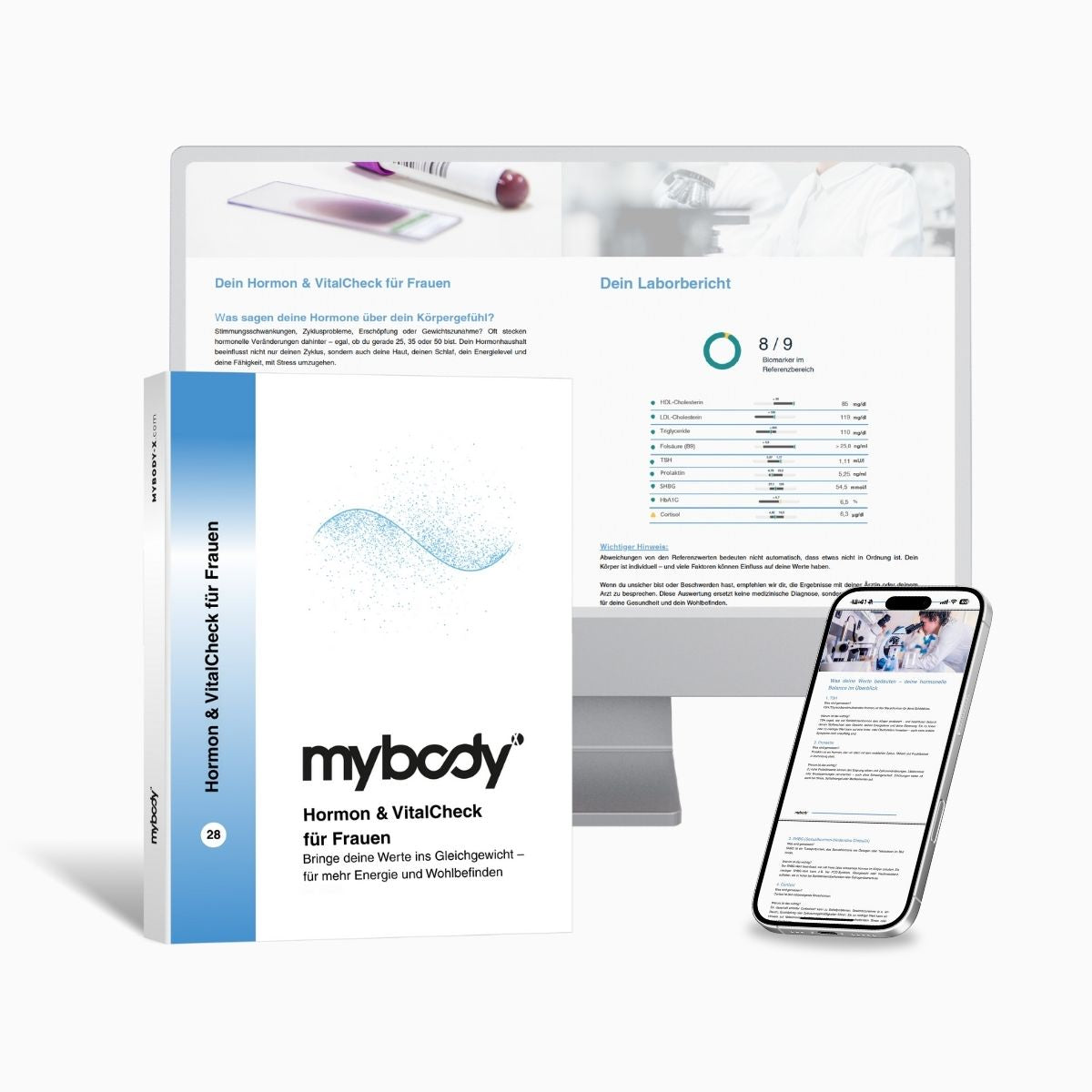
Hormone & Vital Check for Women
Measures nine biomarkers from capillary blood, including cortisol, TSH, prolactin, SHBG, folic acid, long-term blood sugar, and blood lipids, as well as complete blood count values. The test provides a cortisol level at the time of sampling—not a daily profile or a diagnosis. Any abnormal result should be assessed by a doctor.
Price: €169.00 · Sample type: Capillary blood · Processing time: 3–5 business days for laboratory analysis after sample receipt, kit shipping 1–3 business days · Laboratory: ISO-certified laboratory analysis in Germany
For the Hormone & Vital Check for Women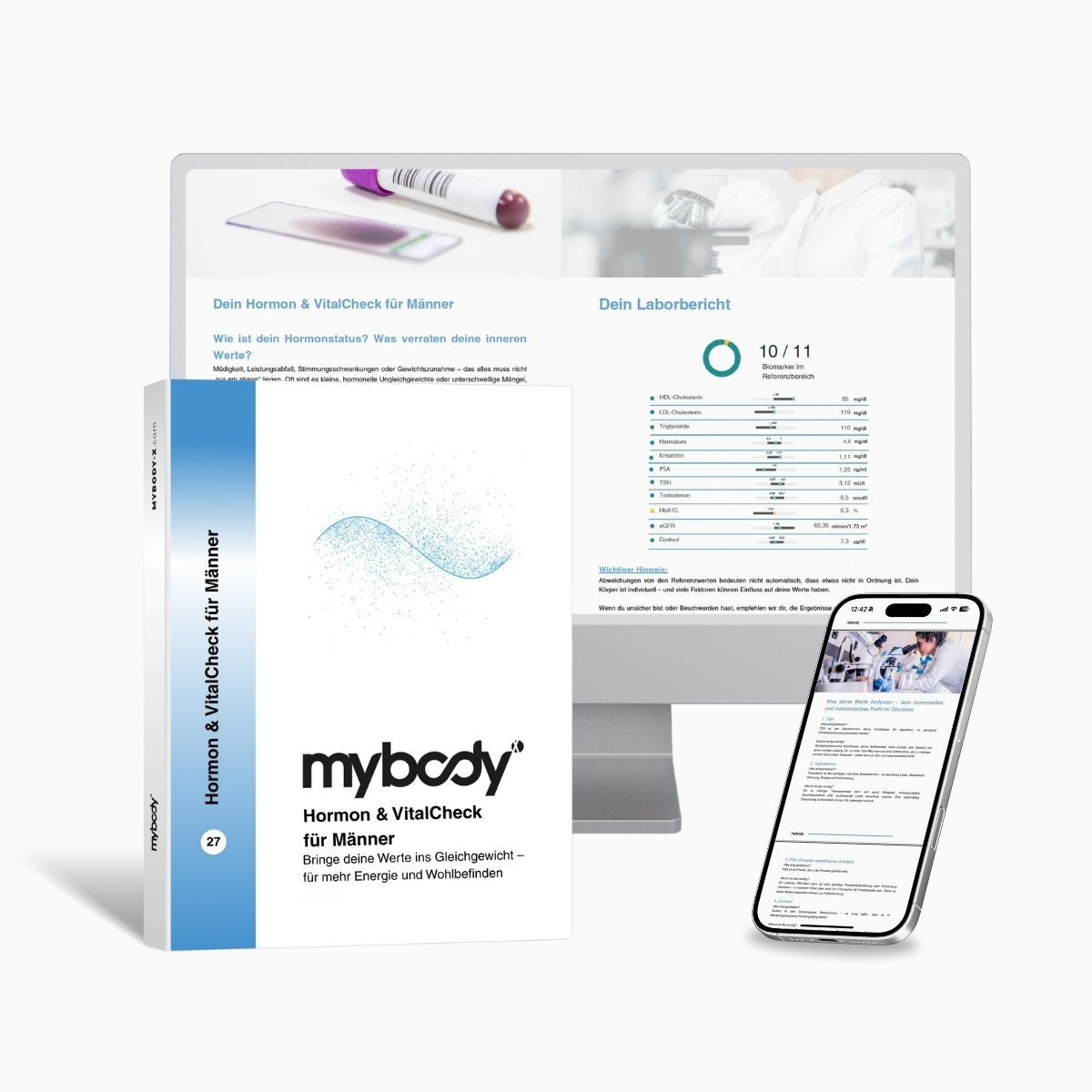
Hormon & VitalCheck for Men
Measures eleven biomarkers from capillary blood, including cortisol, testosterone, TSH, PSA, long-term blood sugar, creatinine, uric acid, and blood lipids. The same applies here: one value at the time of sampling, not a daily profile. The test does not replace medical evaluation; it provides the values with which that evaluation can begin.
Price: €169.00 · Sample type: Capillary blood · Processing time: 3–5 business days for laboratory analysis after sample receipt, kit shipping 1–3 business days · Laboratory: ISO-certified laboratory analysis in Germany
To the Hormon & VitalCheck for MenAll prices and details of services as of August 5, 2026. Prices, the range of markers, and processing times may change.
Who a measurement is suitable for—and who it is not
A test is not an end in itself. It is worthwhile when its result changes a decision—and not worthwhile when the answer is already clear or the symptoms require medical evaluation.
Useful for you if …
… you have been exhausted for weeks and want to know whether several values are abnormal at the same time.
… you want to change your diet and are looking for a baseline that you can compare against later.
… you are preparing for a medical consultation and want to bring test results rather than just a feeling.
Probably not if …
… you have significant symptoms—major weight changes, missed periods, or persistent weakness. These require medical evaluation, not testing.
… you are specifically interested in how your levels vary throughout the day. This requires a salivary day profile, which is not included in these tests.
… you already know what is stressing you, and a measurement would not change that.
Limitations: What diet cannot do
The most honest answer to the original question is: Diet is one lever among several, and it is not the strongest. Sleep, exercise, and the actual stress of everyday life matter more than the choice of individual foods.
There is also a gap in the available data. For many popular recommendations—certain nuts, certain teas, certain supplements—there are no reliable figures on their effect on cortisol levels. That is why this article deliberately gives no number in several places where other texts provide one.
And finally: No self-test can provide a diagnosis. A single cortisol value from capillary blood is a snapshot and varies over the course of the day. It can be a clue that starts a conversation. It is not a finding that ends one.
There is also a limit that cannot be solved with a better test. If the cause of the strain is a situation—a double burden, caring responsibilities, or a job that exceeds your capacity—neither a measurement nor a dietary plan will change that situation. At most, both can help you identify and name it.
This article therefore deliberately does not provide a weekly plan promising to lower your cortisol by a specific amount. Such a promise would be easy to market but impossible to substantiate. Instead, it offers three approaches with a reasonable evidence base and a clear statement of where the knowledge ends.
What ultimately matters
Anyone who wants to influence their cortisol level through diet has three approaches with a reasonable evidence base: the amount of caffeine and, above all, its timing; a predictable meal schedule without long gaps; and avoiding alcohol as a sleep aid. The German Federal Institute for Risk Assessment considers 400 milligrams of caffeine per day and 200 milligrams as a single dose safe for healthy adults—this is the most concrete figure available on the subject.
Everything beyond that needs to be assessed honestly. Detox cleanses have no proven benefit, and a persistently high cortisol level is a medical finding, not a dietary problem. If you want to know where you stand, a broad overview of blood values is the more pragmatic first step than making dietary changes without a clear basis.
Frequently asked questions
Can I lower my cortisol level through diet alone?
Partly. The best-documented effect is that of caffeine, for which the German Federal Institute for Risk Assessment specifies concrete limits. Meal timing and alcohol act indirectly through blood sugar and sleep. Diet cannot lower a pathologically elevated level—for example, in Cushing’s disease.
How much coffee is too much?
According to the German Federal Institute for Risk Assessment (as of January 5, 2026), up to 400 milligrams of caffeine spread throughout the day is considered safe for healthy adults, with up to 200 milligrams as a single dose. Accordingly, a 200-milliliter cup of filter coffee contains around 90 milligrams, and a 60-milliliter espresso around 80 milligrams.
When should I see a doctor instead of testing?
If symptoms are pronounced or persistent: substantial unexplained weight change, missed periods, ongoing weakness, or muscle loss. In such cases, a self-test is the wrong first step because it does not replace a medical evaluation and may delay it.
What exactly does the Hormone & VitalCheck measure—and what does it not measure?
It measures a cortisol level from capillary blood at the time the sample is taken, along with other hormone, metabolic, and blood lipid levels. It does not measure a daily profile, which would require several saliva samples throughout the day, and it does not provide a diagnosis.
Can dietary supplements help with too much cortisol?
There is no reliable evidence for the effect of individual supplements on cortisol levels. We therefore do not provide dosages or product recommendations. Where a figure is missing, the honest answer is that it is missing.
Measure first, then make changes
If you want to know where your cortisol level stands in relation to your thyroid, blood sugar, and blood lipids, a broad blood-value overview is the pragmatic first step. You collect both samples at home.
View the test for women View the test for menYou might also be interested in
→ Lower Cortisol Naturally – Your Guide to Inner Balance
An overview of all the levers: movement, sleep, relaxation, and nutrition working together.
→ High Cortisol Levels: Symptoms, Causes, Help
What an elevated level may feel like and what causes may be behind it.
Sources
- Institute for Quality and Efficiency in Health Care (IQWiG): Causes of obesity (as of 2022) — gesundheitsinformation.de
- Institute for Quality and Efficiency in Health Care (IQWiG): What are hormones and what functions do they have? (as of 2024) — gesundheitsinformation.de
- German Federal Institute for Risk Assessment (BfR): Questions and answers about caffeine and caffeinated foods, including energy drinks (as of 2026) — bfr.bund.de
- German Nutrition Society (DGE): Detox diets, DGEinfo 3/2018 — dge.de
The definition of Cushing’s disease and the proportions of resting and active energy expenditure are based on [1]. The statement about energy expenditure caused by stress hormones is based on [2]. All caffeine quantities come from [3], and the verbatim quote about detox diets comes from [4]. Product details come from the mybody®x product pages, accessed on August 5, 2026.

mybody®x Editorial & Expert Team
Blood analysis Nutritional science Laboratory diagnostics
This article was created and medically reviewed by the mybody®x Editorial and Expert Team. The team combines expertise in nutrigenetics, microbiome and gut science, blood test interpretation, nutritional science, and laboratory diagnostics.
Published on August 5, 2026 · Last updated on August 5, 2026
Medical note: This article is for general information only and does not replace medical advice, diagnosis, or treatment. Persistent exhaustion, significant weight changes, or missed periods should be medically evaluated.




Share now:
Nutrition Testing: What Types There Are and What They Really Measure
Symptoms When Candida Dies: What’s Behind the Die-Off Theory