
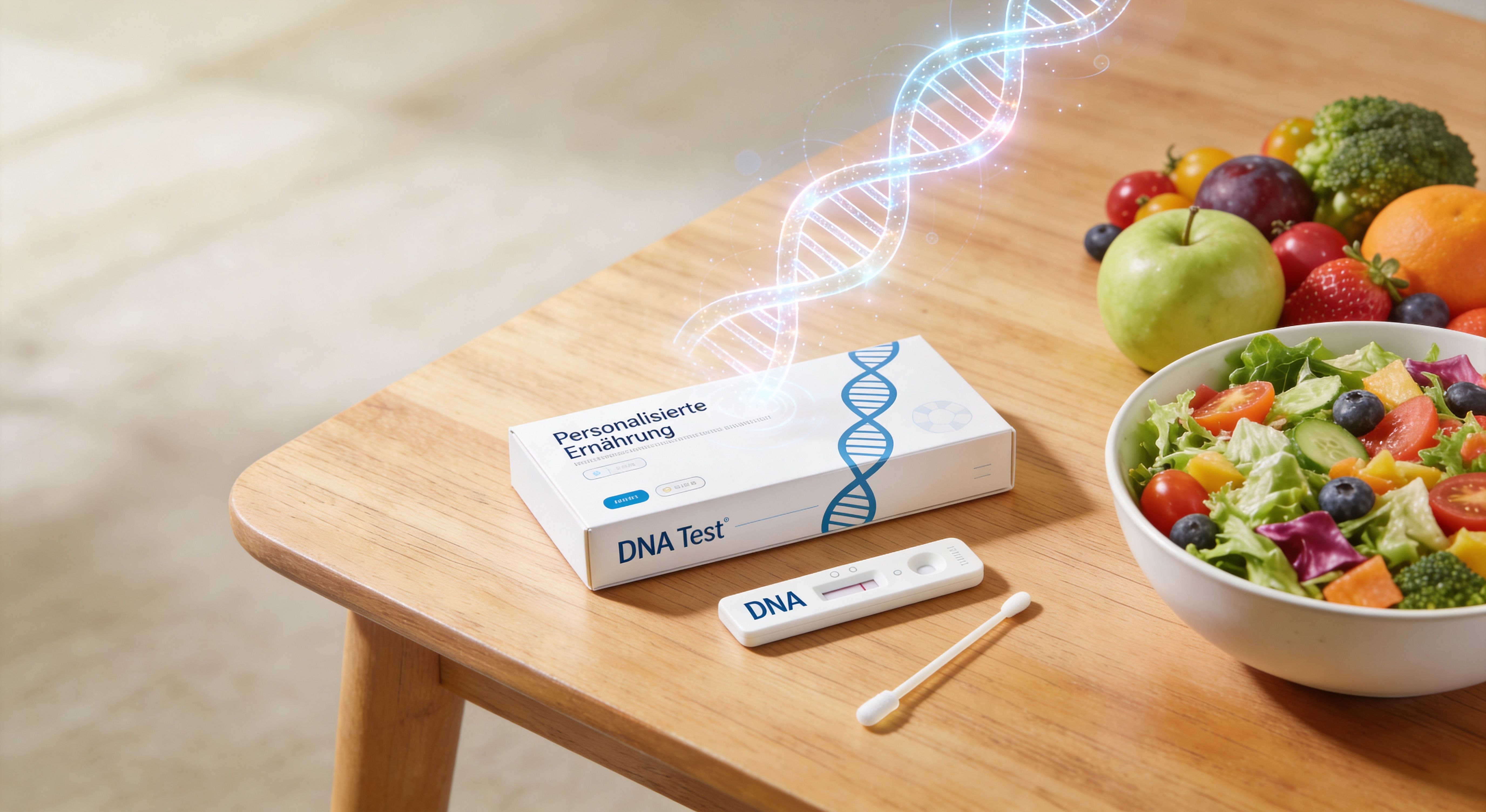
Nutrigenetics Test Experiences: Your Path to DNA-Based Nutrition
You make an effort. You read labels, try low-carb, then more protein, maybe even intermittent fasting. It works for a few weeks, then everything stagnates. Or even more confusing: your friend seems to eat everything and stays stable, while you notice that your energy, hunger, or weight go out of whack with just small deviations.
It's precisely at this point that many people look for nutrigenetics test experiences. Not because they want a miracle solution. But because they finally want to understand why general dietary rules only half work for them.
The good news is: this feeling of trial and error doesn't mean you're undisciplined. Often, what's missing is a closer look at what your body is already pre-determining in the background. Genes are not your destiny. But they are part of your personal instruction manual.
Why Diets Often Fail and What Your Genes Have to Do With It
Anna is a typical example. First, she counted calories. Then she reduced carbohydrates. After that, it was supposed to be more healthy fats. Each concept had good arguments, but none felt right in the long term. With one method, she quickly got tired, with the next, she was constantly hungry, with the third, she lacked strength during training.
Many people experience this. The problem is often not the will, but the assumption that one plan should work equally well for everyone. That's where the frustration begins.

If you want to delve deeper, this article on your genes as the key to healthy nutrition provides a good starting point.
Why Standard Advice Often Only Half Fits
General recommendations are useful. They just aren't automatically individually suitable. Two people can eat the same meal and feel very different afterwards. One feels full and focused for a long time, the other quickly gets hungry again or experiences a dip in performance.
This is partly because your body doesn't process nutrients neutrally. It has its own preferences, weaknesses, and reaction patterns.
You are very likely not "bad at dieting." You might just be working with a plan that doesn't fit your metabolism well.
Where Genes Come into Play
Your genes influence how your body handles fats, carbohydrates, proteins, recovery, and micronutrients. This doesn't mean that nutrition suddenly becomes only about genetics. Sleep, stress, exercise, and daily life still matter. But genes provide the basic tendency.
A good analogy for this is a GPS. You can also drive without a GPS. You often get there eventually. With a GPS, you save detours. That's how many people experience personalized nutrition: less guessing, more targeted decisions.
For everyday life, this primarily means one thing:
- Less Trial and Error: You don't have to test every diet for months.
- More Understanding: You are more likely to understand why you react well or poorly to certain meals.
- Better Feasibility: A suitable plan often feels more natural because it works with your body instead of against it.
Nutrigenetics Explained Simply
Nutrigenetics investigates how genetic differences influence your response to food. So, it's not primarily about diagnosing diseases. It's about revealing patterns that can be relevant for nutrition, training, and recovery.
Imagine your DNA as a very personal instruction manual. Not a novel, but rather a set of many small clues. A nutrigenetics test helps to make these clues readable.
What is Actually Analyzed
Genetic factors explain 40 to 70 percent of the variability in human metabolism. In the DACH region, tests like those from mybody® typically analyze 82 genetic variants from 70 genes to assess the need for micronutrients, sensitivities, and metabolic processes, as MITOcare describes for nutrigenetics.
While it sounds technical, it's fundamentally simple. Small genetic variants are analyzed that are related to questions such as:
- Macronutrients: How do you tend to react to carbohydrates, fats, and proteins?
- Micronutrients: Are there indications of a different need for certain vitamins or minerals?
- Stress and Recovery: Which genetic patterns can be relevant for training, muscle building, or recovery?
- Sensitivities: Where is a closer look at your reaction to certain diets worthwhile?
What a Test Can and Cannot Do
A test doesn't tell you: "You have to eat exactly like this forever." It rather shows probabilities and meaningful directions. This is important because many readers here understandably get confused.
A DNA result is not an autopilot meal plan. It is a well-founded basis for better decisions.
Practical Rule: Don't use genetic results as a rigid label, but as a filter. They help you identify suitable options more quickly.
Another important point: the quality of interpretation matters. Precisely because genetic correlations are complex, raw data alone is of little use. A test only becomes valuable when genetic variants are translated into concrete everyday recommendations. For example: Which breakfast structure suits you better, which type of training harmonizes better with your profile, and which nutrients should you pay closer attention to?
That's why so many people look for nutrigenetics test experiences. Not just for "What does the test show?" but for the much more important "And what do I do with it?"
The Most Common Metabolic Types and Their Needs
Many practical reports work with simplified metabolic types to make results understandable. This is helpful as long as you know: these types are models, not rigid categories. They provide orientation, not a complete identity.

If you've previously used the term metabolism rather vaguely, this metabolic analysis explanation offers a practical supplement.
Why Types Can Be Derived at All
According to Stanford models, analyzing five genetic variants is sufficient to classify dietary types with 80 to 90 percent accuracy. Genes such as APOA2 or KCTD10 are mentioned, among others. Furthermore, a variant in the APOA2 gene can increase LDL cholesterol by 15 to 20 percent with high intake of saturated fats, as the Gene Institute summarizes regarding nutrigenetics.
This does not mean that every person fits exactly into three categories. But it explains why some react very well to high-carb, others should focus on more fat stability, and still others need a balanced mix.
Three Types That Often Make Sense in Everyday Life
| Type | Typical Everyday Perception | What Often Works Well |
|---|---|---|
| Carbohydrate Type | Energy from starchy meals feels rather stable | clean carbohydrate sources, moderate fat intake, regular meals |
| Protein-Fat Type | Long-lasting satiety from protein and fat-rich meals | more protein, high-quality fats, conscious handling of highly processed carbs |
| Mixed Type | Extreme diets often bring little benefit | balanced macronutrients, flexible meal structure |
The Carbohydrate Type
People with this tendency often report feeling relatively stable after oatmeal, potatoes, or rice, as long as the meal doesn't consist solely of fast sugars. Very fatty foods sometimes make them feel heavy and sluggish.
In everyday life, this could mean that a breakfast with oats, yogurt, and berries works better than coffee plus pastries. Some also benefit more from well-planned carbohydrates around exertion during training.
The Protein-Fat Type
Here, many report better satiety and a calmer energy curve when protein and healthy fats are sufficiently present. Classic low-fat diets often feel unsatisfying for these people.
This does not automatically mean "keto forever." It rather means: consciously portion carbs, don't underestimate protein, take fat quality seriously. Especially with an APOA2-related sensitivity, it's worth looking at saturated fats.
If you get hungry quickly after a pasta meal, but stay stable for a long time after a protein-rich meal, that's an everyday clue. Not proof, but a signal.
The Mixed Type
Many people ultimately land here. Not because there's nothing special going on, but because their system works best with balance. Extreme rules often cause more stress than benefit.
Typically: neither very fat-focused nor very carb-heavy feels optimally sustainable. A mixed plate with vegetables, protein, a suitable carbohydrate source, and reasonable fats often fits surprisingly well.
Self-Test: How Well Do You Really Know Your Metabolism?
Before you consider a test, honest self-observation is worthwhile. Not as a definitive diagnosis. Rather as a reality check.

Mini-Check for Everyday Life
Answer the questions spontaneously:
- After pasta or bread: Do you feel pleasantly satisfied or tired and hungry shortly after?
- After a protein-rich meal: Do you stay full for a long time or do you lack energy?
- When dieting: Does low-carb come surprisingly easy to you or rather difficult?
- During training: Is endurance more natural for you than strength building, or vice versa?
- In everyday life: Do you quickly get cravings when eating irregularly, or do you remain calm?
If you notice a clear tendency for several questions, that's useful. But nothing more.
Why Self-Observation is Often Misleading
Most people confuse a snapshot with a pattern. Perhaps pasta makes you tired. But was it due to the carbohydrates, poor sleep, stress, portion size, or eating too quickly?
This is where it gets tricky. The body sends many signals simultaneously. Not every signal comes from your genetics.
That's why self-tests are limited:
- Stress overshadows many things: Under pressure, hunger, satiety, and energy change.
- Lack of sleep distorts your feelings: Then almost every diet seems worse.
- Habits play a role: Those who have eaten an unbalanced diet for a long time often interpret body signals uncertainly.
- Hormones and everyday life fluctuate: This makes pure self-assessment inaccurate.
Self-assessment is a good start. It's rarely sufficient for a reliable answer.
Many nutrigenetics test experiences begin exactly here. With the feeling: "I think I know what suits me." And then the analysis shows that one part is correct, but another looks surprisingly different.
The Path to Certainty: The Process of a DNA Nutrition Test
You're sitting at the kitchen table, the test kit in front of you, and the real question immediately pops into your head: What exactly is happening here, and what will I do with the results later?
That's precisely what a DNA nutrition test is about. Not a laboratory secret, but a clear process that turns a small sample into useful insights for your daily life.

This is How It Typically Works
-
Select Test
You choose a test that suits your question. Some reports focus heavily on macronutrients, others more on metabolism, micronutrients, or reactions to specific diets. The clearer the evaluation is formulated, the easier the step from theory to everyday life will be later. -
Take Sample at Home
You usually collect material via a cheek swab or saliva sample. This only takes a few minutes. Simply put, you are collecting your body's blueprint. Not the whole novel, but individual passages that are interesting for nutrition and utilization. -
Send Sample to Lab
The sample is then sent to a specialized laboratory. There, specific gene variants are checked, i.e., small differences in your biological blueprint. These differences do not explain a complete personality or a complete health picture. They rather show where your body often reacts somewhat differently than the average. -
Understand Report
The most important moment comes not when sending, but when reading. A good report translates technical jargon into questions like: Are you more sensitive to carbohydrates? Do you benefit more from a protein-rich structure? Do you need more regularity to keep energy and satiety stable? -
Translate Results into Actions
Here, an interesting test separates from a useful test. Good providers deliver not only gene names, but concrete approaches for breakfast, meal rhythm, snack selection, or training nutrition. How such an implementation can look in everyday life is shown in a DNA test nutrition experience report with practical examples.
What You Should Pay Attention to Regarding Quality
The test itself is done quickly. The quality is evident in three other areas: data protection, laboratory standard, and clarity of the report.
Especially with data protection, a closer look is worthwhile. According to Genosalut, only about 15 percent of providers guarantee fully GDPR-compliant pseudonymization with sample destruction after analysis, according to the overview of nutrigenetic tests and data protection. For many users, this is precisely an important point. Genosalut also describes in the same context that data protection is a central concern for 68 percent of German users, according to the same classification. Providers with ISO-certified laboratories are also mentioned there, and a rating of 4.77 out of 5 stars from over 11,300 customers is also mentioned in this market overview.
Practically, this means for you:
- Check data protection: Is it explained how your sample is labeled, processed, and destroyed?
- Check lab quality: Is it clearly stated which lab is used and according to which standards?
- Look at the report: Do you receive understandable recommendations or just raw data and technical terms?
- Check everyday usefulness: Does the test help you with real decisions, such as breakfast, snacks, meal timing, or training routine?
A good DNA nutrition test doesn't give you a perfect future prediction. It gives you a better starting hand. And for many people, that's exactly what makes the difference between exciting knowledge and decisions that actually hold up in everyday life.
Real Experiences: What a Nutrigenetics Test Really Delivers
The most exciting question is rarely: "What does the report say?" The most exciting question is almost always: What changes in everyday life?
That's exactly why people search for nutrigenetics test experiences. They want to know if such a test can really lead to useful decisions.
Experience One: Fewer Puzzles When Losing Weight
A man in his early forties trained regularly and ate "healthily" from his perspective. Nevertheless, every diet felt like a struggle. After his results report, he didn't change everything, but only the levers with the greatest impact: higher protein breakfast, more structured snacks, less random dinners.
The crucial factor wasn't perfection. It was clarity. Suddenly, he had a reason why certain meals kept him stable and others didn't. This made his everyday life simpler, not stricter.
Experience Two: More Calm While Eating
A woman in her mid-thirties had tried many healthy trends. Sometimes vegan, sometimes low carb, sometimes intuitive. The problem wasn't a lack of knowledge, but the constant uncertainty about what suited her.
Her report helped her both psychologically and practically. She stopped trying a new concept every week. Instead, she built a repeatable plan: suitable breakfasts, clear shopping patterns, fewer spontaneous slips due to cravings.
The real gain is often not a spectacular individual result, but a more stable everyday life with less decision fatigue.
Experience Three: Better Integration of Training and Nutrition
Another common case: someone eats healthily, trains diligently, but feels poorly recovered. The report then doesn't show "the one solution," but a profile that allows for better integration of training, protein distribution, and recovery.
This makes recommendations practical:
- Shopping list: Which foods should be in the basket more often?
- Meal construction: Do you need more protein, more structure, or a different distribution of macronutrients?
- Training proximity: When is which meal most beneficial for you?
- Long-term: Which rules can you stick to even during stressful weeks?
What Must Be Said Fairly
Not every test on the market is equally strong. Critics rightly point out that the clinical validity of many offerings is limited. At the same time, the market is growing, and established providers show high practical satisfaction. For mybody®, over 11,300 customers are mentioned with 4.77 stars, especially when DNA analysis is combined with further health data such as the microbiome, as the discussion at Rosenfluh on the everyday suitability of nutrigenetic tests classifies.
If you are looking for concrete insights, an experience report on DNA test nutrition is also helpful, as it makes the implementation in everyday life more tangible.
The honest classification is therefore: A nutrigenetics test is not a miracle cure. Its value arises when you translate the results into routines. Then information turns into a long-term ROI. Test once, then make smarter decisions for years.
Your Roadmap to Personalized Nutrition
Monday morning, little time, the day starts hectically. You're facing breakfast and making the same decision as always, but with more uncertainty than you'd like. This is where it becomes clear whether a nutrigenetics test was just interesting or if it truly makes your everyday life easier.
Your roadmap begins not with perfection, but with translation. The test result is the map. Your habits are the route. The benefit only arises when genetic clues turn into simple rules that work even on busy days.
A good first question is therefore not: "What can I no longer eat?" More useful is: "What one thing will I change this week so that my body gets reliable energy?" For some, this is a higher-protein breakfast. For others, a clearer meal structure or fewer spontaneous evening snacks. Small adjustments often have a stronger effect here than a radical restart.
This is how knowledge becomes action:
- Derive exactly one daily rule per result: For example, a different distribution of carbohydrates, a fixed eating window, or more focus on satiety.
- Test the rule for two weeks: Don't make new decisions daily, but give a clear line time.
- Observe three signals: energy, hunger, digestion. These are often the most understandable feedback in everyday life.
- Only then adjust: Genes provide a direction. Your everyday life shows how you implement them practically.
Many anonymized experiences are similar at this point. Not because everything suddenly becomes easy, but because the constant guesswork stops. Those who previously tried something different every week often report primarily more calm: less dietary stress, clearer shopping decisions, less friction in everyday life. That is the actual long-term ROI. You don't have to constantly start over because your plan suits you better.
If you want to take the next step, a simple sequence helps: read the results, mark two to three key levers, build fixed meal rules from them, and make them visible in your calendar, shopping, and kitchen routine. Health rarely changes through more information alone. It changes through repeatable decisions.
At MYBODY Lab GmbH, you will find DNA, metabolism, and health analyses for home use. The approach remains objective and practical: making data understandable and translating it into concrete steps for nutrition and routine.



Share:
Genetic Testing Compared: A Guide to Health and Prevention
How long does a genetic test analysis take? All the facts