
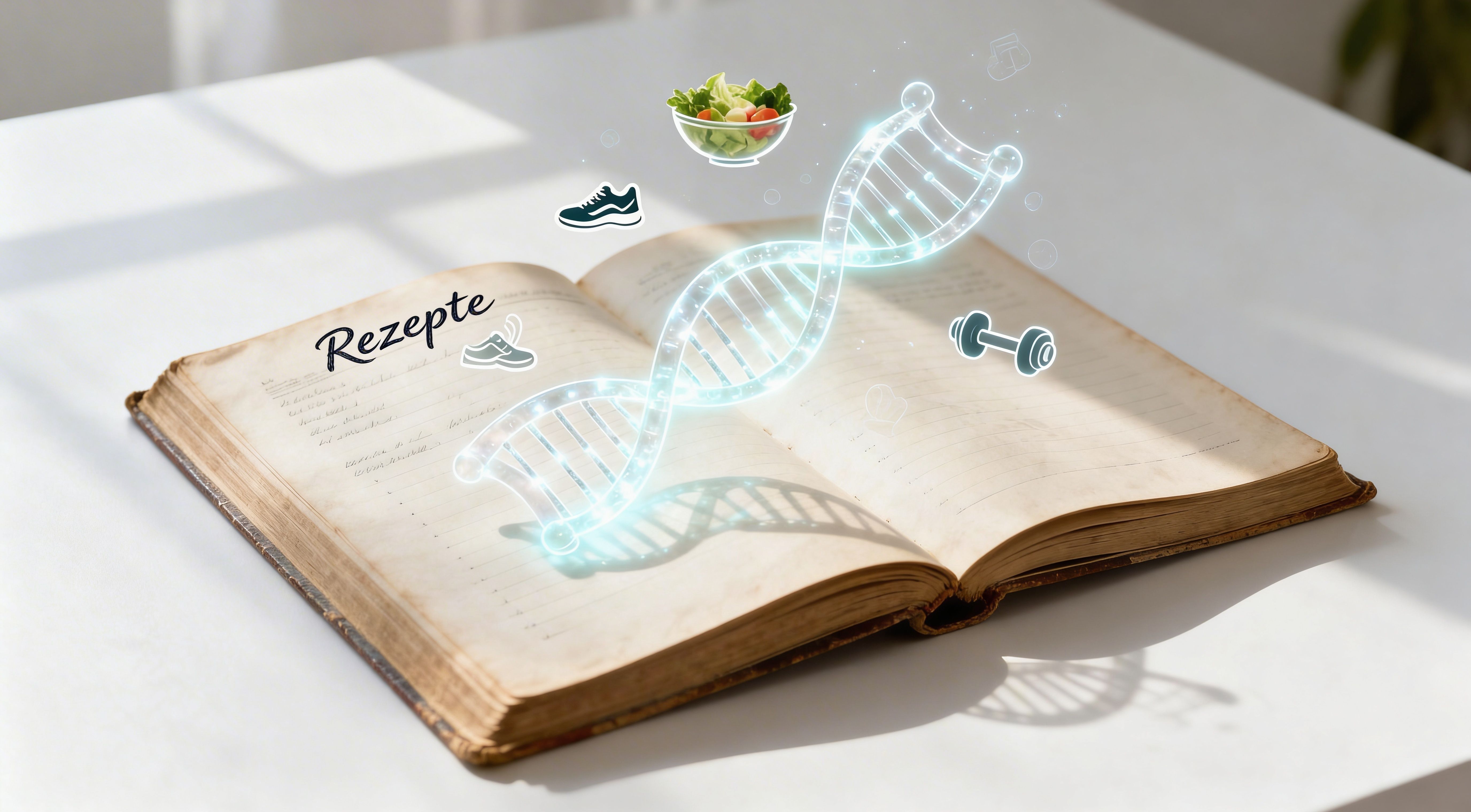
Understanding your genetic predisposition and shaping your own health
Imagine your DNA as an old, well-kept family recipe book. Passed down through generations, it contains the basic instructions for everything that makes you who you are – from your eye color to how your metabolism works. But your genetic predisposition is n't an unchangeable fate . Rather, it's a personal map that reveals your individual strengths, but also potential weaknesses.
Your genes are not your destiny.
Have you ever wondered why your best friend seems to be able to eat anything without gaining a single gram, while you regret every piece of cake? Or why some people are born sprinters and others effortlessly finish a marathon? The answer to these questions lies deep within your cells: in your genetic predisposition.
Your genes are the foundation, the blueprint of your body. They are fixed and unchanging – the inheritance you received from your parents and grandparents.
But now comes the crucial point: Your genes are merely the blueprint. Whether and how this blueprint is implemented is largely in your hands. Every single day.
The power of your lifestyle
This fascinating interplay between genes and environment is what scientists call epigenetics . Imagine your genes as a series of light switches. Your daily behavior—what you eat, how you move, how you sleep—can turn these switches on or off, thus controlling the activity of your genes. You are therefore not just a passive carrier of your genetic code, but the active director who decides what happens on the stage of your body.
The following factors have a direct influence on how your genes "behave":
- Your diet: Certain nutrients can activate genes that protect your cells, while others can switch on pro-inflammatory genes.
- Your movement: Regular exercise influences the genes responsible for muscle building, fat metabolism, and your overall performance.
- Your sleep: Sufficient good sleep is crucial for the activity of genes involved in repair processes and hormone balance.
- Your stress management: Chronic stress can flip switches that increase the risk of various health problems.
The following graphic beautifully illustrates how it all fits together: Your genes form the basis, epigenetics acts as a mediator, and your lifestyle ultimately controls the result.

So you see: You play a very active role and don't have to simply accept your genetic predisposition.
The interplay between genetic predisposition and lifestyle
The following table illustrates how your genes and your daily decisions interact and which aspects you can directly influence to optimize your health.
| Health aspect | Genetic influence (your predisposition) | Influence through lifestyle (your power to act) | Practical example |
|---|---|---|---|
| Weight management | Predisposition for faster or slower fat metabolism. | Diet, exercise, stress levels. | If you are predisposed to a slow fat metabolism: eat more protein and fewer simple carbohydrates. |
| Cardiovascular health | Genes that influence cholesterol levels or blood pressure. | Balanced diet, endurance sports, abstaining from smoking. | Despite a genetic predisposition to high cholesterol, a plant-based diet can reduce the risk. |
| Muscle building/performance | Predisposition for endurance (type I fibers) or strength sports (type II fibers). | Training type and intensity, protein timing, regeneration. | Knowing the muscle fiber type helps to optimally tailor training to strength or endurance. |
| Stress resistance | Genes that regulate the production of stress hormones such as cortisol. | Meditation, sleep hygiene, social contacts, exercise. | For those with a genetic predisposition to stress: integrate regular relaxation exercises firmly into everyday life. |
These examples clearly show: Your genes provide a direction, but you are in the driver's seat.
Knowledge as the key to self-responsibility
Knowing your genetic predisposition gives you back control. It's not about searching for unchangeable risks. It's about recognizing your own personal potential and vulnerabilities.
For example, if you know you tend to have a slower fat metabolism, you can adjust your diet accordingly and save yourself a lot of frustration. If you'd like to delve deeper into the basics, you'll find valuable further information in our article "Genetics Explained Simply ."
By reading your genetic map, you make conscious decisions that are perfectly tailored to your body. This is the first step towards taking proactive and self-determined control of your health and getting the most out of what you were born with.
How your lifestyle controls your genes

We now know: Your genes are the blueprint, not the finished house. But who's actually directing this construction site? The surprising answer: You. Your lifestyle is the crucial factor that guides your genes. This fascinating interplay between environment, habits, and gene activity has a name: epigenetics .
Imagine your genes as countless light switches. Your genetic predisposition determines where these switches are located in your body. Epigenetics, however, decides which ones are turned on or off. And who flips the switches? Your daily decisions.
Epigenetics is the bridge between your DNA and your everyday life. It shows that you have the power to influence the message your genes send – without altering the genes themselves.
The power of your daily habits
Every decision you make daily sends epigenetic signals to your cells. These are tiny chemical markers that attach to your DNA and essentially give your genes instructions: "become active" or "remain silent".
What does that mean for you in practical terms?
- Nutrition: Certain foods such as broccoli, turmeric, or green tea contain substances that can "switch on" protective genes. Sugar and highly processed products, on the other hand, can activate genes that promote inflammation in the body.
- Exercise: Regular exercise sends a signal to boost genes for muscle building, fat burning, and cell repair. Lack of exercise has the exact opposite effect.
- Stress: Chronic stress floods the body with cortisol. If prolonged, this hormone can activate genes associated with weight gain and a weakened immune system.
- Sleep: Essential epigenetic "maintenance" processes take place during sleep. Sleep deprivation disrupts this process and can negatively affect the activity of important metabolic genes.
So you see, your genetic predisposition isn't a one-way street. It's a dynamic system that constantly reacts to your lifestyle. If you want to delve deeper into how these mechanisms work in detail, read our comprehensive article "What is Epigenetics?" .
The twin paradox explained
Studies of identical twins provide a striking example of the power of epigenetics. They have 100% identical DNA and therefore the exact same genetic predisposition. Nevertheless, they often develop completely different health outcomes over the course of their lives.
Imagine two twin brothers. Both have a genetic predisposition to being overweight. One pays attention to a balanced diet, exercises regularly, and has learned to manage his stress well. His brother, on the other hand, has a demanding job, often eats fast food, and hardly finds any time for exercise.
Although both brothers possess the same "risk genes," it is very likely that the first brother will remain slim and fit, while the second will struggle with being overweight. The reason lies in their lifestyles, which have directed the activity of their genes in completely opposite directions. One has "switched on" the switches for a healthy metabolism, the other those for fat storage.
This principle applies not only to weight, but to countless other aspects – from performance and skin condition to stress resistance. It impressively demonstrates that you have the power to make the most of your genetic makeup. The crucial first step is understanding what genetic cards you actually hold.
Why standard diets often fail

Does this sound familiar? You stick to a strict diet for weeks, but the scale barely budges. Meanwhile, your friends seem to lose weight effortlessly. It's frustrating, but you're not alone. Many people fail at standard diets, and the reason often lies deeper than sheer willpower: it's your own personal genetic predisposition .
A "one-size-fits-all" diet ignores the most crucial factor of all – you and your unique body. Your genes significantly determine how you react to food. They regulate your metabolism, control your hunger and satiety signals, and even influence whether you metabolize fats or carbohydrates more efficiently.
This genetic influence is not uncommon, but rather the norm. In Germany , 60 percent of men and 46.5 percent of women are overweight (as of 2019). Studies show that 40–70% of differences in body weight are attributable to our genes. This explains why so many diets simply don't work. You can find more information in the research report from the Robert Koch Institute .
The FTO gene as a personal metabolic regulator
A well-known example of this influence is the FTO gene , often referred to as the "obesity gene." Certain variants of this gene can directly affect your metabolism and eating habits.
People with an unfavorable FTO variant tend to:
- Having a lower feeling of satiety and therefore eating more before they feel full.
- Having a slightly reduced basal metabolic rate , meaning burning fewer calories at rest.
- To develop a preference for foods high in fat and calories .
This doesn't mean you're doomed to be overweight. It simply means you should perhaps pay more attention to your portion sizes and focus on protein- and fiber-rich foods that will keep you feeling full for longer.
Your genes are not your destiny, but they are your personal rulebook. Knowing the rules allows you to develop a strategy that leads to success – instead of giving up in frustration.
Low-carb or low-fat? Your DNA holds the answer.
One of the biggest questions when trying to lose weight: Should I reduce carbohydrates or fats? The answer is different for everyone and depends heavily on your genetic predisposition.
- The carbohydrate type: Some people metabolize carbohydrates extremely efficiently thanks to their genes. A diet rich in complex carbohydrates is no problem for them and can even improve performance.
- The fat type: Others, however, utilize fats much more efficiently as an energy source. For them, a low-carb diet with a higher proportion of healthy fats can be the key to success.
When someone with a "fat type" follows a strict low-fat, high-carbohydrate diet, they are fighting against their own biology. The result? Often intense cravings, lack of energy, and a lack of progress.
The way out of the diet trap
The failure of standard diets is therefore rarely a question of discipline. Rather, it is a sign that you are trying to reach your goal with the wrong map.
A DNA metabolic test, like the one offered by mybody®, is your personal navigator. It analyzes relevant genes such as FTO and many others that control your metabolism, your nutritional needs, and your response to various macronutrients.
With this knowledge, you can finally stop guessing. You'll learn whether a low-carb or low-fat diet works better for you and can design your nutrition plan to work with your biology, not against it. This is the sustainable way to achieve your goals – without the constant struggle and the dreaded yo-yo effect.
Leverage your genetic advantages for sports and longevity
Beyond nutrition and weight, your genetic predisposition also holds incredibly valuable clues for your athletic performance and long-term health. Do you want to take your gym performance to the next level or invest specifically in a long, healthy life? Your DNA is an invaluable source of information for this as well.
You may have noticed that certain sports come more easily to you than others. This is no coincidence. Your genes have a massive influence on whether you're more of an endurance athlete or a powerhouse.
Are you a strength or endurance type?
Your athletic talents depend heavily on the genetically determined distribution of your muscle fibers. There are primarily two types that shape your performance:
- Type I fibers (slow-twitch): These fibers work slowly but are extremely fatigue-resistant. They are your engine for long endurance activities such as marathons or extended bike rides.
- Type II fibers (fast-twitch): These fibers contract quickly and powerfully, but also fatigue more rapidly. They are ideal for short, explosive activities such as sprinting or heavy weightlifting.
So, if you're genetically predisposed to a high proportion of type II muscle fibers, you'll likely build strength and muscle mass faster. This knowledge helps you tailor your training precisely, avoid frustration, and fully utilize your strengths. Want to delve deeper into how your genes influence your athletic success? Then our article on athletic success and genetics is just what you're looking for.
Your genes don't determine whether you can be athletic, but rather how you train most efficiently. It's about understanding your natural predisposition and using it to your personal advantage.
Regeneration and injury risk in your DNA
But it's not just about performance. Your genetic predisposition also reveals how quickly you recover after training and how susceptible you are to certain injuries. For example, your genes control collagen production, which is crucial for strong tendons and ligaments.
A specific gene variant can mean you have a predisposition to weaker connective tissue. With this information, you can take targeted preventative measures: through smart strength training, tailored warm-up routines, and an adequate supply of nutrients like vitamin C and collagen. Your individual protein requirements for optimal muscle repair are also encoded in your DNA.
The field of longevity or longevity
Your genes also play a central role in the aging process. The fascinating field of longevity research explores how we can not only live longer, but above all, maximize our "healthspan"—that is, the years we spend in good health.
Some gene variants are particularly interesting here:
- Cell repair genes: Your cells possess ingenious repair systems to fix DNA damage. How efficiently these work is genetically determined. Reduced activity can accelerate the aging process.
- Genes for oxidative stress: Some people are naturally more susceptible to the harmful attacks of free radicals. This, too, is determined by their genes.
- Inflammatory genes: Chronic, low-grade inflammation ("inflammaging") is considered a major driver of aging. Your genes help determine how prone your body is to such inflammatory responses.
A DNA test from mybody® provides insights into precisely these areas. Knowing where your personal genetic vulnerabilities lie in the aging process allows you to develop targeted anti-aging strategies. This could mean consuming more antioxidants through your diet, consciously choosing anti-inflammatory foods, or optimally protecting your cells with targeted nutritional supplements – thus actively extending your healthspan.
How a DNA test works and how your data is protected
So you understand how your genetic predisposition influences your life, and now you want to use these exciting insights for yourself? Great, that's the first and most important step towards taking control of your own health.
But you might be wondering how such a test even works – and, more importantly, how secure your extremely personal data is in the process. That's a perfectly valid question.
We'll guide you through the simple and completely transparent process of the mybody-x DNA test. From the first click to the finished report, every step is designed to make you feel secure and keep track of everything at all times.
Your path to genetic clarity in three steps
The entire process is designed so you can complete it comfortably from home. You don't need a doctor's appointment and you don't have to wade through complicated instructions.
-
Order and receive your test kit: Simply order your desired test kit online at mybody-x. A package containing everything you need – including easy-to-follow instructions – will arrive within a few days.
-
Easy saliva test at home: Obtaining the sample is really straightforward. You simply take a saliva sample yourself using the enclosed cotton swab. This only takes a few minutes, is completely painless and hygienic.
-
Free return shipping to the lab: Simply pack your sample in the pre-paid return envelope and send it off. From here on, our experts will take care of everything else.
As soon as your sample arrives at the lab, your DNA is isolated and the gene segments relevant to you are examined in detail. Afterwards, you will find a detailed, scientifically sound results report directly in your customer account. This report is your personal translator: it transforms complex genetic data into clear information and concrete, actionable tips for your everyday life.
Your privacy – our top priority
Quite frankly, the security of your genetic data is non-negotiable for us. We know this is arguably the most personal information we have about you. That's why we've developed a process that not only meets but exceeds the strictest data protection regulations.
Your genetic data belongs solely to you. Our system is designed so that your sample can never be linked to your name in the lab. We call this consistent pseudonymization.
Here's how we specifically protect your data:
- Pseudonymization via barcode: Once you register your kit online, your sample receives an anonymous barcode. Only this code is visible to the lab – your name and personal data remain secure with us.
- Analysis in Germany: Your sample will be analyzed exclusively in our certified partner laboratory in Germany. High German and European data protection standards (GDPR) apply.
- No sharing with third parties: Your data will under absolutely no circumstances be shared with third parties. Not with insurance companies, not with employers, not with anyone.
- Secure destruction of the sample: Once the analysis is complete, your biological sample will be destroyed immediately and securely. We do not retain anything that is not absolutely necessary.
We are fully committed to protecting your privacy. If you would like to delve deeper into our strict guidelines and technical measures, you can find all the details in our article on data protection for genetic testing . At mybody-x, you can be absolutely certain that your data is in the best and most trustworthy hands.
Frequently asked questions about DNA tests and genetics
A DNA test naturally raises questions. That's a good thing, because it shows that you're taking your health seriously. To clear up any remaining uncertainties, we've compiled the answers to the most frequently asked questions.
Is my genetic predisposition a fixed destiny?
No, absolutely not. That's perhaps the most important insight from modern genetic research. Your genes are just the blueprint – but your lifestyle is the architect that decides what gets built from it.
Imagine it like a card game: your genes may hand you a certain hand, but how you play those cards is entirely up to you. Epigenetics shows us that you can actively influence the activity of your genes through diet, exercise, and your daily habits. It's not about accepting fate, but about knowing your individual strengths and weaknesses in order to make the best decisions for yourself.
How secure is my genetic data at mybody-x?
We know how personal and sensitive this information is. That's why protecting your data is our absolute priority. You can rely on that.
We use a strict pseudonymization process. This means that your name and your sample are never linked in the lab. The lab only sees an anonymous barcode – nothing more.
In addition, we guarantee you these protective measures:
- Analysis in Germany: Your sample does not leave Germany. It is analyzed exclusively in a certified German partner laboratory according to the highest data protection standards (GDPR).
- No data sharing: Your results belong solely to you. They will never be shared with third parties – such as insurance companies or employers.
- Secure destruction: Once the analysis is complete, your biological sample will be destroyed promptly and securely.
What happens if the test indicates an increased risk of illness?
This concern is understandable, but we can reassure you. Our lifestyle DNA tests, such as the mybody® DNA Metabolic Test , are not medical diagnostics . We do not look for genes associated with serious, incurable hereditary diseases.
Our focus is on the things you can control: metabolism, nutrition, exercise, and longevity. If, for example, your genes indicate a higher sensitivity to oxidative stress or a predisposition to inflammation, there's no need to panic. On the contrary: we'll provide you with concrete, preventative recommendations to specifically counteract these weaknesses. The goal is to empower you, not worry you.
For whom is a DNA test like the one from mybody-x useful?
A DNA test is for anyone who wants to stop guessing and base their health decisions on facts. It's a powerful tool if you want to act proactively and take control of your own health.
It is especially valuable to you if you:
- You finally want to understand why certain diets simply don't work for you.
- You want to take your training and recovery to the next level.
- You want to know which nutrients your body really needs to function optimally.
- You are looking for targeted strategies for a long and healthy life (longevity).
In short: The test gives you a scientific basis to make decisions that truly suit you and your body.
Are you ready to unlock the secrets of your genes and take your health to a new, personal level? At mybody®, you'll find scientifically sound DNA analyses that not only provide clarity but also deliver actionable recommendations for your everyday life. Discover what's in your DNA now and start your journey to a healthier you.
Learn more about mybody® health analyses

Share:
Genetic analysis for weight loss: Your path to a personal metabolism boost
Weight loss with genetic analysis: Your personal success plan