
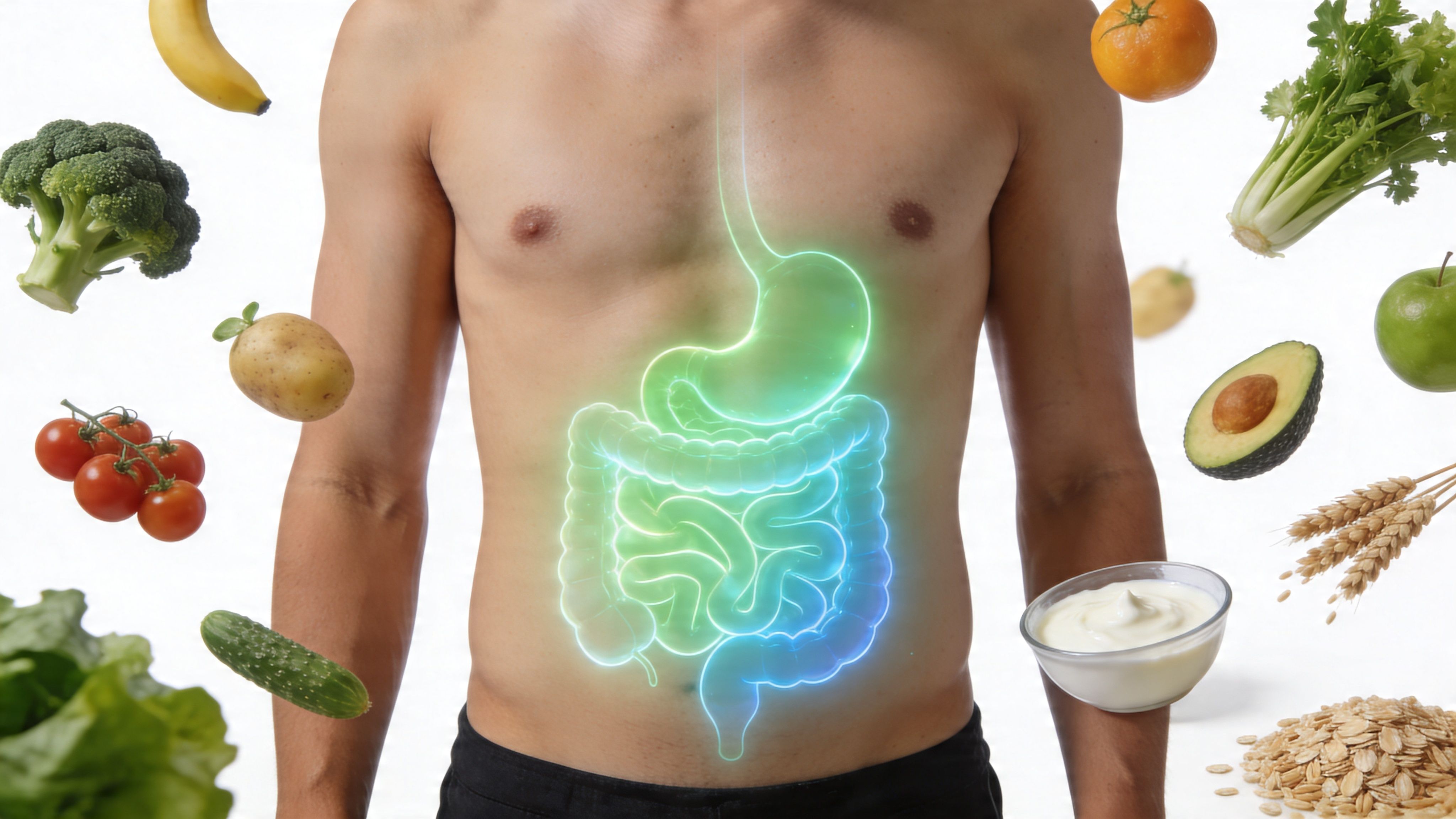
What is healthy for the gut? Your guide for 2026
You are making an effort. You eat “pretty well, actually,” drink enough, stay active, and yet your gut speaks up almost every day. Sometimes it is bloating after a meal; other times, that heavy, sluggish feeling. Perhaps fatigue joins in, even though you have slept enough.
This is exactly where many people end up. They read guides, save recipes, try yoghurt, psyllium husks, or give up this and that for a while. But the big question remains: What is healthy for the gut when standard tips do not really help?
The honest answer has two parts. First, there are clear fundamentals that are good for almost everyone’s gut. Second, your gut is still individual. Understanding both together is what makes the difference between blindly trying things and following a plan that suits you.
Why your gut feeling is often right
You wake up in the morning feeling more or less okay. Then comes breakfast, coffee, an ordinary workday, and by the afternoon your trousers feel tighter than they did in the morning. In the evening, you find yourself googling again: Increase fibre? Eat less raw food? More probiotics? Gluten? Dairy? Stress?
This uncertainty is not a sign that you are making a fuss. It is more likely a sign that your body is sending you signals you have not yet been able to interpret correctly.
When symptoms feel vague
The gut is not simply a tube for digestion. It is connected to many areas of your well-being. That is why gut problems often feel like more than just “stomach” issues; they can also feel like a lack of energy, discomfort, or the sense that your body is not functioning properly right now.
In Germany, this topic has long since moved beyond the niche. According to Nutrition Hub’s 2026 trend report, 59 percent of the experts surveyed see gut health as a continuing growth trend. This reflects what many people experience in everyday life: The gut is no longer a peripheral topic, but a key health concern.
Your gut often speaks up before your mind does. Many people first notice bloating, irregularities, or fatigue before they understand what is behind them.
Why generic tips often lead to frustration
The internet loves simple answers. Eat more of this. Cut that out. Drink this. Chew that for longer. Such tips are not fundamentally wrong. They are just often too simplistic.
Because two people can eat the same “healthy” meal and react completely differently. One person feels light and satisfied. The other feels bloated and tired. If you recognize yourself in this, taking a closer look at common warning signs can often help. A good starting point can be found in the article how to tell when something is wrong with your gut.
The important change in perspective
It’s not about making your gut perfect. It’s about understanding it better. That alone takes the pressure off.
What is healthy for the gut? Not one miracle ingredient. Rather, a state in which your digestive system works calmly, processes food well, and your everyday life is not constantly dictated by your stomach.
Understanding your gut as a complex ecosystem
Many people hear terms like microbiome, gut flora, or intestinal barrier and mentally tune out. Yet these concepts are fairly easy to understand when you have the right images in mind.

The microbiome as a lively city center
Your microbiome is the community of microorganisms in your gut. Imagine it as a lively city center. It is home to many residents with different tasks. Some help with cleaning up, others process delivered food, and still others keep unwanted guests under control.
As long as this city functions in a reasonably balanced way, many things run smoothly. But when certain “residents” get too little food or others take up too much space, unrest arises. You may not notice this immediately in a lab report, but you often notice it in everyday life.
The intestinal barrier as a bouncer
You can think of the intestinal barrier as a strict bouncer. It decides what is allowed through and what should stay outside. Nutrients should be absorbed. Unwanted substances should be kept out as much as possible.
When this protective function is under strain, your body often reacts more sensitively. Then even food that looks healthy on paper may not be as well tolerated as expected.
How the two work together
The microbiome and the intestinal barrier are not separate teams. They influence each other. A well-nourished microbiome supports the environment in the gut. In turn, a stable intestinal barrier creates conditions in which the system remains calmer.
That’s why gut health is about more than just “going to the toilet regularly.” It’s about balance.
| Area | Simple explanation | Why this matters to you |
|---|---|---|
| Microbiome | Lively city center with helpful and less helpful residents | It affects how well food is processed |
| Intestinal barrier | Bouncer at the entrance door | It helps let nutrients in and ward off unwanted substances |
| Interaction | The city and the security service work together | When both get out of balance, your stomach often reacts sensitively |
Why your gut does not react the same way for everyone
This is where confusion often arises. Many people think: If foods are healthy, they should surely be good for everyone. But that is not how the gut works.
Your personal ecosystem responds to what you eat, how you sleep, how stressed you are, and what else your body currently has to handle. That is why “healthy” is always also a matter of tolerance, habits, and your individual situation.
Key point: A healthy gut is not a rigid ideal, but a well-regulated system that fits your everyday life.
The cornerstones of a gut-friendly diet
If you are looking for a practical starting point when asking “what is healthy for the gut,” you will almost always end up with nutrition. That makes sense—not because food solves everything, but because it is something you can directly influence every day.
Fiber is food for the right helpers
Fiber is particularly important for the gut. The German Nutrition Society recommends 30 g per day for adults, yet most Germans do not reach this amount. At the same time, fiber specifically promotes the growth of beneficial gut bacteria.
Many people hear “fiber” and immediately think of dry whole-grain bread. But it means much more than that. Vegetables, legumes, oats, nuts, seeds, fruit, and whole-grain products provide your gut with substances it can put to good use for a stable environment.
The pace is important. If you have previously eaten a rather low-fiber diet and suddenly add a great deal of fiber, your stomach will often initially react with protest. In that case, the plan is not wrong—the change was simply too quick.
Prebiotics and probiotics explained simply
This is where many people get confused.
- Prebiotics, put simply, are food for beneficial gut bacteria.
- Probiotics are living microorganisms that are consumed through certain foods.
- Fermented foods such as yogurt, kefir, or sauerkraut can therefore be interesting because they may contain such cultures.
In practice, this means that your gut often benefits from a combination: food for the beneficial bacteria already present, along with foods that can expand or support your microbial spectrum.
Anyone who wants to explore the topic in more depth will find a useful addition in the article on a healthy gut flora.
What you can eat more often and what tends to slow things down
Not every food has to be perfect. It is more helpful to have a clear direction in everyday life.
| Green These foods are loved by your gut bacteria | Red These foods are less appreciated by your gut |
|---|---|
| Vegetables in many varieties | Highly processed, very one-sided meals |
| Legumes such as lentils or beans | Very sugar-heavy routines |
| Oats and other whole-grain products | Frequent large amounts of alcohol |
| Nuts and seeds | A very meat-heavy diet over a longer period |
| Fruit that you tolerate well | Eating under constant time pressure |
| Yogurt, kefir, sauerkraut, if you tolerate them well | Constant snacking without real breaks |
Making it practical for everyday life
Many people don't fail because of a lack of knowledge, but because of implementation. That's why small changes usually work better than a radical fresh start.
- Upgrade breakfast: Add oats, flaxseeds, or fruit to your usual breakfast.
- Make vegetables easier to digest: Cooked vegetables are often more comfortable for sensitive stomachs than huge plates of raw vegetables.
- Try fermented foods: Start with small amounts and observe whether your stomach becomes calmer or more unsettled.
- Variety instead of bans: Don't eat the same thing every day. Different plants provide different stimuli.
Practical rule: When eating, don't just ask yourself, “Is this healthy?” Also ask, “Will my gut tolerate this well today?”
Identifying common causes of gut problems
If your stomach regularly rebels, it is often not caused by a single food. Several triggers frequently come together. That is why it is worth taking an objective look at patterns rather than culprits.

According to n-tv, citing Leipzig University Hospital, almost 20 percent of Germans suffer from digestive problems. This shows how widespread the issue is. It also shows that symptoms often arise from a combination of factors.
Common triggers in everyday life
- Stress: Under pressure, many people eat hastily, irregularly, or reach for familiar foods that are quickly available.
- Poor sleep: After short or restless nights, the body often reacts more sensitively.
- Too little exercise: The gut likes routine. Sitting for many hours can make it sluggish.
- Medications: Especially after antibiotics, many people report that their stomach feels different than before.
- Dietary changes that are too rapid: High-protein today, raw vegan tomorrow, then intermittent fasting again. The gut generally prefers less chaos.
How to recognize patterns
Not every reaction occurs immediately. Some symptoms build up over several days. That is why many people overlook their triggers.
It becomes easier with three questions in the evening:
- When was my gut calm today, and when was it not?
- How did I eat—slowly or while doing something else?
- How high was my stress level?
Often, it is not the individual food that is the problem, but the context in which you eat it.
More than just food Your lifestyle for a healthy gut
Diet is important. But if you are under constant pressure during the day, go to bed late, and hardly get any time to relax, your gut is working against the tide. That is why the answer to “what is healthy for the gut” always includes lifestyle as well.
Stress directly affects the gut
Chronic stress is not an abstract issue. According to deine-gesundheitswelt, in Germany 42 % of those aged 25 to 55 are affected. The article points out that, according to studies by Techniker Krankenkasse, chronic stress reduces the diversity of the microbiome by 15–20 % reduce. This can worsen digestive problems.
You do not have to work in a permanent crisis job for this to happen. Even the feeling of constantly rushing, eating every meal on the go, and never really winding down in the evening can put strain on your gut.
Three factors that are often underestimated
Breathing and the nervous system
When you are stressed, you often eat in alarm mode. But the gut prefers a state of calm. A short breathing routine before eating can therefore make a surprisingly big difference.
- Pause before the meal: Put your phone away.
- Breathe calmly: A few deep, slow breaths can help you step out of the rush.
- Eat more slowly: This alone often changes how your stomach experiences a meal.
Movement without performance pressure
You do not need extreme training to do your gut some good. A walk after a meal, taking the stairs instead of the lift, or regular movement in everyday life can already help support your digestive rhythm.
Those who are always searching for the perfect supplement often overlook the basics. Exercise is not a bonus. It is part of the solution.
Sleep as a quiet regulator
Poor sleep makes many things more difficult. You eat less mindfully, are more susceptible to stress, and often perceive your body in a distorted way. That is why it is worth making your evenings simpler.
| A small habit | Why it can help your gut |
|---|---|
| A consistent bedtime | More rhythm for your whole body |
| A calmer evening without constant stimulation | Less inner tension |
| Rethink late, heavy meals | Many people then sleep and digest more peacefully |
A calm gut needs more than good food. It also needs signals of safety, regularity, and recovery.
When a test is truly useful
There comes a point when general advice is no longer enough. Not because it is wrong, but because it becomes too imprecise for you.

If you continue to struggle with bloating, irregularity, or unexplained fatigue despite making changes, guessing is often no longer a good strategy. This is exactly where personalization becomes valuable. Many guides give general advice about foods while ignoring individual differences. A personal microbiome test can close this gap by showing which nutrients your specific gut ecosystem needs.
How to recognize that standard advice is no longer enough
A test is often useful if you identify with several of these points:
- Your symptoms persist: You have already made several changes, but your stomach remains sensitive.
- Certain foods confuse you: What is healthy for others seems to place more strain on you.
- You want to take a more targeted approach: Instead of constantly trying new things, you want to use data as a basis.
- You suspect several issues: Digestion, energy, nutrient supply, and intolerances are often connected.
Which tests may be suitable depending on the question
Not every question requires the same analysis. Sometimes the focus is mainly on the microbiome. Other times, it is more about hidden intolerances or nutrient-related concerns that place additional strain on the gut.
This guide on when a gut analysis is useful will help you assess the situation more clearly.
mybody x Gesundheit offers, among other things, at-home self-tests for the gut microbiome, intolerances, and nutrient-related concerns. This is useful when you do not just want to know what is generally healthy, but what your body specifically needs.
The real advantage of data
The greatest benefit of a test is often not the report itself. It is the peace of mind that comes from no longer operating in the dark.
Instead of simply eating more of everything “healthy,” you can make more targeted choices. This is usually more sustainable and also reduces the mental load.
Your 4-week plan for a healthy gut
If you want to support your gut, you do not need a perfect fresh start on Monday. You need a plan you can stick to in real life. Four weeks are enough to make patterns visible and become more aware of initial changes.
Week 1 More calm and more observation
The first step is not restriction but awareness. Eat more slowly, sit down for meals, and observe how your stomach responds on typical days.
In the evening, note down three brief points:
- Stomach feeling: calm, bloated, pressured, changeable
- Energy: stable or rather tired
- Rhythm: did your digestion feel regular or not
Week 2 Increase fiber wisely
Now consciously add more gut-friendly basics. Not everything at once. One extra serving of vegetables, oats for breakfast, or legumes more often in a well-tolerated form is enough to get started.
If your stomach reacts sensitively, slow down rather than cutting everything out again. The gut likes adaptation, but often in small steps.
It is better to start smaller and stick with it than to eat perfectly for two days and then give up in frustration.
Week 3 Test fermented foods and everyday habits
This week, observe how you react to small amounts of fermented foods if you generally tolerate them. At the same time, it is worth taking a look at your lifestyle.
Try this for a few days:
- Take a moment to slow down before eating
- Take a short walk after a meal
- Wind down a little earlier in the evening
The goal is not optimization at any cost. It is about finding out what eases the strain on your stomach.
Week 4 Recognize personal triggers more clearly
Now look back. Which meals made you feel good? When was your stomach particularly calm? Where did recurring symptoms occur?
A brief overview helps:
| Observation | Your note |
|---|---|
| Foods that feel good | |
| Situations in which symptoms occur more frequently | |
| Influence of stress, sleep, or pace | |
| Questions that remain open |
If you notice after these four weeks that your gut is reacting but the connections are still unclear, that is not a step backward. It is a sign that you can approach the next step in a personalized way.
If you want to stop guessing and understand your body better based on data, mybody x Gesundheit offers home self-tests covering the gut microbiome, intolerances, nutrient status, and other health topics. This allows you to translate general knowledge into concrete decisions for your everyday life.



Share now:
How can you tell when something is wrong with your gut? Your check
Loose stools cause: Find the answer!