

Lower abdominal and back pain: Identifying and understanding the causes
The essentials at a glance
Pain that occurs simultaneously in the lower abdomen and back rarely has only one possible explanation. Three possibilities often come to mind: diverticular disease of the large intestine, irritable bowel syndrome, and—in women—endometriosis. Which one applies cannot be determined by the sensation of pain alone, but by the pattern of its location, timing, and accompanying symptoms.
This article categorizes the causes that can originate in the lower abdomen and radiate into the back. It clearly distinguishes between causes originating in the intestines and causes outside the digestive tract—because radiating lower abdominal pain is expressly not exclusively an intestinal issue. All medical information comes from the Institute for Quality and Efficiency in Health Care (IQWiG).
If you are short on time: The overview of causes in Chapter 2 compares the three common explanations side by side. Chapter 3 lists the warning signs that mean you should not wait. And Chapter 8 openly explains what a gut flora analysis cannot do in this regard.
What to expect in this article
1. Why do the lower abdomen and back often hurt at the same time?
2. What causes are possible—diverticular disease, irritable bowel syndrome, or endometriosis?
3. How do you monitor your pain—and when is it an emergency?
4. Diverticular disease: When does pain come from the lower left abdomen?
5. Endometriosis: Why lower abdominal pain radiates into the back
6. What if no physical cause can be found?
7. How can a gut flora analysis with mybody® help put things into perspective?
8. What a microbiome test can—and cannot—do
Conclusion
Frequently asked questions
Sources
Why do the lower abdomen and back often hurt at the same time?
Pain that begins in the lower abdomen and is also felt in the back usually does not mean that two conditions are present at the same time. It generally means that one set of symptoms is radiating—that is, it is perceived in several places even though it has only one origin.
The Institute for Quality and Efficiency in Health Care (IQWiG) explicitly describes this radiation in relation to endometriosis. Accordingly, the pain may “be stronger at times and weaker at others and radiate into the lower abdomen, back, and legs” (IQWiG, 2024).
What radiating pain means when searching for the cause
Radiating pain makes classification more difficult because the location where the pain is perceived and the location where it originates can differ. Those who experience their back as the main complaint often first look for the cause in the spine—and overlook what is happening in the lower abdomen.
The reverse is also true: When people think of the lower abdomen, they quickly think of the intestines. But with radiating lower abdominal pain, this is only one of several possibilities—and in women of childbearing age, not even the most likely one.
Why pain location alone does not establish a diagnosis
The location of the pain provides an initial clue, but not an answer. According to IQWiG (2026), diverticular disease typically causes pain in the lower left abdomen—but left-sided lower abdominal pain is by no means proof of diverticular disease.
The pattern is more informative: When does the pain occur, how long does it last, what changes it, and which accompanying symptoms occur? You can document this pattern yourself before visiting your doctor.
Key statement: Lower abdominal pain radiating to the back is a symptom pattern, not a diagnosis. Whether the cause lies in the intestines or elsewhere depends on the timing, progression, and accompanying symptoms—not on the location of the pain alone.
This article specifically addresses the combination of lower abdominal pain and back pain. If you are more concerned with a dull feeling of tension without clear pain, you can find the explanation in the article Pressure in the abdomen; if, on the other hand, the symptoms occur in the upper abdomen and directly after meals, then Stomach pain after eating is the relevant article.
Which causes are possible—diverticula, irritable bowel syndrome, or endometriosis?
When lower abdominal pain is associated with back pain, three explanations are particularly common: diverticular disease, irritable bowel syndrome, and endometriosis. Two originate in the intestines, one does not—and women in particular are often not considered for this one until too late.
The following overview compares the three possibilities side by side according to the same criteria. It is based exclusively on information from IQWiG. Where the sources used do not provide a statement, this is explicitly indicated in the table—nothing is estimated here.
| Criterion | Diverticular disease | Irritable bowel syndrome | Endometriosis |
|---|---|---|---|
| Where is the pain located? | Usually in the lower left abdomen, less often in the lower right (IQWiG, 2026) | Persistent abdominal or lower abdominal pain and cramps, without a fixed location (IQWiG, 2023) | Lower abdominal pain as the main symptom (IQWiG, 2024) |
| Does it radiate to the back? | The source material used here makes no statement on this | The source material used here makes no statement on this | Yes – the pain can “radiate to the lower abdomen, back, and legs” (IQWiG, 2024) |
| Typical accompanying symptoms | Bloating, constipation, or diarrhea; with inflammation, sudden dull pain accompanied by a slight fever (IQWiG, 2026) | Altered stool is part of the symptom pattern (IQWiG, 2023) | Cramp-like pain, often with menstruation and during or after sexual intercourse; nausea, vomiting, and diarrhea are possible (IQWiG, 2024) |
| Who is affected? | Approximately 13% of people under 50 have diverticula, compared with around 50% of people over 70 (IQWiG, 2026) | An estimated 10 to 20 out of 100 people (IQWiG, 2023) | Up to 10% of all women of childbearing age; around 50% among those with chronic lower abdominal pain (IQWiG, 2024) |
| How is it evaluated? | Medical – the source material used here does not name a specific examination procedure | Medical – the source material used here does not name a specific examination procedure | Gynecological – a stool test or self-test is not suitable for this |
The table highlights a gap that should be acknowledged honestly: The IQWiG pages used here do not describe pain radiating to the back for diverticular disease or irritable bowel syndrome. Radiation to the back is explicitly documented for endometriosis.
This does not rule anything out, but it does establish an order of thought: If lower abdominal pain and back pain regularly occur together in a woman of childbearing age, gynecological evaluation should come first—not at the end of a lengthy gastrointestinal diagnostic process.
How should you monitor your pain—and when is it an emergency?
Before monitoring your symptoms, check for warning signs. There are symptom patterns for which waiting and documenting are the wrong response because they require prompt medical attention.
Warning signs: These require medical evaluation, not a self-test
- ✓ Severe abdominal pain with a rigid abdominal wall – for diverticulitis, IQWiG (2026) lists “severe abdominal pain, a rigid abdominal wall, fever, nausea, a rapid heartbeat, and general weakness” and notes that it is “important to seek medical help promptly.”
- ✓ Fever together with lower abdominal pain – according to IQWiG (2026), diverticulitis causes sudden, dull lower abdominal pain “accompanied by a slight fever.”
- ✓ Significant weight loss, blood in the stool, fever, or pallor – according to IQWiG (2023), this combination “is more likely to indicate another intestinal disease” than irritable bowel syndrome.
- ✓ Blood in the stool in any amount – according to IQWiG (2023), it “should generally be medically examined to clarify the cause.”
- ✓ Rapid heartbeat and general weakness—together with abdominal pain, this is a reason to seek medical help immediately and stop self-observation.
If none of these warning signs are present and the symptoms have persisted for weeks or months, structured self-observation can help. It does not replace an examination, but it makes the medical consultation much more precise.
Four questions are enough. Write down the answers over two to four weeks—by hand or in a notes app; the format is secondary. What matters is bringing the information to your appointment rather than reconstructing it from memory.
Where exactly is the pain located?
On the left, right, in the middle, or does it shift? According to IQWiG (2026), the lower left abdomen is the typical location of diverticular disease.
Does it radiate, and where?
To the lower back, the legs, or the lower abdomen? The direction in which the pain radiates is one of the most important details for the doctor.
Is there a connection?
In relation to your menstrual cycle, bowel movements, or meals? A connection with your cycle is a different clue from a connection with bowel movements.
How long has it been present?
Days, weeks, or months? The duration helps determine whether this is an acute situation or a chronic pattern of symptoms.
These four questions are preparation for a medical consultation, not self-diagnosis. They organize your observations so that the doctor can identify the appropriate examination more quickly.
Diverticular disease: When does pain come from the lower left abdomen?
Diverticular disease is the most common intestinal cause considered when someone has pain in the lower left abdomen. It develops in pouches in the intestinal wall that increasingly form with age.
IQWiG (2026) defines them as follows: “Diverticula are pouches in the intestinal lining: At the affected sites, the inner wall of the intestine bulges outward through weak points in the intestinal muscles.”
“
“Diverticular disease usually causes pain in the lower left abdomen, and less often in the lower right abdomen.”
Institute for Quality and Efficiency in Health Care (IQWiG)
“Diverticular Disease and Diverticulitis,” gesundheitsinformation.de, 2026
How common are diverticula in the colon?
Diverticula become very common with increasing age. About 13% of people under 50 have diverticula, compared with around 50% of those over 70 (IQWiG, 2026).
Having diverticula does not necessarily mean having symptoms. Only when they cause symptoms is it referred to as diverticular disease—and only when there is inflammation is it called diverticulitis.
About 1% of all people with diverticula develop diverticulitis within 10 years (IQWiG, 2026). For most people affected, the finding of “diverticula” is therefore no reason for concern.
What accompanying symptoms are associated with diverticular disease?
In addition to pain in the left lower abdomen, IQWiG (2026) states that “bloating, constipation, or diarrhea may occur.” The symptoms therefore resemble those of irritable bowel syndrome—one reason why the two are often confused in everyday life.
The distinction becomes clear when inflammation develops. According to IQWiG (2026), this causes “sudden dull pain in the lower abdomen, accompanied by a slight fever.” Fever is not part of irritable bowel syndrome—it is a sign that requires medical evaluation.
Key message: Left-sided lower abdominal pain with bloating and changes in bowel movements is consistent with diverticular disease. If fever is also present, this is no longer a situation for self-monitoring but requires prompt medical evaluation.
Endometriosis: Why lower abdominal pain radiates into the back
In women, endometriosis is the most clearly established explanation for the combination of lower abdominal and back pain. It is not a bowel condition—but that is precisely why it belongs in this article.
IQWiG (2024) describes the condition as follows: “In endometriosis, tissue resembling the lining of the uterus is found in the uterine wall or outside the uterus.”
What does endometriosis pain feel like?
IQWiG (2024) clearly identifies the leading symptom: “The main symptom of endometriosis is lower abdominal pain. It often occurs together with menstrual bleeding, but also during or after sexual intercourse.”
The pain is “often experienced as cramping and may be accompanied by nausea, vomiting, and diarrhea” (IQWiG, 2024). These accompanying symptoms explain why many people affected initially suspect a gastrointestinal cause.
The wording used by IQWiG (2024) is particularly important regarding back pain: The pain “may sometimes be stronger and sometimes weaker and may radiate into the lower abdomen, back, and legs.” This is exactly the pattern described by the symptoms discussed in this article.
How common is endometriosis in chronic lower abdominal pain?
According to studies, up to 10% of all women of reproductive age have endometriosis (IQWiG, 2024). This makes it a common condition, not a rare exception.
The second figure is even more informative. Among women with chronic lower abdominal pain, it is estimated that around 50% have endometriosis (IQWiG, 2024). For persistent lower abdominal pain, endometriosis is therefore statistically not a marginal explanation, but one of the first possibilities that should be investigated.
In practical terms: If you are a woman who has had lower abdominal pain for months that radiates to your back and has a recognizable link to your menstrual cycle, see a gynecologist—not for a stool sample and not to change your diet.
The link to the menstrual cycle is the key distinguishing feature from intestinal causes. Irritable bowel syndrome is not linked to the cycle, and neither are diverticula.
In brief
Endometriosis is the only one of the three common explanations for which IQWiG (2024) explicitly describes pain radiating to the back. Up to 10% of women of reproductive age are affected; among those with chronic lower abdominal pain, the figure is estimated at around 50%. Typical symptoms include cramp-like lower abdominal pain associated with menstruation or sexual intercourse, often accompanied by nausea, vomiting, and diarrhea. Suspected endometriosis should be evaluated by a gynecologist.
What if no physical cause can be found?
Not every examination produces a finding. If pain persists without an identifiable organic cause, two possible explanations are irritable bowel syndrome and functional physical symptoms.
Irritable bowel syndrome: common, burdensome, but not dangerous
It is estimated that around 10 to 20 in 100 people have irritable bowel syndrome (IQWiG, 2023). According to IQWiG (2023), typical symptoms include “persistent abdominal or lower abdominal pain, cramps, and changes in bowel movements.”
Important for context: According to IQWiG (2023), irritable bowel syndrome is not dangerous, and most people affected can manage well with a mild form without treatment. This reassurance belongs in the text just as much as the warning signs from Chapter 3.
According to IQWiG (2023), suspected causes of irritable bowel syndrome include hypersensitive intestinal nerves, disturbances of the intestinal muscles, changes in the gut flora, and inflammation of the intestinal wall. The term “suspected” is used deliberately—there is no single confirmed trigger.
Functional physical symptoms: real, even without a finding
According to IQWiG (2026), functional physical symptoms are present “when physical symptoms exist without a physical cause, such as inflammation or an injury, being identifiable.”
IQWiG (2026) explicitly states: “However, this does not mean that the symptoms are merely imagined and that nothing can be done.” Therefore, the absence of a finding is not a judgment about whether the pain is real.
It is estimated that around 10% of the population has symptoms for which no clear explanation can be found (IQWiG, 2026). This explicitly includes “stomach and intestinal problems such as nausea, vomiting, bloating, diarrhea, and constipation.”
IQWiG (2026) also addresses the connection with stress: “Stress can, for example, disrupt bowel function. This can lead to diarrhea, bloating, or constipation.” This explains why symptoms can increase during stressful periods of life without anything having changed organically.
From Notes to a Structured Conversation with the Doctor
Good documentation is especially valuable when there is no clear finding. It prevents having to start from scratch at every new appointment and makes patterns visible that might otherwise be missed in conversation.
Example: Martin, 54
Fictional scenario for illustration
For around six months, Martin has repeatedly noticed pain in his lower left abdomen that radiates to his lower back. Because at his first doctor’s appointment he could only say that it had been going on “for quite some time,” he then began keeping a brief note: date, location of the pain, direction of the radiation, duration, and what was different that day. After four weeks, his notes reveal a pattern—the symptoms occur mainly on days with altered bowel movements, he has never had a fever, and he has never noticed blood in his stool. He takes these notes to his follow-up appointment. Instead of a vague description, there is now an organized overview of how the symptoms have progressed, which the doctor can use to guide her questions. The scenario shows neither treatment success nor a diagnosis—it simply shows how much better a conversation goes when personal observations are organized.
The main takeaway is this: It is not the amount of notes that matters, but their structure. Location, radiation, triggers, and duration are entirely sufficient.
How can a gut microbiome analysis with mybody® help put things into context?
A gut microbiome analysis is useful when medical evaluation is already underway or complete and you also want to understand the composition of your gut microbiome. It complements diagnostic evaluation; it does not replace it.
The relevant context is narrowly defined. According to IQWiG (2023), changes in the gut microbiome are suspected, among other factors, to contribute to irritable bowel syndrome—suspected, not proven. It is within this framework that a microbiome analysis provides additional information.
A microbiome analysis does not replace a diagnosis—it helps put what is happening in the gut into context. It shows the composition of the gut microbiome at a specific point in time, providing a starting point for conversations about diet and daily life.
A microbiome analysis does not replace a diagnosis—it helps put what is happening in the gut into context.
mybody® (MYBODY Lab GmbH) offers two gut microbiome analyses for this purpose, which differ in scope. Both use a stool sample you collect at home and are evaluated in an ISO-certified laboratory.

Gut Flora MICROBIOME Test Complete
The Complete test uses DNA sequencing to identify more than 1,500 bacterial species and assesses, among other things, bacterial diversity, the ratio of protective to problematic microorganisms, and indications of dysbiosis. The report is approximately 15 pages long and additionally includes a FODMAP index and enterotype determination. What the test does not do: It does not provide a diagnosis and does not detect diverticula, endometriosis, inflammatory bowel disease, tumors, or infections.
Price: €189.00 (instead of €219.00) · Sample type: stool sample · Processing time: approx. 20–25 business days · Laboratory: ISO-certified laboratory analysis, ISO 27001, GDPR-compliant
To the Complete microbiome testThose who initially want only an overview of the composition of their gut flora will find the Basic version a more limited entry point. It covers fewer evaluation topics but uses the same sample type and offers the same laboratory quality.
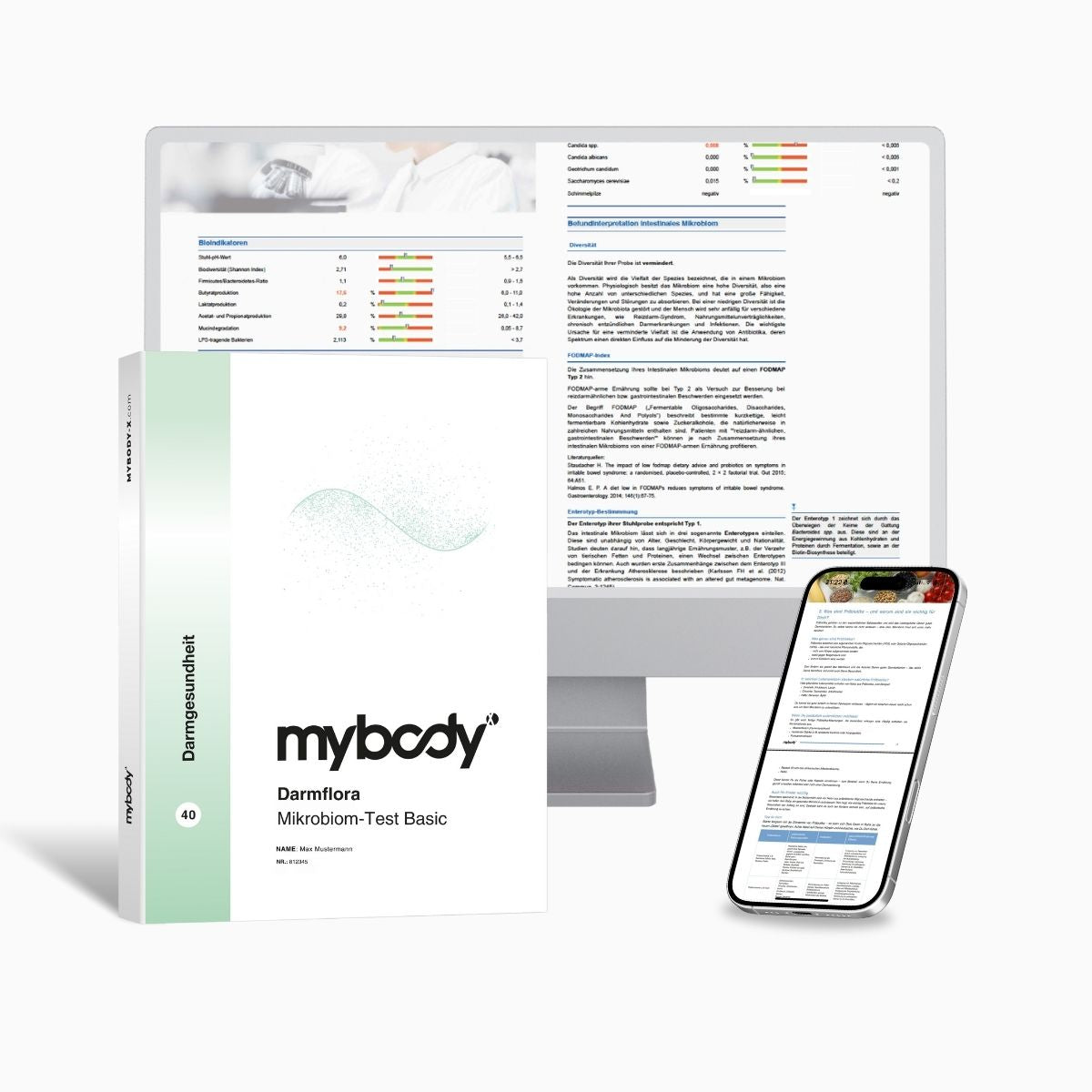
Gut Flora MICROBIOME Test Basic
The Basic test shows the composition of the gut flora, the ratio of protective to potentially harmful bacteria, the intestinal environment based on the pH level, possible fungal colonization, and indications of dysbiosis. The report is also approximately 15 pages long. This test is not a diagnostic procedure either: it does not determine the cause of radiating lower abdominal pain and does not replace a medical examination.
Price: €139.00 · Sample type: stool sample · Processing time: approx. 20–25 business days · Laboratory: ISO-certified laboratory analysis, ISO 27001
To the Basic microbiome testAll price and service information is current as of July 28, 2026. Prices and processing times may change; the respective product page is always authoritative.
What a microbiome test can—and cannot—do
A microbiome test describes the composition of your gut flora. It does not answer why pain in the lower abdomen radiates to the back.
This is not a weakness of the method, but its definition. A stool sample reveals bacteria—it does not show outpouchings of the intestinal wall, tissue outside the uterus, or inflammation in the abdominal cavity.
Therefore, the following applies to all three causes discussed in this article: Neither diverticular disease, endometriosis, nor irritable bowel syndrome can be identified through a gut flora analysis. Irritable bowel syndrome is a medical assessment, endometriosis requires gynecological evaluation, and diverticular disease is a medical finding.
Suitable for you if …
… you have already undergone medical evaluation and additionally want to know the composition of your gut flora.
… you have recurring digestive complaints and are looking for a structured starting point for dietary questions.
… you want a written basis to discuss with a nutrition professional or at a medical practice.
… you are aware that the result is a snapshot and not a diagnosis.
Not recommended if …
… you have acute severe abdominal pain with a rigid abdominal wall and fever—this requires immediate medical treatment, not a self-test.
… endometriosis is suspected—it is evaluated gynecologically, not through a stool sample.
… you expect a diagnosis—anyone who does is poorly advised to use a self-test.
… warning signs such as significant weight loss, blood in the stool, fever, or paleness are present—according to IQWiG (2023), these require medical examination.
The converse is not true either: An unremarkable microbiome result does not rule out any disease. If symptoms persist, medical evaluation remains necessary—regardless of what a test report says.
It is also important to be honest: mybody® does not offer its own test product for lactose or fructose intolerance. For lactose intolerance, the hydrogen breath test is the medical standard: According to IQWiG (2024), the hydrogen content of the exhaled air is measured several times after drinking a lactose solution.
Conclusion
Lower abdominal pain that radiates to the back is a pattern with several possible explanations. In the gastrointestinal tract, diverticular disease and irritable bowel syndrome are the main possibilities; outside the gastrointestinal tract, endometriosis is the main possibility in women.
The clearest figures point to a gynecological cause: According to IQWiG (2024), it is estimated that around 50% of women with chronic lower abdominal pain have endometriosis. The connection with back pain is explicitly described in this context.
Specifically recommended: Check the warning signs first. If you have severe abdominal pain with a rigid abdominal wall, fever, nausea, a rapid heartbeat, and general weakness, seek medical attention promptly. The same applies if there is blood in your stool, significant weight loss, or paleness.
If none of these apply, document the location, radiation, triggers, and duration of the pain over two to four weeks and bring these notes to your doctor’s office. A gut flora analysis can accompany this process, but it does not replace it.
Frequently asked questions
What does it mean when my lower abdomen and back hurt at the same time?
Usually, this means that one set of symptoms radiates—the pain is perceived in several places but has only one origin. Two simultaneous conditions are the exception. For endometriosis, the IQWiG (2024) explicitly states that the pain can “radiate to the lower abdomen, back, and legs.”
Can endometriosis cause back pain?
Yes. The IQWiG (2024) describes endometriosis pain as being able to “vary in intensity and radiate to the lower abdomen, back, and legs.” The main symptom is lower abdominal pain, which often occurs together with menstrual bleeding and during or after sexual intercourse.
When should I seek immediate medical help for lower abdominal pain?
The IQWiG (2026) lists “severe abdominal pain, a rigid abdominal wall, fever, nausea, rapid heartbeat, and general weakness” as symptoms of diverticulitis and states that it is “important to seek medical help quickly.” According to the IQWiG (2023), blood in the stool should also always be medically examined.
Can a microbiome test find the cause of my pain?
No. A microbiome test describes the composition of the gut flora and is not a diagnostic procedure. It detects neither diverticula nor endometriosis, chronic inflammatory bowel disease, a tumor, nor an infection. It can complement a medical evaluation, but not replace it.
Which information is most helpful during a consultation with a doctor?
Four details are enough: Where exactly is the pain located, does it radiate, and if so, where, is there a connection with your menstrual cycle, bowel movements, or meals, and how long has it been present? Record these points over two to four weeks and bring the notes with you to your appointment.
Have your gut flora assessed
If you are undergoing medical evaluation and would also like to know how your gut flora is composed, you will find the appropriate analyses from mybody® here. They do not replace a diagnosis, but they provide a written basis for your next consultation.
View the Complete Microbiome Test All gut tests at a glanceYou might also be interested in
→ Intestinal inflammation: What to eat and what to avoid?
How nutrition can be classified in the context of inflammatory bowel complaints—and where its limits lie.
→ The Most Reliable Microbiome Tests for Your Gut Flora
How to recognize a reputable gut flora analysis and which criteria really matter.
→ Gut Encyclopedia: All Bacteria and Markers in Your Gut Flora
Reference work with over 6,000 microbiome biomarkers—from protective bacteria and fiber degraders to the key metrics in the report.
Sources
- IQWiG / gesundheitsinformation.de: Diverticular disease and diverticulitis (2026) — gesundheitsinformation.de
- IQWiG / gesundheitsinformation.de: Endometriosis (2024) — gesundheitsinformation.de
- IQWiG / gesundheitsinformation.de: Irritable bowel syndrome (2023) — gesundheitsinformation.de
- IQWiG / gesundheitsinformation.de: Unexplained physical symptoms (functional physical symptoms) (2026) — gesundheitsinformation.de
- IQWiG / gesundheitsinformation.de: Lactose intolerance (milk sugar intolerance) (2024) — gesundheitsinformation.de
All information on diverticula, diverticulitis, and associated warning signs is based on [1]. Statements about endometriosis, pain radiating to the back, and frequencies of up to 10% and approximately 50% are taken from [2]. Information on irritable bowel syndrome, its typical symptoms, and the warning signs of weight loss, blood in the stool, fever, and paleness is based on [3]. The classification of functional physical symptoms follows [4], and the information on the hydrogen breath test for lactose intolerance follows [5]. Product information is taken from the mybody® product pages, accessed on July 28, 2026. All other studies mentioned in the text are cited directly at the relevant point with the authors, journal, and year.

mybody® Editorial & Expert Team
Lower abdominal pain Gut health Microbiome Laboratory diagnostics
This article was created and medically reviewed by the mybody® Editorial and Expert Team. The team brings together expertise in nutrigenetics, microbiome and gut science, blood analysis interpretation, nutritional science, and laboratory diagnostics.
Published on July 28, 2026 · Last updated on July 28, 2026
Medical notice: This article is for general information only and does not replace medical advice, diagnosis, or treatment. Lower abdominal pain radiating to the back can have many causes, including some outside the digestive tract. If you experience severe, sudden, or persistent symptoms, or fever, blood in the stool, significant weight loss, or paleness, please consult a doctor promptly.




Share now:
Persistent nausea after eating without vomiting: causes, assessment, and the right next steps
Bloating: what to do? The step-by-step plan for a calmer stomach