

Bloating: What to do? A step-by-step plan for a calmer stomach
The essentials at a glance
A structured approach is more helpful for bloating than quick restrictions: eat more slowly and chew thoroughly, increase fiber gradually rather than abruptly, move after eating, and test suspected foods individually. If this does not lead to improvement after four to six weeks, the cause should be professionally evaluated.
Bloating is usually harmless, but it is bothersome and often persistent. There is no remedy that reliably gets rid of it. That is why this article classifies the most common triggers, presents a realistic order of steps, and identifies the warning signs that mean you should stop trying things on your own.
If you want to get started right away, begin with the four everyday steps directly below the table of contents and then read Chapter 5. If you want to understand what is behind the symptoms, start with Chapter 2 and the comparison in Chapter 6. The warning signs are listed in Chapter 3, and the honest assessment of self-tests is in Chapter 9.
What to expect in this article
1. Why does bloating occur in the first place?
2. What causes recurring bloating?
3. When should you have bloating medically evaluated?
4. How should you proceed step by step with recurring bloating?
5. What helps with a bloated stomach in everyday life?
6. Lactose intolerance, irritable bowel syndrome, or stress—how do they differ?
7. How much does changing your diet really help with bloating?
8. When is a gut microbiome analysis useful?
9. Putting it into perspective: What a self-test can—and cannot—do
Conclusion
Frequently asked questions
Sources
The following four steps are a starting point for everyday life. They cost nothing, carry little risk, and help many people within the first few weeks. The overall process over several weeks is explained later in Chapter 4.
Eat more slowly and chew thoroughly
People who eat hastily and talk while eating swallow more air. Consciously allow yourself twenty minutes per meal and put your cutlery down from time to time.
Increase fiber slowly
The DGE recommends at least 30 grams of fiber per day for adults as a guideline (2021). Increase your intake in small steps over several weeks, not overnight.
Move after eating
A calm ten- to fifteen-minute walk after the main meal is the simplest way to keep gas moving.
Test triggers individually
Eliminate one suspected food at a time—never several at once. Otherwise, you won’t know what made a difference in the end.
Why does bloating occur in the first place?
Bloating occurs when more gas is produced or swallowed in the intestines than the body can inconspicuously eliminate. Some of this gas comes from swallowed air; most of it is produced in the large intestine when gut bacteria break down undigested food components.
This process is not an error but part of normal digestion. The large intestine is specifically designed to ferment food residues that the small intestine has not absorbed. Symptoms only arise when quantity, speed, or sensitivity are no longer in balance.
How intestinal bacteria turn food residues into gas
The mechanism can be clearly understood using lactose as an example. According to the Institute for Quality and Efficiency in Health Care (IQWiG, 2024), lactose remains in the small intestine when more is consumed than the enzyme lactase can break down. It reaches the large intestine, where intestinal bacteria ferment it, producing increased amounts of gases such as carbon dioxide and hydrogen, as well as fluid and fatty acids in the intestines.
The same principle applies to many other carbohydrates that the small intestine absorbs only partially—including those in legumes, cruciferous vegetables, onions, and sugar substitutes. The food itself is not “bad”; rather, the quantity encounters a digestive system that is currently unable to cope with it.
Why perception varies so much
Two people with the same amount of gas in their intestines can react completely differently. How sensitive the intestines are to stretching helps determine whether this turns into an unpleasant feeling of tension or whether the gas is passed along unnoticed.
Key message: In the vast majority of cases, bloating is a problem of quantity and sensitivity, not a sign of illness. What matters is not whether gas forms in the intestines, but how much accumulates over what period of time and how strongly the intestines react to it.
This article is deliberately designed as a practical guide: it explains what you can do and in what order. If what concerns you most is a persistent feeling of tension and pressure, the article Pressure in the abdomen is the more suitable starting point; if audible sounds are bothering you, explains Bowel sounds—the background.
What triggers are behind recurrent bloating?
Four groups of triggers are particularly common with recurrent bloating: eating habits, certain hard-to-digest carbohydrates, intolerances such as lactose intolerance, and stress and functional disorders of intestinal function. The order in which you investigate these factors is more important than which remedy you take.
Eating habits: pace, air, and portion size
The simplest trigger is most often overlooked. Eating hastily, talking while chewing, using straws, and drinking carbonated beverages introduce additional air into the digestive tract, which can make the abdomen feel bloated before bacteria are involved at all.
Portion size also plays a role. A very large meal means more substrate for the small intestine to process in a short time – and therefore more residue reaching the large intestine. For many people, three medium-sized meals are easier to digest than one very large meal.
Lactose intolerance as a common individual cause
Lactose intolerance is the best-known single cause of gas after eating. It is not an allergy but an enzyme deficiency: too little lactase is available to fully break down the lactose consumed.
“
“About 5 to 15% of people from Europe cannot digest lactose.”
Institute for Quality and Efficiency in Health Care (IQWiG)
“Lactose intolerance (inability to digest lactose),” gesundheitsinformation.de, 2024
Regional differences are substantial. According to IQWiG (2024), 65 to over 90 percent of adults in Africa or East Asia cannot digest lactose, while lactose intolerance is least common in Northern Europe. Anyone from a region where it is widespread should have this possible trigger checked early.
Stress and functional physical symptoms
Bloating can persist even when no physical cause is found. According to IQWiG (2026), an estimated 10 percent of the population have symptoms for which no clear explanation is found; bowel function can, for example, be disrupted by stress, resulting in diarrhea, bloating, or constipation.
This is not meant to dismiss your symptoms. IQWiG (2026) explicitly states: “However, this does not mean that the symptoms are merely imagined or that nothing can be done.” Understanding this connection can often save you from another round of unsuccessful dietary experiments.
When should you have bloating medically evaluated?
Bloating alone is rarely a warning sign. It becomes concerning when additional symptoms occur that do not fit a harmless digestive reaction. These signs should be assessed by a doctor, not treated through self-experimentation.
Warning signs that mean it is time to stop self-treatment
- ✓ Significant weight loss – according to IQWiG (2023), “significant weight loss, blood in the stool, fever, or pallor” are more indicative of another intestinal disease.
- ✓ Blood in the stool – IQWiG (2023) states: “Blood in the stool should always be medically examined to clarify the cause.”
- ✓ Fever or pallor – neither is consistent with gas caused solely by diet and requires medical evaluation.
- ✓ Sudden severe abdominal pain with a rigid abdomen – if you have severe abdominal pain, a rigid abdomen, fever, nausea, a rapid heartbeat, and general weakness, IQWiG (2026) says it is important to seek medical help promptly.
- ✓ Nighttime symptoms and persistent vomiting – Symptoms that wake you from sleep should be medically evaluated, as should repeated vomiting.
Why age matters
Some causes become more common with age. Regarding diverticular disease, IQWiG (2026) notes that about 13 percent of people under 50 have diverticula, compared with about 50 percent of people over 70. According to the same source, possible symptoms include bloating, constipation, or diarrhea in addition to pain in the lower left abdomen.
This is not a reason to worry but a reason to put things into perspective: According to IQWiG (2026), about 1 percent of all people with diverticula develop diverticulitis within ten years. New, persistent bloating after middle age therefore warrants medical evaluation before you start modifying your diet.
How should you proceed step by step with recurring bloating?
The most effective lever is not a single remedy but an orderly sequence over several weeks. If you change everything at once, you cannot tell afterward what helped—and you often end up cutting out foods that were not actually the problem.
The following four stages outline the overall approach. The four everyday steps above continue throughout; they are the foundation, not an alternative.
Keep a symptom diary for two weeks
For two weeks, note what you eat, how much, and when—and when the symptoms occur. Also record your sleep, stress level, and bowel movements. Without this foundation, any dietary change is just guesswork.
Test suspected triggers one at a time
Choose the most noticeable candidate from your diary and avoid it consistently for one week—this one only. Then reintroduce it and observe what happens. Only after that should you move on to the next candidate.
Check for warning signs and seek medical evaluation
Compare your notes with the warning signs from Chapter 3. If any of them appear, stop monitoring yourself and make an appointment at your doctor’s office. The diary will provide a valuable basis for the consultation.
Assess honestly after four to six weeks
Compare your notes with the initial state. If nothing has measurably improved, you took the wrong approach—then professional guidance is more useful than starting another elimination round on your own.
What helps with a bloated stomach in everyday life?
In everyday life, the most helpful measures are those that reduce the amount of gas or make it easier to pass: eat more slowly, choose smaller portions, move around after eating, and gradually increase your fiber intake. There is no remedy that reliably eliminates bloating.
Eating pace and chewing as an underestimated lever
Chewing is the first step in digestion and, at the same time, the only one you consciously control. Thoroughly chewed food gives digestive enzymes more surface area to work on, so less undigested material reaches the large intestine.
In practical terms, this means putting your cutlery down from time to time, not eating in front of a screen, and avoiding straws and highly carbonated drinks with meals. These changes cost nothing and help many people within a few days.
Fiber: beneficial, but not abruptly
The German Nutrition Society (DGE) recommends that adults consume at least 30 grams of fiber per day as a guideline (as of 2021). According to the DGE (2021), increased fiber intake shows “protective effects against cardiovascular disease, type 2 diabetes, obesity, high blood pressure, colon and breast cancer, as well as the risk of death.”
For people with bloating, one limitation is important: More fiber may initially increase gas production before the bowel adapts. Anyone who jumps from 15 to 30 grams often experiences exactly the opposite of what they hoped for and gives up in frustration.
A gradual increase in small steps over four to six weeks, accompanied by sufficient fluids, is practical. Fiber binds water—without enough fluids, stools become firmer rather than softer.
Everyday measures you can implement right away
- ✓ Twenty minutes per meal – setting a fixed time frame is more effective than resolving to eat “more slowly.”
- ✓ Smaller portions, but more regularly – three moderate meals put less strain on digestion than one very large meal.
- ✓ Move for ten to fifteen minutes afterward – a gentle walk is enough; exercise is not necessary.
- ✓ Increase fiber in weekly increments – five extra grams per week is better than adding ten grams overnight.
- ✓ Reduce carbonated drinks and drinking through straws – both introduce additional air into the digestive tract.
- ✓ Soak legumes thoroughly and cook them for a long time – preparation also determines how well they are tolerated.
Key message: No single remedy reliably relieves bloating, but the combined effect of small everyday changes can: eating more slowly, having smaller portions, moving around after meals, and increasing fiber gradually rather than abruptly.
Lactose intolerance, irritable bowel syndrome, or stress—which is the difference?
Three very different causes can trigger similar bloating: lactose intolerance, irritable bowel syndrome, and functional bodily symptoms in which stress, among other factors, disrupts bowel function. They differ in how they develop, how they are assessed, and what actually helps.
The following comparison summarizes how to distinguish the three paths. It does not replace a diagnosis, but it helps you have a more focused conversation at the doctor's office.
| Criterion | Lactose intolerance | Irritable bowel syndrome | Functional physical symptoms caused by stress |
|---|---|---|---|
| What causes the gases? | Undigested lactose reaches the large intestine and is fermented there; according to IQWiG (2024), this produces increased amounts of carbon dioxide and hydrogen. | The causes have not yet been conclusively clarified; possible factors discussed include oversensitive intestinal nerves, disturbances in the intestinal muscles, and changes in the gut flora (IQWiG, 2023). | According to IQWiG (2026), stress can disrupt intestinal function, resulting in diarrhea, bloating, or constipation. |
| Typical accompanying symptoms | Symptoms after eating foods containing lactose; according to IQWiG (2024), additional fluid and fatty acids form in the intestine. | According to IQWiG (2023), “persistent abdominal or lower abdominal pain, cramps, and changes in stool.” | According to IQWiG (2026), “stomach and intestinal problems such as nausea, vomiting, bloating, diarrhea, and constipation.” |
| How is it diagnosed? | Hydrogen breath test: After drinking a lactose solution, the hydrogen level in the breath is measured several times (IQWiG, 2024). | Medical evaluation based on the symptoms and exclusion of other intestinal diseases (IQWiG, 2023). | This classification applies when, according to IQWiG (2026), no physical cause such as inflammation or injury can be identified. |
| How common is it? | Approximately 5 to 15% of people in Europe; in Africa or East Asia, 65% to more than 90% of adults (IQWiG, 2024). | An estimated 10 to 20 out of 100 people (IQWiG, 2023). | An estimated 10% of the population experience symptoms without a clear explanation (IQWiG, 2026). |
| What has been proven to help? | Adjust the amount of lactose to the lactase that remains—according to IQWiG (2024), symptoms only occur when more lactose is consumed than the lactase can break down. | Individual dietary adjustments; according to IQWiG (2023), there is no evidence that additional fiber supplements help. | IQWiG (2026) emphasizes: “However, this does not mean that the symptoms are merely imagined and that nothing can be done.” |
The key takeaway from this table is that, when lactose intolerance is suspected, the hydrogen breath test is the medical standard. Neither a stool sample nor a blood test can replace it—and mybody® deliberately does not offer a standalone test product for lactose intolerance.
What does changing your diet really do for bloating?
Changing your diet can significantly relieve bloating when done in a targeted way—and it can be harmful when it leads to indiscriminate avoidance. The difference lies in whether you test or prohibit.
FODMAP elimination phases: effective, but not harmless
FODMAPs are certain carbohydrates that the small intestine absorbs only partially. According to IQWiG (2023), it is assumed that absorbing FODMAPs causes more water to enter the intestine, which may promote diarrhea.
A low-FODMAP diet is therefore a commonly recommended approach for IBS symptoms. However, it has a serious drawback: According to IQWiG (2023), “there is a risk of malnutrition because it becomes difficult to consume enough vitamins and minerals.”
Such an elimination phase should therefore be professionally supervised—ideally by a nutrition professional—and limited in duration. It is a trial phase followed by gradual reintroduction, not a long-term diet.
Fiber supplements and probiotics: what is established and what is not
Dietary supplements are the most obvious approach, but rarely the most effective. Regarding IBS symptoms, IQWiG (2023) explicitly states: “It has not been established that additional fiber supplements help.”
When it comes to probiotics, it is worth taking a second look at the side effects. According to IQWiG (2023), probiotics are generally well tolerated, with mild side effects such as bloating occurring only rarely. The very symptom you want to get rid of may therefore temporarily worsen.
In brief
Changing your diet for bloating is most effective when it specifically tests individual triggers rather than permanently eliminating entire food groups. Low-FODMAP phases may alleviate symptoms, but according to IQWiG (2023), they carry a risk of malnutrition and should therefore be professionally supervised and limited in duration. The benefits of additional fiber supplements for IBS symptoms have not been established, and probiotics can themselves cause bloating in rare cases.
When does a gut flora analysis make sense?
A gut flora analysis makes sense when you have already completed the everyday steps and the four-week program, warning signs have been medically ruled out, and you want to know how your gut bacteria are composed. It is one component for assessing the situation, not a substitute for medical evaluation.
For this purpose, mybody® (MYBODY Lab GmbH) offers two at-home stool tests. The samples are analyzed in an ISO-certified laboratory, with processing carried out in compliance with the GDPR and ISO 27001.
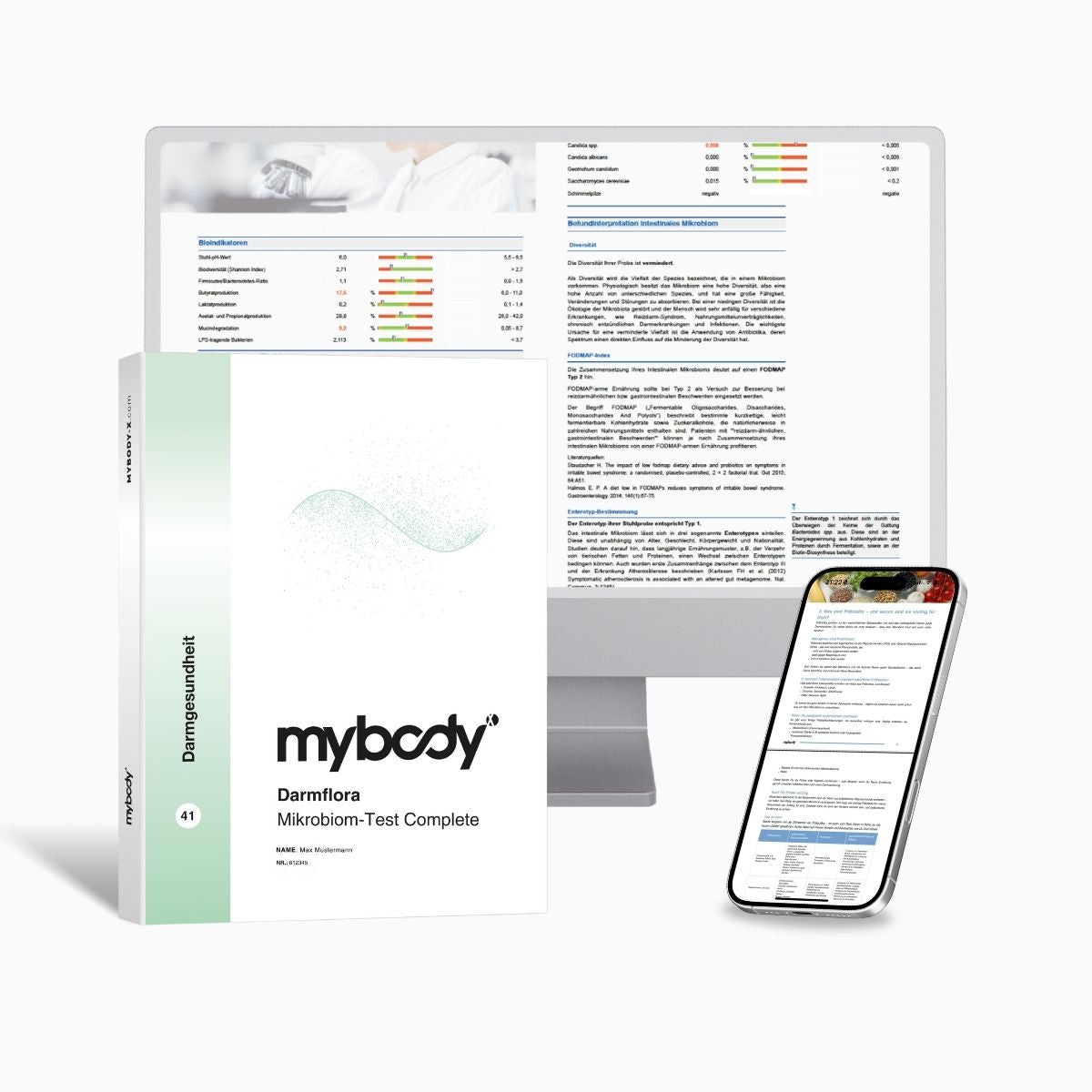
Gut Flora MICROBIOME Test Complete
The Complete test identifies more than 1,500 bacterial species through DNA sequencing and describes, in a report of around 15 pages, among other things, bacterial diversity, the ratio of protective to potentially problematic microbes, indications of dysbiosis, as well as a FODMAP index and enterotype classification. It does not provide a diagnosis: It cannot detect chronic inflammatory bowel disease, an infection, celiac disease, or a tumor, nor can it identify lactose intolerance.
Price: €189.00 (instead of €219.00) · Sample type: Stool sample · Processing time: approx. 20–25 business days after receipt of the sample · Laboratory: ISO-certified laboratory analysis, ISO 27001
About the Microbiome Test CompleteThose who initially want only a general overview of their own gut flora will find a more affordable entry point with a shorter report in the Basic version.
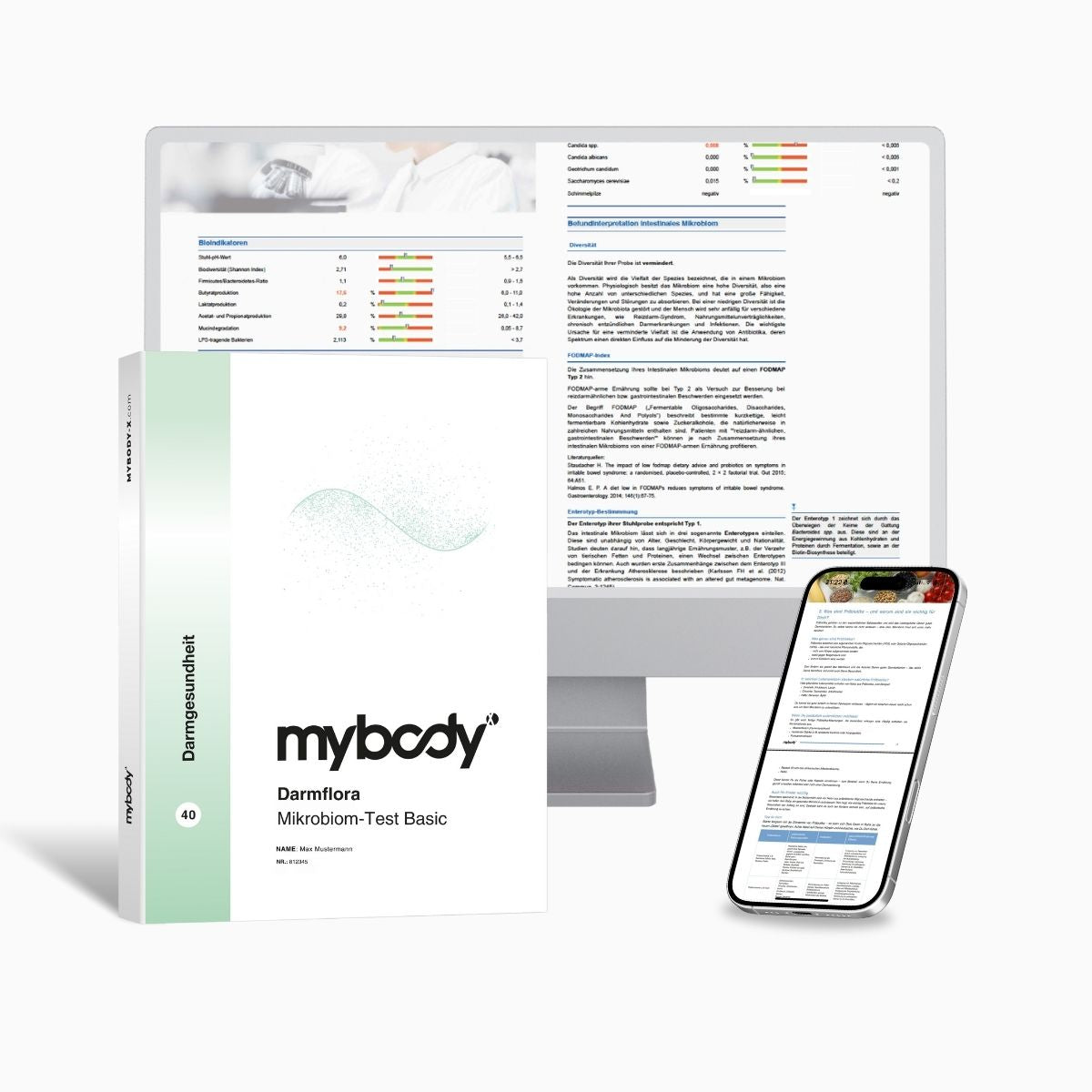
Gut Flora MICROBIOME Test Basic
The Basic version describes the composition of the gut flora, the ratio of protective and potentially harmful bacteria, the intestinal environment based on the pH value, possible fungal colonization, and indications of dysbiosis in a report of around 15 pages. It includes neither the FODMAP index nor the enterotype analysis offered by the Complete test, and it is not a diagnostic procedure either.
Price: €139.00 · Sample type: Stool sample · Processing time: approx. 20–25 business days after receipt of the sample · Laboratory: ISO-certified laboratory analysis, ISO 27001
About the Microbiome Test BasicAll prices and service details are accurate as of July 28, 2026. Prices and processing times may change; the relevant product page always takes precedence.
Who a stool analysis is suitable for—and who it is not
The following comparison presents both sides of the decision. The right-hand column is more important than the left because it explains when your money would be better spent elsewhere.
It may be useful for you if …
… you have already implemented the everyday steps and the four-week plan but still regularly notice bloating.
… warning signs have been medically evaluated and ruled out, and you now want to put the composition of your gut flora into context.
… you are already changing your diet and looking for a baseline against which you can measure changes in a few months.
… you want to discuss the results with a doctor, nurse, or nutrition professional.
Probably not if …
… you suspect lactose intolerance. The hydrogen breath test is the medical standard for this—not a stool sample—and mybody® does not offer a standalone lactose intolerance test product.
… warning signs such as significant weight loss, blood in the stool, fever, or pallor are present. These should be evaluated in a doctor’s office, not with a home test.
… you expect a diagnosis or a ready-made treatment plan. A microbiome analysis provides neither.
… you have not yet tried the four everyday steps. They cost nothing and already help some people.
Putting it into context: What a home test can—and cannot—do
A home microbiome test provides a snapshot of the bacterial composition in your stool. It provides no diagnosis, clarification of the causes, or treatment recommendation—and this expectation is precisely the most common reason for disappointment.
A laboratory analysis describes a state; it does not yet explain your symptoms. There is an interpretive gap between an unusual bacterial distribution and the feeling of bloating after dinner—a gap that can only be bridged meaningfully together with your symptom diary and professional assessment.
A laboratory analysis describes a state; it does not yet explain your symptoms.
What a microbiome analysis explicitly cannot detect
A stool analysis of the gut microbiome does not detect inflammatory bowel disease, an infection, coeliac disease, or a tumor. It neither replaces a colonoscopy nor a medical examination, and it does not indicate whether your gut is “healthy.”
It also does not answer the question of lactose intolerance. As IQWiG (2024) describes, the hydrogen breath test measures the hydrogen content of exhaled air several times after drinking a lactose solution—a procedure that a stool sample cannot replicate in principle.
The composition of the gut microbiome also changes with diet, physical activity, sleep, and medication. A single measurement therefore shows a snapshot rather than a fixed characteristic—which is precisely why this article focuses on the process before the product.
Conclusion
For bloating, the sequence leads to the goal—not any single remedy. Start with the four everyday steps, keep a symptom diary for two weeks, test noticeable triggers individually, and honestly assess what has changed after four to six weeks.
Keep an eye out for warning signs: significant weight loss, blood in the stool, fever, or pallor should be medically evaluated according to IQWiG (2023). If lactose intolerance is suspected, a hydrogen breath test is the right approach.
If the symptoms persist despite consistently following the recommendations and serious causes have been ruled out, a gut microbiome analysis may be useful as an additional component—as a starting point for a better conversation, not as a diagnosis.
Frequently asked questions
What helps quickly with bloating?
In the short term, movement helps most: A gentle ten- to fifteen-minute walk after a meal supports the onward movement of gas. Applying warmth to the abdomen and lying down in a relaxed position are considered pleasant by many people. However, there is no remedy that reliably eliminates bloating—the lasting improvement comes from the combined effect of everyday measures.
Which foods commonly cause bloating?
Legumes, cabbage vegetables, onions, sugar substitutes, and larger amounts of lactose-containing products are often mentioned. However, the decisive factor is less the individual food than the quantity and individual tolerance. A two-week symptom diary is therefore more informative than any general list of foods to avoid.
Can fiber make bloating worse?
Yes, temporarily. More fiber initially means more substrate for gut bacteria, so gas production may increase in the short term before the gut adapts. The DGE recommends at least 30 grams per day for adults as a guideline (as of 2021)—reach this amount in small weekly increments and with sufficient fluids rather than overnight.
When is bloating a warning sign?
When additional symptoms occur. According to IQWiG (2023), “significant weight loss, blood in the stool, fever, or paleness” are more likely to indicate another intestinal disease, and “blood in the stool should always be examined by a doctor to clarify the cause.” Symptoms that occur at night, persistent vomiting, and sudden severe abdominal pain with a rigid abdominal wall should also be assessed by a doctor immediately.
What does a microbiome analysis show when you have bloating—and what doesn’t it show?
It shows the composition of your gut flora at a specific point in time, such as bacterial diversity, the ratio of protective to potentially harmful microorganisms, and indications of dysbiosis. It does not provide a diagnosis and cannot detect inflammatory bowel disease, an infection, celiac disease, or a tumor—and it cannot confirm lactose intolerance. The hydrogen breath test is the medical standard for that.
Have your gut flora assessed
Once everyday measures have been implemented and serious causes have been ruled out by a doctor, a stool analysis can be an additional component. Take your time to see what the reports contain—and what they explicitly do not provide.
View the Microbiome Test Complete All gut tests at a glanceYou might also be interested in this
→ Stimulate digestion: What really works in everyday life
Specific measures for sluggish digestion—from fiber to exercise.
→ The Most Reliable Microbiome Tests for Your Gut Flora
How to recognize a reputable gut flora analysis and understand its limitations.
→ Gut Encyclopedia: All Bacteria and Markers in Your Gut Flora
Reference work with more than 6,000 microbiome biomarkers—from protective bacteria and fiber degraders to the metrics in your report.
Sources
- IQWiG / gesundheitsinformation.de: Lactose Intolerance (Milk Sugar Intolerance) (2024) — gesundheitsinformation.de
- IQWiG / gesundheitsinformation.de: What Helps with Irritable Bowel Syndrome—and What Does Not? (2023) — gesundheitsinformation.de
- IQWiG / gesundheitsinformation.de: Irritable Bowel Syndrome (2023) — gesundheitsinformation.de
- IQWiG / gesundheitsinformation.de: Unexplained Physical Symptoms (Functional Physical Symptoms) (2026) — gesundheitsinformation.de
- IQWiG / gesundheitsinformation.de: Diverticular Disease and Diverticulitis (2026) — gesundheitsinformation.de
- German Nutrition Society (DGE): Reference Values for Fiber (2021) — dge.de
The information on gas production in lactose intolerance, the prevalence of lactose intolerance, and the hydrogen breath test is based on [1]. Statements on FODMAPs, the risk of malnutrition associated with an elimination diet, fiber supplements, and probiotics are taken from [2]. The frequency, typical symptoms, and warning signs of irritable bowel syndrome are based on [3], while the information on functional physical symptoms and the influence of stress is based on [4]. The figures on diverticular disease and the warning signs mentioned there are taken from [5], while the recommended fiber intake and the protective effects described are based on [6]. Product information comes from the mybody® product pages, accessed on July 28, 2026. All other sources cited in the text are identified directly at the relevant point by institution and year.

mybody® Editorial & Expert Team
Gut Health Microbiome Bloating Nutritional Science
This article was created and medically reviewed by the mybody® Editorial and Expert Team. The team combines expertise in nutrigenetics, microbiome and gut science, blood test interpretation, nutritional science, and laboratory diagnostics.
Published on July 28, 2026 · Last updated on July 28, 2026
Medical note: This article is intended for general information and does not replace medical advice, diagnosis, or treatment. Persistent or recurring bloating, especially when accompanied by weight loss, blood in the stool, fever, or paleness, should be medically evaluated. A microbiome self-test is not a diagnostic procedure.




Share now:
Lower abdominal and back pain: identifying and understanding the causes
Constant burping without heartburn: causes, how to assess it, and what you can observe