

Sluggish bowel function: What you can do step by step for a sluggish bowel
The essentials at a glance
Three levers work together in cases of sluggish bowel function, and official bodies mention them as well: more fiber from food, sufficient fluid intake, and regular exercise. IQWiG (2025) recommends 1.5 to 2 liters of fluid per day, while the German Nutrition Society (2021) recommends at least 30 grams of fiber daily. The key is to implement these measures together over several weeks.
This article is a step-by-step guide to digestion that works more slowly than usual over an extended period. It shows how to establish mealtimes, fluid intake, fiber, exercise, and toilet routines over four weeks—and where the evidence is limited, the text explicitly says so.
Chapter 1 explains how to recognize a genuine change. Chapter 2 explains the role of fiber, and Chapter 3 covers warning signs. Chapter 4 contains the four-week plan, while Chapter 5 covers rhythm and stress. From Chapter 6 onward, the focus is on when an analysis of the gut microbiome can actually contribute anything.
What to expect in this article
1. What does sluggish bowel function mean—and how can you recognize it?
2. Why is fiber the key lever?
3. When does sluggish digestion require a visit to the doctor?
4. How do you build the routine over four weeks?
5. What role do rhythm, stress, and toilet routines play?
6. When does a microbiome analysis make sense—and when does it not?
7. How mybody® carries out the gut microbiome analysis
8. What self-care measures and a test cannot achieve
9. Fiber, psyllium seeds, or exercise: What does each lever achieve?
10. Conclusion
Frequently asked questions
Sources
Regular mealtimes
Three meals at roughly the same times give the digestive system a recurring rhythm. It costs nothing and is the foundation for everything else.
Fluid intake: 1.5 to 2 liters
IQWiG (2025) recommends 1.5 to 2 liters per day to prevent constipation and excessive straining. Without fluids, fiber cannot bind water.
Exercise after eating
A short walk after the main meal is the easiest way to make regular exercise part of your everyday routine—and it can be done almost anywhere.
Time on the toilet without straining
According to IQWiG (2025), straining hard with enlarged hemorrhoids can worsen symptoms. Rest and time are more important than force.
What does sluggish bowel function mean—and how can you recognize it?
Sluggish bowel function is not a medical diagnosis but a colloquial description: digestion works more slowly over an extended period than you are used to. Typical signs include hard stools, less frequent bowel movements, a feeling of incomplete evacuation, and pronounced straining.
There is no universally applicable figure for how often a person should have a bowel movement in the sources reviewed for this article—and that is why none is given here. The benchmark is not a target value, but the deviation from your own previous pattern.
Why consistency is more informative than frequency
Stool consistency describes how much water it contains. Hard, dry stool is more difficult to transport—and that is precisely what creates the feeling that the bowel is sluggish.
According to the German Nutrition Society (DGE, 2021), dietary fiber affects the transit time of food through the stomach and intestines, as well as stool volume and consistency and the frequency of bowel movements. Nutrition therefore addresses all three factors at the same time.
How to identify a genuine change
- ✓ Consistency – Has the stool become harder and drier than in the preceding months?
- ✓ Effort required – Do you regularly have to strain even though that was not necessary before?
- ✓ Feeling afterward – Does it still feel as though the bowel movement was incomplete?
- ✓ Duration – Has the change persisted for weeks, or was it a one-off after a trip or a course of antibiotics?
Key point: To assess a sluggish bowel, it is not a specific bowel movement frequency that matters, but a persistent deviation from your own previous pattern—in consistency, the effort required, and the feeling of complete evacuation.
How this article differs from related topics
This article is a practical guide to digestion that remains sluggish over a longer period—with a focus on daily routines, regularity, and processing of stimuli over four weeks. The overview evaluates which specific measures for stool frequency and consistency are available at all and how well each is supported by evidence Stimulate bowel movements. The guide addresses digestion overall, including feelings of fullness and bloating Stimulate digestion. The evaluation of the options is deliberately not repeated here.
Why is dietary fiber the key lever?
Dietary fiber binds water in the intestines. This changes the property of stool that is most troublesome when the bowel is sluggish: its hardness. That is why nutrition comes first in this plan, rather than a supplement.
The Institute for Quality and Efficiency in Health Care (IQWiG) describes a high-fiber diet as one consisting primarily of plenty of fruit, grains, vegetables, and legumes (IQWiG, 2026). IQWiG summarizes exactly what this high-fiber diet does in the intestine in a single sentence — the pronoun ‘It’ at the beginning of the following quotation refers to the high-fiber diet:
“
“It softens the stool, increases stool volume, and stimulates digestion.”
Institute for Quality and Efficiency in Health Care (IQWiG)
“Diverticular disease: How are chronic complaints treated?”, gesundheitsinformation.de, 2026
Important for context: This source comes from an IQWiG guide on diverticular disease. However, the mechanism described — softer stool, greater stool volume, and stimulated digestion — is exactly what is meant by the term sluggish bowel.
IQWiG (2026) remains cautious regarding the evidence: According to the institute, initial studies suggest that a high-fiber diet may alleviate digestive complaints associated with diverticular disease. Initial indications are not proof of effectiveness — and this article does not elevate them to that.
30 grams per day: the German Nutrition Society’s guideline
The German Nutrition Society (DGE) gives adults a guideline of at least 30 grams of fiber per day (DGE, 2021). This figure refers to the total daily intake from foods, not to a single product or dietary supplement.
In practical terms, this means choosing whole grains instead of refined flour for bread, pasta, and rice, eating legumes several times a week, and including vegetables and fruit throughout the day. However, anyone who doubles the amount in a single day will often experience bloating — which is why it increases gradually in this plan.
Fiber does not work without fluids
IQWiG (2026) explicitly recommends drinking enough when following a high-fiber diet. The reason lies in how it works: fiber binds water. If this water is not available, the stool cannot become softer.
IQWiG (2025) gives a specific figure elsewhere: 1.5 to 2 liters per day, in connection with dietary changes and regular exercise. This means that fluid intake is not an independent trick, but the condition required for fiber to work at all.
Flaxseed and psyllium husks as a supplement, not a substitute
According to IQWiG (2026), some people with intestinal complaints also take flaxseed or psyllium husks; they contain soluble fiber that binds water in the intestine. This is the same mechanism as with fiber-rich foods, only more concentrated.
The fluid rule is especially important here as well: According to IQWiG (2025), anyone taking psyllium husks must pay particular attention to drinking enough. Psyllium seeds without sufficient fluid intake can worsen the problem instead of relieving it.
When does sluggish digestion require a doctor's visit?
Certain accompanying signs suggest that the change is caused by more than a low-fiber diet. They should be medically evaluated before you start a four-week plan—not afterward.
These signs belong in a doctor's office, not in a self-experiment
- → Significant weight loss, blood in the stool, fever, or pallor – according to IQWiG (2023), these additional symptoms are more likely to indicate another bowel disease.
- → Blood in the stool in any amount – according to IQWiG (2023), blood in the stool should always be medically examined to clarify the cause.
- → Sudden, persistent change in bowel habits – if the pattern changes for no apparent reason and stays that way, it should be evaluated rather than self-treated for weeks.
- → Straining hard with pain or bleeding – according to IQWiG (2025), straining hard with enlarged hemorrhoids can worsen symptoms and cause pain.
Sluggish digestion as an accompanying symptom: the example of irritable bowel syndrome
Estimates suggest that about 10 to 20 out of 100 people have irritable bowel syndrome (IQWiG, 2023). According to IQWiG (2023), typical symptoms include persistent abdominal or lower abdominal pain, cramps, and changes in bowel movements—constipation is explicitly included.
At the same time, there is no need for alarm: According to IQWiG (2023), irritable bowel syndrome is not dangerous, and most people affected have a mild form. Sluggish digestion is therefore not automatically a warning sign—it is a reason to take a closer look.
How do you build the routine over four weeks?
The most common mistake with sluggish digestion is the speed: implementing all measures at once, on the first day, at the full dose. This usually causes bloating and is abandoned again after a week.
The following plan therefore distributes the four key measures over four weeks. The order is not arbitrary: fluid intake and fixed times come first because fiber cannot work without them.
Week 1: Establishing meal times and fluid intake
In the first week, the content of your diet does not change yet. Schedule three meals at roughly fixed times and increase your fluid intake to the 1.5 to 2 liters per day specified by IQWiG (2025). Anyone who skips this week loses the foundation for everything that follows.
Week 2: Gradually increasing fiber and fluid intake
Now add dietary changes, but in stages: first switch breakfast to whole grains and fruit, then change one main meal per day. The goal by the end of the week is the DGE guideline value of at least 30 grams of fiber per day (DGE, 2021). If the amount increases, fluid intake must increase accordingly, according to IQWiG (2026).
Week 3: Making exercise part of everyday life
The World Health Organization (WHO) recommends that adults engage in 150 to 300 minutes of moderate-intensity or 75 to 150 minutes of vigorous-intensity aerobic activity per week, as well as muscle-strengthening activities on at least two days (WHO, 2020). Everyday activities count too: walking briskly, taking the stairs instead of the elevator, or going for a walk after dinner.
Week 4: Toilet routine and evaluation
In the final week, add a set toilet time, preferably in the morning after breakfast, with enough time and without straining. At the end of the week, evaluate the four observations from Chapter 1. If nothing has changed, this is the time to talk to a doctor—not to pursue more aggressive self-treatment.
Two lines of notes per day are completely sufficient for the evaluation. If you do not take notes, after four weeks you will mainly remember the bad days and underestimate the change—or overestimate it.
What role do rhythm, stress, and toilet routines play?
The bowel responds more strongly to regularity than to individual measures. Fixed mealtimes, a set toilet time, and a reasonably stable sleep schedule are therefore not an optional add-on to the plan but its framework.
The bowel responds more strongly to regularity than to individual measures.
Why stress can change bowel function
Persistent tension is a real factor in sluggish digestion, not an excuse. According to IQWiG, bowel function can be disrupted by stress, for example, leading to diarrhea, bloating, or constipation (IQWiG, “Unexplained physical symptoms (functional physical symptoms),” gesundheitsinformation.de, 2026).
The toilet routine: time instead of force
A set toilet time after breakfast takes advantage of the natural urge that occurs after a meal. The key is to allow enough time—being rushed is the main reason people strain.
Straining itself is not a solution. According to IQWiG (2025), straining forcefully when you have enlarged hemorrhoids can worsen symptoms and cause pain. If nothing happens after a few minutes, getting up is a better choice than straining harder.
When is a microbiome analysis useful—and when is it not?
A microbiome analysis measures the composition of the gut flora. It does not measure intestinal motility or transit time. If you want to know how quickly your intestines are working, a stool sample cannot answer that.
Nevertheless, there is a connection with diet. A statement from the German Nutrition Society says that diet shapes the composition of bacteria; it can be assumed that the type and amount of dietary fiber substantially influence the microbiome (DGE, statement “Diet and Microbiome,” 2021).
The opposing view should also be acknowledged: One expert assessment quoted in a DGE statement says that it is not yet clear how a specific diet can influence the microbiome in a clearly defined direction. This is not the DGE’s institutional position, but an assessment quoted there—and it tempers expectations of any analysis.
Who may benefit from an analysis
Analysis becomes useful when the basic measures are already in place and questions nevertheless remain—for example, about bacterial diversity or the balance between protective and potentially harmful microorganisms. It does not replace diagnostic testing or medical evaluation.
Worth considering for you if …
… you have followed a fiber-, fluid-, physical-activity-, and regularity-focused routine for several weeks and still want to know the composition of your gut flora.
… you are making lasting changes to your diet and want to document a baseline.
… you have already undergone medical evaluation and are looking for additional information about bacterial diversity and the gut environment.
Not advisable if …
… blood appears in the stool or bowel habits have suddenly and persistently changed—according to IQWiG (2023), this should be medically evaluated.
… you want to know how quickly your intestines are working: A microbiome analysis measures the composition of the gut flora, not transit time or intestinal motility.
… the basic measures have not yet been implemented: If you have not addressed fiber intake, fluid intake, and physical activity, a test will not provide any benefit.
How mybody carries out gut flora analysis
mybody® (MYBODY Lab GmbH) offers gut flora analysis as an at-home test: The stool sample is collected at home and analyzed in an ISO-certified laboratory. Processing complies with the GDPR, and the laboratory operates according to ISO 27001.
For the issue of sluggish bowel movements, the classification in Chapter 6 is crucial and is therefore also included in the product cards: Both tests describe the composition of the gut flora—they measure neither intestinal motility nor transit time and do not provide a diagnosis.
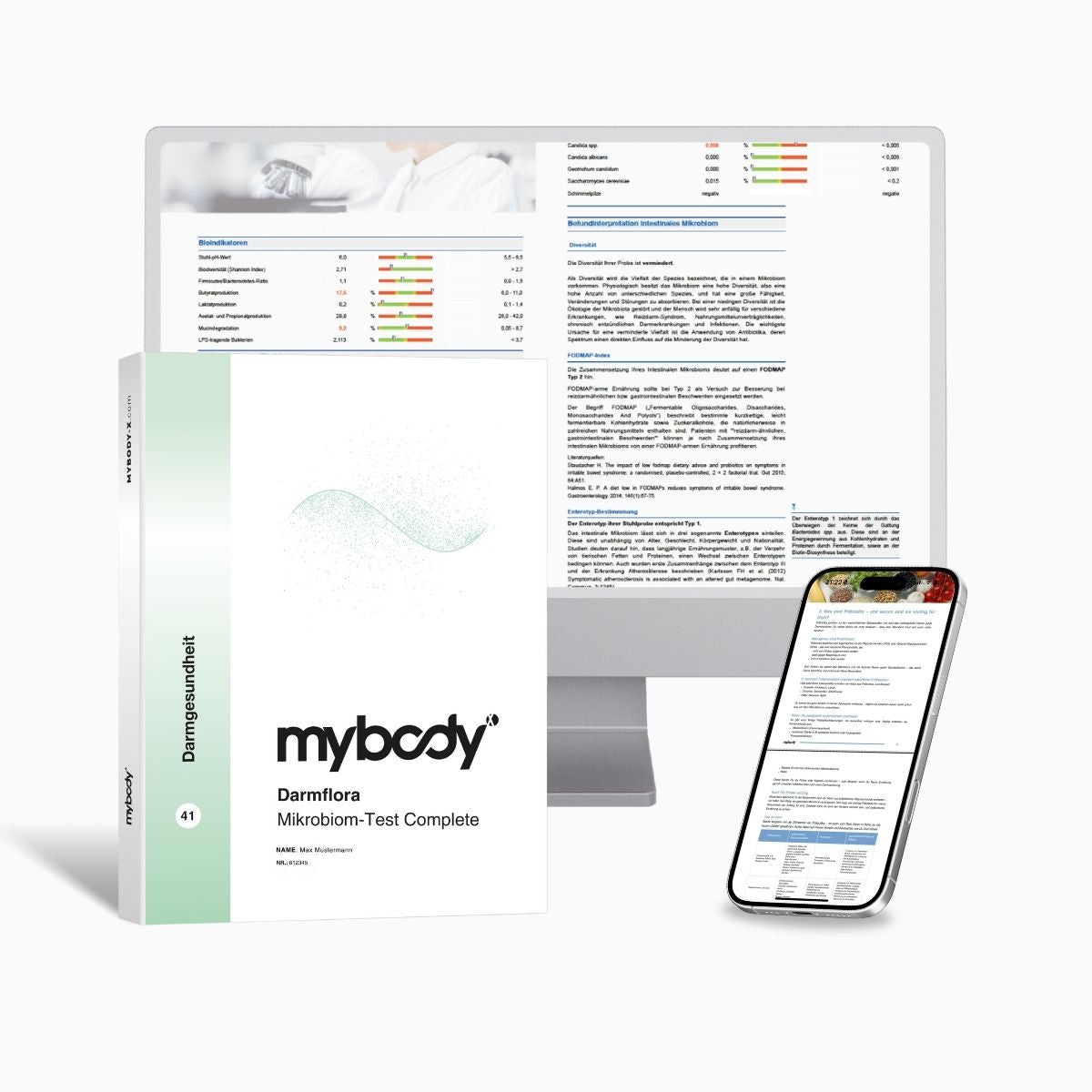
Gut Flora MICROBIOME Test Complete
Using DNA sequencing, the test determines more than 1,500 bacterial species and assesses bacterial diversity, the ratio of protective to potentially harmful bacteria, and indications of dysbiosis. The report comprises around 15 pages and also includes a FODMAP index and enterotype classification. What the test does not do: It measures neither gut motility nor transit time and does not provide a diagnosis.
Price: €189.00 (instead of €219.00) · Sample type: Stool sample · Processing time: approx. 20–25 business days · Laboratory: ISO-certified laboratory analysis, ISO-27001
To the Complete microbiome testThose who initially want only an overview of the composition of the gut flora will find the Basic version to be the more affordable entry-level option with a shorter report.
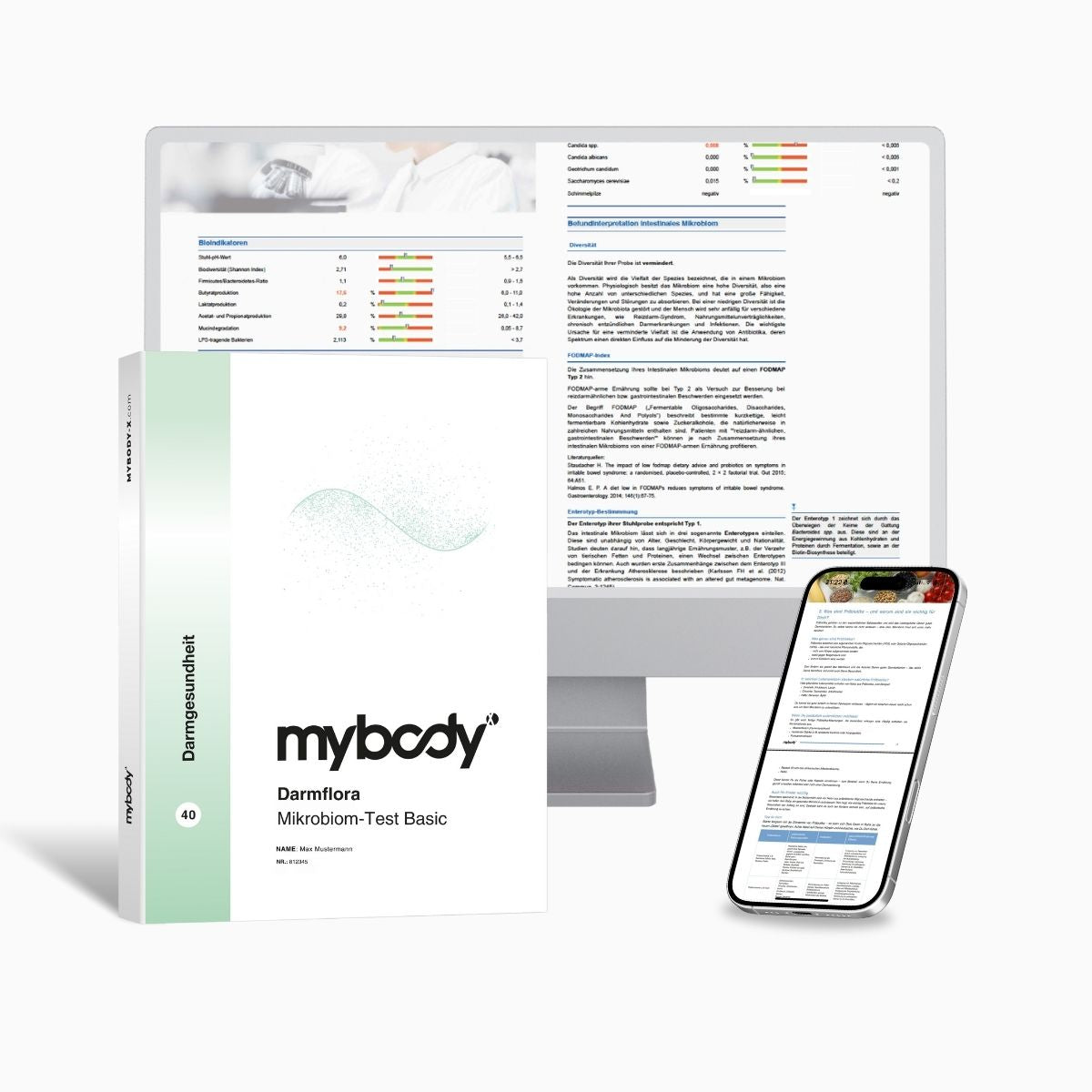
Gut Flora MICROBIOME Test Basic
The entry-level version describes the composition of the gut flora, the ratio of protective to potentially harmful bacteria, the intestinal environment based on the pH value, fungal colonization, and indications of dysbiosis; the report also comprises around 15 pages. This test likewise measures neither gut motility nor transit time and is not a diagnostic procedure.
Price: €139.00 · Sample type: Stool sample · Processing time: approx. 20–25 business days · Laboratory: ISO-certified laboratory analysis, ISO-27001
To the Basic microbiome testAll price and service information is current as of July 28, 2026. Prices and processing times may change; the respective product page is always authoritative.
In brief
An analysis of the gut flora from a stool sample describes which bacteria live in the gut and their relative proportions. It measures neither the speed of intestinal transit nor gut motility and does not replace medical diagnosis. mybody® (MYBODY Lab GmbH) offers two variants: the Complete test for €189.00 and the Basic test for €139.00. Both are analyzed in an ISO-certified laboratory, and processing takes approximately 20 to 25 business days.
What self-help measures and a test cannot do
A four-week plan is not a treatment method. It changes the conditions under which the gut works—nothing more. Whether it works cannot be promised in advance.
Fiber supplements are not a substitute for food
According to IQWiG (2023), it has not been established that additional fiber supplements help. This statement refers to irritable bowel syndrome, but it is important for setting expectations: Powder does not replace a high-fiber diet.
Laxatives: described, not recommended
Laxatives are medicines that force bowel movements. This article therefore describes them, does not recommend them, and deliberately does not specify dosages or active ingredients for self-use.
If you are considering using a laxative, this is the point at which medical or pharmaceutical advice is advisable—especially for prolonged use and if you have existing conditions or take other medications.
Probiotics: well tolerated, but no promise
According to IQWiG (2023), probiotics are generally well tolerated; mild side effects such as bloating occur only rarely. However, good tolerability does not demonstrate effectiveness for sluggish digestion—and the reviewed source material does not support any further conclusions here.
What happens if nothing changes after four weeks?
If your digestion remains sluggish after four weeks of consistent implementation, that is a finding, not a failure. It should be discussed with a doctor, together with your notes from the four weeks.
It is also advisable to discuss any medications you take regularly, as well as pre-existing conditions. Sluggish digestion may be a symptom of an underlying issue—the assessment belongs in the hands of a doctor, not in a self-experiment.
Fiber, mucilage seeds, or physical activity: What does each lever achieve?
The plan’s three levers work differently and are supported by varying levels of evidence. The following overview compares them according to the same five questions.
| Criterion | Fiber from food | Flaxseed and psyllium | Physical activity |
|---|---|---|---|
| How does it work? | According to IQWiG (2026), a high-fiber diet softens the stool, increases stool volume, and stimulates digestion. | According to IQWiG (2026), they contain soluble fiber that binds water in the intestine—the same mechanism, in a more concentrated form. | IQWiG (2025) mentions regular physical activity together with dietary changes and fluid intake as ways to prevent constipation and excessive straining. |
| What is established? | According to DGE (2021), it affects transit time, stool volume and consistency, and the frequency of bowel movements. Regarding diverticular disease, IQWiG (2026) cites initial evidence from studies. | According to IQWiG (2025), studies provide evidence that plant-based products containing fiber, such as psyllium, may reduce the frequency of bleeding—the statement refers to hemorrhoids. | The WHO (2020) recommends 150 to 300 minutes of moderate or 75 to 150 minutes of vigorous aerobic activity per week — as a general health recommendation, not as a treatment for constipation. |
| What do you need to pay attention to? | Increase the amount slowly; otherwise, bloating may occur. Your fluid intake must increase accordingly: 1.5 to 2 liters per day (IQWiG, 2025). | According to IQWiG (2025), anyone taking psyllium seeds must pay particular attention to drinking enough. | The WHO (2020) also recommends muscle-strengthening activity on at least two days per week. Everyday walking counts too. |
| How long does it take to adjust? | In this plan, weeks 2 to 4, until reaching the DGE guideline value of at least 30 grams per day. | As a supplement from week 2 at the earliest — only once your fluid intake is reliably established. | Can be implemented immediately; in this plan, it is firmly incorporated into daily life in week 3. |
| Who is it unsuitable for? | According to IQWiG (2023), significant weight loss, blood in the stool, fever, or pallor require medical evaluation before any self-treatment. | Unsuitable until your fluid intake is reliably established — without sufficient fluids, taking it is not advisable according to IQWiG (2025). | For acute symptoms with fever or blood in the stool, the same rule applies: have them medically evaluated first (IQWiG, 2023). |
The overview shows a hierarchy: fiber from food is the broadest lever, exercise is the easiest to implement, and psyllium seeds are the targeted addition with the strictest condition. None of the three replaces the other two.
Conclusion
The best way to address sluggish bowels is through structure: regular mealtimes, 1.5 to 2 liters of fluids per day (IQWiG, 2025), gradually increasing fiber intake to the DGE guideline value of at least 30 grams per day (DGE, 2021), and regular exercise within the WHO recommendation of 150 to 300 minutes per week (WHO, 2020).
The specific recommendation is therefore: Start with week 1 of the plan in Chapter 4, write down two lines per day, and after four weeks evaluate the four observations from Chapter 1 — consistency, effort required, feeling of complete evacuation, and duration.
Two things are part of being honest: According to IQWiG (2023), blood in the stool, significant weight loss, fever, or pallor should be medically evaluated before you try anything yourself. And a microbiome analysis describes the composition of the gut flora, not the speed of your digestion.
Frequently asked questions
What helps with sluggish bowels first?
First, regular mealtimes and a fluid intake of 1.5 to 2 liters per day, as stated by IQWiG (2025), are worthwhile. Only then should you increase your fiber intake, because without sufficient fluids, fiber cannot bind water.
How often are bowel movements normal?
There is no universally applicable figure in the sources reviewed—therefore, this article does not provide one either. What matters is a persistent change from your own previous pattern in stool consistency, straining, and the sensation of complete evacuation.
How much do I need to drink if I eat more fiber?
According to IQWiG (2026), drinking enough fluids is recommended when following a high-fiber diet. IQWiG (2025) gives a specific figure elsewhere: 1.5 to 2 liters per day. As your fiber intake increases, your fluid intake should increase accordingly.
Are laxatives a solution for sluggish digestion?
Laxatives are medicines that force bowel evacuation. This article describes them, does not recommend them, and intentionally does not provide dosages. If you are considering using them, seek medical or pharmaceutical advice.
When should I see a doctor about sluggish digestion?
Seek medical attention immediately if you experience significant weight loss, blood in your stool, fever, or paleness: According to IQWiG (2023), these symptoms are more likely to indicate another intestinal disease, and blood in the stool should always be medically examined. A sudden, persistent change in bowel habits should also be evaluated.
Would you like to know how your gut flora is composed?
Once the basic measures are in place, you can have your gut flora analyzed from a stool sample at home if you are looking for additional information about bacterial diversity, the gut environment, and signs of dysbiosis. The analysis describes the composition of your gut flora and does not replace medical evaluation.
View Microbiome Test Complete All gut tests at a glanceYou may also be interested in
→ Pressure in the abdomen: causes, interpretation, and what helps
What may be behind a persistent feeling of pressure and when it should be medically evaluated.
→ The most reliable microbiome tests for your gut flora
How to recognize a reputable gut flora analysis and what conclusions it allows.
→ Gut encyclopedia: all bacteria and markers in your gut flora
Reference work with over 6,000 microbiome biomarkers—from protective bacteria and fiber degraders to the metrics in your report.
Sources
- IQWiG / gesundheitsinformation.de: Diverticular disease – How are chronic symptoms treated? (2026) — gesundheitsinformation.de
- IQWiG / gesundheitsinformation.de: What can you do yourself about hemorrhoids? (2025) — gesundheitsinformation.de
- German Nutrition Society (DGE): Reference values for dietary fiber (2021) — dge.de
- World Health Organization: Guidelines on Physical Activity and Sedentary Behaviour (2020) — ncbi.nlm.nih.gov
- IQWiG / gesundheitsinformation.de: Irritable bowel syndrome (2023) — gesundheitsinformation.de
- IQWiG / gesundheitsinformation.de: What helps with irritable bowel syndrome—and what does not? (2023) — gesundheitsinformation.de
The verbatim quote in Chapter 2, the description of a high-fiber diet, the classification of the evidence as initial findings from studies, the information on flaxseed and psyllium seeds, and the recommendation to drink enough when following a high-fiber diet are taken from [1]. The recommendation to drink 1.5 to 2 liters per day, the note on excessive straining, and the study references on psyllium are taken from [2]. The guideline value of at least 30 grams of fiber per day, the information on transit time, stool volume and consistency, and the protective effects are taken from [3]. The exercise recommendation is taken from [4]. Warning signs, the recommendation to have blood in the stool evaluated, the frequency of irritable bowel syndrome, and the reassurance regarding it are taken from [5]. The statements on fiber supplements and probiotic tolerability are taken from [6]. The information on stress and bowel function is taken from the IQWiG article “Unexplained physical symptoms (functional physical symptoms)” (2026), while the information on diet and the microbiome is taken from the DGE publication “Diet and the microbiome” (2021); both are identified directly at the relevant text passages. Product information is taken from the mybody® product pages, accessed on July 28, 2026. All other sources cited in the text are identified directly at the relevant passage by institution and year.

mybody® Editorial & Expert Team
Gut health Microbiome Dietary fiber Nutritional science
This article was created and medically reviewed by the mybody® Editorial and Expert Team. The team combines expertise in nutrigenetics, microbiome and gut science, blood test interpretation, nutritional science, and laboratory diagnostics.
Published on July 28, 2026 · Last updated on July 28, 2026
Medical information: This article is for general information only and does not replace medical advice, diagnosis, or treatment. Persistently sluggish digestion, a sudden change in bowel habits, blood in the stool, significant weight loss, fever, or pallor should be medically evaluated. Laxatives are described here but are neither recommended nor dosed. An analysis of the gut microbiome is not a diagnostic procedure.


Share now:
Build your microbiome: What the gut flora demonstrably influences—and what it doesn’t
Glutamate intolerance and the gut: What’s really behind symptoms after eating