

Intestinal inflammation: What should you eat—and what is better avoided?
The essentials at a glance
In cases of acute intestinal inflammation, the following are usually well tolerated: sufficient fluids, mild cooked foods such as potatoes, rice, or porridge, steamed vegetables, and low-fat sources of protein. Many affected people tolerate very fatty, heavily fried, very spicy, or very sugary foods, as well as alcohol, less well. How long this restricted diet is necessary depends on the cause.
The key distinction addressed in this guide is this: Acute intestinal inflammation is usually infectious in origin and generally resolves on its own. Chronic inflammatory bowel disease, such as Crohn’s disease or ulcerative colitis, on the other hand, occurs in flare-ups and requires ongoing medical care. No diet can cure chronic inflammatory bowel disease—nutrition can alleviate symptoms and help maintain nutritional status, but nothing more.
Read Chapter 2 first: It outlines the warning signs that require medical evaluation as a priority. Chapters 3 and 5 cover the practical aspects, Chapter 6 compares acute and chronic courses, Chapter 7 explains dietary fiber and FODMAPs—and Chapter 11 outlines the limitations of self-tests.
What to expect in this article
2. What should you eat if you have intestinal inflammation—and when should it be medically evaluated first?
3. Which foods are often well tolerated during an acute flare-up?
4. How common are chronic inflammatory bowel diseases?
5. How can you find out which foods you tolerate?
6. Acute or chronic: How does the diet differ?
7. What do dietary fibers do—and what are the benefits of a low-FODMAP diet?
8. What should you make of probiotics, gut cleanses, and dietary supplements?
9. Who can benefit from a microbiome analysis—and who cannot?
10. How mybody® can provide additional support
11. Classification: What a microbiome test can—and cannot—do
12. Conclusion
Frequently asked questions
Sources
What is intestinal inflammation—and what forms are there?
“Intestinal inflammation” is not a single disease, but a collective term for very different conditions. The only thing they have in common is that the intestinal lining has undergone inflammatory changes. What this means for nutrition depends entirely on which form is present.
For everyday purposes, a rough distinction is sufficient: acute inflammation, usually caused by pathogens and subsiding after a few days, and chronic inflammatory bowel diseases, which persist for years and occur in flare-ups. The two groups require completely different approaches.
Acute intestinal inflammation: usually infectious and temporary
Acute intestinal inflammation is often caused by viruses or bacteria and typically manifests as diarrhea, abdominal pain, and sometimes vomiting. It begins suddenly, quickly reaches its peak, and in many cases improves on its own within a few days.
Nutrition has a clearly limited role here: it should compensate for fluid and mineral loss and avoid placing additional strain on the intestines. It does not treat the underlying cause but serves as a supportive measure for a few days.
Chronic inflammatory bowel diseases: Crohn’s disease and ulcerative colitis
The second group is significantly more serious medically. The Institute for Quality and Efficiency in Health Care (IQWiG, as of 2026) puts it succinctly: “Crohn’s disease is a chronic inflammatory bowel disease.” Ulcerative colitis is also one of these conditions.
These conditions occur in flare-ups: periods of severe symptoms are followed by periods with few or no symptoms. According to IQWiG (2026), “during an acute Crohn’s disease flare-up, the main symptoms are abdominal pain and diarrhea.”
Key message: Acute, usually infectious intestinal inflammation generally resolves on its own after a few days—nutrition only provides support during this time. In contrast, a chronic inflammatory bowel disease such as Crohn’s disease or ulcerative colitis occurs in flare-ups and requires ongoing medical treatment. No diet can cure chronic inflammatory bowel disease.
How does this article differ from the related articles?
This guide deals exclusively with nutrition for inflammatory intestinal symptoms. If you are mainly experiencing upper abdominal discomfort shortly after eating, Nausea after eating is the relevant article. If cramp-like pain is the main symptom, you can find the explanation in Stomach pain after eating. How microbiome analyses work technically and how they differ is explained in The Most Reliable Microbiome Tests for Your Gut Flora.
What should you eat if you have intestinal inflammation—and when should it be evaluated first?
During acute intestinal inflammation, three things are especially important: drink enough, choose mild, low-fat foods, and eat small portions. Many people tolerate potatoes, rice, oatmeal, steamed vegetables, bananas, and low-fat protein sources such as low-fat quark or chicken broth well during this phase.
Just as important is what is often less well tolerated during this phase: very fatty and heavily fried foods, very spicy dishes, large amounts of sugar, alcohol, and, for some people, coffee as well. These are observations from experience, not prohibitions—and they do not apply equally to everyone.
This is precisely where a limitation is more important than any list of foods. In its overview of nutrition for bowel symptoms (as of 2023), IQWiG explicitly notes that individual reactions cannot be generalized.
“
“However, how people respond to certain foods is highly individual.”
Institute for Quality and Efficiency in Health Care (IQWiG)
gesundheitsinformation.de, “What helps with irritable bowel syndrome—and what does not?”, as of 2023
This sentence comes from the context of irritable bowel syndrome, but it applies just as much to inflammatory bowel symptoms: Two people with the same diagnosis often tolerate different foods. That is why a general list is always only a starting point, never the final answer.
Which warning signs take priority over any dietary question?
Before changing your diet, another question needs to be clarified: Are your symptoms suitable for self-treatment at all? IQWiG (2023) identifies additional symptoms that indicate another bowel disease and require medical evaluation.
These signs belong in a doctor’s office, not in a nutrition plan
- ✓ Significant weight loss – according to IQWiG (2023), unintentional weight loss is an indication of another bowel disease.
- ✓ Blood in the stool – IQWiG (2023) states: “Blood in the stool should always be medically examined to clarify the cause.”
- ✓ Fever – fever is not part of the picture of a harmless digestive disorder.
- ✓ Pallor – it may indicate anemia and requires a blood test.
- ✓ Persistent vomiting, nighttime symptoms, or sudden severe pain – these call for prompt medical evaluation, not waiting.
According to IQWiG (2023), “additional symptoms such as significant weight loss, blood in the stool, fever, or pallor are more likely to indicate another bowel disease.” This assessment is why this article does not offer a remote diagnosis, but instead puts medical evaluation first.
Which foods are often well tolerated during an acute flare-up?
During an acute flare-up, a simple principle applies: simple ingredients, little fat, mild seasoning, thoroughly cooked, and served in small portions throughout the day. The goal is not to heal the bowel, but to minimize additional irritation and maintain energy and fluid intake.
The most important point is fluids. With diarrhea, the body loses water and minerals—that is why drinking regularly in small sips comes before any consideration of solid food.
What is often well tolerated during the acute phase
- ✓ Fluids in small amounts – water, unsweetened tea, clear broth; spread throughout the day instead of consuming a few large portions.
- ✓ Starchy staple foods – potatoes, rice, pasta, porridge, or rusks as the basis of the meal.
- ✓ Well-cooked vegetables – steamed carrots, zucchini, or fennel instead of raw.
- ✓ Low-fat sources of protein – chicken, lean fish, low-fat quark, or a softly boiled egg.
- ✓ Small, frequent meals – five to six small portions put less strain on the bowel than two large ones.
On the other hand, there are foods that often worsen symptoms during this phase: fried and heavily browned dishes, large amounts of cream or butter, very spicy seasonings, sugary drinks, and alcohol. Foods that cause a lot of gas, such as legumes or cabbage, are also often less well tolerated during a flare-up.
These restrictions are explicitly intended as a temporary solution. Keeping your food choices very limited over the long term carries the risk of missing important nutrients—and that is already an issue with inflammatory bowel diseases.
How common are chronic inflammatory bowel diseases?
Chronic inflammatory bowel diseases are less common than the attention given to the topic might suggest. This distinction is important because it prevents two misconceptions: jumping to a self-diagnosis on the one hand and dismissing persistent symptoms on the other.
Source: IQWiG, as of 2026 (Crohn’s disease), and the German Nutrition Society (DGE), as of 2021 (fiber)
According to IQWiG (as of 2026), an estimated 320 out of 100,000 people in Europe have Crohn’s disease. Accordingly, around 3 to 6 out of 100,000 people develop it each year.
For comparison: For irritable bowel syndrome, which is not an inflammatory disease, IQWiG (2023) gives a significantly different figure—estimates suggest that 10 to 20 out of 100 people have irritable bowel syndrome. Persistent abdominal discomfort is therefore far more common than chronic inflammatory bowel disease.
The third figure in the strip belongs in a different context: In its reference values (as of 2021), the German Nutrition Society (DGE) gives adults a guideline of at least 30 g of fiber per day. This value applies to the healthy general population—it is explicitly not the goal during an acute flare-up.
How can you find out which foods you tolerate?
Because individual reactions vary widely according to IQWiG (2023), systematic observation is essential. A structured approach provides more reliable insights than relying on how you feel afterward—and it prevents your food choices from becoming unnecessarily restrictive.
Prioritize medical evaluation
If you have weight loss, blood in the stool, fever, or pallor, seek medical evaluation first (IQWiG, 2023)—only then address your diet.
Document for two weeks
Record meals, times, symptoms, and bowel movements. Without documentation, every connection remains a supposition.
Test individually
Eliminate and reintroduce suspected foods one at a time—never five at once, or the result cannot be attributed to a specific food.
Seek professional guidance
Longer elimination diets should be undertaken with nutritional therapy support because of the risk of malnutrition (IQWiG, 2023).
This approach has an additional benefit: It reveals when no food is actually the trigger. Symptoms are often also related to eating speed, portion size, lack of sleep, or stress—factors that are overlooked in a food diary alone.
The time frame is also important. Two weeks of documentation are enough to identify initial patterns; anyone who continues eliminating foods for months without improvement is more likely to worsen their nutrient intake than their symptoms.
Acute or chronic: How does the diet differ?
The following overview compares acute, usually infectious intestinal inflammation with inflammatory bowel disease according to the same four criteria. It is the core of this article: Almost every misconception about the topic arises because the two forms are conflated.
| Criterion | Acute intestinal inflammation | Inflammatory bowel disease |
|---|---|---|
| Typical course | Sudden onset, usually triggered by an infection, and generally subsides within a few days | Progresses over years in flare-ups, with periods of few symptoms in between (IQWiG, as of 2026) |
| Symptoms | Diarrhea, abdominal pain, and sometimes vomiting—limited in duration | According to IQWiG (2026), an acute Crohn’s disease flare-up “mainly causes abdominal pain and diarrhea”; weight loss and exhaustion are also common. |
| Role of diet | Supportive for a few days: replace fluids, eat mild, low-fat foods, and have small portions | Long-term support: alleviating symptoms and maintaining nutritional status. No diet can cure the disease |
| Medical treatment necessary? | Often not—but essential in cases of blood in the stool, fever, pallor, or significant weight loss (IQWiG, 2023) | Yes, permanently and under medical supervision. Diet complements treatment; it does not replace it. |
The practical conclusion from the table is this: In acute intestinal inflammation, diet is the most important tool at your disposal for a few days. In inflammatory bowel disease, it is one component alongside medical treatment—a helpful one, but not the decisive factor.
In its overview of Crohn’s disease, IQWiG (as of 2026) does not name any diet that has been conclusively shown to influence existing chronic inflammatory bowel disease. It describes a generally beneficial diet “with plenty of vegetables and as few animal products and highly processed foods as possible”—as a general recommendation, not as treatment.
What does fiber do—and what are the benefits of a low-FODMAP diet?
Fiber is a key component of a gut-friendly diet in the long term—but is often poorly tolerated during an acute flare. This apparent contradiction is resolved by considering the time frame: The guideline describes everyday life, not the acute phase.
The German Nutrition Society (DGE) describes how fiber works in its reference values (as of 2021): “Fiber—also known as dietary fiber—influences the transit time of food through the stomach and intestines, the volume and consistency of stool, and the frequency of bowel movements.”
Regarding the benefits in everyday life, the DGE (2021) states: “Increased fiber intake has protective effects against cardiovascular disease, type 2 diabetes, obesity, high blood pressure, colon and breast cancer, as well as the risk of death.” The guideline is at least 30 g per day for adults.
In the acute phase, this value is not the benchmark. It is more sensible to gradually rebuild intake after the symptoms have subsided—and through foods, not supplements: IQWiG (2023) notes that additional fiber supplements have not been shown to help.
What is a low-FODMAP diet—and who is it suitable for?
FODMAP stands for a group of carbohydrates that are poorly absorbed in the small intestine. IQWiG (2023) describes the suspected mechanism as follows: “It is thought that consuming FODMAPs causes more water to enter the intestine and may promote diarrhea.”
This approach has been studied primarily for irritable bowel syndrome, not as a treatment for inflammatory bowel diseases. Therefore, anyone with chronic inflammatory bowel disease should never view a low-FODMAP phase as a substitute for medical treatment, but at most as an attempt to alleviate individual symptoms.
And the approach comes with a clearly stated cost. IQWiG (2023) writes verbatim: “However, there is a risk of malnutrition because it becomes difficult to consume enough vitamins and minerals.” An elimination diet without professional guidance is not a gentle experiment, but an intervention in nutrient intake.
An elimination diet without professional guidance is not a gentle experiment, but an intervention in nutrient intake.
In practical terms, a low-FODMAP diet should be temporary and accompanied by nutritional therapy. It is not a permanent diet, and the subsequent reintroduction of the food groups is just as important as the elimination phase itself.
Key message: The recommended fiber intake of at least 30 g per day (DGE, as of 2021) describes a symptom-free everyday diet, not an acute flare. According to IQWiG (2023), a low-FODMAP diet carries a risk of malnutrition and should therefore be followed for a limited period under professional guidance.
What should you make of probiotics, gut-cleansing programs, and dietary supplements?
There is a large market for cleansing programs, powders, and capsules aimed at inflammatory bowel symptoms. The honest answer is that many of these products lack evidence of effectiveness—and this is not a minor detail but the central point.
Regarding probiotics, IQWiG (2023) at least describes their tolerability: “In general, probiotics are well tolerated: only mild side effects such as bloating occur rarely.” Good tolerability, however, is not the same as a proven benefit for inflammatory bowel disease.
The statement is even clearer regarding fiber supplements. IQWiG (2023) states: “It has not been demonstrated that additional fiber supplements help.” Anyone wishing to increase their fiber intake should preferably do so through food.
The German Nutrition Society (DGE) takes a similarly clear position on cleansing programs: “There is currently no scientific evidence for the effectiveness of so-called cleansing or detox diets.” This assessment comes from the DGE’s evaluation of detox diets (DGEinfo, 2018).
There is, however, one situation in which supplementation may be medically appropriate: when a chronic inflammatory bowel disease has been shown to cause nutrient deficiencies, for example because absorption is impaired in the inflamed intestine. This decision belongs in the hands of a doctor and should be based on measured values, not assumptions.
In brief
According to IQWiG (2023), probiotics are generally well tolerated, but this does not establish a proven benefit for inflammatory bowel disease. According to IQWiG (2023), the benefit of additional fiber supplements has not been demonstrated, and according to the DGE (2018), there is no scientific evidence for detox or cleansing diets. Supplements make sense when a deficiency has been medically confirmed—not as a preventive regimen.
Who can benefit from a microbiome analysis—and who cannot?
A microbiome analysis describes which bacteria can be detected in a stool sample and the proportions in which they occur. It therefore answers a completely different question from “Is my gut inflamed?”—and this distinction determines whether such a test is even suitable for you.
A microbiome test does not detect intestinal inflammation. It does not provide a diagnosis and cannot establish the presence of inflammatory bowel disease, an infection, a tumor, or celiac disease. This point is deliberately made before considering any potential benefits.
Useful for you if …
… you have already undergone medical evaluation and now want to develop your diet in a structured way.
… you are looking for a snapshot of your bacterial diversity and the ratio of protective to potentially problematic microbes.
… you are interested in a FODMAP index or your enterotype as additional guidance for selecting foods.
… you want to discuss the results with your doctor or a nutrition professional instead of interpreting them on your own.
Not recommended if …
… you have acute warning signs: Blood in the stool, fever, significant weight loss, or pallor require medical evaluation (IQWiG, 2023). A self-test does not take priority here.
… you want to know whether intestinal inflammation is present. A microbiome test does not detect inflammation and does not provide a diagnosis.
… you hope it will replace treatment. In Crohn’s disease or ulcerative colitis, no analysis or diet can replace medical treatment.
… you need an answer quickly: The evaluation takes approximately 20 to 25 business days after the sample is received.
The honest conclusion: A microbiome analysis is an add-on for nutrition planning, not a diagnostic tool. It can provide guidance after medical evaluation—but it can never anticipate or replace it.
How mybody® can provide complementary support
mybody® (MYBODY Lab GmbH) offers this complementary perspective through a microbiome analysis based on a stool sample. The analysis is performed in an ISO-certified laboratory, data processing is organized according to ISO 27001 and complies with the GDPR.
Important for interpreting this article: The test is expressly intended to complement medical evaluation, not to replace it. If intestinal inflammation is suspected, consulting a doctor is the first step.
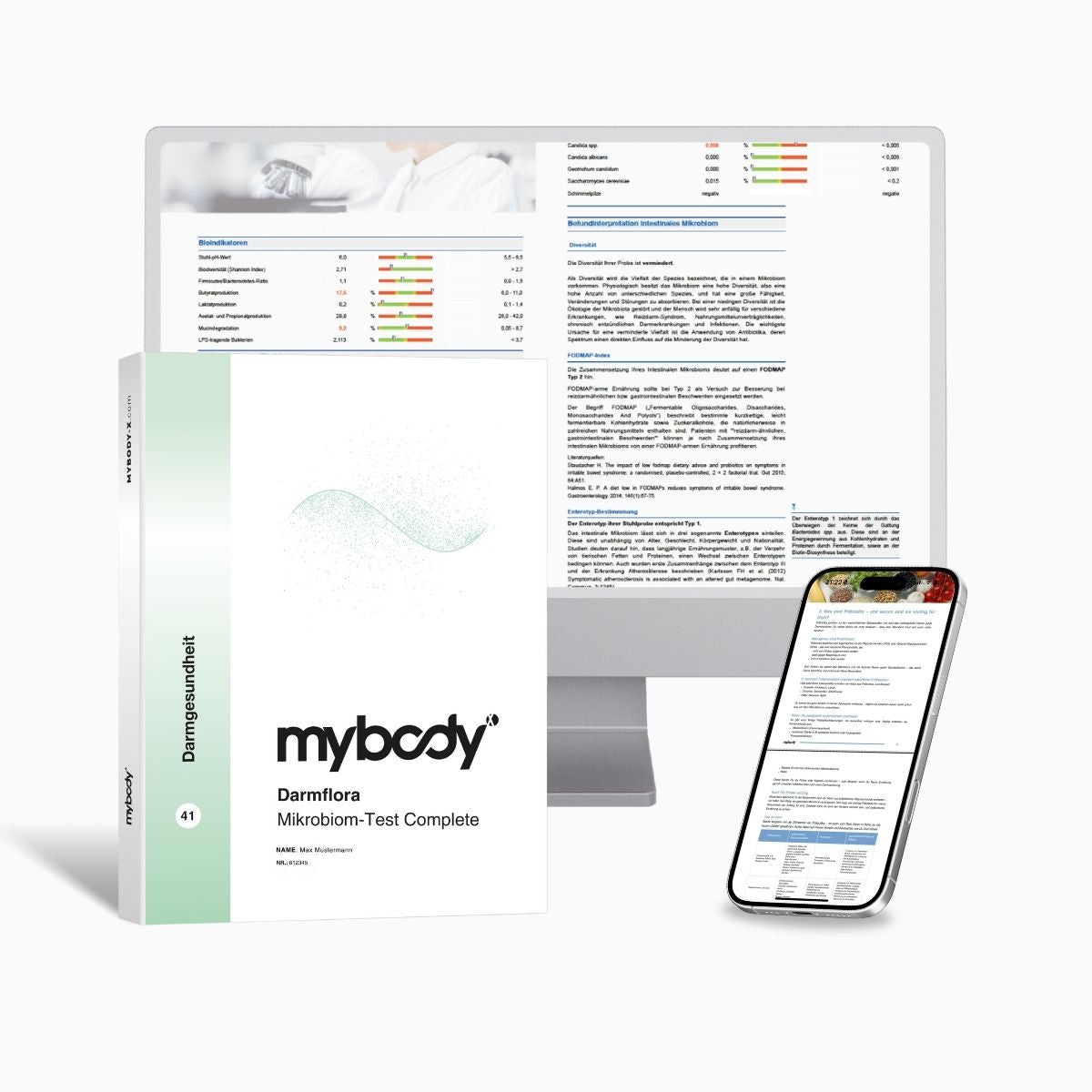
Darmflora MIKROBIOM-Test Complete
The Darmflora MIKROBIOM-Test Complete analyzes a stool sample using DNA sequencing for more than 1,500 bacterial species and summarizes the results in a report of around 15 pages—with information on bacterial diversity, the ratio of protective to potentially problematic microbes, indications of dysbiosis, a FODMAP index, and an enterotype classification.
The test explicitly does not include a diagnosis: It does not detect intestinal inflammation, chronic inflammatory bowel disease, infection, or a tumor. It does not replace a medical examination or medical treatment.
Price: €189.00 (instead of €219.00) · Sample type: Stool sample · Processing time: approx. 20–25 business days after receipt of the sample · Laboratory: ISO-certified laboratory analysis, ISO 27001
Go to the Complete Gut Flora MICROBIOME TestPrice information as of July 28, 2026. Prices, report scope, and processing times may change—the linked mybody® (MYBODY Lab GmbH) product page is always authoritative.
The article Gut microbiome tests: Microbiome analysis meets practical recommendations for action explains how to translate the results of a microbiome analysis into concrete everyday steps.
Putting it into perspective: What a microbiome test can—and cannot—do
A microbiome test describes a snapshot of the bacterial composition in stool. This limitation gives rise to five important boundaries, particularly for an article about intestinal inflammation.
First, a microbiome test does not detect intestinal inflammation. Whether the intestinal lining is inflamed is determined through medical examinations—for example, blood and stool laboratory tests, ultrasound, or a colonoscopy, the necessity of which is assessed by a doctor.
Second, a microbiome test does not provide a diagnosis. Neither Crohn’s disease nor ulcerative colitis, neither an infection nor celiac disease, can be identified based on the composition of the gut microbiome.
Third, neither a test nor a dietary approach replaces medical treatment for chronic inflammatory bowel disease. Diet can alleviate symptoms and help maintain nutritional status—but it cannot cure these conditions.
Fourth, the result is a snapshot. The composition of the gut microbiome changes with diet, medication, and illness; a single report describes the time of sampling, not a permanent state.
And fifth, medical evaluation takes priority without exception. If there is blood in the stool, fever, significant weight loss, pallor, persistent vomiting, or sudden severe pain, the doctor’s office is the first step—not the shopping cart.
Conclusion
For acute intestinal inflammation, the answer to the dietary question is straightforward: drink plenty of fluids, eat mild, low-fat foods in small portions, and gradually reintroduce more variety once the symptoms subside. This gentle approach is a measure for days, not months.
Chronic inflammatory bowel disease follows a different logic. According to IQWiG (as of 2026), an estimated 320 out of 100,000 people in Europe have Crohn’s disease, with 3 to 6 new cases per 100,000 people added each year—and no dietary pattern has been proven to cure these conditions. Diet alleviates symptoms and ensures nutrient intake; treatment is managed by the doctor.
For everyday life, three evidence-based guidelines remain: the recommended intake of at least 30 g of fiber per day during symptom-free periods (DGE, as of 2021), the risk of malnutrition with a low-FODMAP diet (IQWiG, 2023), and the warning signs for which medical evaluation takes priority.
Once your symptoms have been assessed by a doctor and you want to continue developing your diet in a structured way, a microbiome analysis may provide additional insights. It is a supplement—the first step remains medical evaluation.
Frequently asked questions about nutrition for intestinal inflammation
What should you eat with intestinal inflammation?
During the acute phase, mild, low-fat, and well-cooked foods are usually tolerated: potatoes, rice, pasta, porridge, steamed vegetables, and low-fat sources of protein—along with sufficient fluids in small portions. However, IQWiG (2023) points out that reactions to individual foods vary greatly from person to person. A general list is therefore a starting point, not a plan.
Which foods are often less well tolerated with intestinal inflammation?
Very fatty and heavily fried foods, very spicy dishes, large amounts of sugar, alcohol, and highly gas-producing foods such as legumes or cabbage are often mentioned. These are based on personal experiences and are not universally applicable prohibitions: According to IQWiG (2023), people react very differently to individual foods.
Can changing your diet cure Crohn’s disease or ulcerative colitis?
No. No dietary pattern cures a chronic inflammatory bowel disease. Diet can alleviate symptoms and maintain nutritional status, but it does not replace medical treatment. According to IQWiG (as of 2026), its overview of Crohn’s disease does not identify any diet proven to influence an existing condition; it only describes a generally beneficial diet rich in vegetables and low in highly processed foods.
Can a microbiome test detect intestinal inflammation?
No. A microbiome test describes the composition of the gut flora in a stool sample. It does not detect intestinal inflammation, identify Crohn’s disease or ulcerative colitis, an infection, a tumor, or celiac disease, and it does not provide a diagnosis. It can supplement a medical evaluation but can never replace one.
When should I see a doctor about intestinal symptoms?
According to IQWiG (2023), “additional symptoms such as significant weight loss, blood in the stool, fever, or pallor are more likely to indicate another intestinal disease.” Blood in the stool should therefore always be examined by a doctor. The same applies to persistent vomiting, nighttime symptoms, sudden severe pain, and symptoms that persist for weeks.
Would you like to assess your gut flora as a supplement to a medical evaluation?
The Complete Gut Flora MICROBIOME Test analyzes a stool sample using DNA sequencing for over 1,500 bacterial species and provides a report of around 15 pages, including a FODMAP index and enterotype determination. Results are available approximately 20–25 business days after the sample is received. The test does not detect intestinal inflammation or provide a diagnosis.
Go to the Complete Gut Flora MICROBIOME Test All gut health testsYou may also be interested in
→ The most reliable microbiome tests for your gut flora
How to recognize the quality of a microbiome analysis—and what differences there are between the methods.
→ Gut flora tests: microbiome analysis meets practical recommendations
How to translate test results into concrete steps for diet and everyday life.
→ Gut flora encyclopedia: all bacteria and markers of your gut microbiome
Reference guide with over 6,000 microbiome biomarkers—from beneficial bacteria and fiber fermenters to the metrics in your report.
Sources
- Institute for Quality and Efficiency in Health Care (IQWiG): Crohn’s disease (as of 2026)
- Institute for Quality and Efficiency in Health Care (IQWiG): What helps with irritable bowel syndrome—and what doesn’t? (as of 2023)
- Institute for Quality and Efficiency in Health Care (IQWiG): Irritable bowel syndrome (as of 2023)
- German Nutrition Society (DGE): Reference values for nutrient intake: dietary fiber (as of 2021)
- German Nutrition Society (DGE): Detox diets, DGEinfo 3/2018 (2018)
The information on Crohn’s disease—frequency, new cases, symptoms during a flare, and the role of diet—is based on [1]. The institute quotation and the statements on FODMAP, the risk of malnutrition, fiber supplements, and probiotic tolerability are from [2]. The warning signs and figures on irritable bowel syndrome are from [3], while the reference values for fiber and their description of effects are from [4]. The assessment of detoxification and detox diets is based on [5]. All other sources cited in the text are identified directly at the relevant point by institution and year. All product information on mybody® (MYBODY Lab GmbH) comes from the official product pages at mybody-x.com (as of July 28, 2026).

mybody® Editorial & Expert Team
Gut health Microbiome Nutritional science Laboratory diagnostics Digestion
This article was created and medically reviewed by the mybody® editorial and expert team at MYBODY Lab GmbH. The team combines expertise in nutritional science, laboratory diagnostics, blood analysis interpretation, microbiome and gut research, and nutrigenetics. Learn more about the people behind it on the mybody® authors’ page.
Published on July 28, 2026 · Last updated on July 28, 2026
Medical notice: This article is intended for general information and does not replace medical advice, diagnosis, or treatment. Self-tests provide indications, not diagnoses; a microbiome test does not detect intestinal inflammation. If you have blood in your stool, fever, significant weight loss, paleness, persistent vomiting, nighttime symptoms, or sudden severe pain, please contact a doctor immediately. If you have a known chronic inflammatory bowel disease, discuss dietary changes, elimination diets, and nutritional supplements with your treating medical practice in advance.




Share now:
Nausea After Eating: The Most Common Causes and What Really Helps
Stomach pain after eating: What causes it and what you can do