

Glutamate intolerance and the gut: What is really behind symptoms after eating
The essentials at a glance
Glutamate intolerance, in the sense of a consistently demonstrable reaction to the flavor enhancer, has not been scientifically substantiated. As early as 2003, the German Federal Institute for Risk Assessment (BfR) reported that extensive investigations had failed to confirm the existence of Chinese restaurant illness. Symptoms after eating are nevertheless real—their cause is simply usually something else.
This article puts the term into perspective rather than confirming or dismissing it. It explains what the BfR’s 2003 risk assessment actually says, which explanations for stomach pain, bloating, or diarrhea after a meal are much more likely, and how to monitor your symptoms in a way that makes them useful in a medical consultation.
Chapter 1 explains the term; Chapter 2 compares glutamate, lactose intolerance, and irritable bowel syndrome. Chapter 3 identifies warning signs that mean self-monitoring is no longer sufficient. Chapter 4 quotes the BfR from 2003 verbatim, Chapter 6 clears up two common misconceptions, and Chapter 9 explains openly what a test cannot do in this context.
What to expect in this article
1. What is glutamate—and what is behind the term glutamate intolerance?
2. Glutamate, lactose intolerance, or irritable bowel syndrome: Which explanation fits?
3. What symptoms are attributed to glutamate—and when should they be investigated?
4. What did the German Federal Institute for Risk Assessment (2003) say about glutamate?
5. How can you find out what is causing your symptoms?
6. Which myths persist about Chinese restaurant syndrome?
7. What role does the gut microbiome play in symptoms after eating?
8. How mybody® classifies the issue
9. Putting it into perspective: What a test can—and cannot—do
10. Conclusion
Frequently asked questions
Sources
What is glutamate—and what is behind the term glutamate intolerance?
Glutamate is the salt of glutamic acid, an amino acid. Amino acids are the building blocks of protein, which is why glutamic acid naturally occurs in protein-rich foods. In processed foods, monosodium glutamate is also used as a flavor enhancer and must be declared on the label.
The term glutamate intolerance describes the assumption that this particular additive regularly causes physical symptoms. This assumption is widespread, but it has not been substantiated. The German Federal Institute for Risk Assessment examined it as early as 2003 and reached a different conclusion.
Where the term Chinese restaurant syndrome comes from
The debate has a specific starting point. According to the 2003 statement by the German Federal Institute for Risk Assessment (BfR), it states verbatim: “Since the occurrence of hypersensitivity reactions after consuming food in Chinese restaurants was first described in 1968, monosodium glutamate has repeatedly been suspected of being the causative agent of this so-called ‘Chinese restaurant syndrome.’”
Thus, an observation from 1968 became an established term over the course of decades. The suspicion was the starting point of the research—not its result. In everyday use of the word, this exact sequence is usually lost.
Why “intolerance” is an imprecise term here
With genuine intolerances, it is possible to describe what happens in the body. In lactose intolerance, the process is known: If an adult consumes more lactose than the enzyme lactase can break down, the remainder reaches the large intestine, where it is broken down by intestinal bacteria. According to IQWiG (2024), this produces increased amounts of gases such as carbon dioxide and hydrogen, as well as fluid and fatty acids in the intestine, which cause the typical symptoms.
Gluten intolerance in the sense of celiac disease involves a different, but likewise described, mechanism: an immune-system reaction to a grain protein. Here, too, recognized diagnostic procedures are available in medical practice.
There is no comparably described mechanism or recognized test procedure for a reaction to glutamate. The word intolerance therefore suggests a degree of clarity that the available data do not support.
Key message: Lactose intolerance and celiac disease have a described mechanism and recognized diagnostic procedures—but according to the BfR statement from 2003, there is neither a confirmed condition nor a test procedure for glutamate intolerance.
Glutamate, lactose intolerance, or irritable bowel syndrome: Which explanation fits?
Anyone who regularly experiences abdominal discomfort after eating looks for an explanation—and the flavor enhancer is a convenient one. The following overview compares three possible explanations using the same five questions. All information comes from the 2003 BfR statement and IQWiG patient information.
| Criterion | Reaction to glutamate | Lactose intolerance | Irritable bowel syndrome |
|---|---|---|---|
| What happens in the body? | No regular mechanism has been described. Reactions were observed only under atypical conditions after consuming 3 g or more of monosodium glutamate on an empty stomach (BfR, 2003). | Undigested lactose reaches the large intestine and is broken down by intestinal bacteria; this produces gases, fluid, and fatty acids (IQWiG, 2024). | Hypothesized factors include hypersensitive intestinal nerves, disturbances of the intestinal muscles, changes in the gut flora, and inflammation of the intestinal wall (IQWiG, 2023). |
| How well is the connection substantiated? | Not confirmed: Extensive studies by English, Italian, and American authors were unable to confirm the existence of Chinese restaurant syndrome (BfR, 2003). | Well described: The process in the intestine is known, and the intolerance can be measured with a breath test (IQWiG, 2024). | Recognized as a clinical condition, but its causes have not yet been conclusively clarified (IQWiG, 2023). |
| How common is it? | No reliable frequency figure is available. BfR (2003) describes reactions in otherwise healthy individuals only under experimental conditions. | Approximately 5 to 15% of people in Europe are unable to tolerate lactose; in Africa or East Asia, the figure is 65 to over 90% of adults (IQWiG, 2024). | According to estimates, approximately 10 to 20 out of 100 people have irritable bowel syndrome (IQWiG, 2023). |
| How is it investigated? | No recognized testing procedure. Structured observation remains an option to prepare for a medical consultation. | Hydrogen breath test: After drinking a lactose solution, the hydrogen content of exhaled air is measured several times (IQWiG, 2024). | Medical evaluation. Blood in the stool should always be medically examined to clarify the cause (IQWiG, 2023). |
| What helps? | Those who feel better with less added glutamate can take this into account—the labeling requirement makes it possible to identify it (BfR, 2003). | Consume less lactose than the body is unable to break down (IQWiG, 2024). | According to IQWiG (2023), how people react to foods varies greatly from person to person; additional fiber supplements have not been proven effective. |
The table shows a difference in magnitude that rarely appears in public discussion. Frequency figures are available for two of the three explanations, but not for the third. According to IQWiG estimates (2023), approximately 10 to 20 out of 100 people have irritable bowel syndrome—a scale that accounts for many symptoms after eating.
The line about diagnostic evaluation is also noteworthy. For lactose, the hydrogen breath test is an established procedure that, according to IQWiG (2024), measures the hydrogen content of exhaled air several times after the person drinks a lactose solution. There is no such procedure for glutamate—neither in a doctor’s office nor as a self-test.
Which symptoms are attributed to glutamate—and when should they be investigated?
The symptoms most commonly attributed to flavor enhancers are those that occur shortly after a meal: abdominal pressure, bloating, nausea, abdominal pain, and sometimes headaches or a general feeling of discomfort. These symptoms are real. The question is not whether they exist, but what causes them.
Part of the attribution arises from the situation. Foods with added flavor enhancers are often eaten away from home, frequently in larger portions, often higher in fat or salt than meals prepared at home, and commonly together with alcohol. Each of these factors can promote symptoms on its own—the flavor enhancer is simply the easiest component to name in this situation.
How typical digestive symptoms can be described
To put things into perspective, it helps to name symptoms precisely. IQWiG (2023) literally lists “persistent abdominal or lower abdominal pain, cramps, and altered stool” as typical symptoms of irritable bowel syndrome.
Diarrhea is also clearly defined. According to IQWiG (2023), someone is considered to have diarrhea if they have very soft or watery stools at least three times within 24 hours. Diarrhea is often accompanied by abdominal pain, abdominal cramps, and bloating. In Germany, adults experience it on average once a year, while children become ill even more often.
IQWiG (2023) lists, among other things, noroviruses and rotaviruses, bacteria such as Salmonella and Campylobacter, unfamiliar food, food intolerances, irritable bowel syndrome, chronic inflammatory bowel diseases, and side effects of antibiotics as possible causes of diarrhea. A flavor enhancer does not appear on this list.
Warning signs: This is where self-observation ends
- ✓ Significant weight loss – According to IQWiG (2023), additional symptoms such as “significant weight loss, blood in the stool, fever, or pallor” are more likely to indicate another intestinal disease.
- ✓ Blood in the stool – IQWiG (2023) states clearly: “Blood in the stool should always be medically examined to determine the cause.”
- ✓ Fever or pallor – Both are among the signs mentioned by IQWiG (2023) that argue against a harmless functional explanation.
- ✓ Shortness of breath or swelling in the mouth and throat – Such reactions after eating are warning signs of an allergic reaction and require immediate medical evaluation.
- ✓ Circulatory problems after eating – The same applies here: seek immediate medical attention; do not monitor the symptoms yourself or try to verify them with a self-test.
These warning signs are not a reason to panic, but rather a shortcut. They save you weeks of self-observation in a situation where a medical examination will reach a conclusion more quickly and safely.
What does the German Federal Institute for Risk Assessment (2003) say about glutamate?
The central German assessment on this topic comes from the German Federal Institute for Risk Assessment and is titled “Hypersensitivity reactions caused by glutamate in food.” It dates from 2003 — this date is part of every statement because the document is correspondingly old.
“
“As long as labeling requirements are complied with, the BfR has no objections to the occasional use of small amounts of glutamate.”
German Federal Institute for Risk Assessment (BfR)
Statement “Hypersensitivity reactions caused by glutamate in food,” 2003
The sentence is deliberately cautious. It refers to the occasional use of small amounts and makes the assessment conditional on compliance with labeling requirements. This is not approval for arbitrary amounts and does not constitute a statement about highly processed diets as a whole.
What the evidence showed according to the BfR (2003)
Regarding whether the much-cited condition exists at all, the BfR reported in the same 2003 document that “extensive studies by English, Italian, and American authors … were unable to confirm the existence of Chinese restaurant syndrome.”
The description of the conditions under which reactions occurred at all is equally important. According to the BfR (2003), reactions in otherwise healthy individuals occurred “under atypical consumption conditions, i.e., after administration of large amounts of monosodium glutamate (3 g or more) on an empty stomach.”
This condition does not correspond to a normal meal. Three grams of pure monosodium glutamate on an empty stomach is an experimental setup, not dinner. Anyone eating a dish at a restaurant consumes glutamate together with protein, fat, carbohydrates, and liquid—and generally not on an empty stomach.
Key statement: According to the German Federal Institute for Risk Assessment (BfR, 2003), extensive studies by English, Italian, and American authors were unable to confirm the existence of Chinese restaurant syndrome; the reactions described occurred only under atypical consumption conditions, after 3 grams or more of monosodium glutamate had been consumed on an empty stomach.
How can you find out what is causing your symptoms?
The most useful step is structured observation over two weeks. It does not replace a diagnosis, but it turns a vague feeling into data that a doctor can work with. Four details for each episode of symptoms are enough.
What exactly did you eat?
Write down all the ingredients, not just the suspected one: dairy products, grains, legumes, onions, fat, alcohol, and the portion size.
How quickly did the symptoms appear?
Minutes, an hour, or only the following day? The time interval clearly helps distinguish between different causes.
What symptoms did you have?
Bloating, cramps, nausea, or changes in bowel movements—and how severe they were on a simple scale from one to ten.
Did it also occur without a flavor enhancer?
Prepare the same dish yourself without added glutamate: if the symptoms persist, the cause is very likely elsewhere.
The fourth point is the crucial one because it makes the suspicion testable in the first place. If the same meal without added flavor enhancer triggers the same symptoms, the flavor enhancer is effectively ruled out as an explanation—then the quantity, fat content, individual ingredients, or a functional cause become more likely.
Take this record to your doctor’s appointment. It is explicitly intended as preparation for the consultation and not for self-diagnosis. Two weeks of structured notes are more valuable for taking a medical history than saying you cannot tolerate glutamate.
This article deliberately addresses only the term glutamate intolerance and the evidence behind it. If severe bloating is your main problem, you can find the causes and countermeasures in the article Bloating: what to do?; if cramps and loose stools are the main symptoms, Abdominal cramps and diarrhea is the more appropriate article.
Which myths persist around Chinese restaurant syndrome?
Two assumptions appear particularly often in conversations about glutamate. Both can be assessed on the basis of the available sources—not through a counter-opinion, but through published assessments and figures.
The first myth persists because the terms are older than the evidence used to assess them. The suspicion was formulated in 1968, and the studies followed afterward—and the BfR assessment from 2003 states that the studies were unable to confirm the suspicion.
The second myth is primarily a calculation error. If two very common types of symptoms in the population are well documented, while there is not even a frequency estimate for the third explanation, the probabilities are clearly distributed. This does not make the flavor enhancer innocent—it simply makes it the least likely of the three candidates.
A third factor comes into play that does not require a number: expectation. If you are convinced that a particular dish does not agree with you, you pay especially close attention to your abdomen afterward. That is precisely why the comparison with the same dish without added glutamate from Chapter 5 is so useful.
What role does the gut microbiome play in symptoms after eating?
The gut microbiome has been demonstrably involved in symptoms after eating—but in a different way than the glutamate debate suggests. Bacteria in the large intestine break down what the small intestine has not absorbed, producing gases in the process.
IQWiG (2024) describes exactly this process in relation to lactose intolerance: Undigested lactose reaches the colon, where it is broken down by intestinal bacteria, producing increased amounts of gases such as carbon dioxide and hydrogen, as well as fluid and fatty acids. The hydrogen breath test uses precisely this process as a measurement.
What the DGE (2021) says about the connection between diet and the microbiome
In its statement “Nutrition and the Microbiome,” the German Nutrition Society (DGE, 2021) states: “Diet shapes the composition of bacteria — so it can be assumed that the type and amount of dietary fiber significantly influence the composition of the microbiome.”
In the same statement, the DGE (2021) also identifies what indicates a stable microbiome: “Bacterial diversity is considered a marker of a stable microbiome in healthy people.” It also describes the activity of protective bacteria: “Protective bacteria break down carbohydrates and produce short-chain fatty acids, especially butyrate.”
The time factor is important in practice. According to the DGE (2021), short-term dietary changes rapidly alter the gut microbiota, but these changes are reversible, while longer-term changes may continue to have an effect. Anyone wishing to make a change should therefore think in terms of months, not days.
Why elimination diets are not a good first step
When symptoms are unclear, many people initially eliminate entire food groups. With the FODMAP diet, for example, IQWiG (2023) suspects that consuming FODMAPs causes more water to enter the intestine and may promote diarrhea.
However, IQWiG (2023) explicitly points out a downside: “There is, however, a risk of malnutrition because it becomes difficult to take in enough vitamins and minerals.” Such an elimination diet should therefore be carried out with professional guidance and not independently based on suspicion.
Caution is also advisable with supplements. According to IQWiG (2023), it has not been established that additional fiber supplements help with irritable bowel syndrome. The same source states that probiotics are generally well tolerated and only rarely cause mild side effects such as bloating — this is a statement about tolerability, not effectiveness.
In brief
The gut microbiota contributes to the formation of gas and bloating because intestinal bacteria in the colon break down what the small intestine has not absorbed. According to the German Nutrition Society (DGE, 2021), the type and amount of dietary fiber in particular significantly influence the composition of the microbiome, and bacterial diversity is considered a marker of a stable microbiome. Nevertheless, elimination diets are not a good first step: IQWiG (2023) explicitly points out the risk of malnutrition with the FODMAP approach. These sources do not describe a connection between the gut microbiota and a reaction to glutamate.
How mybody® classifies the issue
mybody® (MYBODY Lab GmbH) offers at-home health tests that are evaluated in an ISO-certified laboratory, operate in compliance with the GDPR, and are interpreted by its in-house team of specialists. Nevertheless, there is a clear limitation when it comes to determining glutamate intolerance.
A microbiome test is not a test for a glutamate reaction. It examines the composition of the gut flora, not the body's reaction to an individual food additive. Anyone hoping for confirmation or reassurance regarding glutamate will be disappointed.
A microbiome test is not a test for a glutamate reaction.
A microbiome analysis can be useful in a different context: if, after medical evaluation, you want a structured look at your gut flora, such as bacterial diversity or the ratio of beneficial to potentially problematic microbes. This is an assessment of the current state, not an investigation into the cause of symptoms after a restaurant visit.
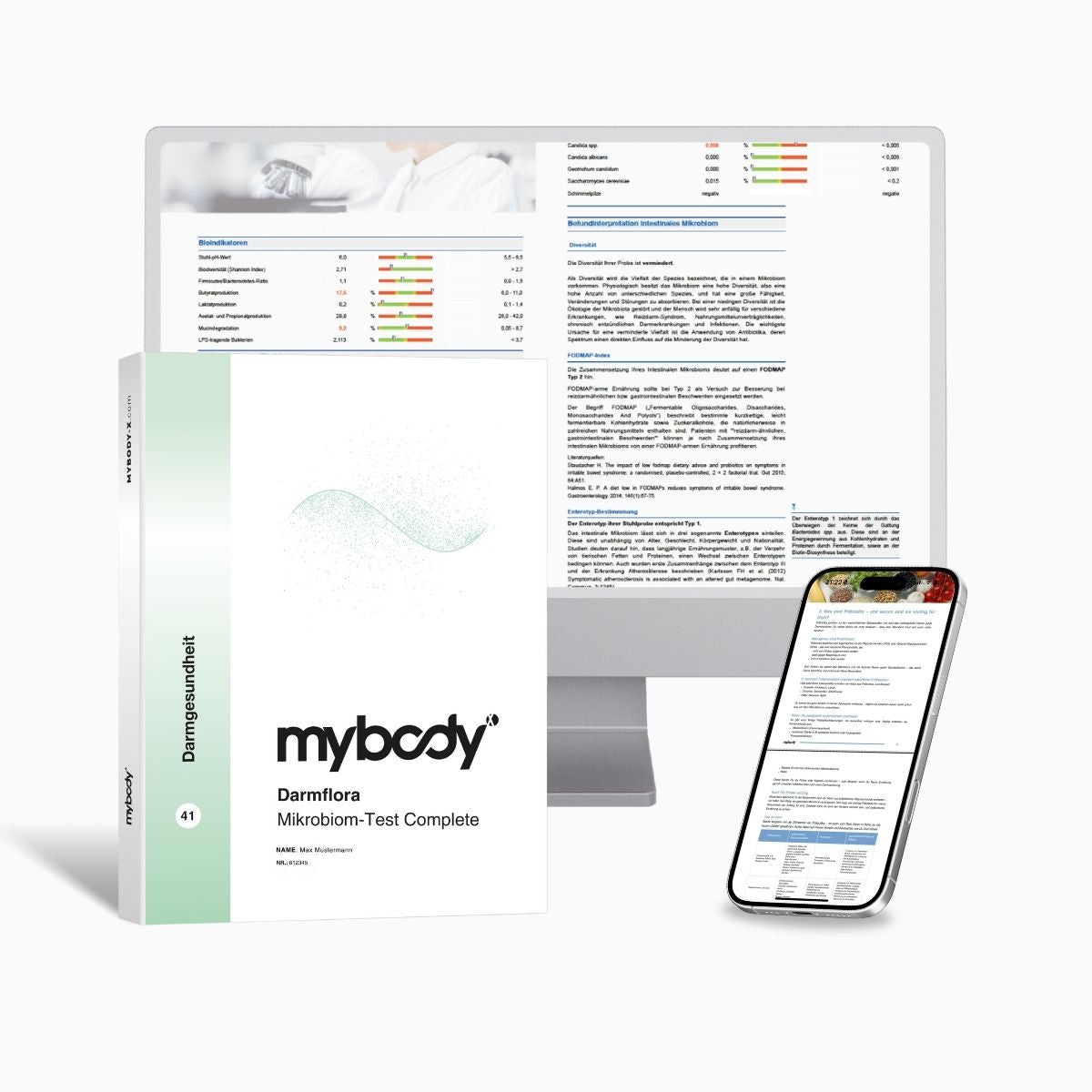
Gut Flora MICROBIOME Test Complete
From a stool sample, the test analyzes more than 1,500 bacterial species using DNA sequencing. The approximately 15-page report covers, among other things, bacterial diversity, the ratio of beneficial to potentially problematic microbes, indications of dysbiosis, as well as a FODMAP index and enterotype classification. Explicitly not included: detection of a glutamate reaction. This test cannot determine glutamate intolerance, nor can it diagnose conditions such as irritable bowel syndrome, celiac disease, or inflammatory bowel disease—those require medical evaluation.
Price: €189.00 (instead of €219.00) · Sample type: stool sample · Processing time: approx. 20–25 business days after receipt of the sample · Laboratory: ISO-certified laboratory analysis, ISO 27001, GDPR-compliant
About the Microbiome Test CompleteAll price and performance information is current as of July 28, 2026. Prices and processing times may change; the relevant product page always prevails.
Putting it into perspective: What a test can—and cannot—do
There is currently no test procedure that can detect glutamate intolerance—neither in a doctor's office nor as a self-test at home. Anyone who reads such a claim should be skeptical.
This explicitly also applies to IgG-based intolerance tests. They measure IgG antibodies against foods, not the body's reaction to a flavor enhancer. They are therefore not a suitable tool for investigating glutamate, and this article deliberately does not present them as a solution.
A self-test is not the standard for lactose intolerance either. IQWiG (2024) describes the hydrogen breath test, in which the hydrogen content of the breath is measured several times after drinking a lactose solution. mybody® does not offer a standalone lactose or fructose test product—this should be stated openly.
An honest assessment is also needed regarding the overall significance of microbiome analyses. The DGE statement “Nutrition and the Microbiome” (2021) reproduces an expert assessment that reads: “So far, I do not see how a specific diet can influence the microbiome in a clearly defined direction.” This sentence is presented as the assessment of an expert voice, not as an institutional position of the DGE—but it does show how cautiously the scientific community approaches targeted microbiome claims.
And finally: Symptoms without a clear finding are not imaginary. According to IQWiG (2026), an estimated 10% of the population has symptoms for which no clear explanation can be found—including gastrointestinal problems such as nausea, bloating, diarrhea, and constipation. The same source states: “However, this does not mean that the symptoms are merely imagined and that nothing can be done.”
Conclusion
Based on the available assessment, glutamate intolerance has not been established as an independent, regularly occurring clinical condition. As early as 2003, the German Federal Institute for Risk Assessment (BfR) stated that, provided labeling requirements are observed, there is no reason for concern about the occasional use of small amounts of glutamate. In the same document, it reported that extensive investigations had been unable to confirm the existence of Chinese restaurant syndrome.
Your symptoms remain valid regardless. If you regularly feel nauseous or have stomach pain after eating, that is a real problem—the available evidence simply suggests that the flavor enhancer is rarely the cause. Much more common are irritable bowel syndrome, affecting about 10 to 20 out of 100 people (IQWiG, 2023); lactose intolerance, affecting about 5 to 15% of people in Europe (IQWiG, 2024); and functional symptoms without a clear finding, affecting about 10% of the population (IQWiG, 2026).
The concrete next step: For two weeks, carry out the four notes from Chapter 5, test the same food once without added flavor enhancer, and take these records with you to the doctor’s office. If you experience significant weight loss, blood in the stool, fever, or pallor, skip the observation phase—these symptoms should be evaluated by a doctor immediately.
Frequently asked questions
Does glutamate intolerance actually exist?
It has not been established as a consistently demonstrable clinical condition. According to the German Federal Institute for Risk Assessment (BfR, 2003), extensive studies by English, Italian, and American authors could not confirm the existence of a Chinese restaurant illness. Individuals may still feel unwell after certain meals, but there are several possible explanations.
What is Chinese restaurant syndrome?
It is a historical term. According to BfR (2003), the occurrence of hypersensitivity reactions after eating meals in Chinese restaurants was described in 1968, and since then monosodium glutamate has repeatedly been suspected as the causative agent of this so-called Chinese restaurant syndrome. The suspicion was the starting point for the investigations, not their result.
What causes are more common than a reaction to glutamate?
Three explanations have substantially stronger evidence: irritable bowel syndrome, affecting approximately 10 to 20 out of 100 people (IQWiG, 2023); lactose intolerance, affecting approximately 5 to 15% of people in Europe (IQWiG, 2024); and functional physical symptoms, which according to IQWiG (2026) are estimated to affect around 10% of the population.
Can I get tested for glutamate intolerance?
No. There is no recognized procedure that can detect a reaction to glutamate — neither at a doctor's office nor as a self-test. IgG-based intolerance tests cannot do this either: they measure IgG antibodies against foods, not the reaction to a food additive. What remains is structured observation as preparation for a medical consultation.
How do I know that I need medical help?
According to IQWiG (2023), additional symptoms such as “significant weight loss, blood in the stool, fever or paleness” are more likely to indicate another intestinal disease; blood in the stool should always be medically examined to clarify the cause. Shortness of breath, swelling in the mouth and throat, or circulatory problems after eating are warning signs of an allergic reaction and require immediate medical attention.
Taking stock of your gut flora
If, after medical evaluation, you would like to take a structured look at your gut flora, you can find an overview of mybody®'s analyses here. A microbiome test does not replace a diagnosis and cannot detect a reaction to glutamate.
View the Microbiome Test Complete All gut tests at a glanceYou might also be interested in
→ Stomach pain after eating: causes and context
If the symptoms are mainly located in the upper abdomen, this article can help put them into context.
→ The most reliable microbiome tests for your gut flora
What matters in a gut flora analysis and what such tests cannot do.
→ Gut encyclopedia: all bacteria and markers in your gut flora
Reference guide with more than 6,000 microbiome biomarkers—from beneficial bacteria and fiber fermenters to the key measurements in your test results.
Sources
- German Federal Institute for Risk Assessment (BfR): Hypersensitivity reactions caused by glutamate in food (2003) — bfr.bund.de
- IQWiG / gesundheitsinformation.de: Irritable bowel syndrome (2023) — gesundheitsinformation.de
- IQWiG / gesundheitsinformation.de: What helps with irritable bowel syndrome—and what does not? (2023) — gesundheitsinformation.de
- IQWiG / gesundheitsinformation.de: Lactose intolerance (milk sugar intolerance) (2024) — gesundheitsinformation.de
- IQWiG / gesundheitsinformation.de: Unexplained physical symptoms (functional physical symptoms) (2026) — gesundheitsinformation.de
- German Nutrition Society (DGE): Report “Nutrition and the Microbiome” (2021) — dge.de
All statements concerning the assessment of glutamate, the term Chinese restaurant syndrome, the state of research, and the experimental conditions involving 3 grams of monosodium glutamate are based on [1]. The frequency and typical symptoms of irritable bowel syndrome, as well as the warning signs, are taken from [2]; information on FODMAPs, fiber supplements, and probiotics is from [3]. The mechanism, frequency, and hydrogen breath test for lactose intolerance are taken from [4], the information on functional physical symptoms from [5], and the statements on diet and the microbiome from [6]. The definition of diarrhea, accompanying symptoms, and list of causes are taken from the IQWiG information “Diarrhea” (as of February 8, 2023). Product information comes from the mybody® product pages, accessed on July 28, 2026. All other sources cited in the text are identified directly at the relevant point by institution and year.

mybody® editorial & specialist team
Gut health Food additives Intolerances Microbiome
This article was created and medically reviewed by the mybody® editorial and specialist team. The team combines expertise in nutrigenetics, microbiome and gut science, blood test interpretation, nutritional science, and laboratory diagnostics.
Published on July 28, 2026 · Last updated on July 28, 2026
Medical notice: This article is for general information only and does not replace medical advice, diagnosis, or treatment. Persistent symptoms after eating, significant weight loss, blood in the stool, fever or pallor, as well as shortness of breath, swelling in the mouth or throat, or circulatory problems should be medically evaluated. The cited statement from the German Federal Institute for Risk Assessment dates from 2003.




Share now:
Sluggish bowels: What you can do step by step for a sluggish bowel
Abdominal cramps and diarrhea: causes, immediate measures, and warning signs