
Detoxification: What lies behind the term and what really helps the body
The essentials at a glance
Detoxification describes the idea that the body stores “toxins” that can be removed again through a cleanse. This term does not come from physiology. According to the German Nutrition Society (DGE, 2018), there is still no scientific evidence for the effectiveness of so-called detox or cleansing diets. By contrast, simple everyday measures are supported by evidence.
People who want to detox rarely mean a theory; they usually mean a feeling: heavy, sluggish, bloated, tired. This article takes that feeling seriously. It explains where the term comes from, what the reviewed sources say about it, and which measures for digestion and metabolism are actually supported by evidence—with figures, institutions, and years.
Chapter 1 clarifies the term. Chapter 2 presents the evidence, and Chapter 3 covers warning signs indicating that a cleanse is no longer appropriate. Chapter 4 dispels two widespread assumptions, while Chapter 5 explains what the body does continuously anyway. Chapter 6 directly compares cleanses, long-term diets, and daily routines, and Chapter 7 examines fasting, enemas, Epsom salt, and detox teas.
What to expect in this article
1. What does “detox” actually mean?
2. What does nutritional science say about detox and cleansing diets?
3. When do symptoms belong in a doctor’s office rather than a cleanse?
4. Which beliefs about detoxification persist?
5. What do the liver, kidneys, and intestines do anyway—and how can they be supported?
6. Cleanse, long-term diet, or daily routine: What makes a difference?
7. What should we make of fasting, enemas, Epsom salt, and detox teas?
8. What does a gut microbiome analysis show—and what doesn’t it show?
9. What cleanses and tests cannot do
10. Conclusion
Frequently asked questions
Sources
What does “detox” actually mean?
Detoxification refers to the idea that residues—so-called toxins—accumulate in the body and can be flushed out again through a time-limited cleanse. The term comes from naturopathy and metalworking, not from physiology.
The word “slag” originally describes the residue left over when ore is smelted. It was only later applied to metabolism as a metaphor—not as a clinical finding.
There is no class of substances with this name in medical terminology. Anyone looking for a definition will find descriptions from health retreat providers, but no measurable parameter, laboratory value, or reference range.
Key point: “Toxins” in the sense used by detoxification theories are not a concept in physiology: there is neither a definition, a laboratory value, nor a reference range for them.
Why the desire to detox is nevertheless justified
People who want to detoxify generally describe a genuine physical experience: a feeling of heaviness after weeks of irregular meals, a bloated stomach, sluggish digestion, and low energy. This experience is real, even if the explanation for it is not.
The term works so well because it translates a vague feeling into a simple image: something is inside that needs to come out. That very simplicity makes it appealing—and imprecise at the same time.
The more useful question is: What has changed in recent weeks regarding food, drink, exercise, and sleep? This question can be answered—and it leads to measures for which there is evidence.
How this article differs from related topics
This article evaluates exclusively the term “detox” and the idea associated with it. The article Gut cleanse: meal plan explains what a structured gut-focused meal plan looks like and which components of popular cleanse plans are supported by evidence. Gut cleanse: meal plan. If your specific concerns are bloating, eating patterns, and sluggish digestion, the guide Stimulating digestion is the more suitable place to start.
What does nutritional science say about detox and cleansing diets?
The German Nutrition Society (DGE) evaluated detox diets in its specialist publication DGEinfo 3/2018. The result is clear and is still listed unchanged on the DGE website today.
“
“There is currently no scientific evidence for the effectiveness of so-called detox or cleansing diets.”
German Nutrition Society (DGE)
“Detox Diets,” DGEinfo 3/2018
This sentence does not say that a detox week harms everyone. It says that the claimed effect has not been proven—and for a paid program, that is an important distinction.
In the same publication, the DGE goes one step further and writes the following verbatim about the frequently promised metabolic effect: “It is questionable to what extent such a diet stimulates the metabolism.” Here too, there is no prohibition, but an open question without an answer.
Why many people still feel better after a cleanse
A detox week rarely changes just one thing. Usually, alcohol, highly processed foods, and late meals are eliminated at the same time, while fluid intake, vegetable consumption, and sleep increase.
So it is plausible that something changed afterward. However, the change cannot be attributed to the alleged flushing out of toxins, but rather to the accompanying lifestyle changes—and those work without a cleanse as well.
That is precisely the practically useful insight from the DGE assessment: It is not the label that works, but what is done differently during the program.
When should symptoms be evaluated by a doctor rather than treated with a cleanse?
Before nutrition becomes the focus, there is a more important question: Could the feeling of heaviness be caused by something that needs to be evaluated? Certain accompanying signs point in that direction.
These signs belong in a doctor’s office, not in a cleanse
- → Significant weight loss – According to IQWiG (2023), additional symptoms such as significant weight loss, blood in the stool, fever, or paleness are more likely to indicate another intestinal disease.
- → Blood in the stool – According to IQWiG (2023), blood in the stool should always be medically examined to clarify the cause.
- → Fever – Fever is not a nutrition issue; it requires medical assessment.
- → Paleness – According to IQWiG (2023), paleness is also one of the signs that are more likely to indicate another intestinal disease.
These four signs are not a reason to panic, but they are a reason to make an appointment. They cannot be clarified with any home remedy or cleanse.
When abdominal symptoms are persistent but harmless
Many symptoms that lead people to want to cleanse have a known and harmless background. Irritable bowel syndrome is the most common example.
According to estimates by IQWiG (2023), around 10 to 20 out of 100 people have irritable bowel syndrome. Typical symptoms include persistent abdominal or lower abdominal pain, cramps, and altered stools.
Anyone who has such symptoms over an extended period does not need a cleanse, but an assessment. This belongs in a doctor’s office, where it can be clarified whether it is a functional disorder or something else.
Which beliefs about cleansing stubbornly persist?
Two assumptions repeatedly arise around this topic. Both can be clearly assessed on the basis of the sources reviewed—without lecturing, but also without evasion.
Taken together, the two points lead to a sober conclusion: The promised benefits have not been proven, while the risks of one-sided programs have been identified. That is an unfavorable balance for a method that costs money and discipline.
What IQWiG describes instead for weight loss
Many detox programs are effectively used as weight-loss programs. There is a clearly worded recommendation for this purpose.
According to IQWiG (2022), weight loss in people with obesity should involve a combination of dietary changes, increased physical activity, and behavioral changes. This may be unglamorous, but it is the statement supported by a reviewed evidence base.
According to IQWiG (2022), participants in structured weight-loss programs lost approximately 3 to 8 kilograms within 6 to 12 months, with an average loss of about 5 to 6 kilograms. These are figures from studies—and they come from programs lasting months, not days.
What do the liver, kidneys, and intestines do anyway—and what supports them?
The body has no special programs for transforming and excreting metabolic products; it has organs that work continuously. The liver, kidneys, and intestines operate continuously, regardless of whether a cleanse is currently underway.
The liver transforms substances and makes them suitable for excretion. The kidneys filter the blood and excrete water-soluble substances in the urine. The intestines eliminate what is not absorbed. The lungs and skin also play a role.
The amount of work these organs perform each day cannot be quantified using the reviewed source material. That is why there is deliberately no figure here—a guess would be worthless.
Four everyday factors for which substantiated guidelines exist
Instead of a cleanse, it is worth looking at the conditions under which digestion and metabolism operate. Institutions provide specific values for three of them; there is no numerical value for the fourth.
Drink enough fluids
In the context of regulating bowel movements, IQWiG (2025) specifies 1.5 to 2 liters per day—as part of basic measures, not as a way to flush out the body.
Fiber from food
The DGE (2021) gives adults a guideline of at least 30 grams of fiber per day.
Regular physical activity
The WHO (2020) recommends that adults engage in 150 to 300 minutes of moderate-intensity or 75 to 150 minutes of vigorous-intensity aerobic activity per week.
Routine and sleep
Fixed meal times and sufficient sleep are part of the general framework. The reviewed source material does not provide a substantiated numerical value for either.
These four factors are the unglamorous core of the topic. They do not require a special product, they have no end date—and that is precisely their advantage over a cleanse.
Why fiber is the best-supported lever
Of all the factors mentioned, fiber intake has the broadest body of evidence. The German Nutrition Society has its own reference values page on this topic.
According to the DGE (2021), increased fiber intake has protective effects against cardiovascular disease, type 2 diabetes, obesity, high blood pressure, colon and breast cancer, as well as the risk of death. This statement concerns the long-term diet, not one week.
The DGE (2021) also states that dietary fiber affects the transit time of food through the stomach and intestines, the amount and consistency of stool, and the frequency of bowel movements. This makes it the most direct way to address precisely the feeling that motivates people to undergo a cleanse.
What has actually been proven in everyday life
- ✓ At least 30 grams of dietary fiber per day – DGE (2021) guideline for adults, achievable through fruit, grains, vegetables, and legumes.
- ✓ Drink 1.5 to 2 liters – cited by IQWiG (2025) as part of the basic measures against constipation and excessive straining.
- ✓ 150 to 300 minutes of moderate physical activity per week – recommendation of the WHO (2020), supplemented by muscle-strengthening activity on at least two days.
- ✓ Long-term rather than limited – all three figures refer to everyday life, not a week-long cleanse.
Key message: The proven measures for digestion and metabolism are fiber, fluid intake, and physical activity—they work over months in everyday life, not over days in a cleanse.
Cleanse, long-term diet, or everyday routine: What does what?
Three approaches compete for the same time and money in this area. The following table compares them using identical criteria—every figure comes from the reviewed source material.
| Criterion | Detox or cleansing cleanse | Long-term high-fiber diet | More drinking and physical activity |
|---|---|---|---|
| What is the promise? | The body is supposedly freed from “toxins” and feels lighter afterward. | Not a promise, but a guideline: at least 30 g of dietary fiber per day (DGE, 2021). | Not a promise, but basic measures (IQWiG, 2025) and a physical activity recommendation (WHO, 2020). |
| What has been proven? | According to the DGE (2018), there is currently no scientific evidence for the effects of so-called cleansing or detox diets. | According to the DGE (2021), protective effects against cardiovascular disease, type 2 diabetes, obesity, high blood pressure, colon and breast cancer, as well as the risk of death. | IQWiG (2025) specifies 1.5 to 2 liters per day and regular physical activity; according to IQWiG (2022), physically active people lost nearly two kilograms more after twelve months. |
| How long? | Limited in duration, usually lasting from a few days to a few weeks, with a clear endpoint. | Long-term, with no endpoint—the DGE statement refers to the usual diet. | Long-term; the WHO measures it in minutes per week, not in days of a cleanse. |
| What are the risks? | According to IQWiG (2022), extreme and one-sided diets can have side effects and medical risks such as malnutrition. | The reviewed source material mentions no risks. Regarding psyllium husks, IQWiG (2025) advises paying particular attention to drinking enough fluids. | The reviewed source material mentions no risks. |
| How much effort does it take? | A high level of effort in a short time: special products, restriction, planning—then usually a return to the old pattern. | Adjust your shopping and cooking routine, with no special products and no end date. | Little material, lots of consistency—the effort lies in repetition. |
The table shows the pattern: The cleanse makes the biggest promise and has the weakest evidence. The two unglamorous approaches make no promises, but they do have identifiable sources.
What the comparison means in practice
Anyone who uses a cleanse as a starting signal and then permanently eats more fiber gets the benefit from the right-hand column—not the left. The starting signal can still be helpful if it remains realistic.
It only becomes problematic when the cleanse itself is the goal. After seven strict days, everyday life usually returns to the same routine as before—and the demonstrated effects never occur because they require time.
The same time frame is apparent when it comes to weight loss: According to IQWiG (2022), the results of structured weight-loss programs cover 6 to 12 months, and programs using formula foods led to greater weight loss of around 10 to 15 kilograms in studies—also over months, not during a one-week cleanse.
What should we make of fasting, enemas, Epsom salts, and detox teas?
Four methods are particularly common under the heading of detoxification. They are described and assessed here—deliberately without recommendations or dosage information.
Fasting and fasting weeks
Fasting means temporarily abstaining from solid food or from a large portion of it. As a detoxification method, it belongs to the group of detox and cleansing diets, for whose effectiveness scientific evidence is lacking according to the DGE (2018).
IQWiG (2022) also points out that extreme and unbalanced diets can have side effects and medical risks, such as malnutrition. Anyone considering fasting should therefore discuss it with a doctor beforehand—especially if they have pre-existing conditions, are pregnant, or take medication.
Enemas and colonic irrigation
Enemas and colonic irrigation mechanically empty the large intestine. In detoxification teachings, they are considered a means of removing alleged deposits—but the reviewed source material does not substantiate this benefit.
However, there is one procedure in which the bowel is deliberately emptied for a clear medical reason: preparation for a colonoscopy. According to IQWiG / gesundheitsinformation.de (“The Full Colonoscopy,” as of July 14, 2021), depending on the appointment time, you drink a laxative with plenty of fluids the evening before and/or the morning of the examination, totaling 2 to 4 liters.
The same source describes the objective in these exact words: “At the end of the procedure, only a clear liquid should be passed on the toilet.” Solid food must be avoided from 2 to 3 hours before taking the laxative until after the examination.
This procedure serves exclusively to provide a clear view of the intestinal lining. According to IQWiG / gesundheitsinformation.de (2021), an estimated 95% of carcinomas are detected through the examination; in 2 to 3 out of 1,000 men, complications requiring treatment occur during colonoscopy. Bowel cleansing is therefore a medical preparation step — not a wellness program or a weight-loss method.
Epsom salt and other laxatives
Epsom salt is described in many cleanse plans as an initial step because it has a laxative effect. This article deliberately does not specify exact amounts: Laxatives are medicines and should be discussed with a pharmacy or doctor’s office.
The same point applies here as with an enema. Emptying the bowel does not remove any proven deposits, because the reviewed source material does not identify any such deposits.
Detox teas, herbal blends, and cleansing supplements
Detox teas and cleansing supplements are the most commercially visible segment of the topic. They are subject to the same assessment by the DGE (2018): Scientific evidence for the effects of so-called cleansing or detox diets is still lacking.
One related point concerns supplements in general. According to IQWiG / gesundheitsinformation.de (“What helps with irritable bowel syndrome — and what doesn’t?”, as of February 22, 2023), it has not been proven that additional fiber supplements help. Here, too, the product does not replace a healthy diet.
Anyone who enjoys drinking herbal tea does not need to give it up for that reason. The expectations associated with the label should simply match what has been proven.
In brief
Fasting, enemas, Epsom salt, and detox teas are marketed as detoxification methods, even though there is no evidence of their detoxifying effects: According to the German Nutrition Society (2018), scientific evidence for the effects of so-called cleansing or detox diets is still lacking. The only procedure in which the bowel is deliberately emptied for medical reasons is preparation for a colonoscopy — according to IQWiG (2021), using 2 to 4 liters of laxative solution and fluids. Laxatives are medicines and should be discussed with a pharmacy or doctor’s office. Anyone who wants to try one of these methods should therefore not view it as detoxification, but as a conscious decision involving a known effort and unproven benefits.
What does a gut microbiome analysis show—and what does it not show?
A gut microbiome analysis examines a stool sample to determine which bacteria occur in the gut and in what proportions. It describes a composition—not toxic load or detoxification capacity.
A gut microbiome analysis shows which bacteria live in your gut, but it does not show toxins or detoxification capacity. There is no measurable parameter for either that a laboratory could determine.
A gut microbiome analysis shows which bacteria live in your gut, but it does not show toxins or detoxification capacity.
Such an analysis is therefore useful only for a different question: What is the baseline situation before you permanently change your diet? It can provide guidance as a baseline assessment, but it is not suitable as proof that detoxification is needed.
How mybody® (MYBODY Lab GmbH) implements this
mybody® (MYBODY Lab GmbH) provides laboratory analyses for home use and has the samples evaluated in an ISO-certified laboratory in Germany. Data transmission is SSL-encrypted, and processing is GDPR-compliant.
For the subject of this article, only one product is relevant—and even that comes with clearly stated limitations.
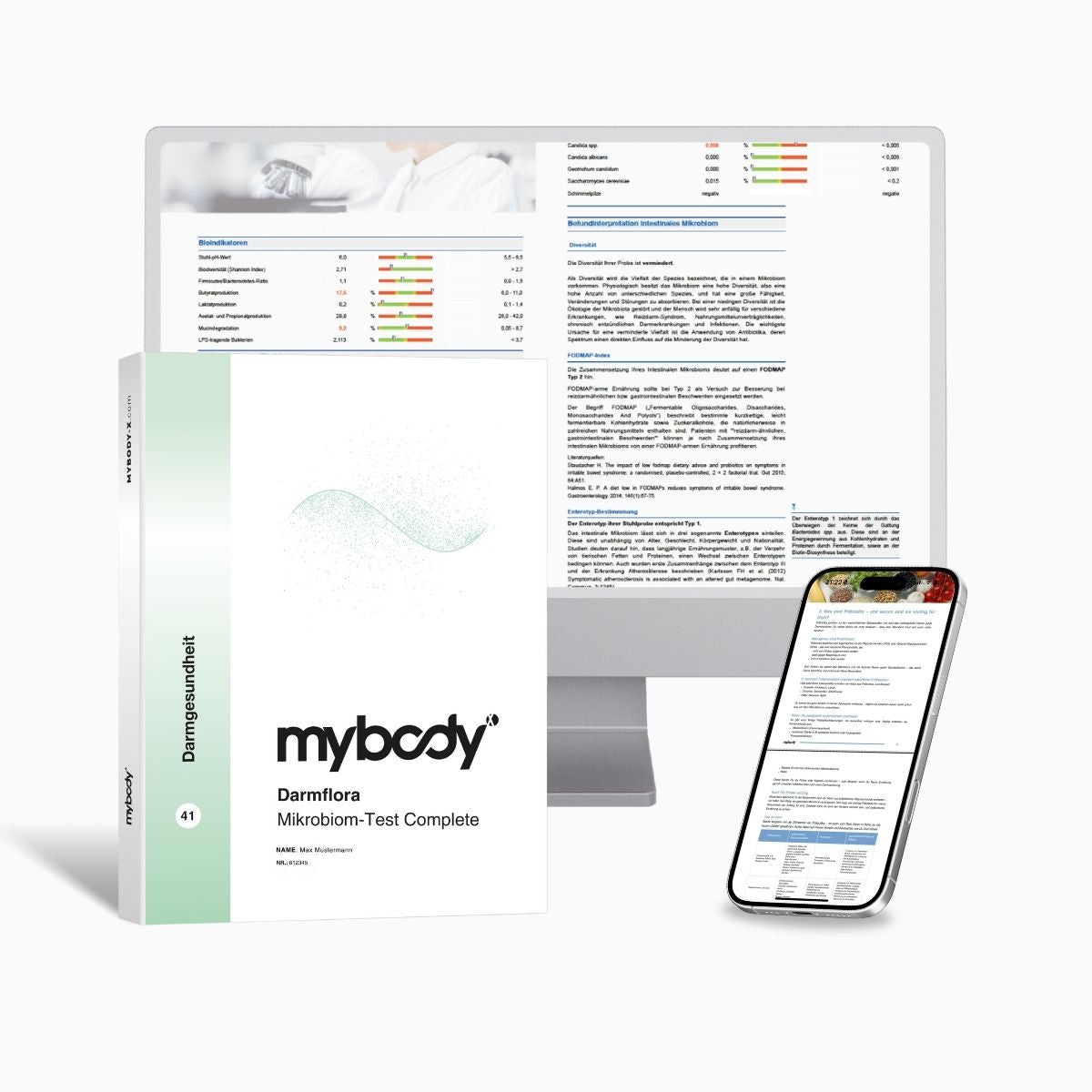
Gut Microbiome COMPLETE Test
The test uses DNA sequencing of a stool sample to determine more than 1,500 bacterial species and describes, among other things, bacterial diversity, the ratio of protective to problematic microorganisms, indications of dysbiosis, a FODMAP index, and the enterotype. It measures the composition of the gut microbiome—it does not measure “toxins,” “toxic load,” or “detoxification capacity.” The test is not a diagnostic procedure: It does not detect inflammatory bowel disease, tumors, infections, or celiac disease.
Price: €189.00 (instead of €219.00) · Sample type: Stool sample · Processing time: approx. 20–25 business days after receipt of the sample · Laboratory: ISO-certified laboratory analysis, ISO 27001, GDPR-compliant
For the Complete Microbiome TestAll prices and service details are as of July 28, 2026. Prices and processing times may change; the respective product page is always authoritative.
An analysis report does not replace any of the three evidence-based basic measures. It can only accompany them—and it is unnecessary as long as fiber intake, fluid intake, and physical activity have not yet been adjusted.
What cleanses and tests cannot do
No cleanse or self-test can replace medical evaluation when warning signs occur. This applies to blood in the stool as well as significant weight loss, fever, or pallor.
A second limitation concerns expectations about speed. The sources reviewed do not specify a timeframe in which a particular feeling should develop through dietary changes—anyone expecting results after three days is measuring against a number that does not exist.
A third limitation is individual variation. According to IQWiG (2023), people respond very differently to certain foods. A plan that works for one person is therefore not evidence that it will work for the next.
A fourth limitation concerns weight. The desire to detox is often a desire to lose weight—and for this, IQWiG (2022) describes a combination of dietary changes, more exercise, and behavioral changes, not a week-long cleanse.
Finally, laboratory analysis also has its limits: A microbiome test describes a state at a particular point in time. It does not predict how you will feel in four weeks, nor does it provide any information about an alleged toxin burden.
Conclusion
Detoxification is a metaphor, not a medical finding. There is no definition of “toxins” in physiology, and according to the German Nutrition Society (2018), there is currently no scientific evidence for the effectiveness of so-called detox or detoxification diets.
The underlying concern should still be taken seriously. A feeling of heaviness, bloating, and sluggishness have identifiable causes—and the three best-supported measures are decidedly unglamorous: at least 30 grams of fiber per day (DGE, 2021), drinking 1.5 to 2 liters (IQWiG, 2025), and 150 to 300 minutes of moderate exercise per week (WHO, 2020).
If you want to change something, start where the evidence is: with your long-term diet rather than a week-long cleanse. And if warning signs such as blood in the stool, significant weight loss, fever, or pallor appear, your first step should be to see a doctor.
Frequently asked questions
What are “toxins” in the body?
“Toxins” is a term from the detoxification doctrine, not from physiology. There is no definition, laboratory value, or reference range for it. The term originally comes from metalworking and was transferred metaphorically to metabolism.
Is a detox cleanse worthwhile?
According to the German Nutrition Society (DGE, 2018), there is still no scientific evidence for the effectiveness of so-called detox or cleansing diets. According to IQWiG (2022), extreme and unbalanced diets can also cause side effects and medical risks such as malnutrition. The promised benefits are therefore unproven, while the risks of unbalanced programs have been documented.
Can detoxing help you lose weight?
There is no evidence that detoxification helps with weight loss. According to IQWiG (2022), weight reduction in people with obesity is recommended to combine dietary changes, more physical activity, and behavioral changes. In structured weight-loss programs, participants lost about 3 to 8 kilograms within 6 to 12 months, averaging around 5 to 6 kilograms, according to IQWiG (2022)—over months, not during a one-week cleanse.
What are the benefits of a colon cleanse?
The only medically justified reason for targeted bowel emptying is preparation for a colonoscopy. According to IQWiG (2021), this involves drinking a laxative with plenty of fluids, a total of 2 to 4 liters, and avoiding solid food from 2 to 3 hours before taking the laxative. The aim is a clear view of the intestinal lining—not detoxification.
Can a microbiome test show whether I need to detox?
No. A microbiome test measures the composition of the gut flora from a stool sample. It does not measure “toxins,” “toxin load,” or “detoxification capacity,” and it is not a diagnostic procedure. It can provide guidance as a baseline assessment before making lasting dietary changes—but not evidence that detoxification is needed.
Would you like to know how your gut flora is composed?
The mybody® gut flora MICROBIOME test analyzes a stool sample in an ISO-certified laboratory. It describes the composition of your gut flora, supplements the evidence-based basic measures outlined in this article—and does not provide a diagnosis.
View the Complete microbiome test All gut tests at a glanceYou might also be interested in
→ Abdominal pressure: identifying and understanding the causes
When the feeling of heaviness is accompanied by pressure or tightness in the abdomen.
→ The most reliable microbiome tests for your gut flora
What you should consider before deciding on a gut flora analysis.
→ Gut flora glossary: all bacteria and markers in your gut microbiome
Reference work with more than 6,000 microbiome biomarkers—from protective bacteria and fiber metabolizers to the metrics in the report.
Sources
- German Nutrition Society (DGE): Detox diets, DGEinfo 3/2018 — dge.de
- IQWiG / gesundheitsinformation.de: Weight-loss programs and medications (2022) — gesundheitsinformation.de
- German Nutrition Society (DGE): Reference values for fiber (2021) — dge.de
- World Health Organization: Guidelines on Physical Activity and Sedentary Behaviour (2020) — ncbi.nlm.nih.gov
- IQWiG / gesundheitsinformation.de: What can you do yourself about hemorrhoids? (2025) — gesundheitsinformation.de
- IQWiG / gesundheitsinformation.de: Irritable bowel syndrome (2023) — gesundheitsinformation.de
The verbatim quotation in Chapter 2, the statement regarding the questionable metabolic effect, and the discussion of fasting, detox teas, and detoxification products are based on [1]. The statements on exaggerated promises, side effects and malnutrition, the recommended combination of dietary changes, exercise, and behavioral changes, as well as the kilogram figures, are taken from [2]. The guideline of at least 30 grams of fiber per day, the protective effects, and the information on transit time and stool consistency are taken from [3]. The recommendation of 150 to 300 minutes of exercise per week comes from [4]. The recommended fluid intake of 1.5 to 2 liters per day and the note on psyllium husks come from [5]. Warning signs, the need to evaluate blood in the stool, the prevalence of irritable bowel syndrome, and the individual nature of reactions to foods come from [6]. Product information comes from the mybody® product pages, accessed on July 28, 2026. All other sources cited in the text—including the information on preparing for a colonoscopy and the note on fiber supplements—are identified directly at the relevant point with the institution, title, and date.

mybody® Editorial & Expert Team
Gut health Microbiome Detox and fasting Nutritional science
This article was written and medically reviewed by the mybody® Editorial and Expert Team. The team combines expertise in nutrigenetics, microbiome and gut science, blood analysis interpretation, nutritional science, and laboratory diagnostics.
Published on July 28, 2026 · Last updated on July 28, 2026
Medical notice: This article is intended for general information and does not replace medical advice, diagnosis, or treatment. Fasting, prolonged food deprivation, and taking laxatives should be discussed with a doctor beforehand in the case of pre-existing conditions, during pregnancy, and when taking medication. Blood in the stool, significant weight loss, fever, or paleness should be medically evaluated. A microbiome test is not a diagnostic procedure.


Share now:
Colon cleanse for weight loss: What is actually proven—and what isn’t?
Colon cleanse diet plan: Realistically plan 14 days—and check every component