

Intestinal cleanse for weight loss: What is actually supported by evidence—and what is not?
The key points at a glance
There is no scientific evidence that an intestinal cleanse causes weight loss. What has been demonstrated is something else: According to IQWiG (2022), a combination of dietary change, increased physical activity, and behavioral changes is recommended for weight reduction in people with obesity. Participants in structured weight-loss programs lost an average of about 5 to 6 kilograms over 6 to 12 months.
The term “intestinal cleanse” is neither protected nor uniformly defined. It refers to very different programs—from fasting days and psyllium husks to laxatives and bacterial preparations. This article objectively examines which of these have been shown to support weight loss, where the risks lie, and which measures instead have a robust evidence base.
Further reading: Chapter 2 compares an intestinal cleanse, a structured weight-loss program, and long-term dietary change according to the same criteria. Chapter 3 presents the evidence-based approaches and warning signs that should be addressed in a doctor’s office. Chapter 6 puts the role of the gut microbiome into perspective, while Chapter 8 outlines the limitations.
What to expect in this article
1. What does an “intestinal cleanse” actually mean?
2. Intestinal cleanse, weight-loss program, or dietary change: What is supported by evidence?
3. Which approaches to weight loss are actually supported by evidence?
4. Why should cleanse promises be viewed critically?
5. Which misconceptions persist about intestinal cleanses and weight?
6. What does the gut microbiome have to do with body weight?
7. When is microbiome analysis useful—and when is it not?
8. What an intestinal cleanse cannot do
Conclusion
Frequently asked questions
Sources
What does an “intestinal cleanse” actually mean?
An “intestinal cleanse” is not a medically defined procedure, but a blanket term. The expression is not protected, there is no professional association that defines it, and there is no binding composition. Any plan circulating under this name may mean something different.
That is precisely the core of the problem when it comes to asking whether they help with weight loss. If two programs have the same name, but one consists of three high-fiber weeks and the other of fasting days with laxatives, then “the intestinal cleanse” as a whole cannot meaningfully be assessed for its effects.
What typically appears in circulating intestinal cleanse plans
Most plans combine four elements in varying order: a severely restricted dietary phase, swelling fibers such as psyllium husks, preparations containing bacterial cultures, and—in stricter versions—laxatives or enemas. Some plans also include bitter substances, herbal teas, or meal-replacement formulas, meaning powdered meal-replacement products.
These components are described here, not recommended. Laxatives and meal-replacement formulas are not everyday weight-loss measures, and this article deliberately provides neither dosages nor usage instructions for them.
Why the word “cleanse” creates a false expectation
The word “cleanse” suggests a completed process with a result afterward: seven days, fourteen days, four weeks—and then the gut is “finished.” But the digestive tract does not function like a project with an end date; it responds continuously to what is on the plate each day.
The same logic applies to body weight. A measure that ends after two weeks cannot sustain a change that would need to be maintained for months. According to IQWiG (2022), reliable results for weight-loss programs concern periods of 6 to 12 months—not short cleanse periods.
How gut cleanses, bowel cleansing, and gut restoration differ in common usage
The three terms are often used interchangeably in everyday language, but they refer to different concepts. “Bowel cleansing” aims to empty the intestines, “gut restoration” aims to rebuild the gut flora, and “gut cleanse” is the broadest of the three terms, encompassing both depending on the provider.
This distinction is important when it comes to weight because it explains why personal accounts are so contradictory. Two people who have “done a gut cleanse” may have done completely different things—a week of fasting with laxatives or four weeks of a high-fiber diet.
Key point: A gut cleanse is not a standardized medical procedure but an umbrella term for very different programs—accordingly, there is no uniform evidence of effectiveness on which to base a promise of weight loss.
This article addresses only the question of weight loss. Anyone looking instead for a structured four-week plan to build a high-fiber diet will find it in the article Gut restoration: Four-week nutrition plan; anyone who wants to get sluggish digestion moving should read Stimulating digestion: What helps. Both articles deliberately avoid discussing weight.
Bowel cleanse, weight-loss program, or dietary change: What evidence is there for weight loss?
The comparison is clear: The reviewed source material contains no evidence that a bowel cleanse is effective for weight loss, whereas structured weight-loss programs have specific figures. The following overview compares the three approaches using the same five criteria.
| Criterion | “Bowel cleanse” | Structured weight-loss program | Permanent dietary change |
|---|---|---|---|
| What happens during it? | No defined procedure. Depending on the plan, this may involve fasting days, psyllium husks, bacterial supplements, and sometimes laxatives or formula diets. | A supervised program combining dietary changes, more physical activity, and behavioral changes (IQWiG, 2022). | A permanent change to everyday eating habits, usually with more fiber. The DGE recommends at least 30 g of fiber per day as a guideline (2021). |
| What evidence is there for weight loss? | The reviewed source material contains no evidence that a bowel cleanse is effective for weight loss. | Participants lost about 3 to 8 kg over 6 to 12 months, with an average loss of about 5 to 6 kg (IQWiG, 2022). | According to IQWiG (2022), dietary changes are a fixed component of the recommended combination for obesity. |
| How long does it take? | Usually days to a few weeks, with a fixed end date. | The studies cited by IQWiG (2022) cover periods of 6 to 12 months. | With no end date, designed for the long term. |
| What risks are there? | According to IQWiG (2022), extreme and unbalanced diets can cause side effects and medical risks such as malnutrition. | Variants involving formula diets significantly affect nutrition and should be professionally supervised (IQWiG, 2022). | Low, as long as the diet remains varied and no food group is eliminated without a reason. |
| Who should provide supervision? | Warning signs such as significant weight loss or blood in the stool should be evaluated by a doctor (IQWiG, 2023). | Medical or nutritional-professional supervision, especially in cases of obesity and pre-existing conditions. | Generally feasible on your own; nutritional counseling is advisable if you have existing medical conditions. |
The second row is the decisive one. The “bowel cleanse” column deliberately contains no figure, because a figure without evidence would be an invention. The absence of evidence is itself information—and often the most important information for a purchasing decision.
Another notable point is the timeline. The only column with documented weight-loss figures is also the one with the longest observation period. Comparing a short cleanse with a six-month program means comparing two completely different scales.
Which weight-loss levers are actually supported by evidence?
What is supported by evidence is a combination, not a single remedy. According to IQWiG (2022), a combination of dietary changes, more physical activity, and behavioral changes is recommended for weight loss in obesity – three components that work together and are significantly less effective individually.
The fourth factor is expectations. According to IQWiG (2022), participants in structured weight-loss programs lost between around 3 and 8 kilograms within 6 to 12 months, averaging around 5 to 6 kilograms. That is a realistic range – and it is far below what many cleanse advertisements suggest.
Dietary changes
A permanent component of the combination recommended by IQWiG (2022) for obesity – designed for the long term, not as a cleanse.
More physical activity
After twelve months, physically active participants had lost nearly two kilograms more than those who changed only their diet (IQWiG, 2022).
Behavioral changes in everyday life
The third component of the IQWiG recommendation (2022): change habits instead of following time-limited rules.
Realistic goals
An average of around 5 to 6 kilograms over 6 to 12 months – that is the range structured programs achieve according to IQWiG (2022).
Why formula foods are not recommended in this article
According to IQWiG (2022), programs using formula foods led to greater weight loss of around 10 to 15 kilograms in studies. This figure is included here because it is part of the evidence – not as a recommendation.
Replacing entire meals with powder is a major intervention in your diet. It should take place under medical or professional nutritional supervision, not as part of a self-designed week-long cleanse. This article therefore deliberately does not provide dosages or usage schedules.
Which warning signs should be evaluated first, before any cleanse or diet
Before starting any cleanse, diet, or self-directed measure, one question is more important: Are there symptoms that require medical evaluation? IQWiG (2023) explicitly identifies warning signs for intestinal complaints that should not be managed independently.
These signs belong in a doctor’s office, not in a bowel cleanse
- ✓ Significant weight loss – according to IQWiG (2023), one of the signs that “are more likely to indicate another intestinal disease.”
- ✓ Blood in the stool – “Blood in the stool should always be medically examined to clarify the cause” (IQWiG, 2023).
- ✓ Fever – is one of the same warning signs and is not consistent with a harmless digestive disorder.
- ✓ Paleness—can indicate anemia and should be medically assessed (IQWiG, 2023).
- ✓ Unintentional weight loss without an apparent reason—especially in an article about intentional weight loss, the rule is: Kilos that disappear on their own are not a success but a reason to seek medical evaluation.
Key message: According to IQWiG (2022), the proven ways to lose weight are dietary changes, more exercise, and behavioral changes in combination—a detox cure is not one of them.
Why should claims about detox cures be read critically?
Because the market for weight-loss promises is large while the evidence base is small. The Institute for Quality and Efficiency in Health Care puts this unusually clearly for a government agency.
“
“Many diet providers advertise with exaggerated promises and sometimes use extreme and one-sided dietary approaches. Such diets can have side effects and medical risks such as malnutrition.”
Institute for Quality and Efficiency in Health Care (IQWiG)
“Weight-loss programs and medications,” gesundheitsinformation.de, 2022
There are two points in this sentence. First: Exaggerated promises are not an isolated slip by individual providers but a widespread pattern. Second: The harm is not limited to the price paid; it also includes a medical risk that can extend to malnutrition.
How to recognize an exaggerated promise
A first signal is a figure without a source. If a plan promises “up to eight kilos in two weeks” but gives no institution, specialist journal, or year, the evidence usually does not exist.
A second signal is a shift in the justification. Instead of citing a study, a mechanism is described—“toxins,” “intestinal blockage,” “disrupted metabolism”—that sounds plausible and therefore seems not to require any further evidence. But an explanation is not proof of effectiveness.
A third signal is the combination of a short duration and a major result. The more these two factors diverge, the more likely the weight loss comes from water and intestinal contents rather than body fat.
How to recognize a factual offering
A factual offering identifies its source. It states which institution or specialist journal is behind a figure, which year it comes from, and over what period it was collected—just as IQWiG bases its information on weight-loss programs on study periods of 6 to 12 months (2022).
A factual offering also clearly states its limits. It explains what a product cannot do, who it is not suitable for, and when medical evaluation should take priority. If this part is completely missing, that indicates advertising rather than information.
And finally, an objective offer does not need urgency. Anyone planning a permanent change in diet loses nothing by starting a week later—a program that uses a countdown and limited places sells time pressure instead of results.
What misconceptions persist about colon cleanses and weight?
Two assumptions appear particularly often in descriptions of cleanses. Both sound plausible, and neither stands up to the available evidence.
Why the scale still shows a lower number after a week of a cleanse
The effect is real, but the explanation is different. Anyone who eats very little for a few days mainly empties the intestinal contents and loses bound water. Both show up on the scale immediately and return just as quickly once normal eating resumes.
A look at how people prepare for a colonoscopy helps put this into perspective. According to IQWiG (2021), patients drink “a laxative with plenty of fluids, 2 to 4 liters in total”—the bowel is deliberately and completely emptied. Even this procedure is explicitly preparation for an examination, not a weight-loss method.
The difference between intestinal contents and body fat is at the heart of the whole issue. A number on the scale says nothing about what type of mass has left the body.
What does the gut microbiome have to do with body weight?
The gut microbiome is an active field of research—but it is not a lever that can be used to deliberately control body weight. Based on the composition of gut bacteria, it is currently not possible to predict a person’s weight or forecast weight-loss success.
What can be said, however, is that the diet that supports a diverse gut microbiome is largely the same as the diet found in recommended weight-loss combinations. Vegetables, legumes, whole grains, and few highly processed foods are common to both contexts.
Dietary fiber: the established link between the gut and body weight
The German Nutrition Society (DGE) recommends that adults consume at least 30 grams of dietary fiber per day (2021). Dietary fiber is the part of food that the body’s own enzymes cannot break down—it reaches the colon, where it serves as a substrate for bacteria.
According to the DGE (2021), increased fiber intake shows “protective effects against cardiovascular disease, type 2 diabetes, obesity, high blood pressure, colon and breast cancer, as well as the risk of death.” This is a statement about protective effects in the population—not a promise that more fiber will reduce an individual’s weight.
In practical terms, the route to 30 grams leads through food, not powders. The evidence for supplementary products is explicitly cautious—according to IQWiG (2023), it has not been demonstrated that additional fiber supplements help.
Probiotics: well tolerated, but not a weight-loss product
Probiotics are living microorganisms, such as lactic acid bacteria, found in natural yogurt or dietary supplements. They are a standard component of treatment packages.
There is a clear statement regarding tolerability: According to IQWiG (2023), probiotics are generally well tolerated, with mild side effects such as bloating occurring only rarely. It makes no statement about weight loss—and this is precisely the gap that advertising often fills.
For people with irritable bowel syndrome, the gut flora is a different issue from weight in any case. It is estimated that around 10 to 20 out of 100 people have irritable bowel syndrome (IQWiG, 2023); for them, the focus is on alleviating symptoms, not on kilograms.
In brief
Based on the composition of the gut flora, no weight prognosis can currently be derived. According to current evidence, the established connection between the gut and weight concerns dietary fiber: The DGE recommends a guideline value of at least 30 grams per day (2021) and describes protective effects of increased intake, including against obesity. However, no benefit has been demonstrated for additional fiber supplements (IQWiG, 2023). Probiotics are considered well tolerated, but they are not a proven means of losing weight.
When is a microbiome analysis useful—and when is it not?
A microbiome analysis answers a question about the current state, not a question about weight. It shows which bacteria can be detected in a stool sample and how diverse the colonization is—it does not predict how much someone will lose.
This also clearly defines the decision. Anyone looking for a starting point for their own diet may find such an analysis useful. Anyone looking for a number on the scale will be disappointed.
Useful for you if …
… you want to permanently change your diet and are looking for a documented starting point.
… you want to know how diverse your gut flora currently is instead of relying on assumptions.
… you see an analysis as a supplement to medical or nutritional guidance, not as a replacement.
Probably not if …
… you want to lose weight: A microbiome analysis does not provide a weight forecast or a weight-loss plan.
… warning signs such as significant weight loss, blood in the stool, fever, or pallor are present—these should be evaluated in a doctor’s office (IQWiG, 2023), not with a self-test.
… you are already pursuing medically supervised weight loss: You do not need an additional self-test to start or continue it.
How mybody® classifies microbiome analysis
mybody® (MYBODY Lab GmbH) offers gut flora analysis as an at-home self-test: The stool sample is evaluated in an ISO-certified laboratory in Germany, and the data is transferred in compliance with the GDPR and pseudonymized. The test is a snapshot—not a diagnostic procedure or a weight-loss program.
The report describes, among other things, bacterial diversity, the ratio of protective to potentially problematic microbes, and indications of dysbiosis. Those who want to act on this information can use it as a starting point for a more fiber-rich everyday diet—not as instructions for a cleanse week with an end date.
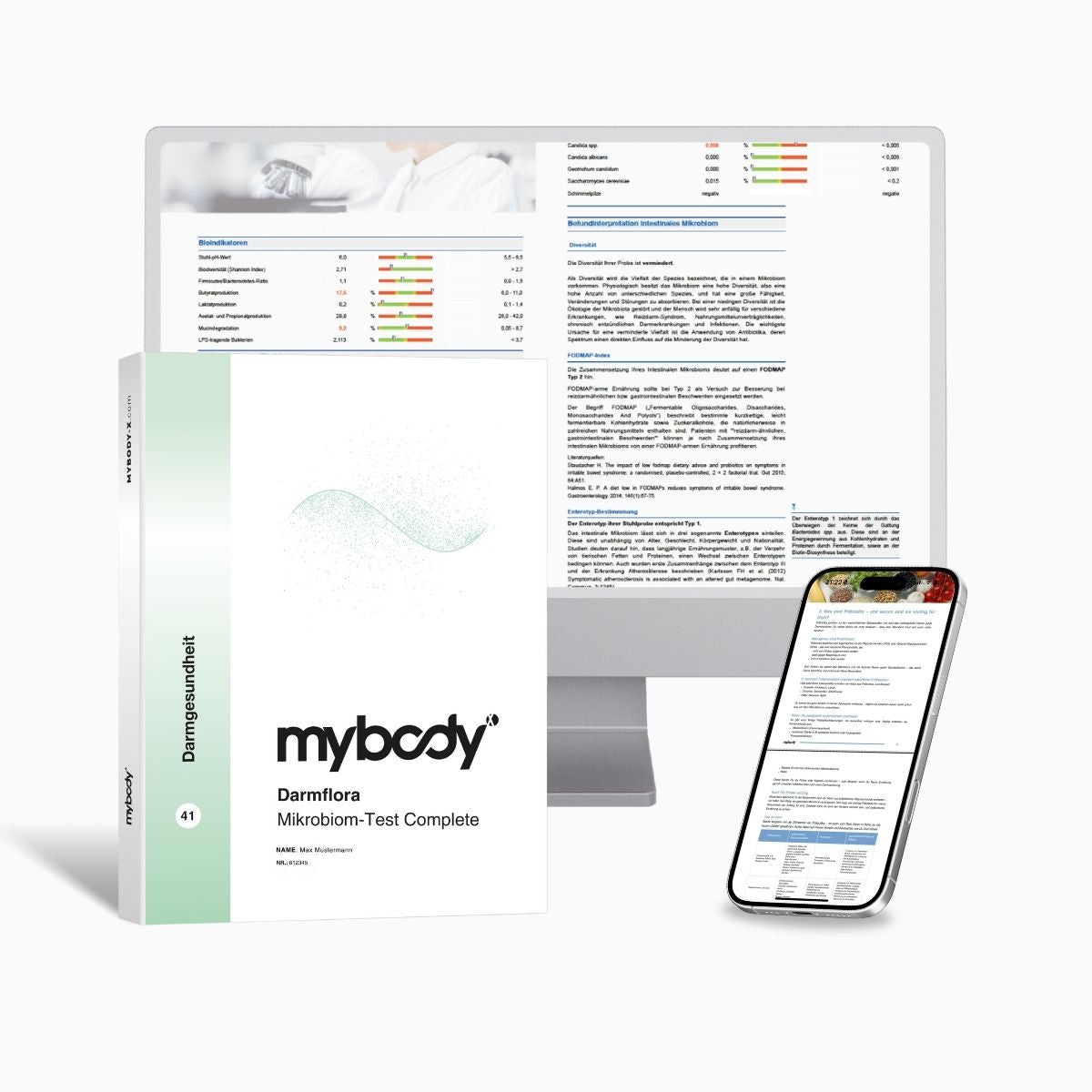
Gut Flora MICROBIOME Test Complete
The test uses DNA sequencing to analyze more than 1,500 bacterial species from a stool sample and summarizes the results in a report of around 15 pages—including bacterial diversity, the ratio of protective to potentially problematic microbes, indications of dysbiosis, the FODMAP index, and enterotype classification. Explicitly not included: a diagnosis, a weight forecast, or a weight-loss promise. The test does not detect chronic inflammatory bowel disease, tumors, infections, or celiac disease—for these, medical evaluation is required.
Price: €189.00 (instead of €219.00) · Sample type: Stool sample · Processing time: approx. 20–25 business days after receipt of the sample · Laboratory: ISO-certified laboratory analysis, ISO 27001, GDPR-compliant
About the Complete Microbiome TestAll price and service information is current as of July 28, 2026. Prices and processing times may change; the relevant product page always prevails.
What a colon cleanse cannot do
A colon cleanse is not a weight-loss method, but a collective term with no proven effect on weight. This sentence is the most honest answer to the original question—and it takes nothing away; it simply saves time and money.
A bowel cleanse is not a weight-loss method, but a collective term without a proven effect on weight.
When the bowel is actually emptied for medical reasons
There is exactly one situation in which targeted bowel cleansing is medically justified: preparation for a colonoscopy. According to IQWiG (2021), “solid food must be avoided from 2 to 3 hours before taking the laxative until after the examination.”
The purpose of this emptying is to see the intestinal lining, not to affect weight. Estimates suggest that 95% of carcinomas are detected through the examination (IQWiG, 2021)—at the same time, 2 to 3 out of every 1,000 men examined experience complications requiring treatment. A procedure with this benefit-risk profile is not a wellness program.
What a microbiome test cannot do either
A microbiome test is not a diagnostic procedure. It replaces neither a medical examination nor a colonoscopy and does not detect inflammatory bowel disease, a tumor, an infection, or celiac disease.
Nor does such a test predict weight-loss success. Anyone who uses one gets a snapshot of their gut flora—a useful piece of information for their own diet, but not a number from which kilograms can be inferred.
Finally, according to IQWiG (2023), how people respond to individual foods varies greatly. That is why no test result can replace trying things out in everyday life—ideally with guidance and documentation rather than relying on intuition.
Conclusion
There is no evidence that a bowel cleanse leads to weight loss. The term is not defined, its components vary from plan to plan, and what becomes visible on the scale after a few days is mostly intestinal contents and water.
Another combination is supported by evidence. According to IQWiG (2022), weight reduction in people with obesity is recommended through a combination of dietary changes, increased physical activity, and behavioral changes; participants in structured weight-loss programs lost an average of about 5 to 6 kilograms over 6 to 12 months.
The specific recommendation is therefore: instead of planning a week-long cleanse, make your everyday diet richer in fiber—the DGE recommends at least 30 grams per day as a guideline (2021)—schedule regular physical activity, and seek medical or nutritional guidance if you have obesity. Anyone who also wants to know the current composition of their gut flora can have it analyzed as a baseline assessment; it is not useful as a weight-loss aid.
If there is significant or unintended weight loss, blood in the stool, fever, or paleness, one thing applies regardless of everything else: have it medically evaluated first (IQWiG, 2023), then think about nutrition.
Frequently asked questions
Can you lose weight with a bowel cleanse?
There is no scientific evidence that a bowel cleanse causes weight loss. According to IQWiG (2022), what is supported by evidence is a combination of dietary changes, more physical activity, and behavioral changes. Any lower number on the scale after a week of cleansing is primarily intestinal contents and bound water—not body fat.
How much weight can you realistically lose if you take a structured approach?
According to IQWiG (2022), participants in structured weight-loss programs lost between approximately 3 and 8 kilograms over 6 to 12 months, with an average loss of about 5 to 6 kilograms. Programs using formula foods led to greater weight loss of approximately 10 to 15 kilograms in studies; however, they significantly restrict the diet and should be professionally supervised.
Are laxatives or enemas useful for losing weight?
No. The only medically justified bowel cleansing is preparation for a colonoscopy—according to IQWiG (2021), this involves drinking “a laxative with plenty of fluid, totaling 2 to 4 liters.” The purpose is to provide a clear view of the intestinal lining, not to affect weight. This article deliberately gives no dosages for self-use.
Does a microbiome test predict how well I will lose weight?
No. A microbiome analysis shows which bacteria can be detected in a stool sample and how diverse the microbial community is. It does not provide a weight-loss prognosis, a weight-loss plan, or a diagnosis. It can be useful as a snapshot before changing your diet—but it is not a weight-loss aid.
When should digestive symptoms be assessed by a doctor?
According to IQWiG (2023), additional symptoms such as significant weight loss, blood in the stool, fever, or pallor “are more likely to indicate another intestinal disease.” Blood in the stool should always be examined by a doctor to clarify the cause. Unintentional weight loss without an apparent reason should also be investigated—it is not a weight-loss success.
Would you like to know your gut flora as a starting point?
A microbiome analysis is a snapshot, not a weight-loss program—but it can provide an objective starting point for making lasting dietary changes. All information current as of July 28, 2026.
View Microbiome Test Complete All gut tests at a glanceYou might also be interested in
→ The most reliable microbiome tests for your gut flora
What matters when analyzing your gut microbiome and how to recognize reputable providers.
→ Gut Flora Tests: Microbiome Analysis Meets Practical Recommendations for Action
How to translate an analysis result into concrete steps for everyday life.
→ Gut Encyclopedia: All Bacteria and Markers in Your Gut Flora
Reference work with more than 6,000 microbiome biomarkers—from protective bacteria and fiber degraders to the metrics in your report.
Sources
- Institute for Quality and Efficiency in Health Care (IQWiG): Weight-Loss Programs and Medications (2022) — gesundheitsinformation.de
- IQWiG: Irritable Bowel Syndrome (2023) — gesundheitsinformation.de
- IQWiG: What Helps with Irritable Bowel Syndrome—and What Does Not? (2023) — gesundheitsinformation.de
- IQWiG: Colonoscopy (2021) — gesundheitsinformation.de
- German Nutrition Society (DGE): Reference Values for Fiber (2021) — dge.de
The statements on the recommended combination of dietary changes, exercise, and behavioral changes; the weight-loss results of structured programs; formula diets; and the direct quotation about diet providers are based on [1]. The warning signs and the information on the prevalence of irritable bowel syndrome come from [2]; the statements on fiber supplements, probiotics, and individual responses to food come from [3]. The information on colonoscopy as the only medically justified form of bowel cleansing comes from [4], while the recommended fiber intake and the statement on protective effects come from [5]. Product information comes from the mybody® product pages, accessed on July 28, 2026. All other sources cited in the text are identified directly at the relevant point by institution and year.

mybody® Editorial & Expert Team
Gut Health Microbiome Weight Management Nutritional Science
This article was created and medically reviewed by the mybody® Editorial and Expert Team. The team brings together expertise in nutrigenetics, microbiome and gut science, blood analysis interpretation, nutritional science, and laboratory diagnostics.
Published on July 28, 2026 · Last updated on July 28, 2026
Medical notice: This article is intended for general information and does not replace medical advice, diagnosis, or treatment. Weight reduction in cases of obesity should be medically or nutritionally supervised. If you experience significant or unintentional weight loss, blood in your stool, fever, or paleness, please consult a doctor promptly.



Share now:
Stimulating bowel movements: Available methods and how well-supported they are by evidence
Detoxing: What the term means and what really helps the body