

Gut bacteria in children: What is proven and when an examination is useful
The key points at a glance
Gut bacteria in children are the microorganisms that colonize the child’s intestines and are involved in digestion, nutrient absorption, and immune development. Most abdominal complaints in childhood are temporary and harmless. A gut flora analysis can show the composition, but it does not provide a diagnosis. That is the responsibility of the pediatrician’s office.
Many claims circulate about children’s gut flora, and the established evidence is far more limited than advertising claims suggest. This article clearly distinguishes between the two: It explains what professional institutions such as the Institute for Quality and Efficiency in Health Care (IQWiG) and the German Nutrition Society (DGE) say about probiotics, prebiotics, and dietary fiber, and where the evidence ends.
Chapter 1 explains which signs require immediate medical evaluation. Chapters 2 and 4 assess the evidence on probiotics. Chapters 5 and 6 answer the question of when a gut flora analysis can be useful for a child. Chapter 9 compares the three approaches.
What to expect in this article
1. What are gut bacteria in children, and what do they do in the body?
2. What has been proven about probiotics and prebiotics in children?
3. What shapes a child’s gut flora in everyday life?
4. Which assumptions about children’s gut flora do not stand up to scrutiny?
5. What does a gut flora analysis show in children, and what does it not show?
6. When is a gut flora analysis useful for a child?
7. How does mybody® conduct a gut flora analysis for children?
8. How can you support your child’s gut flora without pressure?
9. Diet, probiotics, or analysis: What does each option offer?
Conclusion
Frequently asked questions
Sources
What are gut bacteria in children, and what do they do in the body?
Gut bacteria in children are microorganisms that colonize the digestive tract and are involved in breaking down food components, absorbing nutrients, and developing the immune system. The totality of these bacteria is referred to as the gut flora or microbiome. In everyday usage, both terms mean the same thing.
A child’s gut flora is not a fixed state but changes continuously. Diet, infections, medications, and age all affect it. That is why any snapshot is always just that: a snapshot.
How the gut flora changes during childhood
Colonization of the child’s gut begins in the first days of life and continues to develop throughout early childhood. With the introduction of solid foods, the range of nutrients available to bacteria expands significantly because plant-based components are added that the human body cannot digest on its own.
For parents, this leads to one particularly important conclusion: What a child eats over weeks and months shapes the gut microbiome more strongly than a single meal or a single week. Short-term measures are rarely the decisive factor in such a dynamic system.
Why abdominal pain is so common in children
Recurrent abdominal symptoms are among the most common complaints in childhood. According to the Institute for Quality and Efficiency in Health Care (IQWiG, 2025), between 10 and 20% of children report persistent or recurrent upper abdominal symptoms.
This figure is initially reassuring, not a warning. It shows that abdominal pain is common in children and, in most cases, does not indicate a serious illness. Functional symptoms are also common in adults: according to IQWiG (2025), around 10 to 15% of adults in Germany have functional dyspepsia.
The key is distinguishing between symptoms that come and go and symptoms accompanied by additional warning signs. For the second group, there is a clear rule—and it is not to take a self-test.
These signs belong in a pediatrician’s office, not in a self-test
- ✓ Significant weight loss – according to IQWiG (2023), this is more likely to indicate another intestinal disease and should be medically evaluated.
- ✓ Blood in the stool – according to IQWiG (2023), this should always be medically examined to clarify the cause.
- ✓ Fever – together with persistent abdominal symptoms, this is a reason to see a doctor promptly.
- ✓ Paleness – according to IQWiG (2023), this is also one of the signs that may indicate another cause.
- ✓ Persistent or nighttime symptoms – if pain regularly wakes your child, seeking medical assessment is the right next step.
Key message: A child’s gut microbiome is a dynamic system that changes with diet, infections, and age. According to IQWiG (2023), a child with significant weight loss, blood in the stool, fever, or paleness should be examined by a doctor rather than taking a self-test.
What is proven about probiotics and prebiotics in children?
There are studies on probiotics for children, but their evidentiary value is limited. IQWiG describes the idea behind these products so clearly that it provides a good illustration of where intention ends and evidence begins.
“
“Probiotics contain live microorganisms, such as lactic acid bacteria. They are intended to positively influence the gut microbiome and thus protect against the later development of allergic diseases.”
Institute for Quality and Efficiency in Health Care (IQWiG)
“Do pro- or prebiotics help protect children from atopic dermatitis?”, gesundheitsinformation.de, 2021
The crucial word in this quotation is “are supposed to.” It describes an intention, not evidence of effectiveness. This is exactly where advertising claims regularly slide into a level of certainty that the evidence does not support.
What probiotics and prebiotics actually are
According to IQWiG, probiotics are living microorganisms such as lactic acid bacteria or certain yeasts. They are found in foods such as plain yogurt or in dietary supplements. IQWiG explicitly states in its glossary that probiotics are “often attributed a health-promoting effect”—attributed, not proven.
Prebiotics are something different. According to IQWiG (2021), they are usually indigestible carbohydrates such as oligosaccharides, meaning certain complex sugars that stimulate the growth of health-promoting bacteria in the digestive system. Prebiotics are therefore food for bacteria, while probiotics are bacteria.
What the studies actually show about atopic dermatitis
According to IQWiG (2021), around 6 to 14 out of 100 fewer children developed atopic dermatitis when probiotic dietary supplements were used. This figure initially sounds significant—and it needs the qualification that IQWiG mentions in the same context: The data were insufficient to determine whether different bacterial species have different effects or how they should best be dosed.
For parents, this means in plain language: There is an indication of an effect, but no reliable answer to the practical questions. Which product, which bacterial strain, what amount, and for how long—these cannot be determined from the available data.
The findings are even more cautious for prebiotics. According to IQWiG (2021), the studies showed no clear protective effect against atopic dermatitis. Anyone advertising prebiotic products for children as offering protection against allergies is going beyond the available evidence.
How well tolerated probiotics are
Regarding tolerability, the IQWiG assessment (2023) is comparatively clear: Probiotics are generally well tolerated, with mild side effects such as flatulence occurring only rarely. Good tolerability, however, is not evidence of effectiveness; it is a statement about risks.
Before giving your child a dietary supplement, the pediatrician’s office is the right point of contact. This is especially true for children with chronic conditions, weakened immune systems, or ongoing medication.
Key message: According to IQWiG (2021), there is some evidence of an effect of probiotics in children with atopic dermatitis, but no reliable information on the bacterial strain or dosage. No clear protective effect was found for prebiotics.
What shapes a child’s gut microbiome in everyday life?
A child’s gut microbiome is shaped primarily by what regularly ends up on the plate and by how medications are used. These four factors are practical for everyday life, cost nothing, and are supported by a broader body of evidence than any supplement.
Variety on the plate
The more varied the plant-based foods are over the course of the week, the broader the food supply for different groups of bacteria.
Fiber from vegetables, fruit, and whole grains
According to the DGE (2021), fiber affects transit time, the amount and consistency of stool, and the frequency of bowel movements.
Fermented foods such as plain yogurt
According to IQWiG, plain yogurt contains live microorganisms. As a food, it is convenient; it is not a treatment.
Antibiotics only when they are truly necessary
The pediatrician’s office decides whether an antibiotic is necessary. Prescribed treatment must never be discontinued without authorization.
Why fiber is the most tangible lever
Fiber is the part of plant-based food that the human body cannot break down itself and that therefore reaches the large intestine. According to the German Nutrition Society (DGE, 2021), fiber affects the transit time of food through the stomach and intestines, the amount and consistency of stool, and the frequency of bowel movements.
The DGE also identifies a long-term benefit: According to the DGE (2021), increased fiber intake has protective effects against cardiovascular disease, type 2 diabetes, obesity, high blood pressure, colon and breast cancer, as well as the risk of death.
Important context: The DGE guideline value of at least 30 grams of fiber per day applies to adults. It cannot simply be applied to children. For children, the practical principle is that vegetables, fruit, legumes, and whole-grain products should be included regularly—without parents having to count grams.
What fermented foods can and cannot do
According to IQWiG, plain yogurt is one of the foods that contain probiotics. As part of a varied diet, it is convenient, widely available, and well tolerated by most children.
It is therefore not a remedy. The fact that a food contains live bacteria does not prove that it alleviates a particular complaint. This distinction is the core of an honest approach to the subject.
Which assumptions about children’s gut flora do not stand up to scrutiny?
Parents encounter two assumptions particularly often when it comes to gut bacteria. Both sound plausible, and neither stands up to scrutiny of the available evidence.
The first misconception arises from oversimplification. “There are studies” becomes, in people’s perception, “it has been proven,” even though the studies leave precisely those questions unanswered that are crucial for use at home.
The second misconception is more dangerous because it costs time. Anyone who waits for weeks for a laboratory report before seeking help for a concerning symptom delays the evaluation that should actually have happened immediately.
Neither point argues against a gut flora analysis. They argue against assigning it a task it was not designed to perform.
What does a gut flora analysis show in children, and what does it not show?
A gut flora analysis examines a stool sample to determine which bacterial groups are present and in what proportions. It therefore describes the current state. It does not indicate whether a disease is present.
What a report can meaningfully show
It can meaningfully show the diversity of the bacteria detected, the ratio of beneficial to potentially problematic microbes, and an indication of dysbiosis, meaning an imbalanced composition. Such information is descriptive and gives parents a starting point for a discussion with their medical practice.
A report can also assess how diet may affect the composition. This, too, remains an assessment and does not become an instruction about what a child may or may not eat starting tomorrow.
What an analysis explicitly cannot detect
A gut flora analysis does not detect an infection, celiac disease, inflammatory bowel disease, or an allergy in children. There are separate, established procedures for these questions, all carried out through a medical practice.
A microbiome analysis cannot identify lactose intolerance either. According to IQWiG (2024), the hydrogen breath test is the standard procedure for this: after drinking a lactose solution, the hydrogen level in the breath is measured several times and is usually elevated in cases of lactose intolerance.
How to recognize a reputable provider
- ✓ The provider clearly states the limitations – a reputable report explicitly says that it is not a diagnosis.
- ✓ Certified laboratory analysis – an ISO-certified laboratory evaluation and an information security standard such as ISO 27001 are verifiable details.
- ✓ Transparency about price and processing time – the price, sample type, and processing time are clearly displayed on the product page before purchase.
- ✓ GDPR-compliant data protection – for samples from children, it is particularly important to know who processes the data and for how long.
- ✓ No promises of cures and no treatment package afterward – anyone who sells a supplement regimen in the same breath goes beyond providing information.
Key message: A gut microbiome analysis in children describes the composition of gut bacteria at a specific point in time. It detects neither infections nor celiac disease, inflammatory bowel disease, or allergies, and it does not replace a pediatric examination.
When is a gut microbiome analysis useful for a child?
A gut microbiome analysis is worth considering when an acute evaluation has already taken place and you want additional descriptive information for further dietary planning. It is not appropriate as the first step for acute or alarming symptoms.
Worth considering if …
… your child has already undergone a pediatric evaluation and no condition requiring treatment was found.
… you want to make long-term changes to your child’s diet and are looking for a descriptive starting point.
… your child has recurring but harmless digestive symptoms and you want to address the issue with professional guidance.
… you want a snapshot to discuss with your child’s pediatrician or a qualified nutrition professional.
Not recommended if …
… your child has acute symptoms or warning signs: significant weight loss, blood in the stool, fever, or pallor should be evaluated by a pediatrician, according to IQWiG (2023).
… celiac disease, lactose intolerance, or an infection is suspected: other methods are used for these, not microbiome analysis.
… you expect a diagnosis: you will not get one from a self-test, regardless of how detailed the report is.
… the result would lead to an elimination diet without professional guidance: for children, that is a real risk, not an experiment.
The last point deserves a separate explanation. Restrictive dietary patterns can become a problem for adults, and even more so for growing children. According to IQWiG (2023), an elimination diet based on FODMAPs carries a risk of malnutrition because it becomes difficult to consume enough vitamins and minerals.
That is why, without exception, children should follow elimination diets and elimination phases only under pediatric or nutritional-professional guidance. No test result is a reason to start one independently.
How does mybody® implement a gut microbiome analysis for children?
mybody® (MYBODY Lab GmbH) offers a gut microbiome analysis specifically tailored to children, as well as a more detailed version for adults. Both use a stool sample collected at home and sent to the laboratory, and both are evaluated through ISO-certified laboratory analysis.
The criteria from Chapter 5 are the benchmark: certified laboratory analysis, transparent information on price, sample type, and processing time, data protection in accordance with the GDPR, and a clear statement of what the report does not provide.
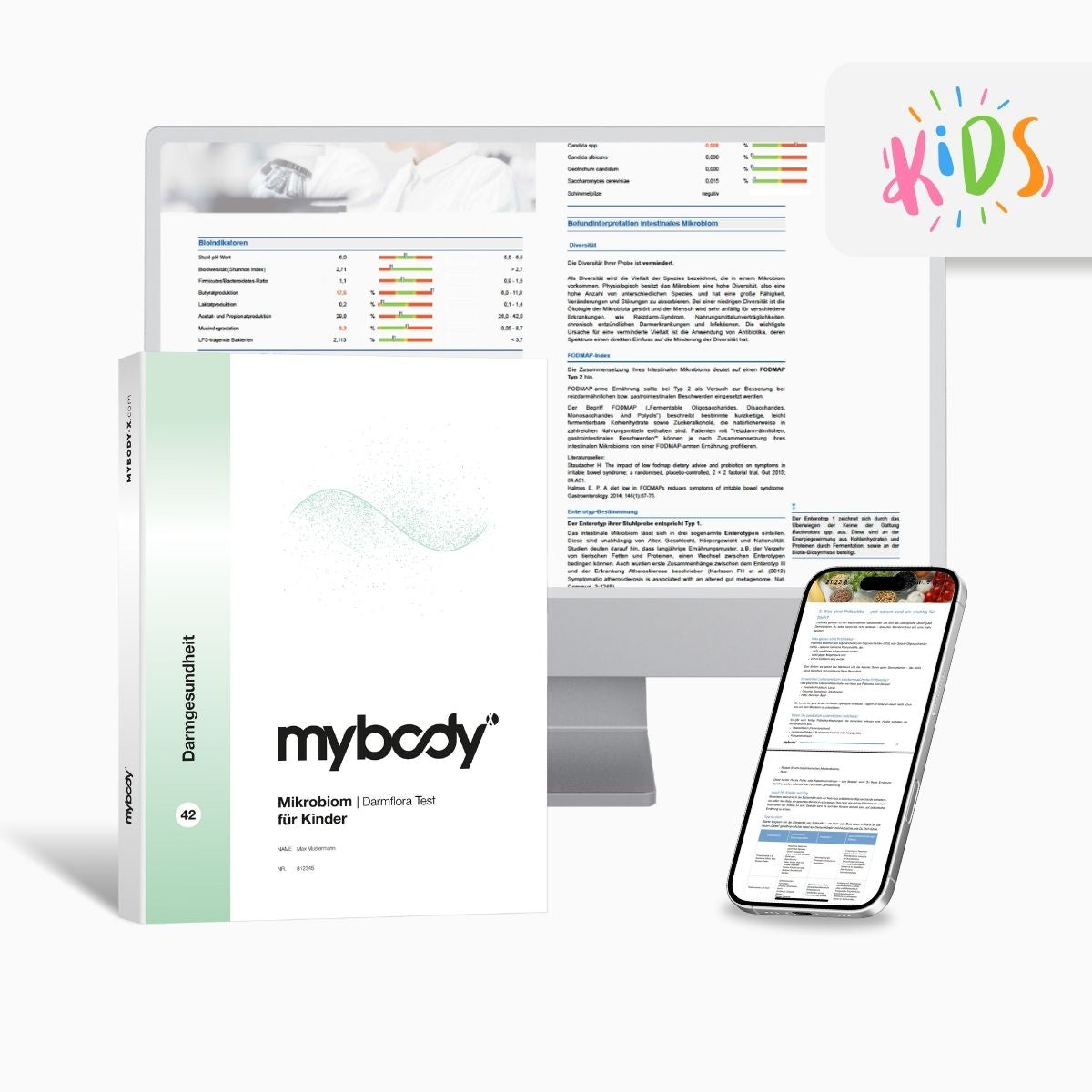
Gut Microbiome Test | Children
The test examines a stool sample from your child and describes bacterial diversity, dietary type, nutrient absorption, intestinal mucosal immunity, energy metabolism, and inflammation indicators across around 15 pages of reporting. It is expressly not a diagnostic procedure: it does not detect an infection, celiac disease, inflammatory bowel disease, or an allergy, and it does not replace a pediatric examination.
Price: €149.00 · Sample type: stool sample · Processing time: approx. 20–25 business days · Laboratory: ISO-certified laboratory analysis, ISO 27001
To the gut microbiome test for childrenSome parents are also interested in their own gut microbiome, for example because similar symptoms occur in the family. For this purpose, there is a more detailed adult version that includes significantly more levels of analysis.

Gut Microbiome Complete Test (for adults)
The Complete variant uses DNA sequencing to identify more than 1,500 bacterial species and supplements the report with, among other things, an enterotype determination and a FODMAP index. This test is also not a diagnostic procedure and does not detect inflammatory bowel disease, an infection, or celiac disease. For children, the Children’s variant is the appropriate option.
Price: €189.00 (instead of €219.00) · Sample type: stool sample · Processing time: approx. 20–25 business days · Laboratory: ISO-certified laboratory analysis, ISO 27001
To the Mikrobiom Test CompleteAll price and service information as of July 28, 2026. Prices and processing times may change; the applicable information is always on the respective product page.
A note on collecting samples from children: It should be done calmly and without pressure. If your child finds the situation unpleasant, choosing a later time is better than forcing a sample.
In brief
The Mikrobiom Test | Kinder von mybody® (MYBODY Lab GmbH) costs €149.00, uses a stool sample, and provides an approximately 15-page report based on an ISO-certified laboratory analysis after about 20 to 25 business days. For adults, the more detailed Complete version is available for €189.00. Both tests describe the composition of the gut microbiome and do not provide a diagnosis. In the event of acute symptoms or warning signs, your pediatrician's office is the first and right place to go.
How do you support your child's gut microbiome without pressure?
The most effective everyday approaches are unspectacular: regular meals, plenty of plant-based variety, and a relaxed attitude toward food. Children do not need a perfect diet, but a consistent and varied one.
Children do not need a perfect diet, but a consistent and varied one.
Variety beats perfection
Rather than focusing on individual superfoods, aim for variety: different types of vegetables throughout the week, fruit in varying forms, legumes prepared in a child-friendly way, and whole grains wherever they are accepted. Each new plant food provides different types of fiber.
If your child refuses vegetables, repetition without pressure is a better approach than negotiation. A rejected food is not a failure, but simply a step along the way.
Increase fiber slowly
Increasing fiber intake quickly can cause bloating in the short term. It is more sensible to introduce whole grains and legumes gradually and make sure your child drinks enough.
How much fluid a child needs depends on their age, weight, activity level, and the weather. The commonly cited liter amounts come from recommendations for adults and cannot be directly applied to children. Your pediatrician's office can assess what is appropriate for your child.
Consider stress and rhythm
According to IQWiG (2026), bowel function can be disrupted by stress, for example, leading to diarrhea, bloating, or constipation. For children, changing schools, exam situations, or conflicts in their surroundings are real triggers that often emerge too late in the search for causes.
What matters here is the attitude: According to IQWiG (2026), the fact that no physical cause is found does not mean that the symptoms are merely imagined or that nothing can be done. Children should experience that their stomachache is taken seriously.
Where this article ends and others continue
This article deals exclusively with the gut microbiome in children and the question of when an examination is useful. Anyone looking for a structured nutrition plan for adults can find one in the article Gut cleansing: nutrition plan; anyone specifically focusing on bloating can find it in the article Bloating: what to do. Both are aimed at adults and do not replace professional support for children.
Nutrition, probiotics, or analysis: What does each one do?
In practice, parents face three options that differ significantly in their purpose, supporting evidence, and effort. The following overview compares them according to the same five criteria so that the differences are clear.
| Criterion | Everyday nutrition | Probiotic foods and supplements | Gut microbiome analysis |
|---|---|---|---|
| What is the goal? | Diversity, fiber, and freshly prepared meals as a long-term foundation | Introduce live microorganisms that, according to IQWiG (2021), are intended to have a beneficial effect on the gut microbiome | Show the composition and diversity of the gut microbiome at a specific point in time |
| What has been proven? | According to the DGE (2021), increased fiber intake has protective effects, including against cardiovascular disease and type 2 diabetes | According to IQWiG (2021), 6 to 14 out of 100 children developed neurodermatitis less often; the data were insufficient to determine the bacterial strain or dosage | Descriptive finding, not a diagnostic procedure; provides no information about infection, celiac disease, chronic inflammatory bowel disease, or allergies |
| What age group is it for? | All ages; the DGE guideline of 30 grams of fiber per day applies to adults, not children | Plain yogurt as a food is straightforward; supplements for children only after consulting a pediatrician | Available as a version for children; only advisable once there is a specific question and a completed evaluation |
| How much effort does it involve? | Ongoing, easy to integrate into everyday life, with no appointment or waiting time | Regular shopping or regular intake over an extended period | One-time stool sample collected at home, followed by a waiting period of approximately 20 to 25 business days |
| Who should provide support? | Parents themselves; every elimination diet for children should be supervised by a qualified professional | Consult a pediatric practice before giving children supplements | Discussion of the results with pediatric or nutrition-professional support |
The overview reveals a hierarchy. The approach with the broadest evidence base is everyday nutrition—not the supplement and not the test.
That does not invalidate the analysis: it provides a descriptive basis for a discussion. It is not a substitute for an examination.
What parents should not expect from any test
No over-the-counter test can predict whether a child will later develop an allergy, intolerance, or intestinal disease. Such statements would be predictions, and the available evidence does not support them.
Nor can a dietary restriction be inferred from a bacterial profile. A result that leads to strict restrictions should always be discussed with a specialist before it changes a child’s meal plan.
Conclusion
Gut bacteria in children are a real and interesting topic, but not a cause for concern. Recurrent abdominal complaints are common in childhood; according to IQWiG (2025), they affect 10 to 20% of children, and most are temporary and harmless.
The evidence-supported course of action lies in everyday life: variety on the plate, fiber from vegetables, fruit, and whole grains, fermented foods as a normal part of the diet, and careful use of antibiotics. According to IQWiG (2021), there are indications that probiotics may help, but no reliable information on bacterial strains or dosage.
A gut microbiome analysis can complement this approach if a medical evaluation has already taken place and you are looking for a descriptive basis for further dietary planning. It does not replace an examination and does not provide a diagnosis.
Specific recommendation: If your child has significant weight loss, blood in the stool, fever, or pallor, make an appointment at a pediatric practice. Once acute causes have been ruled out, start by adding more plant variety to everyday meals. An analysis is an optional third step, not the first.
Frequently asked questions
At what age is a microbiome test possible for children?
There are specific testing options for children that use a stool sample. More important than the minimum age is what the result is intended to be used for. An analysis only becomes useful once acute causes have been evaluated by a pediatrician and you are looking for a descriptive basis for planning your child’s diet. In the case of acute symptoms or warning signs, the pediatric practice is the first place to go—not the test.
Should my child take probiotics?
There is no general answer, and this should be discussed with a pediatrician. According to IQWiG (2021), probiotic dietary supplements reduced the number of children who developed atopic dermatitis by approximately 6 to 14 out of 100; however, the data were insufficient to determine whether different bacterial species have different effects or how they should best be dosed. According to IQWiG (2023), probiotics are generally well tolerated, with mild side effects such as bloating occurring only rarely.
Can a microbiome test detect celiac disease or an allergy in my child?
No. A microbiome analysis cannot detect celiac disease, an allergy, an infection, or chronic inflammatory bowel disease. There are separate medical procedures for these questions, carried out through a medical practice. The test describes only the composition of the gut bacteria at the time the sample was collected.
How can I tell whether my child's stomachache is harmless?
Recurring abdominal complaints are common in childhood: According to IQWiG (2025), 10 to 20% of children experience persistent or recurring typical symptoms. It becomes critical when additional signs appear. Significant weight loss, blood in the stool, fever, or pallor are more suggestive of another intestinal disease according to IQWiG (2023) and should be medically evaluated. The final assessment is always made by the pediatrician's practice.
Can I eliminate foods from my child's diet after receiving a test result?
Not on your own. Elimination diets and elimination phases for children should be supervised by a pediatrician or nutrition professional. According to IQWiG (2023), a low-FODMAP diet carries a risk of malnutrition because it becomes difficult to consume enough vitamins and minerals. This risk is particularly serious for growing children.
Have your child's gut flora analyzed
Once acute causes have been medically evaluated by a pediatrician and you are looking for a descriptive basis for planning your child's diet, you can have your child's gut flora analyzed using a stool sample. The report does not replace a medical examination and does not provide a diagnosis.
View microbiome test for children All gut tests at a glanceYou might also be interested in
→ The most reliable microbiome tests for your gut flora
What matters when choosing a gut flora analysis and which details should be verifiable.
→ Gut flora tests: Microbiome analysis meets practical recommendations for action
How microbiome findings can be translated into concrete steps for everyday life.
→ Gut encyclopedia: all bacteria and markers in your gut microbiome
Reference work with more than 6,000 microbiome biomarkers—from protective bacteria and fiber metabolizers to the metrics in your report.
Sources
- Institute for Quality and Efficiency in Health Care (IQWiG): Can probiotics or prebiotics help protect children against atopic dermatitis? (2021) — gesundheitsinformation.de
- IQWiG: Irritable stomach (functional dyspepsia) (2025) — gesundheitsinformation.de
- IQWiG: Irritable bowel syndrome (2023) — gesundheitsinformation.de
- IQWiG: What helps with irritable bowel syndrome—and what does not? (2023) — gesundheitsinformation.de
- IQWiG: Unexplained physical symptoms (functional physical symptoms) (2026) — gesundheitsinformation.de
- German Nutrition Society (DGE): Reference values for fiber (2021) — dge.de
The direct quotation in Chapter 2, the definitions of probiotics and prebiotics, and the figure “6 to 14 out of 100 children,” along with the qualification regarding bacterial species and dosage, are taken from [1]. The frequency of recurrent symptoms in children and adults is taken from [2]. Warning signs and medical evaluation are based on [3]. The information on probiotic tolerability and the risk of malnutrition with FODMAP elimination diets is taken from [4]. The statements on stress and functional symptoms are taken from [5]. The recommended fiber intake and the effects of fiber consumption are taken from [6]. Information on the hydrogen breath test for lactose intolerance comes from the IQWiG page on lactose intolerance (2024), which is identified at the relevant point in the text. Product information comes from the mybody® product pages, accessed on July 28, 2026. All other sources mentioned in the text are identified directly at the relevant point by institution and year.

mybody® Editorial & Expert Team
Gut health Microbiome Children's nutrition Nutritional science
This article was created and medically reviewed by the mybody® Editorial and Expert Team. The team combines expertise in nutrigenetics, microbiome and gut science, blood test interpretation, nutritional science, and laboratory diagnostics.
Published on July 28, 2026 · Last updated on July 28, 2026
Medical notice: This article is intended for general information and does not replace medical advice, diagnosis, or treatment. For children with symptoms, a pediatrician's office is the right place to seek help. A gut microbiome analysis is not a diagnostic procedure. Dietary changes, elimination diets, and dietary supplements for children should be undertaken with pediatric or nutritional guidance.




Share now:
Diet for intestinal inflammation: How to plan your daily routine
Stimulating bowel movements: Available methods and how well-supported they are by evidence