
Nutrition during intestinal inflammation: How to plan your everyday life
The key points
In everyday life, nutrition during intestinal inflammation primarily means finding out what you personally tolerate and translating that knowledge into a consistent weekly routine. There is no diet that treats chronic inflammatory bowel disease. Food can alleviate symptoms and ensure adequate nutrition—it can never replace medical treatment.
Many people affected know exactly which foods they tolerate poorly—and still find themselves standing tired in front of an empty refrigerator in the evening. That is why this article does not focus on what is allowed on the plate, but on how to organize planning, shopping, cooking in advance, and eating out so they still work during a bad week.
Chapter 2 provides an overview of the differences between an acute flare, a symptom-free phase, and a long-term general approach. Chapter 3 lists the warning signs that mean dietary questions must wait. Chapters 4 to 6 are the practical section: a tolerance list, weekly planning, shopping, and eating out. Chapters 7 and 8 explain what gut microbiome analysis can and cannot contribute.
What to expect in this article
1. What can nutrition do in everyday life during intestinal inflammation?
2. How does eating during a flare differ from eating during a symptom-free phase?
3. When should dietary questions be handled by a doctor?
4. How do you find out what you personally tolerate?
5. How do you build your weekly plan step by step?
6. How do you organize shopping, cooking in advance, and eating out?
7. How can gut microbiome analysis contribute to everyday planning?
8. What can meal planning and gut microbiome analysis not do?
Conclusion
Frequently asked questions
Sources
Everyday life with intestinal inflammation becomes more predictable when it follows a regular weekly rhythm. The following four components are repeated week after week and form the framework referenced in Chapters 4 to 6.
Plan
Set aside a fixed time each week to plan the meals for the next seven days, using dishes you know you tolerate well.
Shop
One shopping trip instead of five spontaneous stops. Create the list directly from the weekly plan, not in the store.
Cook in advance
Cook two or three basic components in advance and refrigerate or freeze them in portions.
Review
Take five minutes at the end of the week to review: What worked well, what didn’t, and what will be new next week?
What can nutrition do in everyday life during intestinal inflammation?
Nutrition during intestinal inflammation has three practical goals in everyday life: ensuring an adequate supply of energy and nutrients, reducing avoidable discomfort, and making the day predictable. A diet that treats chronic inflammatory bowel disease is explicitly not one of them.
The term intestinal inflammation encompasses very different clinical conditions. The main inflammatory bowel diseases are Crohn’s disease and ulcerative colitis. According to the Institute for Quality and Efficiency in Health Care (IQWiG, 2026), in ulcerative colitis “the rectum, and sometimes the entire large intestine, is inflamed.”
According to IQWiG (2026), an estimated 320 in 100,000 people in Europe have Crohn’s disease; around 3 to 6 out of 100,000 people develop it each year. For ulcerative colitis, experts according to IQWiG (2026) estimate that around 400,000 people in Germany are affected.
According to IQWiG (2026), ulcerative colitis is most commonly diagnosed in younger adults between the ages of 20 and 40, with men and women affected equally often. This is precisely the stage of life in which work, childcare, and leisure leave little room for elaborate cooking.
Why there is no proven diet for inflammatory bowel disease
As of 2026, IQWiG information on Crohn’s disease and ulcerative colitis does not identify any diet that has been proven to influence existing inflammatory bowel disease. Anyone who comes across an “anti-inflammatory diet” online accompanied by promises of a cure should view it accordingly.
For prevention, however, IQWiG (2026) does describe a dietary pattern: “a diet with plenty of vegetables and as few animal products and highly processed foods as possible—that is, meals prepared from fresh ingredients instead of ready-made meals.” This statement refers to the risk of developing the disease in the first place, not to treating an existing condition.
Key message: Diet can alleviate symptoms and help maintain nutritional intake during intestinal inflammation, but it cannot cure the disease—medical treatment cannot be replaced by any form of diet.
The role this article plays in the gut health section
This article deliberately does not repeat any food lists. The foods that are often well tolerated during intestinal inflammation and those more likely to cause problems are described in detail in the foundational article Intestinal inflammation: what to eat?. If you are looking for a structured plan for gradually rebuilding your diet over several weeks instead, you can find it at Gut health reset: meal plan. This section focuses exclusively on putting it into practice in everyday life: weekly planning, shopping, batch cooking, eating out, and switching between flare-ups and symptom-free phases.
How does eating during a flare-up differ from eating during the symptom-free phase?
The most important difference is not the food selection, but the goal. During an acute flare-up, the aim is to eat and drink enough at all. During the symptom-free phase, the aim is to expand the selection again. Underlying both is a long-term dietary approach that is independent of either phase.
The following overview compares these three situations using the same five questions. Where the reviewed source material provides no proven statement, this is explicitly stated in the cell—estimated recommendations are not included in a medical topic like this.
| Criterion | Acute flare-up | Symptom-free phase | Long-term dietary approach |
|---|---|---|---|
| What is the focus? | Ensure adequate nutrition. According to IQWiG (2026), during an acute Crohn’s disease flare-up, “abdominal pain and diarrhea occur above all.” | Gradually expand the selection again and add to your personal tolerance list. | Freshly prepared meals instead of ready-made meals, regardless of the current phase. |
| What should the consistency and portion size be like? | The reviewed source material contains no proven recommendation on this matter. Individual tolerance and medical supervision are decisive. | There is likewise no proven requirement. It makes sense to change portion sizes and cooking times gradually rather than all at once. | There is no proven requirement. Regular meal timing is more a matter of planning than of the available evidence. |
| How much fiber? | There is no proven quantity recommendation specifically for a flare-up. What is tolerated depends on the individual response. | Gradually move toward the general recommendation, as tolerated. According to IQWiG (2023), additional fiber supplements have not been proven to help. | The DGE (2021) gives adults a guideline value of at least 30 g per day. This is a general reference value, not a treatment recommendation. |
| Who should provide support? | A doctor leads the treatment. Diet is supportive, not directive. | A nutrition professional should be consulted as soon as food groups are omitted for an extended period. | Regular medical checkups remain necessary, regardless of how well the diet has been established. |
| What is proven, and what is not? | No dietary pattern has been proven to treat a flare-up. | Individual tolerance is real, but it cannot be transferred to other affected people. | A vegetable-focused, minimally processed diet is described by IQWiG (2026) as prevention—not as therapy. |
The table leads to an uncomfortable but reassuring conclusion: There is no plan you can implement “correctly” or “incorrectly.” There is only your own tolerance, carefully observed and translated into a routine.
In practical terms, this means that the weekly plan for a flare-up and the weekly plan for the symptom-free phase are two different documents. Both are prepared during calm periods so that no decisions are necessary during a flare-up.
When should dietary questions be referred to a doctor?
Whenever warning signs appear. Intestinal inflammation is not a minor health complaint that can be managed through recipes—it is a disease with a medical definition and medical treatment.
“
“Crohn’s disease is a chronic inflammatory bowel disease.”
Institute for Quality and Efficiency in Health Care (IQWiG)
“Crohn’s disease,” gesundheitsinformation.de, 2026
This one sentence is the reason for the structure of this article. “Chronic” means that the disease persists and progresses in phases. “Inflammatory” means that there is an inflammatory process in the intestine that is treated medically. A change in diet is supportive—it replaces neither diagnosis nor treatment.
For everyday planning, the course of the phases is crucial. According to IQWiG (2026), ulcerative colitis causes “abdominal pain during an acute flare-up, often accompanied by abdominal cramps—especially during bowel movements.” IQWiG (2026) also describes how “the urge to go to the toilet occurs several times within 24 hours and is then often so strong that it can hardly be suppressed.”
Anyone familiar with this state knows why elaborate recipes do not work during a flare-up. That is precisely why preparation during the symptom-free phase is the focus of this article.
Warning signs: This is where self-management ends
- → Significant weight loss – explicitly mentioned by IQWiG (2023) as a sign that points more toward another intestinal disease than toward irritable bowel syndrome.
- → Blood in the stool – according to IQWiG (2023), the wording is: “Blood in the stool should always be medically examined to clarify the cause.”
- → Fever – one of the additional symptoms mentioned by IQWiG (2023) that should be investigated.
- → Paleness – mentioned by IQWiG (2023) in the same list: “significant weight loss, blood in the stool, fever, or paleness.”
These four signs are not listed here to cause alarm, but to establish an order: clarify first, then plan. A food diary is a useful tool—but it is not a diagnostic instrument.
How can you find out what you can tolerate?
Through systematic observation rather than lists from the internet. According to IQWiG (2023), how people react to individual foods varies greatly—so keeping your own records is the most reliable basis you have.
A food and symptom diary does not need an app or a table with twenty columns. It needs complete records over a continuous period and an honest look at the accompanying circumstances.
What to include in your food and symptom diary
- ✓ Time and meal composition – not just “lunch,” but the individual components and how they were prepared.
- ✓ Drinks and fluid intake – especially with diarrhea, hydration is the factor that can deteriorate most quickly.
- ✓ Symptoms, including their timing and severity – a simple scale from 0 to 10 is perfectly adequate as long as you use it consistently.
- ✓ Bowel movements – frequency and consistency, because changes here often appear earlier than changes in pain.
- ✓ Sleep, stress, and medications – without this column, you can quickly blame symptoms on a food that was not actually the cause.
- ✓ Period of at least two to four weeks – shorter records reveal coincidences, not patterns.
Why FODMAP elimination phases require professional guidance
FODMAP is the collective term for certain fermentable carbohydrates. According to IQWiG (2023), “it is suspected that consuming FODMAPs causes more water to enter the intestines and promotes diarrhea.”
An elimination phase is therefore not a harmless experiment. IQWiG (2023) explicitly identifies the risk: “However, there is a risk of malnutrition because it becomes difficult to consume enough vitamins and minerals.”
In everyday terms, this means that a FODMAP elimination phase should be professionally supervised—by a qualified nutrition professional and in coordination with the treating practice. It is time-limited and ends with a structured reintroduction, not with a permanently restricted selection of foods.
Key message: Any prolonged elimination diet for intestinal inflammation requires professional guidance because, according to IQWiG (2023), FODMAP elimination phases carry a risk of malnutrition.
What you can realistically expect from fiber and probiotics
The German Nutrition Society (DGE, 2021) recommends at least 30 g of fiber per day for adults. This value is a general reference for the population, not a treatment requirement for intestinal inflammation.
For supplements, there is a clear limitation: “It has not been proven that additional fiber supplements help,” writes IQWiG (2023). So if someone cannot tolerate large amounts of fiber during a flare, they are not doing anything wrong by temporarily reducing it and discussing the matter with their healthcare provider.
The topic of probiotics can be assessed in a similarly matter-of-fact way. IQWiG (2023) states: “In general, probiotics are well tolerated: mild side effects such as bloating occur only rarely.” However, good tolerability is not the same as proven benefit for an inflammatory bowel disease.
How do you build your weekly plan step by step?
In four stages that build on one another. The most common mistake is to start with the finished weekly plan—without knowing which dishes are actually safe. The sequence is therefore not arbitrary.
Create a tolerance list from your own diary
After recording for two to four weeks, mark three categories: safely tolerated, uncertain, and repeatedly problematic. The key is that every classification is based on at least two observations, not on a single bad day.
Combine five safe basic dishes into a weekly plan
Five dishes are enough for a week if they can be broken down into components and combined with one another. The plan also includes an emergency line: a dish you can prepare and tolerate even on a bad day.
Shop and batch-cook deliberately once a week
The shopping list is created directly from the plan, not from memory in the store. Immediately afterward, cook two or three basic components and refrigerate or freeze them in portions—this is the real difference between theory and everyday life.
Test new foods individually and in small quantities
Add no more than one new food per week, in a small quantity and on a quiet day. This is the only way to attribute a reaction at all. If the new food is well tolerated, add it to the list of safe ingredients and expand the selection permanently.
This process is repeated for as long as it makes sense. After a few months, the list of safe dishes is generally much longer than at the beginning—and the weekly plan takes fifteen minutes instead of an hour to create.
What matters is how you deal with setbacks. A flare does not mean the list was wrong. It means the disease is following its own course—and that the second, more restrictive plan you prepared during the quiet phase now takes effect.
How do you organize shopping, batch cooking, and eating out?
With as few decisions as possible per week. Every spontaneous decision at the supermarket, in the cafeteria, or in the kitchen in the evening is a moment when fatigue competes with tolerability—and fatigue reliably wins.
The shopping list is created at the kitchen table, not in the store
A useful shopping list for bowel inflammation is organized by the routes through the store, not by dishes. It includes a quantity for each item, so nothing is missing on Thursday and nothing spoils on Sunday.
It is also useful to keep a short staple list: five to eight supplies that are always stocked at home. It is the counterpart to the emergency line in the weekly plan.
It is worth checking the ingredients list regardless of tolerability. IQWiG (2026) explicitly describes “meals prepared from fresh ingredients instead of ready-made dishes” for prevention—not as a treatment recommendation for an existing condition.
Batch-cooking components instead of complete dishes
People who batch-cook entire dishes eat the same thing on the fourth day and give up. Those who batch-cook components—a starchy side, a cooked vegetable, and a source of protein—can recombine them throughout the week while still staying within their safe choices.
Freezing food in individual portions is more than a convenience. It is insurance for the day when abdominal pain and diarrhea make any kitchen work unappealing. A frozen, safe meal prevents you from skipping the meal altogether.
Fluid intake should be part of the same routine. To prevent constipation and straining during bowel movements, IQWiG (2025) mentions, among other things, “adequate drinking (1.5 to 2 liters per day)”—this figure comes from the context of hemorrhoid self-care and is not a statement about inflammatory bowel disease. Discuss how much fluid is appropriate in your situation with your healthcare provider.
Eating out, everyday work, and travel
Eating out becomes manageable when the decision is made before arriving at the restaurant. The menu can be viewed in advance almost anywhere; choosing two dishes beforehand is enough to avoid having to improvise at the table.
At work, the question of restroom access is often more stressful than the question of food. Knowing where the nearest restroom is and, whenever possible, not scheduling meetings directly around a meal takes some of the pressure off a flare day.
Travel follows the same principle: pack safe food for the journey, keep all medication in your carry-on luggage, and take a realistic look at what will be available at your destination. This does not replace medical travel advice.
In brief
When you have intestinal inflammation, how you organize your meals often affects everyday life more than the food choices themselves. A shopping list organized by store route, pre-cooked individual components instead of ready-made dishes, and two dishes selected in advance for eating out significantly reduce the number of spontaneous decisions. A safe meal frozen in individual portions is the most effective safeguard for a bad day. All these measures make everyday life easier, but they do not treat the condition.
What can a gut flora analysis contribute to everyday planning?
A gut flora analysis provides a snapshot of the bacterial composition in stool. It can serve as an assessment of your current situation if you are already systematically reorganizing your diet—but it is not a diagnosis.
mybody® (MYBODY Lab GmbH) offers such analyses as an at-home test. The sample is collected as a stool sample and analyzed in an ISO-certified laboratory; processing complies with the GDPR.
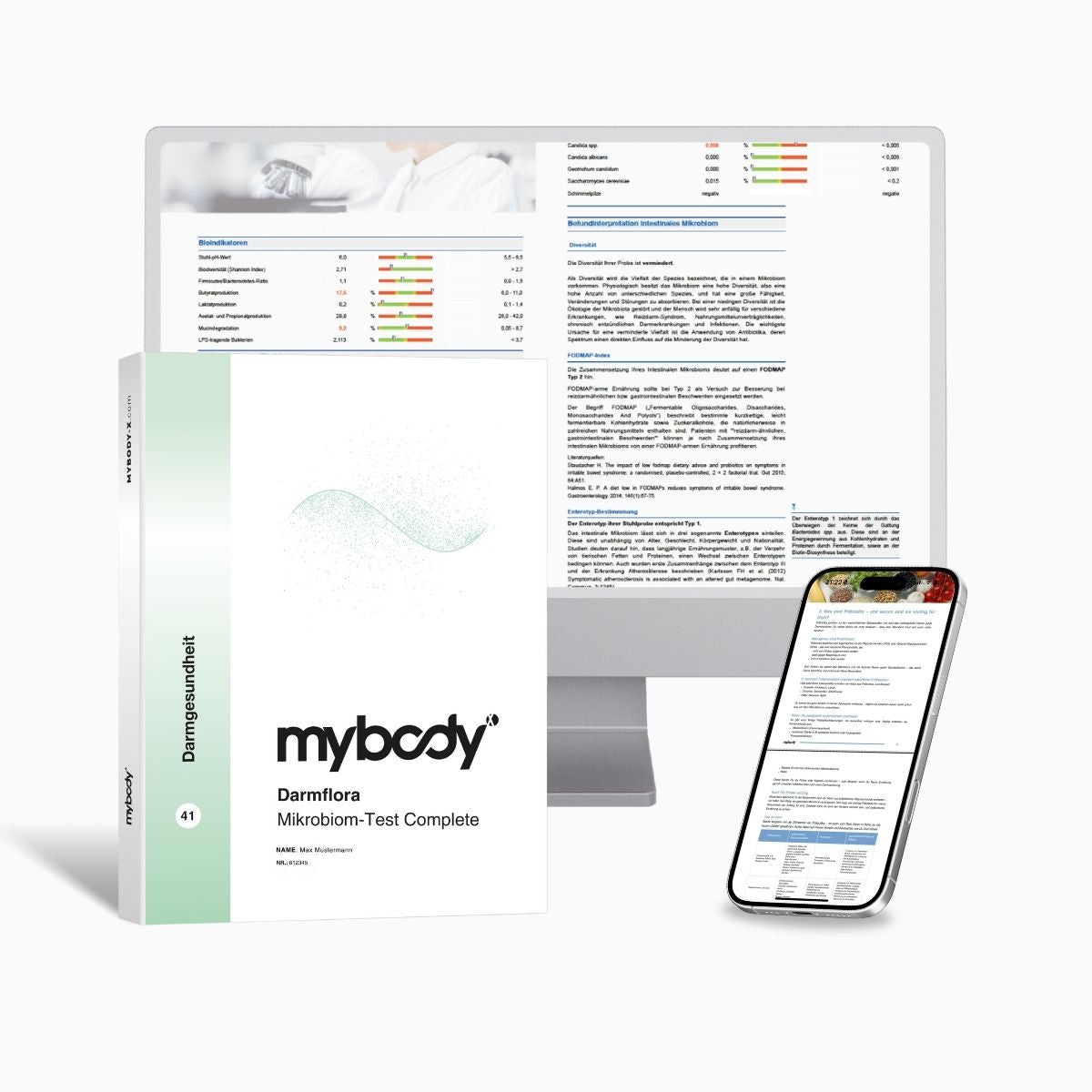
Gut Flora MICROBIOME Test Complete
Using DNA sequencing, the test identifies more than 1,500 bacterial species from a stool sample and categorizes them in a report of around 15 pages—including information on bacterial diversity, the ratio of protective to potentially problematic microbes, indications of dysbiosis, and the FODMAP index and enterotype. The test does not detect inflammatory bowel disease, does not provide a diagnosis, and does not replace a colonoscopy or medical treatment.
Price: €189.00 (instead of €219.00) · Sample type: Stool sample · Processing time: approx. 20–25 business days after sample receipt · Laboratory: ISO-certified laboratory analysis, ISO 27001
About the Microbiome Test CompleteAll price and service information is current as of July 28, 2026. Prices and processing times may change; the respective product page is always authoritative.
For everyday planning, the time factor is particularly relevant: It takes around 20 to 25 business days after the sample is received to receive the report. This cannot be used to manage an acute situation, so such an analysis is more useful during a calm phase.
Whether this is worthwhile for you depends less on the test than on your starting point. The following comparison presents both sides honestly.
Useful for you if …
… you are in a symptom-free or low-symptom phase and are already systematically reorganizing your diet.
… you already keep a food and symptom diary and want to read the results as an additional assessment alongside your own records.
… you can allow for a waiting time of around 20 to 25 business days without any decision depending on it.
… you can discuss the report at your treating practice or with a nutrition professional.
Probably not, if …
… you are experiencing an acute flare: Treating a flare belongs in the hands of a doctor, not in a stool sample.
… you have already been diagnosed with inflammatory bowel disease: Its treatment is not guided by a gut microbiome analysis, but by the medical treatment plan.
… you expect a diagnosis or a ready-made treatment plan: The test provides neither.
… you have warning signs such as significant weight loss, blood in the stool, fever, or pallor: In that case, medical evaluation is the only appropriate next step.
What can’t dietary planning and gut microbiome analysis do?
They do not provide treatment. A meal plan can make everyday life with intestinal inflammation easier, but it does not replace medical treatment. This applies equally to every plan, app, and test.
A meal plan can make everyday life with intestinal inflammation easier, but it does not replace medical treatment.
A gut microbiome analysis cannot detect inflammatory bowel disease, a tumor, an infection, or celiac disease. It describes a snapshot of the bacterial composition—that is all it claims to do, and no one should attribute more to it.
A carefully maintained food diary also has limitations. It shows associations, but not causes. Notes alone cannot establish whether a reaction is due to a food, portion size, stress, or the course of the disease itself.
Finally, dietary supplements are not a substitute for medical treatment. Regarding additional fiber supplements, IQWiG (2023) states that their benefit has not been proven. If you still want to take a supplement, discuss it with your treating practice—especially if medications are involved.
Conclusion
In everyday life, eating with intestinal inflammation is primarily an organizational task. The crucial work happens not at the stove, but in recording, planning, and shopping—and it happens during the symptom-free phase, not during a flare.
Specifically, this means: keep a food and symptom diary for two to four weeks, use it to create a tolerance list, use that to identify five safe staple meals, then create a weekly plan with an emergency option. One grocery shop per week, two or three precooked components, and one new food tested per week.
Just as important is what this plan is not. As of 2026, IQWiG information on Crohn’s disease and ulcerative colitis does not identify any diet proven to influence an existing inflammatory bowel disease. If there is significant weight loss, blood in the stool, fever, or pallor, medical evaluation comes first—before any plan or test.
Frequently asked questions
Is there a diet that cures intestinal inflammation?
No. As of 2026, the IQWiG information on Crohn’s disease and ulcerative colitis does not identify any diet that has been proven to influence existing inflammatory bowel disease. Diet can alleviate symptoms and ensure adequate nutrition, but it does not replace medical treatment.
What should I eat during an acute flare?
There is no generally applicable recommendation in the reviewed source material. According to the IQWiG (2026), during an acute Crohn’s disease flare, “abdominal pain and diarrhea are the main symptoms”—the priority is therefore to ensure adequate fluid and energy intake and choose well-tolerated foods. Treatment of the flare itself belongs in the hands of a doctor.
How much fiber is advisable when the bowel is inflamed?
The German Nutrition Society (DGE, 2021) gives adults a guideline value of at least 30 g per day. This value is a general reference and not a requirement for treating intestinal inflammation. How much you can tolerate depends on the phase and your individual response and should be guided by a doctor or nutrition professional.
Is a low-FODMAP elimination diet advisable for intestinal inflammation?
An elimination phase following a FODMAP diet should only be carried out with professional guidance. The IQWiG (2023) explicitly states the risk: “However, there is a risk of malnutrition because it becomes difficult to consume enough vitamins and minerals.” An elimination phase is limited in duration and ends with a structured reintroduction.
Can a microbiome test show whether my gut is inflamed?
No. A gut flora analysis describes the bacterial composition of stool. It does not detect chronic inflammatory bowel disease, a tumor, an infection, or celiac disease, does not provide a diagnosis, and replaces neither a colonoscopy nor medical treatment.
Assessment of your gut flora
If you are reorganizing your diet during a calm period anyway, an analysis of your gut flora can provide an additional assessment of your current situation. It does not replace medical evaluation and does not provide a diagnosis.
View the Microbiome Test Complete All gut tests at a glanceYou might also be interested in this
→ Stimulating digestion: What really helps in everyday life
Which everyday factors influence digestion.
→ The most reliable microbiome tests for your gut flora
How to recognize a reputable gut flora analysis and what it can do.
→ Gut encyclopedia: all bacteria and markers in your gut flora
Reference work with over 6,000 microbiome biomarkers—from protective bacteria and fiber fermenters to the metrics in your report.
Sources
- IQWiG / gesundheitsinformation.de: Crohn’s disease (2026) — gesundheitsinformation.de
- IQWiG / gesundheitsinformation.de: Ulcerative colitis (2026) — gesundheitsinformation.de
- IQWiG / gesundheitsinformation.de: What helps with irritable bowel syndrome—and what doesn’t? (2023) — gesundheitsinformation.de
- IQWiG / gesundheitsinformation.de: Irritable bowel syndrome (2023) — gesundheitsinformation.de
- German Nutrition Society (DGE): Reference values for fiber (2021) — dge.de
- IQWiG / gesundheitsinformation.de: What can you do yourself to treat hemorrhoids? (2025) — gesundheitsinformation.de
The definition and prevalence figures for Crohn’s disease, as well as the quotation in Chapter 3, are based on [1]. The information on ulcerative colitis, symptoms during a flare, and the prevention statement concerning vegetables, animal products, and highly processed foods comes from [2]. The statements on FODMAPs, the risk of malnutrition, fiber supplements, and probiotic tolerability come from [3], while the warning signs come from [4]. The recommended fiber intake comes from [5], and the information on fluid intake comes from [6], which addresses self-care for enlarged hemorrhoids. Product information comes from the mybody® product pages, accessed on July 28, 2026. All other studies mentioned in the text are cited directly at the relevant point with the authors, journal, and year.

mybody® Editorial & Expert Team
Gut health Chronic inflammatory bowel diseases Nutritional science Microbiome
This article was created and medically reviewed by the mybody® Editorial and Expert Team. The team combines expertise in nutrigenetics, microbiome and gut science, blood test interpretation, nutritional science, and laboratory diagnostics.
Published on July 28, 2026 · Last updated on July 28, 2026
Medical notice: This article is intended for general information and does not replace medical advice, diagnosis, or treatment. Chronic inflammatory bowel diseases such as Crohn’s disease and ulcerative colitis should be diagnosed and treated by a doctor; no dietary approach can replace this treatment. If you experience significant weight loss, blood in your stool, fever, or paleness, please consult a doctor.

Share now:
Constant burping without heartburn: causes, how to assess it, and what you can observe
Gut bacteria in children: What is proven and when an examination is advisable