

Meeting your daily vitamin B12 requirement: the figure and how to achieve it
The essentials at a glance
The daily requirement is quickly stated: The German Nutrition Society estimates that adults need 4.0 micrograms of vitamin B12 per day, pregnant women 4.5, and breastfeeding women 5.5 micrograms. That is little—a serving of cooked beef already provides 4.5 micrograms.
The route to the figure is more interesting than the number itself. The body cannot absorb an unlimited amount of B12 at once: According to the consumer advice center, it can actively absorb only about 2 micrograms per meal, and only after several hours can it do so again. Absorption also requires a substance produced in the stomach, known as intrinsic factor.
The practical takeaway of this article is therefore this: It is less about eating a lot of B12 in one day and more about spreading it throughout the day—and knowing whether you belong to one of the groups for whom absorption itself is the problem.
What to expect in this article
1. The daily requirement and what an estimate is
2. The values for all stages of life
3. Why absorption is limited
4. Which foods provide how much
5. The body’s stores and the long delay
6. Who has an increased risk of deficiency
7. Whether testing makes sense for you
8. What applies to supplements
9. What matters in the end
Frequently asked questions
Sources
The daily requirement and what an estimate is
For vitamin B12, the DGE does not specify a “recommended intake,” but rather an “estimate for an adequate intake.” This is not merely a wording detail, but a statement about the reliability of the available data—and the source explicitly provides the reasoning.
“
“Because vitamin B12 requirements cannot be determined with the desired degree of accuracy, the DGE no longer presents the revised reference values for vitamin B12 intake as recommended intakes, but as estimates for an adequate intake.”
German Nutrition Society (DGE)
New reference value for vitamin B12 intake, 2019
The same revision increased the value from 3.0 to 4.0 micrograms per day for adults. The German Federal Institute for Risk Assessment gives the same figure: a daily intake of 4 micrograms is sufficient for children aged 13 and over, as well as for adolescents and adults.
The source also explains how such an estimate is determined: It is based on studies in which the necessary intake was established using the concentrations of several blood markers. The value is therefore not a guess but a derivation—albeit with an uncertainty that the DGE openly acknowledges.
In practice, this has a reassuring consequence. An estimated value is not a threshold below which things become dangerous, but rather guidance for sustained intake. Being below it on one day is not a problem—the average over a longer period is what matters, and with B12 this is ensured in any case by a reserve, which Chapter 5 will return to.
And one more point of reference regarding the scale: 4 micrograms are four millionths of a gram. The amount at issue here is so small that it cannot be weighed meaningfully. This makes it all the more important to think in terms of foods rather than milligrams—and that is exactly what the table in Chapter 4 does.
Values for all stages of life
The requirement increases with age through adolescence and then remains constant—with two exceptions. The following overview shows the complete progression.
| Criterion | Children and adolescents | Adults aged 15 and over | Pregnant and breastfeeding women |
|---|---|---|---|
| Estimated value per day | 1–4 years 1.5 µg · 4–7 years 2.0 µg · 7–10 years 2.5 µg · 10–13 years 3.5 µg · 13–15 years 4.0 µg | 4.0 µg—unchanged across all age groups through age 65 and beyond | Pregnant women 4.5 µg · Breastfeeding women 5.5 µg |
| Infants | 0–4 months 0.5 µg · 4–12 months 1.4 µg | – | – |
| Type of value | Estimated value for adequate intake | Estimated value for adequate intake | Estimated value for adequate intake |
| Does the value continue to increase with age? | Yes, up to ages 13–15 | No—even from age 65 onward, it remains at 4.0 µg | Only for the duration of pregnancy and breastfeeding |
| What the value refers to | Intake from food | Intake from food—not the dose of a supplement | Intake from food |
All values: German Nutrition Society (DGE), Reference Values for Nutrient Intake, basis of derivation as of 2018. The last line is an editorial classification, not a figure provided by the DGE—it anticipates the distinction in Chapter 8.
What is not happening in this progression is noteworthy: The value does not increase with age, even though older people are more frequently affected by inadequate intake. The reason lies not in the requirement, but in absorption—and thus in the next chapter.
The increase for pregnant and breastfeeding women is just as revealing. Rising from 4.0 to 4.5 and 5.5 micrograms, respectively, represents a significant addition—in the breastfeeding period, almost 40 percent above the normal value. This is because the vitamin is passed on through breast milk, and the child’s supply depends on that of the mother.
Why absorption is limited
Vitamin B12 is the nutrient for which the difference between “eaten” and “absorbed” is greatest. According to the DGE, absorption from food into the intestinal cells requires binding to an intrinsic factor—and this is produced in the stomach cells.
This means that B12 supply depends on two organs rather than one. The stomach provides the auxiliary substance, and the intestine absorbs the finished complex. If either one fails, even the best choice of foods cannot make up for it.
The 2-microgram limit per meal
The second limiting factor is capacity. According to the consumer advice center, the body can actively absorb only about 2 micrograms of B12 per meal; only after several hours, for example at another meal, can this amount be absorbed again.
Compare that with the daily figure, and the practical consequence is obvious. Anyone who eats 4 micrograms in a single meal does not absorb 4 micrograms of it. Anyone who spreads the same amount across two or three meals comes much closer to that figure.
This also explains why supplements are often dosed higher than the daily requirement: At high doses, the entire amount is not actively absorbed; only a portion is absorbed through so-called passive diffusion. The dose stated on the package and the amount in the body are two different things.
In brief
Vitamin B12 can only be absorbed when it is bound to intrinsic factor—a substance produced in the stomach cells. The amount is also limited: According to the consumer advice center, the body actively absorbs about 2 micrograms per meal and can do so again only after several hours. It is therefore more sensible to spread B12-containing foods throughout the day than to consume the daily amount in one meal. The DGE’s estimated value of 4.0 micrograms per day describes intake from food, not the dose of a supplement.
How much different foods provide
Vitamin B12 is produced by microorganisms. The bacteria found in animals’ digestive tracts synthesize it, which is why, according to the BfR, it occurs in significant amounts only in animal-based foods—particularly liver, red muscle meat, fish, eggs, and dairy products.
Vitamin B12 per specified portion, in micrograms
Source: German Nutrition Society (DGE), Vitamin B12 FAQ, 2018, data basis: DGExpert. Important: The values refer to the portion size specified in each case, not to 100 grams. The bars can therefore only be compared with one another if you take the portion size into account.
In its examples, the DGE uses combinations rather than individual foods, and for good reason. A small glass of milk (150 g) and a small pot of yogurt (150 g) each provide 0.6 micrograms, one boiled egg provides 1.14, and two portions of Camembert (60 g) provide 1.86 micrograms—4.2 micrograms in total, which is above the estimated daily value.
This exact calculation fits the 2-microgram limit from the previous chapter. Four foods spread throughout the day cover the requirement better than one large portion at once—without having to plan it specifically.
What plant-based sources can provide—and what they cannot
Here, the evidence is clear and sobering. The DGE states that plant-based foods such as sauerkraut, as well as seaweed and shiitake mushrooms, may contain vitamin B12 compounds—but the forms they contain are not available to the human body and do not contribute to an adequate supply.
For people who eat a vegan diet, the consequence of this is described in Chapter 8. For everyone else, it is useful information when shopping: A product advertised as containing “natural plant-based B12” is making a claim that the DGE does not support.
Fortified foods are a separate matter. If B12 has been added to a plant-based drink or a breakfast product, this is stated in the ingredients list and nutrition table—it is not plant-based B12, but added B12. The difference is stated on the packaging; you just have to look in the right place.
The BZfE summarizes the practical side concisely: One serving of cooked salmon or beef, or a combination of one egg, two slices of Emmental cheese, a glass of milk and a pot of yogurt, contains enough vitamin B12. Two ways to reach the same goal—the second is better suited to the limited amount absorbed per meal.
The stores and the long delay
Vitamin B12 is the nutrient with the longest buffer. According to the BfR, a deficiency often occurs only after years of inadequate intake because the body can store around 2 to 5 milligrams of the vitamin.
Put this figure into perspective: 2 to 5 milligrams are 2,000 to 5,000 micrograms—at a daily requirement of 4 micrograms, a reserve that would theoretically last for years. The BfR gives a specific estimate: After about one to four years of a B12-free diet, the liver’s stores are depleted by half, and the first clinical symptoms appear only once they have fallen to 5 to 10 percent of their original level.
This delay is why your own sense of well-being is a poor guide when it comes to B12. Someone who feels nothing today may nevertheless have been consuming too little for two years. And someone who notices symptoms today may have set the cause in motion years earlier.
How a deficiency becomes noticeable
The DGE describes the chain of effects as follows: Inadequate intake leads to an increase in homocysteine in the blood. If deficient intake persists for a longer period, cell division may be disrupted, resulting in anemia.
The same source also mentions psychological abnormalities such as memory impairment, fatigue, attention deficits and depressive moods, as well as neurological disorders. The BfR describes the anemia more specifically—it is accompanied by paleness, tiredness, tingling or numbness.
As with almost all nutritional topics, these symptoms are nonspecific. Fatigue and concentration problems have many causes, and none of these symptoms alone points to B12. What supports the suspicion is the combination of symptoms and a plausible reason for an inadequate supply—and those are covered in the next chapter.
Who has an increased risk of deficiency
There are two fundamentally different paths to an inadequate supply: consuming too little or absorbing too little. Both lead to the same result but require different responses.
The intake side concerns dietary patterns. According to the DGE, people who follow a purely plant-based diet without taking vitamin B12 supplements have a high risk of deficiency; some vegetarians also have too low an intake. The BfR puts it more briefly: The risk is particularly high for people who follow a vegan diet.
The absorption side includes everything involving the stomach or intestines. The BfR names older people as well as those with certain stomach or intestinal diseases, such as atrophic gastritis, Crohn’s disease, or ulcerative colitis. The DGE adds the mechanism: Diseases of the stomach can affect the production of intrinsic factor, while intestinal diseases can reduce absorption.
Example: Martina, 68
Fictional scenario for illustration
Martina eats cheese and yogurt every day and fish regularly—on paper, she easily meets her B12 requirements. Nevertheless, she has felt tired and more forgetful than before for months. Two points in her medical history catch her family doctor's attention: She has been taking a proton pump inhibitor for heartburn for years, and she is 68. Neither concerns intake, but rather absorption—and therefore the part of the equation that no meal plan can solve. The case shows why, with B12, the question “How much do I eat?” alone does not get you anywhere and why clarification belongs in a medical practice.
Information on medications comes exclusively from the Verbraucherzentrale, so this attribution is stated explicitly: According to the source, about one in ten people who have to take metformin because of diabetes could develop a vitamin B12 deficiency. The same source also states that taking acid blockers or proton pump inhibitors over a longer period can promote a deficiency.
Regarding its frequency in older age, IQWiG cites a figure: In just over 25 percent of people over 65, vitamin B12 levels are below the applicable thresholds. However, what follows from this is less clear-cut than the figure might suggest—more on that in the next chapter.
Why the distinction between intake and absorption matters in practice becomes clear from the consequences. If the issue is intake, changing food choices or—on a strictly plant-based diet—taking a supplement can help. If the issue is absorption, both help only to a limited extent because the bottleneck lies beyond the plate. A self-assessment cannot determine which situation applies.
It is also striking that the two pathways can overlap. Someone who, in later life, also eats less meat and dairy than before experiences a shift on both sides—and this combination is more common in everyday life than either situation on its own.
Whether testing makes sense for you
For laboratory diagnostics, DGE names four markers: the two status parameters total vitamin B12 and holotranscobalamin in serum or plasma, and the functional parameters methylmalonic acid and homocysteine. Its recommendation on combining them is clear: a meaningful functional marker should be measured together with a status marker.
What this article deliberately does not include are numerical values for these markers. The source material used does not provide specific reference ranges—DGE, BfR, IQWiG, and the Verbraucherzentrale mention the markers but no thresholds. Adding them from another source would be the more convenient, but not the more honest, approach. In any case, the reference range on your own test report is what matters.
The objection that honesty requires
IQWiG examined the question of screening and reached a cautious conclusion: Vitamin D or vitamin B12 screening for asymptomatic people aged 50 and over cannot be recommended. Neither of the two studies evaluated found evidence that treating low vitamin B12 levels in symptom-free older people improves their health.
This assessment belongs in any article that mentions testing and should not be omitted. It does not mean that testing is never useful—it means that routine testing of symptom-free people has no proven benefit. Anyone with symptoms or belonging to one of the risk groups is in a different situation from someone who tests without a specific reason.
Worthwhile for you if …
… you follow a vegan or largely plant-based diet and want to know whether your current intake is adequate.
… you belong to one of the risk groups mentioned—older age, a stomach or intestinal disease, or long-term medication use.
… you have nonspecific symptoms and want to go into a doctor's appointment with a result rather than a suspicion.
Probably not if …
… if you are symptom-free and do not belong to a risk group: IQWiG explicitly advises against screening asymptomatic people aged 50 and over.
… you expect a diagnosis: A laboratory value is not a finding and does not clarify the cause—whether low intake or impaired absorption is involved must be determined through medical evaluation.
… an acute suspicion already exists: Then the evaluation, including functional markers, belongs in a medical practice, not in a self-test.
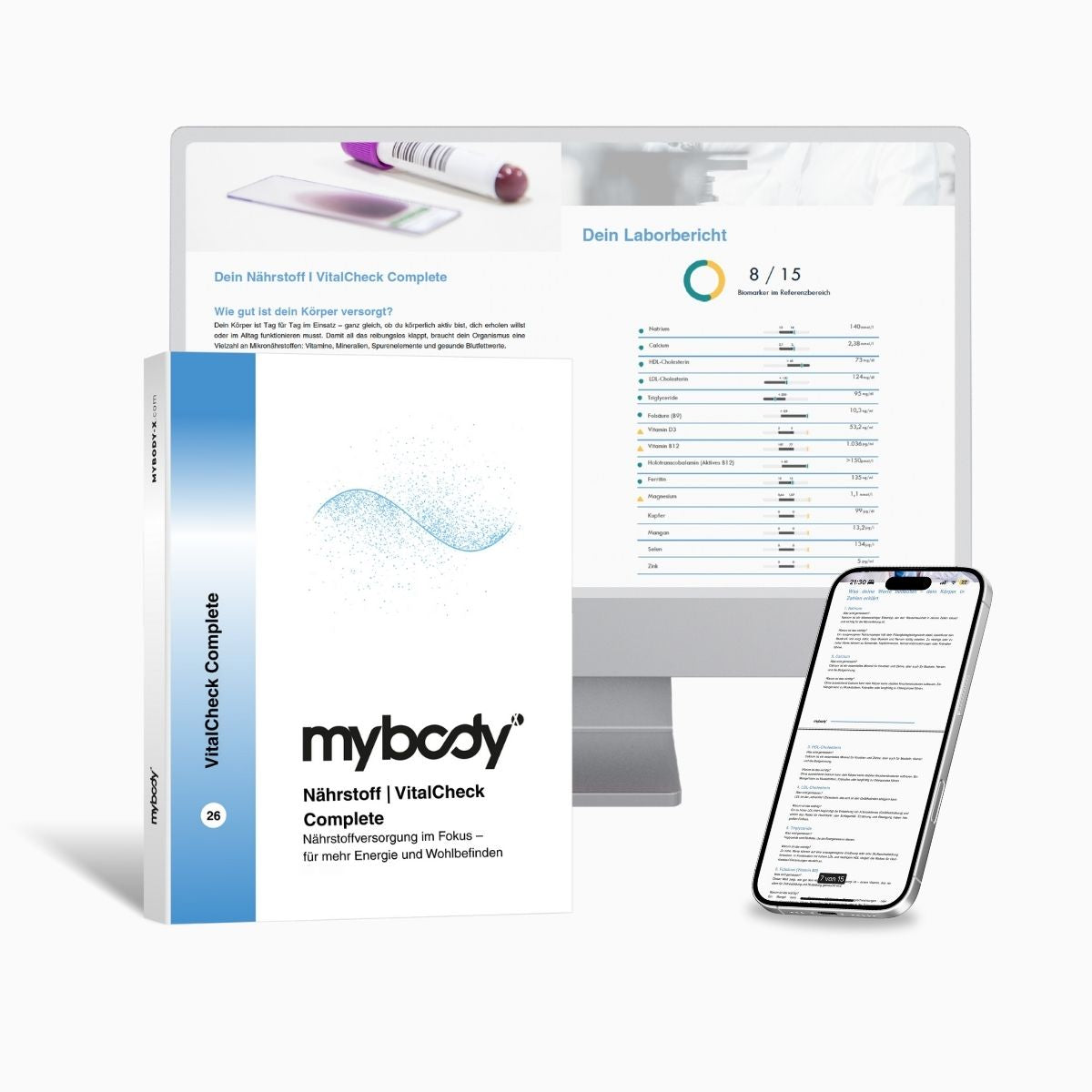
Nutrient | VitalCheck Complete
Determines 15 biomarkers from capillary blood, including vitamin B12 and transcobalamin—that is, one status marker and one additional marker—as well as folate, ferritin, 25-OH vitamin D3, zinc, selenium, magnesium, and calcium. What the test does not do: It measures neither methylmalonic acid nor homocysteine, meaning it does not measure either of the functional parameters mentioned by the DGE. It does not provide a diagnosis or determine whether low intake or impaired absorption is the cause.
Price: €169.00 (instead of €199.00) · Sample type: Capillary blood · Processing time: Kit shipping 1–3 business days, laboratory analysis 3–5 business days after receipt of the sample · Laboratory: ISO-certified laboratory analysis in Germany
About the Nährstoff VitalCheck CompleteAll price and service information is current as of August 5, 2026. Prices and the scope of services may change; the respective product page is always authoritative.
What applies to supplements
For most people, the answer is brief. According to the BfR, dietary supplements are generally unnecessary for healthy people who eat a balanced and varied diet.
One group is exempt from this. According to the DGE, people who follow an exclusively plant-based diet or consume only very small amounts of animal-based foods need to take a vitamin B12 supplement—on a long-term basis. The BfR recommends consulting a doctor for this.
Can you take too much?
A precise distinction is important here, but it is blurred in many texts. The DGE states that a high intake of vitamin B12 occurring naturally in foods is not harmful according to current knowledge. This statement explicitly refers to food.
The assessment is different for supplements. Although the BfR confirms that no adverse effects have so far been observed with high intake from usual foods, it also points out in the same breath that long-term intake of high amounts in the form of supplements, or high plasma levels, could be associated with an increased risk of adverse health effects.
This leads to the specific figure cited by the BfR: Food supplements for adolescents aged 15 and over and adults should contain no more than 25 micrograms of vitamin B12 per daily dose. Anyone comparing this with the amounts listed on commercially available packages will often find significantly higher values—another reason to coordinate supplementation with a doctor.
What ultimately matters
The daily requirement of 4.0 micrograms is easily met with a mixed diet—a glass of milk, a yogurt, an egg, and some cheese already provide more than that. Anyone who eats this way does not need to change anything at this point.
Two things are still worth paying attention to. First, distribution: Because only a limited amount is absorbed per meal, it is more effective to spread B12-containing foods throughout the day than to consume them all at once. Second, consider whether intake or absorption is the critical issue for you—for older people, those with gastrointestinal diseases, or those taking medication long term, the problem lies with absorption, and no meal plan will help in that case.
Your specific next step: Go through a typical day and check how many meals include any animal-based food at all. If it is two or more, intake is generally not an issue. If it is one or none, that is the point at which it is worth discussing the matter with a healthcare professional—and before symptoms appear, because body stores can delay any warning signs for years.
Frequently asked questions
How high is the daily vitamin B12 requirement?
For adults aged 15 and over, the DGE gives an estimated value of 4.0 micrograms per day, 4.5 for pregnant women, and 5.5 micrograms for breastfeeding women (basis of the estimate: 2018). This is explicitly an estimated value for an adequate intake, not a recommended intake, because according to the DGE, the requirement cannot be determined with the desired degree of accuracy.
Which foods meet the daily requirement?
According to the DGE examples, about a small glass of milk, a small cup of yogurt, one boiled egg, and two portions of Camembert are sufficient—4.2 micrograms in total. One portion of lean, cooked beef (100 g) provides 4.5 micrograms on its own, while one portion of salmon (70 g) provides 2.87 micrograms. The figures refer to the stated portion sizes, not to 100 grams.
Why isn’t it enough to eat a lot of B12 once a day?
Because absorption is limited. According to the consumer advice center, the body can actively absorb only about 2 micrograms per meal and can do so again only after several hours. In addition, absorption requires intrinsic factor, an auxiliary substance produced by cells in the stomach. That is why spreading intake throughout the day is more effective than consuming one large portion.
How long do B12 stores last?
According to the BfR, the body can store around 2 to 5 milligrams of vitamin B12. After about one to four years of a B12-free diet, the liver’s stores are half depleted; initial clinical symptoms do not appear until levels have fallen to 5 to 10 percent (as of 2023). A deficiency therefore often occurs only after years of inadequate intake.
Should I have my B12 level measured?
That depends on the situation. The Institute for Quality and Efficiency in Health Care (IQWiG) expressly does not recommend vitamin B12 screening for asymptomatic people aged 50 and over (as of 2022). The situation is different if you have symptoms or belong to a risk group. In that case, the DGE recommends measuring at least one status marker, such as serum vitamin B12, together with a functional marker, such as methylmalonic acid.
Intake or absorption—which is the issue in your case?
The meal plan answers only half the question. If you belong to one of the risk groups or have nonspecific symptoms, a test result provides a better basis for discussing the issue with your doctor than a suspicion.
View VitalCheck Complete Women's Wellness CheckYou might also be interested in
→ Vitamin B12 and diet: What really belongs on your plate
If the focus is less on the number and more on choosing specific foods.
→ Vitamin B12 deficiency test: What is measured and what the result means
In case there is already reason to suspect a deficiency.
Sources
- German Nutrition Society (DGE): Reference values for vitamin B12, basis for derivation as of 2018 — dge.de
- German Nutrition Society (DGE): Vitamin B12 FAQ, December 2018 (data basis: DGExpert), as well as the 2019 press release “New reference value for vitamin B12 intake” — dge.de
- German Federal Institute for Risk Assessment (BfR): Vitamin B12 in plant-based diets, as of 2023 — bfr.bund.de
- Institute for Quality and Efficiency in Health Care (IQWiG): ThemenCheck Medizin on vitamin D and vitamin B12 screening, 2022 — iqwig.de
- Consumer Advice Centre: Vitamin B12 for exhaustion and fatigue, 2025 edition, and FAQ on B12 supplements, 2025 edition — verbraucherzentrale.de
- Federal Center for Nutrition (BZfE): Vitamins, 2025 edition — bzfe.de
All estimates, including the complete age breakdown, the statement about sauerkraut, algae, and shiitake, and the statement about the need for a supplement with an exclusively plant-based diet, come from source [1]. The rationale for the estimates, the increase from 3.0 to 4.0 micrograms, the food values per serving, the information on intrinsic factor, symptoms, laboratory markers, and the safety of high intake from food come from source [2]. The storage capacity of 2 to 5 milligrams, the depletion period, the risk groups with gastrointestinal diseases, the maximum amount of 25 micrograms per daily dose, and the information on high-dose supplements come from source [3]. The assessment of screening and the proportion of just over 25 percent among people over 65 come from source [4]. The information on active absorption of approximately 2 micrograms per meal and all statements about metformin and proton pump inhibitors come exclusively from source [5] and are attributed accordingly in the text. The everyday summary with salmon, beef, or the combination of egg, Emmental cheese, milk, and yogurt comes from source [6]. None of the six sources provides reference ranges for total B12, holotranscobalamin, or methylmalonic acid; the article therefore deliberately does not list any. Product information comes from the mybody®x product pages, accessed on August 5, 2026.

mybody®x Editorial & Expert Team
Blood values Micronutrients Nutritional science
This article was created and medically reviewed by the mybody®x Editorial and Expert Team. The team combines expertise in nutrigenetics, microbiome and gut science, blood test interpretation, nutritional science, and laboratory diagnostics.
Published on August 5, 2026 · Last updated on August 5, 2026
Medical notice: This article is intended for general information and does not replace medical advice, diagnosis, or treatment. Dietary supplements should be taken in consultation with a doctor; this applies especially in the case of existing medical conditions, during pregnancy and breastfeeding, and when taking medication long term. Abnormal laboratory values should be medically evaluated.




Share now:
Low fT3 level: what the lab value means—and what it doesn’t mean
How long does it take for vitamin D to work? Blood levels and well-being