
At-home allergy tests explained simply
An at-home allergy test is like a first-aid kit for your health: readily available and requiring little effort. At mybody-x.com, you can get ISO- and CE-certified home self-tests—not only for allergies, but also for intolerances, nutrients, and hormones. Without visiting a medical practice, you receive valuable insights into your body within a few days.
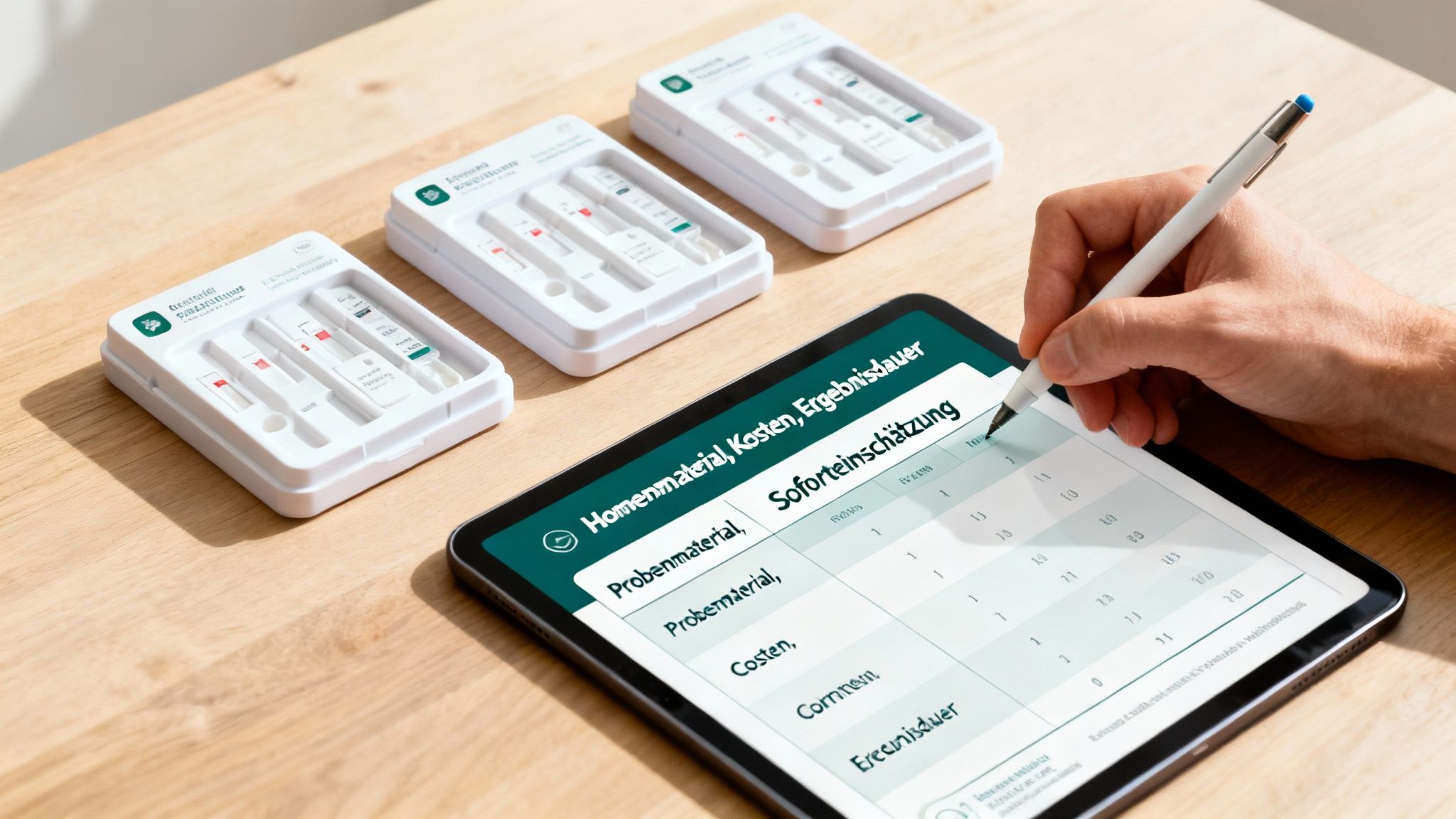
Quick assessment of at-home allergy tests
Here’s the quick check:
- IgE blood tests make specific antibodies visible in a drop of capillary blood
- Skin patch tests directly detect contact allergens on your skin
- Intolerance tests check which foods may cause reactions
According to the Allensbach AWA survey, around 12.49 million people aged 14 and over in Germany report being affected by an allergy—equivalent to about 17.7% of the population. You can find more details here about self-assessment as an allergy sufferer on Statista.
This brief assessment helps you determine in good time which method is best suited to you and what time and cost range you should plan for.
Quick overview and informative value
For an initial check, home self-tests are like a compass: they show you the general direction. At the same time, they do not replace a thorough evaluation by an allergist. Only ISO- and CE-certified providers guarantee a reliable basis.
Before we go into detail, let’s take a look at the most common home self-tests at a glance.
Comparison of common home test types
| Test type | Sample material | Cost (approx.) | Time to results |
|---|---|---|---|
| IgE blood test | Capillary blood | 180–220 € | 5–10 days |
| Skin patch test | Skin sample | 50–90 € | 15–30 minutes |
| IgG intolerance test | Capillary blood | 160–200 € | 2–5 days |
This lets you see at a glance which test suits you in terms of effort and speed.
- Choose a kit: Look for ISO and GDPR compliance at mybody-x.com.
- Plan a doctor’s appointment: For confirmation and further diagnostic testing.
Decision support
Home self-tests stand out for their speed and discretion:
- Results without visiting a medical practice
- Privacy thanks to testing at home
- Guidance for the next step
At the same time, sample collection and shipping conditions can affect accuracy. Afterwards, consider whether to order directly or consult a specialist.
Important considerations
Proceed calmly and carefully when drawing blood so that the drop forms cleanly.
Protect your data strictly in accordance with the GDPR, from sample labeling to the explanation of results.
Understanding available home tests
If you want to find out at home what is irritating your immune system, home self-tests are often the first quick step. They provide initial insights easily and without a doctor’s visit.
Online kits, pharmacy kits, and shipping packages differ in their ordering and support services:
- Online kits stand out with fast delivery and usually detailed digital instructions.
- Pharmacy kits offer the advantage of personal advice directly on site.
- Shipping packages often include return shipping materials along with more extensive test panels.
Test kit components
A home self-test kit is like a well-organized toolbox: everything you need is in the box. You will usually find:
- A lancing device that gently collects a drop of blood using a single-use lancet
- Special sample containers – from pretreated capillary tubes for blood to sealed tubes for saliva or urine
- Clear, well-structured instructions, often with step-by-step illustrations and safety information
- Return shipping materials: padded envelope or prepaid courier envelope for safe transport to the laboratory
This ensures that the sample is collected correctly and arrives at the laboratory intact.
Test materials and applications
Different samples are used depending on what you want to test. Allergy tests generally use capillary blood, while intolerance tests for metabolic or hormone analyses often use saliva or urine.
| Test type | Sample material | Significance |
|---|---|---|
| IgE blood test | Capillary blood | Detection of respiratory and food allergies |
| Saliva analysis | Saliva | Hormone and micronutrient status |
| Urine profile | Urine | Metabolic and uric acid levels |
For an IgE test, one drop of capillary blood (approx. 50 µl) is usually sufficient, and you can collect it in under a minute. Saliva and urine tests take a little longer, but provide a broader view of your metabolism.
Cost range and market development
In 2023, the global self-testing market rose to around USD 15 billion and is growing by approximately 6.7% per year.
In Germany, a home allergy test costs an average of 50 to over 150 euros, with prices usually around 100 euros. Learn more about market developments in the global self-testing market (gminsights.com).
6.7% annual growth shows how strongly interest in self-tests has increased.
Important quality features
Before ordering, you should pay attention to these points:
- ISO 13485 and CE marking guarantee medical quality
- GDPR compliance protects your data
- Laboratory certificates and awards provide additional reassurance
- Reviews from other users can help with the assessment
- Carefully compare the price and included test samples
For more information about the process and sample collection, see our guide on performing a blood test yourself at mybody-x.com.
Uses of home tests
Home self-tests are particularly suitable if your symptoms are mild to moderate and you want to identify initial triggers:
- Identify pollen allergies early in spring
- Quickly clarify pet hair allergies
- Narrow down suspected food reactions before shopping
You can use the results to adjust your daily routine accordingly and avoid potential irritants.
Compare providers
When choosing the right provider, price and test scope are not the only factors that matter. Also pay attention to:
- Customer service: Available by email or phone
- Processing time: Results ideally within 5–10 days
- Data protection: Server location in Germany for greater security
By comparing these criteria, you can make an informed decision and consciously choose your home self-test package.
How blood test kits work
If you want to find out what your body reacts to allergically, a home blood test kit provides exactly the right information. All without a doctor’s visit, but with professional laboratory analysis.
You can think of IgE antibodies as small door locks that can only be opened by very specific keys—the labeled enzymes in the test. As soon as a key fits, the sample visibly changes color.
You can easily collect the sample at home:
- Single-use lancing device for clean blood collection
- Capillary tubes, hermetically sealed
- Clear step-by-step instructions plus shipping materials
You then send the tube to the ISO-certified laboratory.
This is where ELISA procedures or similar enzyme immunoassays are used. An antigen adheres to a solid surface, the blood is added, and labeled enzymes produce a distinct color change when IgE antibodies are detected. This creates your personal allergy profile at mybody-x.com, broken down by individual allergens.
From a drop of blood to the result
Your report is created in five clearly structured steps:
- Sample preparation in the laboratory
- Automated measurement of color intensity
- Translation into specific IgE values
- Data preparation for the health portal
- Digital delivery
Your results will be available in the mybody-x.com health portal within 5–10 business days.
For more information, read our capillary blood collection instructions for safe sample collection.
Tip: Make sure the tube is completely dry. Any moisture can distort the result.
Your result contains not only raw figures but also clear graphs showing which allergens really play a role in everyday life. It also includes clear recommendations:
- Check the IgE level for each allergen tested
- Compare your values with the reference ranges in the report
- Relate your observations to your symptoms and adjust your environment
Why mybody-x kits are trustworthy
mybody-x.com works exclusively with German laboratories that are certified according to ISO 13485 and bear the CE mark.
Your data remains secure and anonymized thanks to GDPR-compliant processes. Independent quality controls and extensive customer feedback help ensure that the measurement results are always reliable.
- Transparency: Every step of the process is documented and traceable
- Safety: A sealed return envelope protects your sample
- Convenience: No visit to a medical practice is necessary; everything is handled digitally
With your test report in hand, you can plan the next step—such as a specialist allergy assessment. This lays the foundation for a life free from symptoms.
Understanding accuracy and quality criteria
Without reliable sensitivity and specificity, you can quickly run into problems. These two values show how well your home self-test detects genuine allergies and avoids false alarms.
Sensitivity indicates the proportion of people who actually suffer from allergies who are correctly identified. Specificity indicates how many healthy users are classified as allergy-free.
An effective test kit gets as close as possible to both values 100 % as close as possible. This is the only way to minimize the risk of incorrect results.
Sources of error can occur everywhere:
- improper storage
- inaccurate sample collection
- Transport without refrigeration
For example, with dry blood collection tubes, even a single drop of moisture can distort the result. If blood samples are stored at too high a temperature, antibody activity decreases—and so does the accuracy of your test.
Sensitivity and specificity compared
| Value | Sensitivity | Specificity |
|---|---|---|
| 80 % | medium | high |
| 90 % | high | very high |
| 95 % | very high | excellent |
As sensitivity or specificity decreases, the risk of misinterpretation increases. Therefore, always check the manufacturer's specifications and look for independent test reports.
Important certificates and standards
A reputable laboratory is transparent. Look for:
- ISO 13485—ensures process quality
- CE marking—ensures product safety
- GDPR compliance—protects your health data
Regular audits and traceability numbers for every sample are strong indicators of genuine quality. Lack of transparency regarding data protection? Then it is better to steer clear.
Experts advise that IgE-based blood tests are recognized in allergy diagnostics. IgG4 analyses and hair tests, on the other hand, are considered scientifically unsuitable and often produce false negatives. Read more in the AOK Magazine: Are self-tests for food intolerances useful?
A positive test result is never the end of the story. A medical specialist will usually carry out further tests to confirm the diagnosis.
You can read about the findings and user reviews in the article about experiences with at-home blood tests:
https://mybody-x.com/blogs/bluttest/bluttest-fur-zuhause-erfahrungen
Before purchasing, be sure that your test kit has a CE marking and complies with ISO 13485. This ensures that your results are valid and reliable.
Steps for performing an allergy test yourself
The test is divided into three simple stages and fits seamlessly into your everyday routine. First, choose your preferred allergy panel at mybody-x.com and add it to your cart.
Shortly afterward, you will receive an email with all the important information. In a few days, the mail carrier will ring your doorbell—your complete package will arrive and contain all the supplies needed to collect the sample.
- Order: Choose a test kit with CE and ISO certification
- Collect: Safely obtain capillary blood using the lancet
- Send: Return the sample in the prepaid envelope
Preparation and ordering
Before you get started, take a close look at the instructions—they explain every step in detail. Make sure your shipping label is filled out correctly and that the barcode is easy to read.
Fill out the information sheet with your details and store the sample tube in a dry place. The lancet and bandages are already included in your kit.
- Fill out the form with your personal details
- Protect the sample tube from moisture
- Keep the lancet and bandages within reach
Collection and shipping
To illustrate the process, we have summarized everything in one graphic:
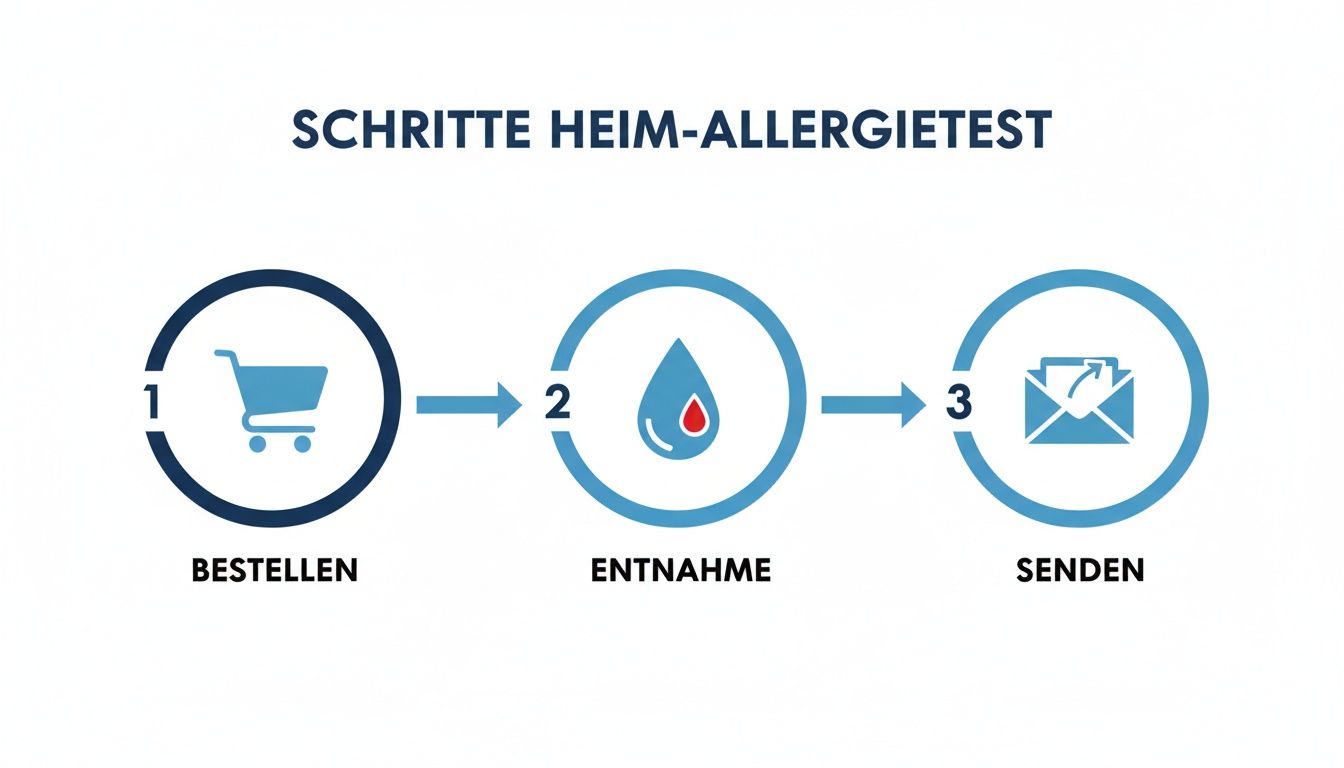
The infographic shows you 3 steps to make the test as stress-free as possible.
Clean your hands, massage your finger until it feels slightly warm, and then position the lancet. Carefully guide the drop of blood into the capillary tube, close it, and place it in the return envelope.
- Disinfect and warm your finger
- Guide the drops of blood into the tube
- Close the tube and place it in the protective container
Once your envelope is stamped, drop it off at the post office or in the nearest mailbox.
Access laboratory analysis and results
In the laboratory, the analysis begins with automated ELISA measurements. IgE antibodies are detected precisely to create your personal allergy profile.
The laboratory process is divided into
- Sample preparation and quality control
- Color intensity measurement for each allergen
- Data processing and summary of results
After 5–10 business days, you’ll find your test result in the mybody-x.com health portal. Your PDF report contains clear charts and specific IgE values—perfect for planning your next steps.
A positive result is only the beginning. Make an appointment with an allergist to discuss therapy or avoidance plans. This way, you’ll know exactly which allergens to avoid in the future.
- Plan an appointment with an allergist for a detailed diagnosis
- Review therapy or avoidance plans
- Use personalized recommendations in the portal
- Plan a follow-up test
More home self-tests at mybody-x.com
In addition to the DIY allergy test, you’ll also find the following at mybody-x.com:
- DIY intolerance test – for food reactions and digestive problems
- DIY nutrient test – to check micronutrients and vitamins
- DIY hormone test – for your hormone profile and cycle balance
Cover all key areas of your health with convenient at-home self-tests.
Recommendations and medical evaluation
After your home allergy test, you now know the possible triggers. The next step: develop a clear plan.
If the result is positive or unclear, it is advisable to see an allergist. In the laboratory, procedures such as a skin prick test, challenge test, and specific IgE measurements are used.
When medical evaluation is advisable
- Skin prick test – shows skin reactions in just a few minutes
- Challenge test – simulates allergy symptoms under controlled conditions
- Specific IgE measurement – provides detailed blood values from the laboratory
This diagnostic process provides certainty and minimizes misdiagnoses.
“Only a specialist medical evaluation provides the necessary basis for planning an appropriate treatment.”
Afterward, continue tracking your symptoms and adjust measures as needed.
Tips to avoid unnecessary elimination diets
- Keep a symptom diary – record triggers, timing, and intensity of reactions
- Gradual elimination – remove foods from your diet one at a time
- Professional guidance – avoid one-sided diets without medical advice
For optimal preparation for tests and medication, read our article on Preparing for antihistamines before an allergy test.
Combine your test results with your personal everyday experiences and use them to derive concrete steps.
Plan the next steps
- Schedule an appointment – see an allergist and secure a diagnosis
- Analyze your surroundings – identify potential triggers at home and in the office
- Discuss treatment options – from allergen immunotherapy to antihistamines
- Schedule a follow-up – review progress and adjust the treatment plan
Important: Only medical supervision can help you avoid health risks and unnecessary diets.
Use the health portal at mybody-x.com for regular updates and stay informed.
Develop a long-term strategy
Collect data for at least one year to identify seasonal patterns.
- Track the annual cycle – identify spring or autumn allergies
- Consider environmental factors – pollen levels, humidity, and living conditions
- Clarify medication coordination – especially if you regularly take antihistamines
This is how you can develop a sustainable allergy strategy and avoid unnecessary restrictions. If you have any questions, mybody-x.com support will be happy to help you quickly. Your family doctor is available for complex cases.
Frequently asked questions about at-home allergy testing
In this FAQ, you will find concise answers to the most important questions about at-home allergy testing. This helps you maintain an overview and make informed decisions.
Which sample materials are recommended?
For most tests, you use capillary blood – it directly detects IgE antibodies. Some providers also use saliva or urine tests. However, these methods are less precise for allergy diagnoses.
How reliable are the results?
Well-certified IgE tests (ISO, CE) score highly in terms of sensitivity and specificity. Nevertheless, minor errors can distort the findings. Therefore, pay attention to:
- Careful sample collection – wash your hands thoroughly
- Check the shipping requirements and drop off the package promptly
- Follow the storage instructions to ensure optimal quality
When is medical evaluation necessary?
If the result is positive or unclear, you should see an allergist promptly. There, tests such as the prick test or challenge test can confirm your diagnosis and provide a solid basis for treatment recommendations.
How much does an at-home allergy test from mybody-x.com cost?
Depending on the scope, prices range from 80 to 150 euros. The website provides transparent information, and you can conveniently put together your individual test package.
“An at-home self-test provides initial indications and supports you in preventive healthcare,” explains an expert from the mybody-x team.
Next steps
To ensure you proceed safely step by step, these four stages are recommended:
- Select and order your preferred test kit
- Collect and send the sample from home
- Check the results digitally
- Schedule an appointment with a specialist to confirm the diagnosis
Stay alert and record symptoms for comparison with your test results.
Test your knowledge now and analyze your allergy levels with mybody-x.com. Book your at-home allergy test today at mybody-x.com.



Share now:
Which blood test results really provide insight into fatigue
Difference Between Allergies and Intolerances: Symptoms, Tests & Diagnoses