

Optimize your health: The best gut microbiome tests with expert tips!
The most important points at a glance
Gut microbiome tests combine microbiome analysis with recommendations for action when they bring together two things: a laboratory evaluation of the bacterial composition in the gut and advice on nutrition and everyday life derived from it. The analysis describes the current state. The recommendations are general conclusions drawn from this finding—not a medical treatment plan or a diagnosis.
This page explains what a microbiome analysis technically measures, how to recognize whether the accompanying recommendations are reliable, and where the limitations of a laboratory analysis lie. It also identifies symptoms for which a self-test is no longer the right answer and medical evaluation is needed instead.
Chapter 1 explains what is measured, Chapter 2 provides six evaluation criteria, Chapter 3 compares the two available analyses, and Chapter 4 outlines the limitations. If you only want to know whether an analysis is worthwhile for you, go straight to Chapter 5.
What to expect on this page
1. What does a microbiome analysis actually measure?
2. How can you recognize reliable recommendations for action?
3. The two gut microbiome analyses in detail
4. What the recommendations can—and cannot—do
5. Who can benefit from an analysis?
Conclusion
Frequently asked questions
Sources
What does a microbiome analysis actually measure?
A microbiome analysis determines which bacteria live in the gut and in what proportions. It does not search for a single pathogen; instead, it describes a community of many different species and its composition at the time the sample was taken.
This difference determines what conclusions a report can actually support. A pathogen test answers the question, “Is something present or not?” A microbiome analysis answers the question, “How is the distribution currently structured?”—and that is a gradual, not binary, statement.
How a bacterial profile is created from a sample
In the laboratory, the bacteria’s genetic material is read from the submitted sample and assigned to known species. The frequency of the sequences detected produces a profile: which groups dominate, which are weakly represented, and how broad the overall spectrum is.
According to the Institute for Quality and Efficiency in Health Care (IQWiG), the gut microbiome consists of billions of bacteria that feed, among other things, on the indigestible components of food and produce the vital vitamins B and K in the process. The institute identifies a second function that is central to evaluating any gut microbiome analysis:
“
“It also protects the gut from other harmful bacteria settling in and multiplying.”
Institute for Quality and Efficiency in Health Care (IQWiG)
gesundheitsinformation.de, “How does the gut work?”, as of June 24, 2026
That is precisely why an analysis looks at the ratio between protective and potentially problematic microbes rather than at a single value. A shift in this ratio is known as dysbiosis—a sign, not a diagnosis of disease.
Key message: A microbiome analysis measures the composition and diversity of gut bacteria, not disease. It provides a starting point for dietary decisions and does not replace medical diagnostics.
Why diversity is the most important individual marker
The German Nutrition Society (DGE) put it this way in its 2021 statement on diet and the microbiome: “The richness of bacteria is considered a marker of a stable microbiome in healthy people.” A diverse microbiome is therefore considered more resilient than a one-sided one—regardless of which individual species is currently dominant.
In the same statement, the DGE also describes what this diversity achieves in practice: “Protective bacteria break down carbohydrates and produce short-chain fatty acids, especially butyrate.” These fatty acids are the biochemical reason why fiber appears in almost every recommendation for gut health.
The DGE also identifies the most important lever of all: “Diet shapes the composition of bacteria—which means that the type and amount of fiber can be assumed to have a significant influence on the composition of the microbiome.” As a guideline, the DGE’s reference values for adults recommend at least 30 grams of fiber per day (as of 2021).
You can look up which bacteria and markers appear individually in a report in the gut microbiome encyclopedia with all microbiome biomarkers, instead of skimming them in a list here.
How can you recognize reliable recommendations for action?
Almost every gut microbiome test now advertises recommendations. The difference lies not in the promise, but in whether the recommendation is visibly derived from your own results or is the same for everyone. The following six criteria can be checked on any product page before you buy.
Six criteria to check before buying
- ✓ Named method – the page identifies the method, such as DNA sequencing, instead of referring only generally to a laboratory analysis.
- ✓ Diversity instead of a single microbe – the bacterial community is assessed as a whole, rather than treating one microbe as the supposed culprit.
- ✓ Recommendations linked to the findings – the guidance clearly refers to the user’s own results rather than general dietary rules.
- ✓ Clearly stated limitations – the provider specifies what the test cannot detect instead of leaving this question unanswered.
- ✓ Verified laboratory and data protection – ISO-certified analysis and GDPR-compliant processing are clearly stated and can be checked.
- ✓ Predictable report – the scope and processing time are stated before purchase, not only in the confirmation email.
Why recommendations unrelated to the findings say little
“Eat more fiber” is correct, but unrelated to the findings—it applies even without any analysis. A recommendation becomes reliable only when it is linked to a measured characteristic, such as a low proportion of bacterial groups that produce short-chain fatty acids. A report whose recommendations would not change even with completely different findings is a guidebook with a laboratory bill.
What an ISO certification covers—and what it does not
An ISO certification concerns laboratory procedures and data handling. It indicates that processes are documented and verifiable. It says nothing about how informative the resulting dietary recommendation is in an individual case. These two questions should be considered separately, even if product pages often mention them in the same breath.
When a test is the wrong answer
There are symptoms for which no laboratory analysis is the right next step. The IQWiG explicitly lists “significant weight loss, blood in the stool, fever, or pallor” as signs that may indicate another intestinal disease (as of 2023). Regarding blood in the stool, the institute states that it “should generally be examined by a doctor to clarify the cause.”
Key message: Significant weight loss, blood in the stool, fever, pallor, persistent vomiting, or sudden severe abdominal pain should be assessed in a doctor’s office—not through a self-test, regardless of how detailed its report may be.
This page categorizes and compares the analyses. Those looking for a more detailed editorial examination of individual provider features can find it in our article on reliable microbiome tests; the article Microbiome analysis meets practical recommendations for action explains how analysis results can be turned into concrete everyday steps.
The two gut flora analyses in detail
mybody® (MYBODY Lab GmbH) offers two gut flora analyses for adults that differ in the scope of the analysis, not in the sample type. Both are analyzed from a stool sample in a certified specialist laboratory and, according to the product page, provide “personalized recommendations to support your gut flora” and “practical tips for adapting your diet and lifestyle.”
| Criterion | MICROBIOME Test Complete | MICROBIOME Test Essential |
|---|---|---|
| What is analyzed | Bacterial diversity, ratio of protective and problematic microorganisms, indications of dysbiosis, enterotype, FODMAP index, bacterial overview | Composition of the gut flora, ratio of protective and burdensome bacteria, intestinal environment (pH value), fungal colonization, indications of dysbiosis |
| Bacterial species analyzed | more than 1,500 analyzed using DNA sequencing | No number of species specified on the product page |
| Sample type | Stool sample collected at home | Stool sample collected at home |
| Report length | approx. 15 pages plus online analysis | approx. 15 pages plus online analysis |
| Recommendations section | personalized recommendations and practical tips on diet and lifestyle | personalized recommendations and practical tips on diet and lifestyle |
| Processing time | approx. 5–10 working days after receipt of the sample | approx. 5–10 working days after receipt of the sample |
| Price | €189.00 (instead of €219.00) | €149.00 (instead of €169.00) |
1. Complete – the comprehensive analysis including the FODMAP index and enterotype
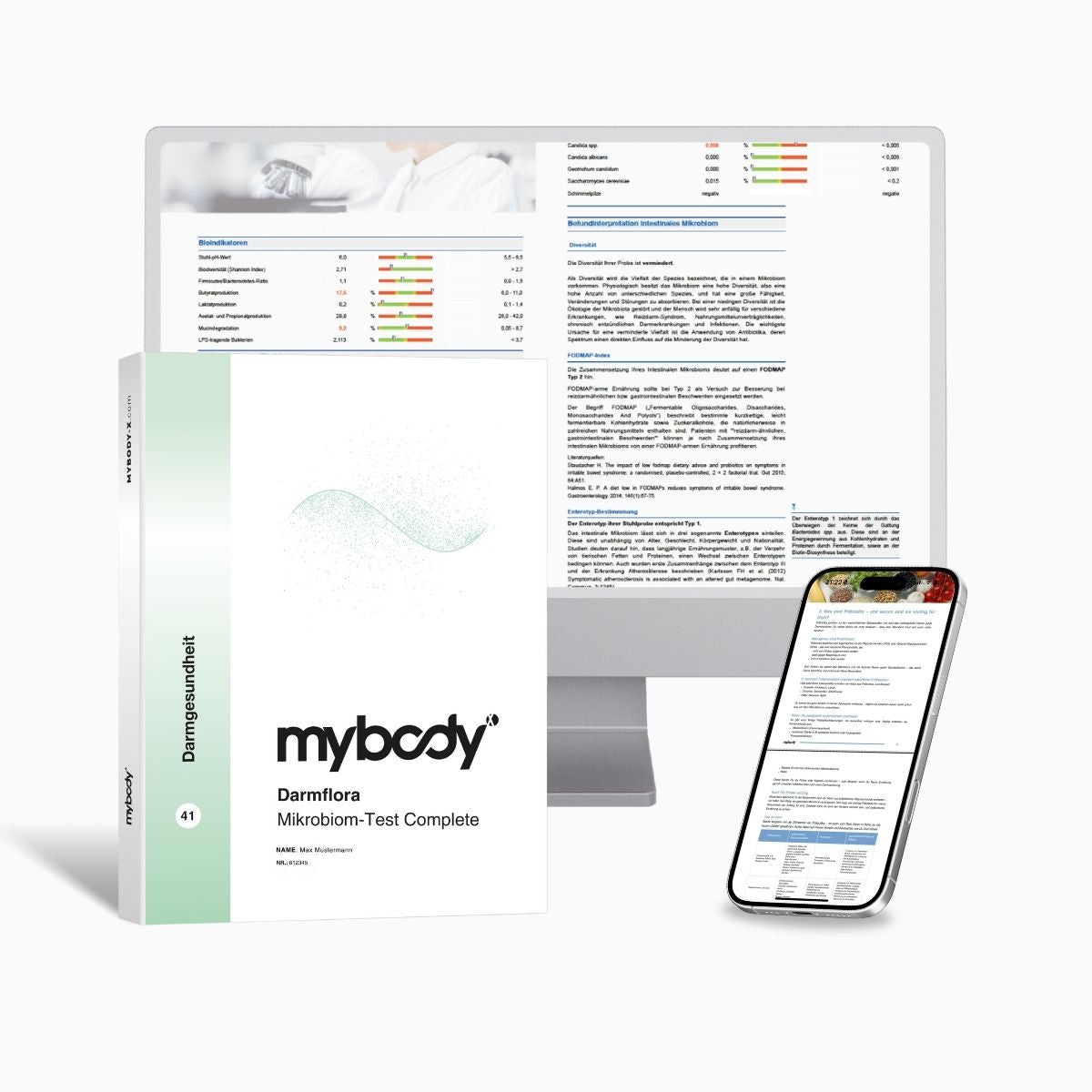
Gut Flora MICROBIOME Test Complete
Analyzes more than 1,500 bacterial species using DNA sequencing and supplements the composition analysis with enterotype determination and a FODMAP index. The report contains personalized recommendations on diet and lifestyle. The test does not provide a diagnosis and does not detect inflammatory bowel disease, celiac disease, infections, or tumors.
Price: €189.00 (instead of €219.00) · Sample type: Stool sample · Processing time: approx. 5–10 working days · Laboratory: ISO-certified laboratory analysis, ISO 27001
The Complete MICROBIOME TestBest for People who want to approach recurring digestive complaints in a structured way while looking for a starting point for selecting foods.
✓ The broadest analysis of the two variants, including an enterotype and FODMAP index.
✓ Specifies the number of bacteria, rather than merely referring to an analysis.
✗ Significantly more expensive than the smaller version despite having the same report length.
✗ This scope of analysis also cannot answer any question that requires medical evaluation.
2. Essential—the more affordable entry point with intestinal environment and fungal colonization
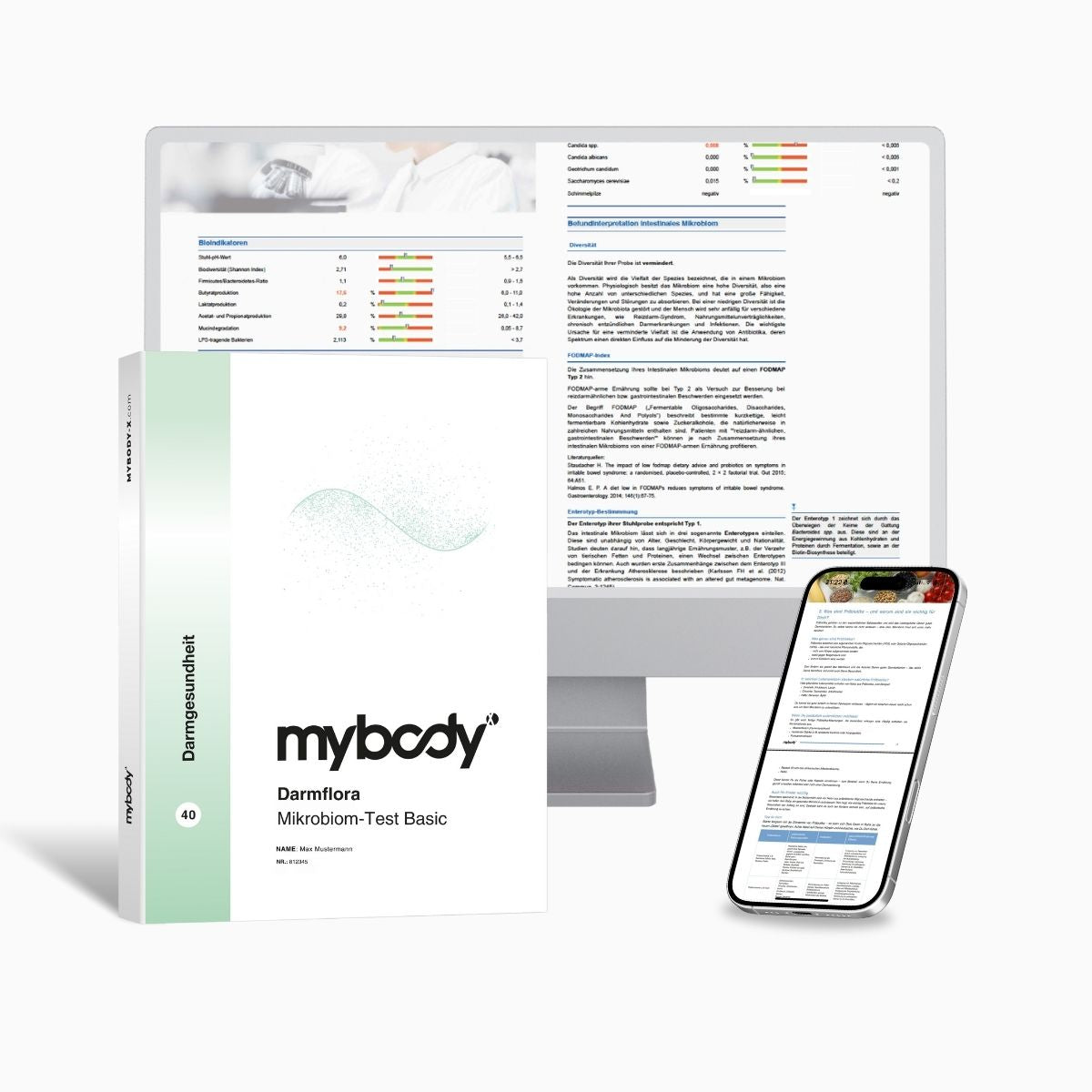
Gut flora MIKROBIOM test | Essential
Analyzes the composition of the gut flora and supplements it with information on the intestinal environment (pH value) and fungal colonization. The report also includes personalized recommendations. The product page does not state the number of bacterial species examined; those who need this information are better served by the Complete version.
Price: €149.00 (instead of €169.00) · Sample type: Stool sample · Processing time: approx. 5–10 business days · Laboratory: ISO-certified laboratory analysis
To the MIKROBIOM Essential testBest for People taking a gut flora analysis for the first time who initially want an overview of their composition and intestinal environment.
✓ Around €40 cheaper with the same report scope and processing time.
✓ Includes two details—the intestinal environment and fungal colonization—that do not appear in the Complete description.
✗ No FODMAP index, no enterotype—precisely the information that is most helpful for dietary questions.
✗ Without a stated number of species, it is harder to assess the depth of the analysis before purchase.
All price and service details are as of July 30, 2026. The stated processing time of 5 to 10 business days refers to laboratory analysis after receipt of the sample. Prices, report contents, and processing times may change.
In brief
Both analyses use the same sample type, report length, and processing time, and both provide a recommendations section. The only difference is the depth of the analysis: Complete identifies more than 1,500 bacterial species and includes an enterotype and FODMAP index, while Essential focuses on composition, the intestinal environment, and fungal colonization. Those who primarily want to use the analysis to make dietary decisions will find the more relevant information in the Complete version.
What the recommendations can—and cannot—do
A gut microbiome analysis is not a diagnostic procedure. It cannot detect inflammatory bowel disease, celiac disease, an infection, or a tumor. Anyone seeking answers to one of these questions needs a medical examination, not a report on bacterial composition.
The recommendations themselves also have clear limits. They are suggestions about diet and everyday life derived from the findings—not an individually prescribed meal plan or a treatment. A finding describes a state, not a cause. This distinction determines how much weight you should give the result.
A finding describes a state, not a cause.
How far has the research really come?
The DGE report on nutrition and the microbiome quotes a professional assessment that is remarkably sober: “So far, I do not see how a specific diet can influence the microbiome in a clearly defined direction.” This is the assessment of one individual expert quoted in the report, not an official DGE position—but it honestly indicates where things currently stand.
A second statement from the same report fits this point: “While short-term dietary changes alter the gut microbiota quickly but reversibly, longer-term changes can affect the genome.” In other words, eating differently for a week measurably shifts something—but only what persists becomes permanent.
Caution with elimination diets and supplements
The FODMAP index can tempt people to immediately eliminate entire food groups. IQWiG explicitly points out a risk associated with a low-FODMAP diet: “However, there is a risk of malnutrition because it becomes difficult to consume enough vitamins and minerals” (as of 2023). Such a dietary change should be professionally supervised and limited in duration, not undertaken permanently on your own.
The evidence on dietary supplements is also clearer than advertising would have you believe. Regarding fiber supplements, IQWiG writes: “It has not been proven that additional fiber supplements help.” Regarding probiotics, it states: “In general, probiotics are well tolerated: only rarely do mild side effects such as flatulence occur.” Being well tolerated does not mean being effective—these are two different statements.
Who can benefit from an analysis?
A gut microbiome analysis is worthwhile when it helps structure an open question—and not when the answer is already clear or a medical evaluation is needed. According to estimates by IQWiG, around 10 to 20 in 100 people have irritable bowel syndrome (as of 2023); for this large group, asking about their own starting point is a natural consideration.
Useful for you if …
… you have recurring symptoms that have already been medically evaluated and are looking for an objective starting point for dietary decisions.
… you already want to change your diet and would like to track the process with a before-and-after measurement.
… you want to know how diverse your gut flora is, because according to the DGE, diversity is considered a marker of a stable microbiome.
Not recommended if …
… you have acute warning signs: significant weight loss, blood in the stool, fever, or paleness require medical evaluation, not analysis.
… you expect a diagnosis. Neither Complete nor Essential provides one, and no analysis replaces a medical examination.
… you expect the result to provide a ready-made meal plan. You receive guidance from which you can derive your own steps.
Conclusion
Gut flora tests that combine microbiome analysis with practical recommendations do exist—but what matters is how closely the recommendations are tied to your own findings. Before purchasing, check whether the method is specified, whether diversity rather than a single microbe is analyzed, whether the provider openly discloses its limitations, and whether the scope and processing time are stated in advance.
If you mainly want to use the analysis for dietary decisions, the Complete version provides more suitable information with its FODMAP index and enterotype. If you are simply looking for an overview, the Essential version offers the same report length at a lower price. And if you notice warning signs, don't take a test—make an appointment with a doctor.
Frequently asked questions
Have your gut flora assessed
If you are looking for an objective starting point for your dietary decisions, an analysis from a certified laboratory provides exactly that—but nothing more.
View the MIKROBIOM Complete Test All gut tests at a glanceYou might also be interested in
→ Gut encyclopedia: all bacteria and markers in your gut microbiome
Searchable overview of the individual microbiome biomarkers.
→ The most reliable microbiome tests for your gut flora
Editorial assessment of the quality characteristics of a gut microbiome analysis.
→ Microbiome analysis meets practical recommendations for action
How findings become concrete steps for everyday life.
Sources
- Institute for Quality and Efficiency in Health Care (IQWiG): How does the gut work? As of June 24, 2026 — gesundheitsinformation.de
- German Nutrition Society (DGE): Nutrition and the microbiome, 2021 report — dge.de
- German Nutrition Society (DGE): Reference values for dietary fiber, as of 2021 — dge.de
- IQWiG: Irritable bowel syndrome, as of February 22, 2023 — gesundheitsinformation.de
- IQWiG: What helps with irritable bowel syndrome—and what doesn't? As of February 22, 2023 — gesundheitsinformation.de
The description of the gut microbiome and its protective function is based on [1]. Statements about diversity, butyrate, dietary fiber, and the reversibility of short-term changes are taken from [2], while the guideline of 30 grams of dietary fiber per day comes from [3]. Information on the frequency and warning signs of irritable bowel syndrome comes from [4], and the information on FODMAPs, fiber supplements, and probiotics comes from [5]. All product information comes from the mybody® product pages, accessed on July 30, 2026.

mybody® Editorial & Expert Team
Gut health Microbiome Laboratory diagnostics Nutritional science
This page was created and medically reviewed by the mybody® Editorial and Expert Team. The team combines expertise in nutrigenetics, microbiome and gut science, blood analysis interpretation, nutritional science, and laboratory diagnostics.
Last updated on July 30, 2026
Medical note: This page is for general information only and does not replace medical advice, diagnosis, or treatment. A gut microbiome analysis is not a diagnostic procedure. If symptoms persist or are severe, or if you experience blood in your stool, fever, unintended weight loss, or paleness, please contact a medical practice.
