
 300 food products
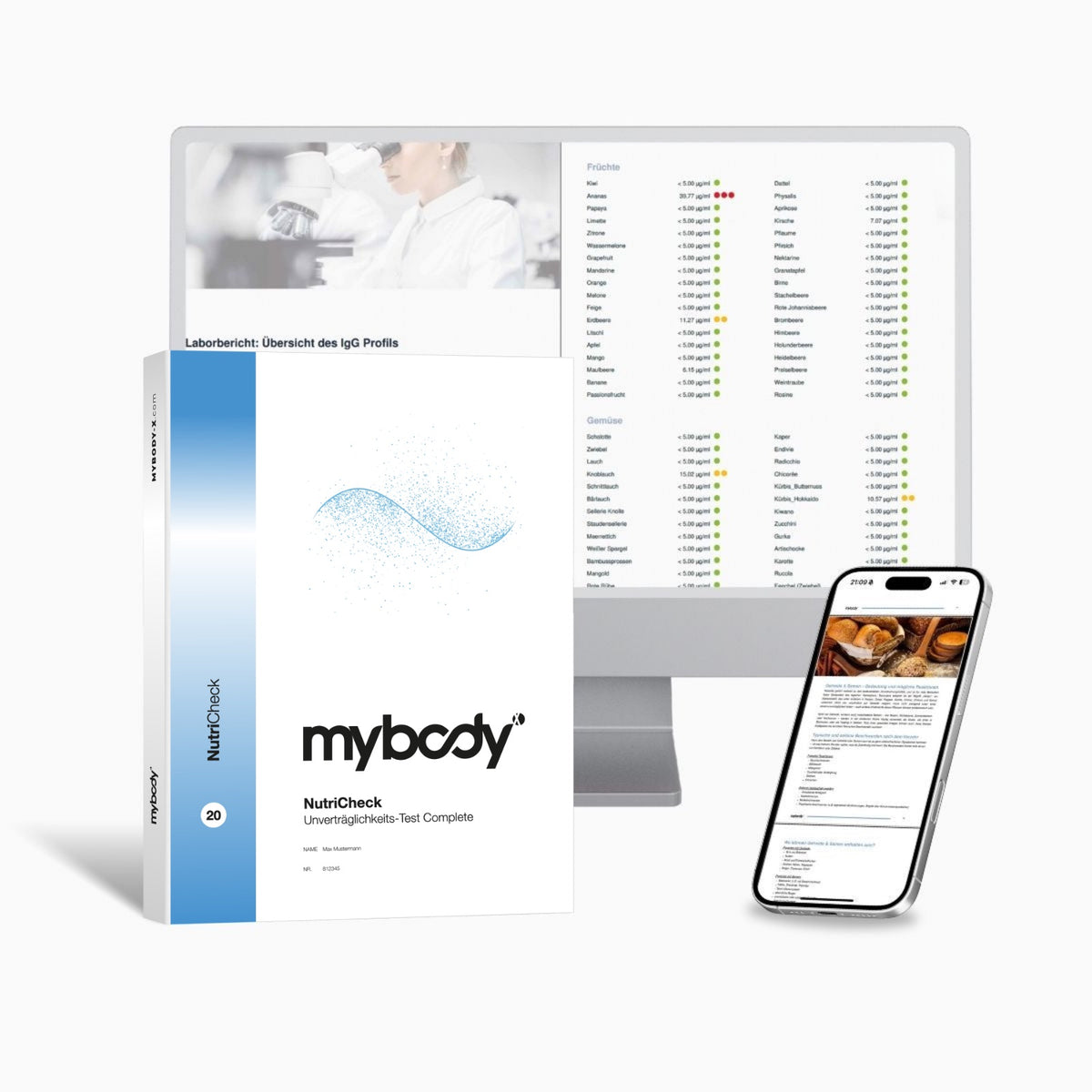




NutriCheck I Complete Intolerance Test
Symptoms after eating, but no discernible pattern? NutriCheck measures IgG antibodies against up to 300 foods and gives you a starting point for your elimination phase.



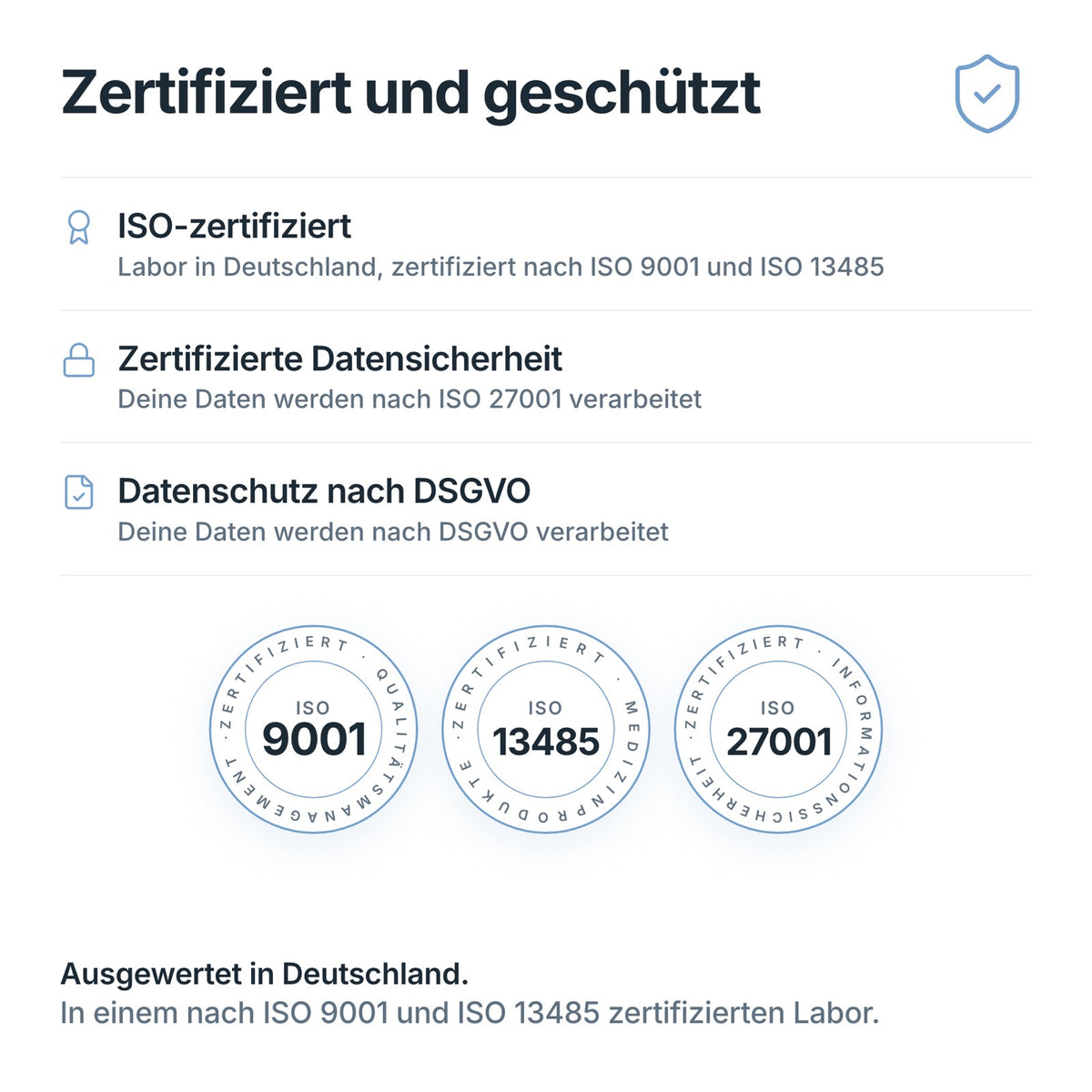
ISO-certified laboratory analysis

High privacy & secure purchase
The intolerance test includes:
- At-home capillary test kit including instructions
- Certified laboratory analysis of your blood sample
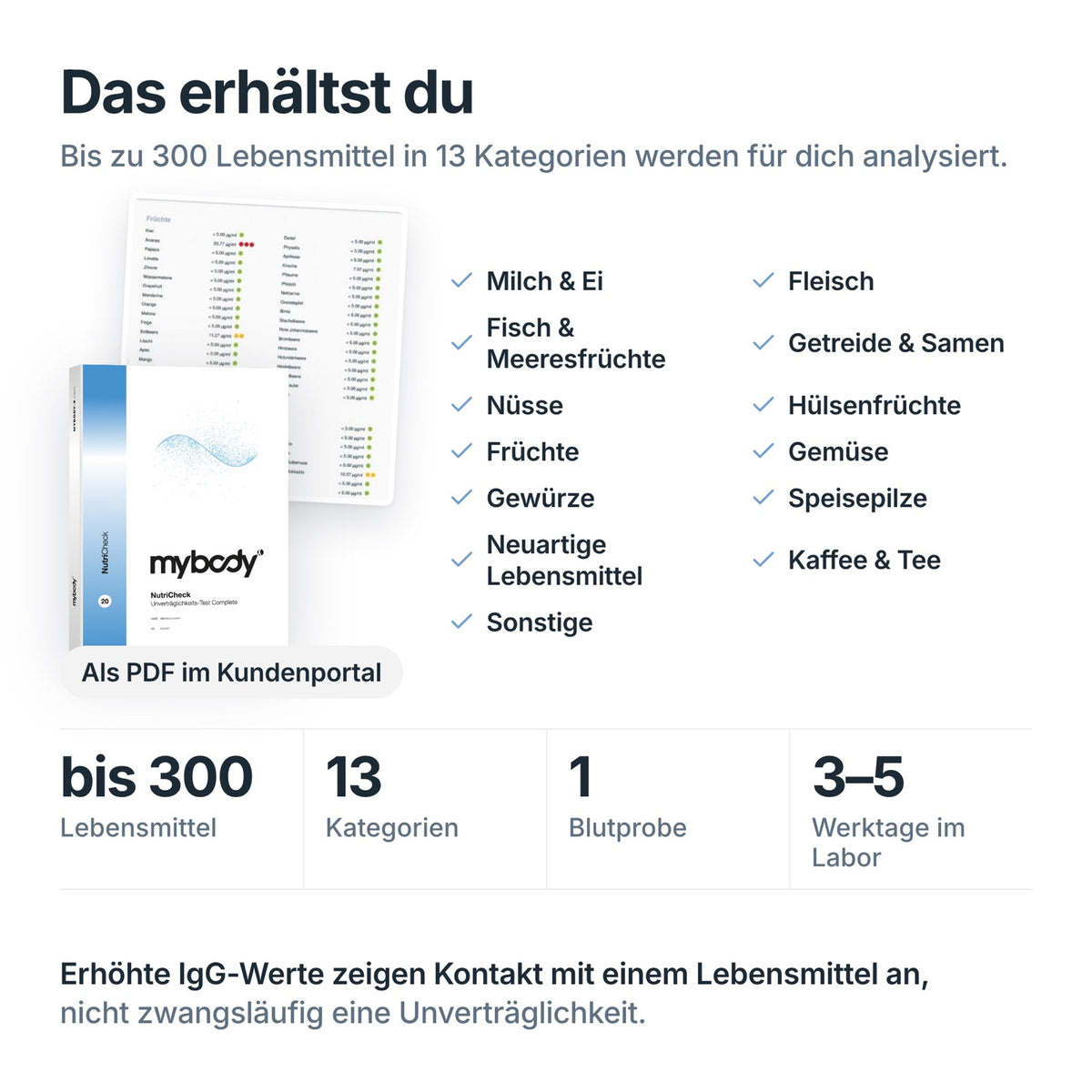
- Analysis of up to 300 foods
- Analysis reports divided into 13 categories
- Results available in the online portal
- Free online customer support
These values will be analyzed for you
- Milk & Eggs
- Meat
- Fish & Seafood
- Grains & Seeds
- Nuts
- Legumes
- Fruits
- Vegetables
- Spices
- Edible Mushrooms
- Novel Foods
- Coffee & Tea
- Other
NutriCheck is right for you if:
Bloating or abdominal pressure after eating
– Complaints after meals can have many possible causes.
Fatigue that sets in after eating
– A food diary is often more helpful here than trial and error.
You have already eliminated foods without any improvement
– Without a starting point, most people eliminate too much.
Symptoms without a recognizable pattern
– When everything is a possibility, what is mainly missing is an order.
A planned elimination phase that you want to structure
– The result tells you where to start.
You eat a varied diet and do not know where to begin
– 13 categories cover the usual suspects.
If you are unsure whether the food intolerance test is right for you, our product finder can help you.
Product description: intolerance test
The NutriCheck from mybody®x is an at-home blood test that measures IgG antibodies against up to 300 foods. The results are provided in 13 category-based reports, covering everything from dairy and eggs to grains and legumes, as well as spices and edible mushrooms. The analysis is carried out in a specialist laboratory in Germany.
Allergology societies do not recommend IgG tests for diagnosing food intolerances. Elevated IgG levels indicate that your immune system has been in contact with a food, not necessarily that you have an intolerance. We state this here on the product page rather than in the fine print because you should know it before you pay.
What the food intolerance test is useful for: as a starting point for a structured elimination phase. Instead of starting from scratch, you know which foods to observe first and in what order to reintroduce them. This is most useful with the guidance of a nutrition professional. People who eliminate foods on their own usually eliminate too many.
Developed by doctors
Scientifically sound
Precise analyses
Easy to use
Experience food mindfully
Your analysis in detail
Vegetarian and animal-based foods
- Edible mushrooms
- Milk and eggs
- Meat
- Fish and seafood
Vegan foods
- Fruit and vegetables
- Grains and seeds
- Nuts and legumes
Other food products
- Tea and coffee
- Novel foods
- Other foodstuffs
What to expect:
Symptoms after eating, but no clear pattern
Bloating, abdominal pressure, fatigue after a meal – and you have no idea what might be causing it. A food diary is the way to find out. The only question is where to start when everything seems like a possibility. That is exactly what NutriCheck is designed for.
✔️ Up to 300 foods – the test measures IgG, an antibody that indicates contact with a food.
✔️ 13 category-based reports – from milk and eggs to grains and legumes, as well as spices and edible mushrooms.
✔️ A starting point for your elimination phase – you know which foods to monitor first instead of starting from scratch.
What you need to know before ordering: Allergy societies do not recommend IgG tests for diagnosing food intolerances. Elevated IgG levels indicate contact with a food, but do not necessarily indicate an intolerance. We are telling you this because you should know it before you pay.
The food intolerance test is most useful when carried out with the support of a nutrition professional. When people eliminate foods on their own, they usually eliminate too many – which is exactly why your results also include guidance on how to proceed.
Your benefits at a glance

300 foods analyzed
Prevention as the top priority

State-of-the-art capillary blood analysis
The NutriCheck I Intolerance Test works this simply
All you need is your mybody® at-home test kit. After your blood sample has been analyzed, you will receive your detailed laboratory report—explained clearly and simply.

1. Remove the probe
After receiving your test kit, collect blood from your finger according to the instructions.

2. Activate test kit
Activate your test on the mybody® platform to track the status of your sample and results later. Then send us your sample.

3. Receive results
As soon as your sample arrives at our partner laboratory, you will conveniently receive your result through the mybody® platform within 4–8 business days.

Understand what you’re reacting to and identify a pattern
Stomach pain after eating, without any discernible pattern. NutriCheck measures IgG antibodies against up to 300 foods and gives you a starting point for a structured elimination phase.
Important to know: Professional medical societies do not recommend IgG tests for diagnosing intolerances. What you get is a list to try out, not a diagnosis—say goodbye to:
🤔 Randomly eliminating foods
📝 Food diaries without results
🥗 Guesswork instead of a plan



Identify intolerances and feel better in the long term
- Simple and convenient: Collect your sample easily from home.
- Professional analysis: Your sample is analyzed in a specialized medical laboratory. ISO-certified & GDPR-compliant.
- Precise antibody measurement: We measure specific IgE and IgG4 antibodies, which are often associated with food intolerances.
- Fast results: You will receive your test results within 4 to 8 working days after your sample arrives.
Practical recommendations: Based on the results, you will receive specific advice on how to improve your diet and manage intolerances in everyday life - safely and always at hand on the mybody® platform
Medicine and science meet ISO-certified laboratory processes

Our tests are developed in close collaboration with experts from various fields, including nutrition and sports science as well as laboratory technology. With many years of experience in the industry and our ISO-certified processes, we ensure the highest quality and reliability.
Thanks to this comprehensive expertise, we offer you products that are not only based on the latest scientific findings, but also meet strict quality standards.


Highest quality standard
ISO-certified analyses & medical self-tests
Expert advice
Free consultation & discussion of the analysis reports
Years of experience
Present across Europe in 12 countries with 11,000+ happy customers
Designed to enhance your quality of life...

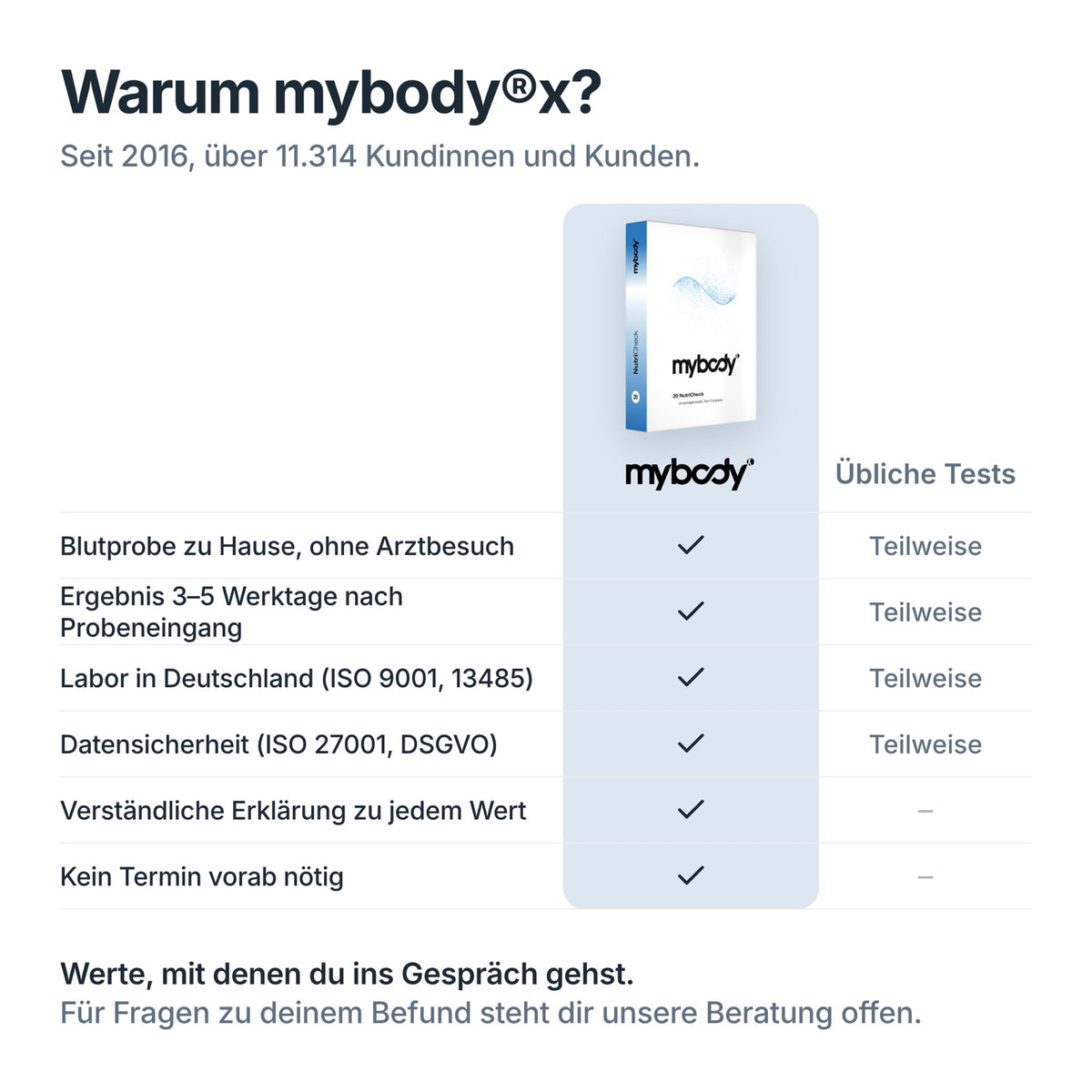
11,314+ people were exactly where you are now...
Don’t take our word for it—listen to our customers. Here’s what our customers say about their experiences with and after the metabolic analysis by mybody©.

⭐️⭐️⭐️⭐️⭐️
Stefanie B. - 42 years old
I’m maintaining my weight
I wanted to lower the dosage of my thyroid medication, eat more healthily, and lose weight. I also wanted to prepare for the future and prevent illnesses.
Overall, I feel healthier. I was able to reduce my thyroid medication, I’ve lost weight, my body is more defined and my arms are firmer, my skin is much better, and my hair is shinier. I’m maintaining my weight.

⭐️⭐️⭐️⭐️⭐️
Christian R. - 46 years old
My well-being has improved
I follow my food traffic-light plan and take a five-hour break between meals. I also regularly look for quick, simple recipes that suit my metabolic type.
Thanks to changing my diet, my food intolerances and therefore the symptoms have virtually disappeared—by 95%. A fantastic success for me! I have also lost a few extra pounds, which is a great side effect.

⭐️⭐️⭐️⭐️⭐️
Vanessa W. - 24 years old
I lost 17 kg
Enjoyment and a vibrant, slim body—these were things I thought I couldn’t reconcile as a hobby cook. Until I tried the mybody® DNA metabolism analysis. Along the way, my waist circumference melted away.
I feel fitter than ever, and the best part is: no calorie counting—just eating delicious, satisfying food and enjoying pure joie de vivre thanks to the foods that suit my metabolism.

⭐️⭐️⭐️⭐️⭐️
Marissa H. - 28 years old
My skin has never looked so beautiful
After years of skin problems and unsuccessful treatments, I took the metabolic analysis—it was the turning point. After just one week of metabolism-optimized nutrition, my skin became clearer; after the gut cleanse, it was radiant and smooth. I also lost 5 kg, feel full of energy, and no longer have cravings.
This transformation was incredible, and I want to encourage others to try it too. That’s why I support the brand’s mission on Instagram

⭐️⭐️⭐️⭐️⭐️
Marina B. - 24 years old
Questions? We have the answers!
What is an IgG antibody blood test?
An IgG test (food intolerance) measures the production of IgG antibodies by your immune system in response to certain foods. These antibodies are a natural response of your body and often develop after immediate consumption. Current scientific evidence suggests that elevated IgG levels may indicate that your body has frequently consumed these products and may have developed immune tolerance. The test helps you identify potential intolerances.
How long does it take to analyze my blood sample?
Once your blood sample has arrived at the laboratory, the average processing time is approximately 20–25 business days. This includes the entire analysis process and validation of the results. The results will then be available to you as a PDF document in your user account. If you opted for a printed booklet, an additional delivery time of 2 to 3 weeks is required for printing and shipping.
What are the symptoms of a food intolerance?
The symptoms can be varied and affect the entire body. They usually occur shortly after consuming the incompatible food. The most common symptoms include:
- Gastrointestinal problems such as diarrhea, abdominal pain, and nausea
- Skin rashes
- Respiratory symptoms such as a runny nose, coughing, wheezing, or shortness of breath
- Tingling, redness, and swelling in the mouth, on the tongue, and in the throat
In severe cases, an anaphylactic shock may occur—a serious allergic reaction that often begins with dizziness and can be life-threatening. This condition requires immediate medical attention. A food intolerance test can identify both mild and severe symptoms so that they can be specifically avoided.
Which foods trigger reactions?
More than 170 foods can cause allergic reactions or intolerances. However, the most common triggers include:
- Cow’s milk and eggs
- Legumes, especially peanuts and soy
- Tree nuts, especially nuts
- Wheat
- Fish and shellfish
Allergies to certain fruits, vegetables, and spices are less common but still known. Many of these food allergies develop during childhood. Some, such as allergies to cow’s milk, eggs, wheat, and soy, often disappear during adolescence. Allergies to nuts, fish, and shellfish, on the other hand, usually persist for life. You can conveniently find out at home which products are currently causing you problems using a food intolerance test.
What is the difference between a food intolerance and a food allergy, and how can these differences affect my symptoms?
There is an important difference between food intolerances and food allergies that can affect symptoms and test results.
Food intolerances are often based on delayed immunological reactions (IgG-mediated) and manifest as nonspecific symptoms such as digestive problems, headaches, or fatigue. These symptoms often occur hours or days after consuming a particular food.
In contrast, food allergies are generally characterized by immediate reactions that often occur right after consuming an allergenic food. These allergic reactions are usually mediated by IgE antibodies and can lead to symptoms such as swelling of the mucous membranes, skin rashes, or breathing difficulties.
How does the IgG blood test work for detecting intolerances?
Using the test kit, you collect a few drops of blood from your fingertip and send the sample to the laboratory. There, your blood is tested for specific IgG antibodies against more than 80 foods. The at-home food intolerance test is simple, reliable, and provides you with specific recommendations for what to do.
Who would particularly benefit from an intolerance test?
If you regularly suffer from digestive problems, skin reactions, or nonspecific symptoms after eating, a food intolerance test may be useful. The test can also provide important insights into your diet if you experience unexplained weight gain, fatigue, or chronic complaints.
How can I specifically adjust my diet after the test?
After the food intolerance test, you will receive a personalized assessment with guidance on which foods you should preferably avoid. Based on the results, you can specifically start an elimination-based diet, in which problematic foods are reduced or replaced. This helps relieve the strain on your gut and effectively alleviate symptoms such as bloating, skin problems, or fatigue.
NutriCheck I Complete Intolerance Test
🩵 Comprehensive intolerance test - Find out which foods your body may not tolerate as well and get a clear basis for adapting your diet to your individual needs and specifically supporting your daily well-being.
 ISO-zertifizierte Laboranalyse
 30 Tage Geld-Zurück-Garantie
The intolerance test includes:
- At-home capillary test kit including instructions
- Certified laboratory analysis of your blood sample
- Analysis of up to 300 foods
- Analysis reports divided into 13 categories
- Results available in the online portal
- Free online customer support
These values will be analyzed for you
- Milk & Eggs
- Meat
- Fish & Seafood
- Grains & Seeds
- Nuts
- Legumes
- Fruits
- Vegetables
- Spices
- Edible Mushrooms
- Novel Foods
- Coffee & Tea
- Other
Identify and understand your food intolerances for greater well-being
A food allergy and a food intolerance fundamentally differ in their causes and the body’s reactions. A food allergy is an immune reaction in which the immune system perceives the food as a threat and produces antibodies, which can lead to immediate and often severe symptoms. These reactions can occur even with the smallest amounts of the triggering product and may be life-threatening.
An intolerance, on the other hand, is not an immune reaction but occurs because the body cannot properly process certain food components, for example due to an enzyme deficiency. The symptoms usually appear with a delay and are generally limited to the digestive tract. While an allergy can potentially be dangerous, an intolerance causes unpleasant discomfort but is rarely life-threatening. Nevertheless, regularly consuming such foods places a burden on the body and causes persistent unpleasant symptoms.
In both cases, the insights you gain from a food intolerance test and targeted dietary changes can significantly improve your symptoms. Do you have any further questions or concerns? Contact us anytime.
Understand your food intolerances. Do you experience symptoms such as stomach pain, bloating, or skin reactions after eating certain foods? A food intolerance could be the cause. Our Food Intolerances IgG Home Blood Test helps you identify potential intolerances. By analyzing IgG antibodies in your blood, you gain insights into which foods you may not tolerate. With this knowledge, you can adjust your diet accordingly and improve your well-being.
Test yourself for histamine intolerance. Histamine is found in many foods and can trigger symptoms such as headaches, skin flushing, or digestive problems in sensitive individuals. With our histamine intolerance test, you can find out whether your body has difficulty breaking down histamine. Early diagnosis enables you to avoid histamine-rich foods and prevent discomfort. Our test offers you a simple way to check your histamine tolerance.
Test food intolerances yourself. Would you like to know which foods you cannot tolerate without having to visit a doctor? Our at-home IgG blood test for food intolerances enables you to independently identify potential intolerances. With a simple blood sample, you receive detailed results and can optimize your diet accordingly.
Find out whether you are lactose intolerant. Do you often experience stomach pain or diarrhea after consuming dairy products? Lactose intolerance could be the cause. Our at-home lactose intolerance test allows you to conveniently and reliably test whether you are unable to tolerate lactose. With this knowledge, you can adjust your diet accordingly and reduce symptoms.
Recognize gluten intolerance. If you experience symptoms after consuming bread, pasta, or other gluten-containing foods, you may have gluten intolerance. Our gluten intolerance test can help you identify a possible intolerance. By adjusting your diet, you can improve your quality of life and alleviate symptoms.
Identify food allergies. Not only intolerances but also food allergies can be the cause of symptoms. With our food allergy test, you can determine whether your immune system reacts allergically to certain foods. An accurate diagnosis enables you to specifically avoid allergens and protect your health.