
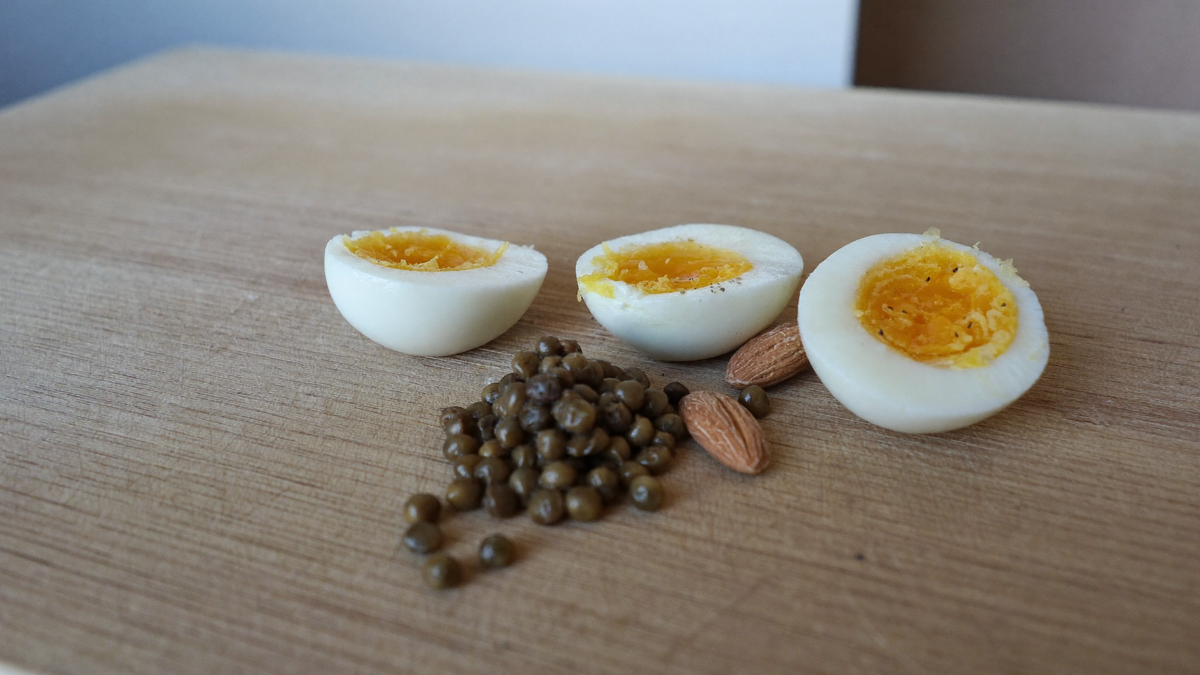
High-protein foods overview: what really matters
The essentials at a glance
The foods highest in protein are chicken breast, Gouda, beef goulash, and dried lentils. The reference value for adults is 0.8 grams per kilogram of body weight per day—48 grams for women and 57 grams for men. Most people reach this amount through ordinary food, without a single specialty product.
This article gives a sourced figure and year for each food. It answers two questions separately: which foods provide a lot of protein, and whether you need more of it at all. The second question is rarely asked and is usually the more important one.
You will first read about what your body needs protein for and what the reference value is. This is followed by an assessment of your protein intake, the labeling rules behind the term “high in protein,” three common misconceptions, three examples of daily intake, and a table showing the amounts.
What to expect in this article
1. What your body needs protein for
2. How much protein you need per day
3. Why most people already get enough
4. What “high in protein” means on the package
5. Why plant and animal proteins differ
6. Three statements that refuse to go away
7. What a day with enough protein looks like
8. How to tell when more is not better
9. Which foods provide how much protein
10. How to find out where you stand
11. Limitations: what an amino acid test cannot do
12. What you can change starting tomorrow
Frequently asked questions
Sources
What your body needs protein for
Protein is building material. Muscles, enzymes, messenger substances, and antibodies are made from amino acids, its building blocks. Your body is constantly rebuilding these structures, which is why it needs a regular supply.
Nine of these building blocks are essential in the technical sense: your body cannot produce them itself and depends on getting them from food. It converts all the others as needed.
Key takeaway
When it comes to protein, the question is rarely how to get more of it. It is whether you have too little in the first place—and no package label can answer that question.
What lies behind the term amino acids
Protein is not a single substance but a chain. In the intestines, it is broken down into its individual links, and only these links enter the bloodstream. What your body builds from them is up to the body itself.
Three of these amino acids appear especially often in sports nutrition: leucine, isoleucine, and valine, collectively known as BCAAs. In the technical sense, they are essential, meaning they are among the nine that the body cannot produce itself. Essential does not mean rare here: it describes their origin, not their availability.
Other amino acids are less well known and are equally involved in everyday life. According to the product page for the test presented below, glutamine and arginine are among the values that become limited first under high strain. Ornithine and citrulline are involved in the urea cycle, through which your body breaks down nitrogen. This breakdown pathway is why very large amounts of protein do not simply disappear without consequences.
Why requirements increase with age
For adults between 19 and 65, the reference value is 0.8 grams per kilogram of body weight per day. From age 65 onward, it rises to 1.0 grams (DGE, derivation status 2017). In absolute terms, this means an increase for men from 57 to 67 grams and for women from 48 to 57 grams.
The DGE does not explain in greater detail here why the value is higher from age 65 onward. The figure is documented, not how it was derived.
How much protein you need per day
The German Nutrition Society derives its reference values for protein both per kilogram of body weight and as an absolute daily amount. The following four steps show how to determine your own value.
Take your body weight
Your actual weight in kilograms, not your desired weight.
Multiply by 0.8
From age 65 onward, use 1.0. The result is your reference value in grams per day.
Record one day
What was actually on the plate, using portion sizes. A single day is enough for an initial impression.
Compare with the table
The values appear below in Chapter 9. Most people overestimate their shortfall.
Three calculations for comparison
A woman weighing 62 kilograms has a reference value of around 50 grams of protein per day. A man weighing 85 kilograms requires 68 grams. An 85-kilogram man aged 70 requires 85 grams because the factor is 1.0 at that age.
The DGE's absolute values of 48 and 57 grams apply to adults in general and are therefore only an approximation. If you are significantly heavier or lighter than average, it is better to calculate it yourself.
The difference between the three calculations is 35 grams. That is more than the serving of chicken breast in the table below and shows how little a general recommendation says about an individual person.
What is added during pregnancy and breastfeeding
From the second trimester onward, the reference value rises to 0.9 grams per kilogram, and to 1.0 grams in the third trimester. In absolute terms, that means an additional 7 and 21 grams per day, respectively. Breastfeeding women require 1.2 grams per kilogram, or 23 grams above the baseline (DGE, 2017).
These additions are smaller than the length of some guides might suggest. Twenty-one grams correspond to a serving of quark or a large piece of hard cheese.
Why most people already get enough
This chapter deliberately comes before the food table. If you read the list first and then the nutritional requirements, you have already lost the order of the questions.
Documented source
“From a nutritional physiology perspective, high-protein products are unnecessary.”
Antje Gahl, press spokesperson for the German Nutrition Society (DGE)
Reproduced in DGE press information 30/2021
The sentence comes from a DGE statement and is attributed there to a named person, rather than being formulated as an institutional position. It nevertheless gets to the heart of the matter: The same statement notes that even people with increased needs, for example due to age or competitive sport, can meet them through conventional protein-rich foods (DGE, 2021).
The Federal Centre for Nutrition puts it more succinctly: “Even without these products, we generally consume enough protein.” (BZfE, 2026). Two bodies therefore arrive at the same conclusion.
Who the question is nevertheless justified for
Four groups have higher or more difficult-to-meet needs: people aged 65 and over, because the reference value is higher for them; pregnant and breastfeeding women, for the same reason; people who train frequently and intensely; and people who follow a purely plant-based diet, because the combination of protein sources matters in that case.
Those who belong to none of these groups but still doubt whether they are getting enough protein are usually looking for an explanation for something else. Exhaustion and poor recovery can have many causes. No nutrition article can determine which one applies in an individual case.
Why the protein trend works anyway
Protein is perceived as both healthy and performance-enhancing. Fat and carbohydrates both carry a stigma in the public mind, while vitamins seem invisible. Protein, by contrast, promises something tangible.
In addition, the claim on the package is truthful. A protein pudding does in fact contain more protein than an ordinary one. The question that gets overlooked is not whether there is more in it, but whether more is needed.
This is precisely where the assessment quoted above comes in. It does not dispute that the products deliver what they promise, but rather that the promise fills a gap.
What “protein-rich” means on the package
The claim is not an advertising term but a regulated one. It is based on the proportion of the product’s energy content that comes from protein, not on the absolute amount in the cup.
The DGE names the two thresholds in its statement: A product is considered a source of protein if at least twelve percent of its energy content comes from protein, and protein-rich from twenty percent onward (DGE, 2021).
This rule has a side effect that is rarely mentioned. Because it is based on the proportion of energy rather than the absolute amount, the term protein-rich says nothing about how much protein is actually in the package. It only says what proportion of this product’s energy comes from protein.
Reference values per day
48 g
for women between 19 and 65 years of age
57 g
for men between 19 and 65 years of age
67 g
for men aged 65 and over; for women, the figure is 57 g
Source: German Nutrition Society, protein reference values, basis for derivation as of 2017
Why comparing with the reference value clarifies the issue
A number of grams on a container can quickly sound like a lot. Whether it is depends on the comparison with the daily reference value of 48 or 57 grams. And the product rarely stands alone on the meal plan; it is usually eaten in addition to bread, cheese, pasta, and everything else.
Anyone who knows their daily requirement can see specialty products for what they usually are: a more expensive form of what is already on the table. Those who want to determine their own requirement more precisely can find the calculation in the article on protein requirements for women.
Why plant-based and animal-based proteins differ
The DGE describes the difference objectively: Proteins of plant and animal origin differ in the composition and bioavailability of their amino acids. However, this can be balanced out by deliberately combining different foods, such as grains with legumes (DGE, 2017).
The BZfE reaches the same conclusion: Although the body can generally utilize animal protein more efficiently, combining plant-based proteins correctly increases their utilization (BZfE, 2026).
Key takeaway
The drawback of plant-based protein sources is not a deficiency but a matter of combining foods. Grains with legumes are the example the DGE gives for this.
What the combination looks like in practice
Lentils with whole-wheat pasta, beans with rice, hummus with flatbread, pea soup with bread. These pairings are older than nutrition science and appear in almost every cuisine where meat was once scarce.
What matters is variety throughout the day, not pinpoint accuracy in a single meal. How the body breaks down protein in the first place is explained in the article on protein digestion.
What the numbers say about combining foods
A glance at the table below makes the point tangible. A serving of 60 grams of dried lentils provides 14 grams of protein—almost as much as a cup of quark. So the quantity is not the problem.
The difference lies in the amino acid composition, which the DGE describes as something that can be balanced out. Anyone who eats lentils with whole-wheat pasta has exactly the combination on their plate that the DGE gives as an example.
For the vegan day in Chapter 7, this means: The 47 grams are not inferior protein; they simply fall slightly short of the reference value. A second serving of tofu or a cup of quark solves that—no specialty product needed.
Three statements that stubbornly persist
Few nutrients are surrounded by as many half-truths. These three come up most often.
Common Claims vs. Evidence
Common belief
“People who exercise need protein powder.”
Documented
Even people with increased requirements due to age or competitive sports can meet them through conventional protein-rich foods (DGE, 2021).
Common belief
“More protein means more benefits.”
Documented
According to the DGE, no health benefit from the extra portion of protein should be expected (DGE, 2021).
Common belief
“Plant protein is inferior.”
Documented
Differences in composition and bioavailability can be offset through targeted combinations, such as grains with legumes (DGE, 2017).
What a day with enough protein looks like
Three examples calculated using the portion sizes provided by the BZfE (2026). They are not meal plans, but show the approximate scale of an ordinary day.
Omnivorous diet, around 83 grams
For breakfast, 150 grams of quark with 21 grams of protein. At midday, a 150-gram chicken breast fillet with 47 grams. In the evening, two slices of whole-grain rye bread with 6 grams and a 30-gram slice of Gouda with 9 grams. That makes 83 grams, well above the reference value of 48 or 57 grams.
Vegetarian, around 64 grams
In the morning, 150 grams of yogurt with 6 grams and 150 grams of quark with 21 grams. At midday, 100 grams of whole-wheat pasta with 14 grams and 60 grams of dried lentils with 14 grams. In the evening, 30 grams of Gouda with 9 grams. That comes to 64 grams, also above both reference values.
Vegan, around 47 grams
100 grams of tofu with 16 grams, 60 grams of dried lentils with 14 grams, 100 grams of whole-wheat pasta with 14 grams, and a slice of whole-grain rye bread with 3 grams. That makes 47 grams, just below the women’s value of 48 grams. This is where a second look is worthwhile; it is not for the other two days.
Fictional scenario for illustration
Example: Martin, 34
Martin works out at the gym three times a week and has been buying protein bars and powder for around €60 a month for the past six months. When he writes down what he eats anyway over the course of a day, he comes to just over 90 grams of protein—without counting the supplements. His reference value is 62 grams. He does not stop buying the bars because they are harming him, but because he realizes he is filling a gap that does not exist. He puts the money toward better meat and a test that shows him where his levels actually stand.
What all three days lack is just as revealing as what they contain. Not one includes a single product marketed as a protein product. The totals come from quark, meat, cheese, lentils, pasta, and bread—in other words, from what is already in the refrigerator.
And none of the three days is specifically designed to be high in protein. They are ordinary meals in ordinary portions. That is precisely the point made by the two cited passages.
How to tell that more is not better
This is the section that product copy leaves out because it works against the sale. It belongs here nonetheless.
Three signs suggest that you are turning the wrong knob. First: You count grams of protein but have never calculated what your reference value actually is. Second: You buy specialty products for nutrients that are cheaper in ordinary foods. Third: You expect more protein to affect exhaustion or recovery, even though the sources reviewed provide no basis for that.
In all three cases, the next sensible step is to take stock, not to have a larger portion. If you do not know your starting point, you cannot improve it.
What the labeling does not reveal
A product may be advertised as high in protein if a certain proportion of its energy content comes from protein. That says little about the absolute amount in the cup and nothing at all about your needs.
That is why the packaging label is the worst guide on this question. It describes the product, not you.
Where excess protein goes
What the body does not use to build tissue is broken down. The nitrogen from amino acids leaves the body through the urea cycle, which involves ornithine and citrulline, among others. This is a normal process, not a warning sign.
But this means that the extra portion does not disappear without a trace, nor is it stored. It is metabolized like any other excess. The DGE explicitly does not expect any health benefit from it (DGE, 2021).
Anyone following a special diet because of an existing medical condition will discuss a significantly increased protein intake with a doctor anyway. For everyone else, the question is less dramatic, but also less interesting, than the market makes it seem.
Chapter at a glance
The reference value for adults is 0.8 grams of protein per kilogram of body weight per day—that is 48 grams for women and 57 grams for men (DGE, 2017). Two of the three daily examples in this article exceed that amount; the vegan example falls just short. If you do not belong to any group with increased needs, consuming more protein solves a problem that the figures do not show.
How much protein different foods provide
The following figures come from the overview published by the German Federal Centre for Nutrition (2026). There, they are given as typical portions; for this table, they have been mathematically converted to 100 grams so that the foods can be compared with one another. The portion size is stated in each note.
| Food | Protein per 100 g | Note |
|---|---|---|
| Chicken breast fillet | 31,3 g | The highest value in the overview. A 150 g portion, providing 47 g, almost single-handedly covers a woman's daily reference value |
| Gouda, 30 percent fat in dry matter | 30,0 g | The usual portion is small at 30 g and provides 9 g |
| Beef goulash | 26,7 g | 150 g provide 40 g, which is more than two-thirds of the value for men |
| Lentils, dry | 23,3 g | The strongest plant-based source in the overview. The figure applies to the dry product; when cooked, lentils absorb water, so the amount per 100 g decreases accordingly |
| Pork schnitzel | 22,0 g | 150 g provide 33 g |
| Salmon | 20,0 g | This makes fish a similar source of protein to lean meat |
| Herring | 17,3 g | 150 g provide 26 g |
| Tofu | 16,0 g | One of the few figures given directly per 100 g |
| Whole-grain pasta | 14,0 g | The staple of many meals, so its total contribution is more important than the value might suggest |
| Quark, 20 percent fat in dry matter | 14,0 g | A 150 g portion provides 21 g, as much as the increase in the third trimester of pregnancy |
| Whole-grain rye bread | 6,0 g | One 50 g slice provides 3 g. It still adds up over the course of the day |
| Yogurt, 3.5 percent fat | 4,0 g | 150 g provide 6 g. The low value explains why yogurt in particular is so often offered in a protein-enriched form |
| Whole milk, 3.5 percent fat | 3,5 g | 200 milliliters provide 7 g, about as much as the increase in the second trimester of pregnancy |
Two things stand out in this order. First, dried lentils, at 23.3 grams, come before pork schnitzel and salmon. The comparison is not entirely fair, however: the lentils are weighed dry, while the meat is cooked. Second, milk and yogurt rank near the bottom, even though they are considered sources of protein.
Portion size still matters in everyday life. Per 100 grams, Gouda has almost as much protein as chicken breast, but it is eaten in 30-gram slices. By the end of the day, the chicken provides five times as much.
The values that do not work for most people
Dairy products perform less well than their reputation might suggest. Whole milk contains 3.5 grams per 100 milliliters, and yogurt 4 grams per 100 grams. Only quark, at 14 grams, and hard cheese, at 30 grams, make it into the upper half.
The reason is the water content. Cheese is milk with the water removed, and as the water is concentrated, so is everything else. The same logic applies to the lentils in the table: the value refers to the dry product; cooked, it is lower.
Bread, on the other hand, is surprisingly high. At 6 grams per 100 grams, whole-grain rye bread is higher than yogurt, and anyone who eats four slices a day gets 12 grams from that alone. That is a quarter of the female reference value from a food that never appears in protein advertising.
How to find out where you stand
The calculation in Chapter 2 shows how much you should eat. It does not show what reaches your bloodstream. There is a measurement for this second question, and it answers something different from what most people expect.
A capillary blood test from mybody®x (MYBODY Lab GmbH) measures the amino acids themselves—the building blocks into which protein is broken down. You collect the sample at home with a finger prick.
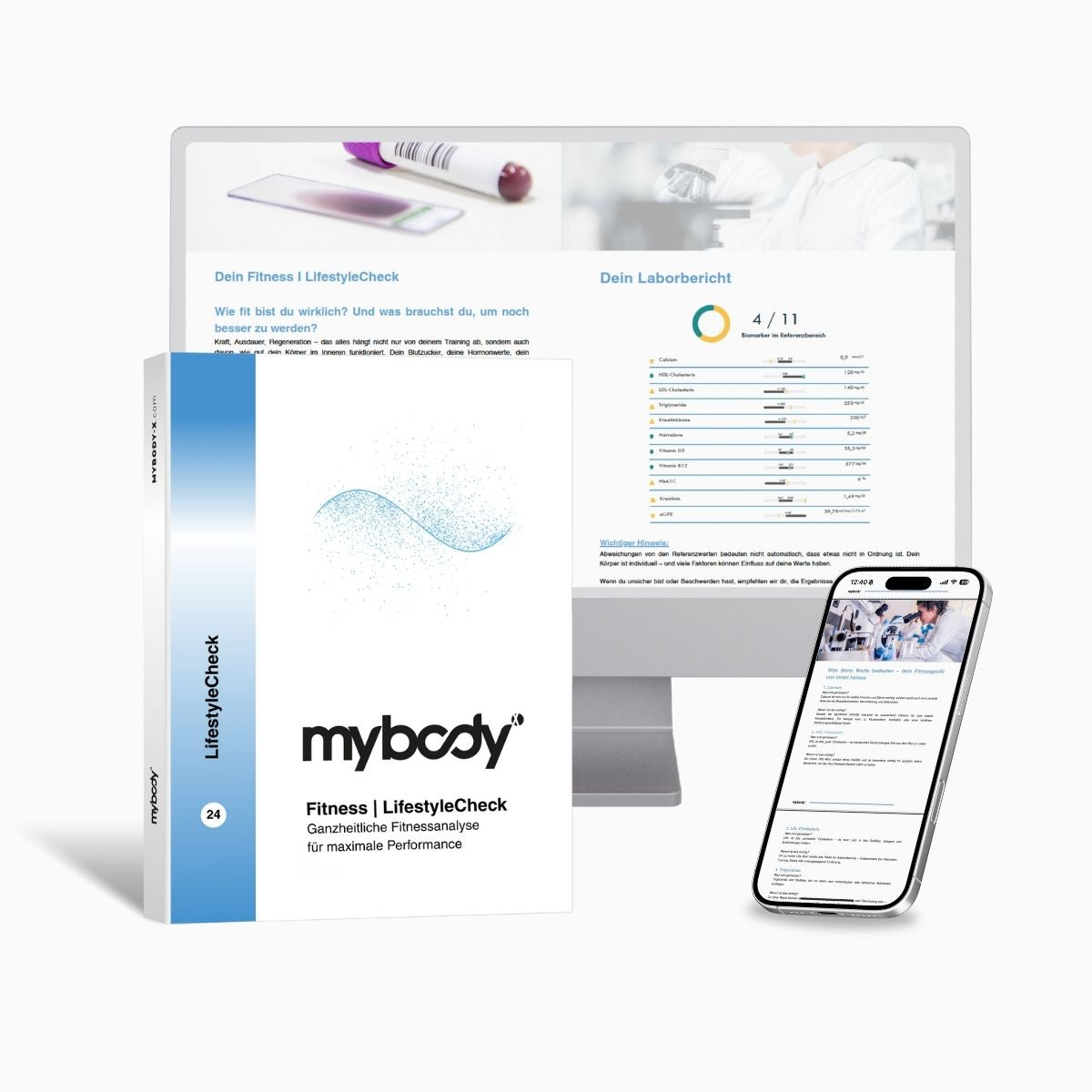
Capillary Blood Test
PerformanceCheck | Amino Acid Test
Measures 22 values from amino acid metabolism, including all nine essential amino acids. According to the product page, the test explicitly does not tell you how much protein you should eat, and it will not make any muscle bigger. The values also fluctuate considerably with your last meal, which is why you should follow the instructions' fasting requirement.
Laboratory analysis 3–5 business days after receipt of the sample
Information from the product page, accessed 28 August 2026
Who the test can answer questions for
It makes sense if you train intensively and want to know where your glutamine and arginine levels stand; according to the product page, these values are the first to become scarce under heavy exertion. It is also useful if you follow a purely plant-based diet and want to compare the combination of your sources with actual figures.
It is of little use if you have not yet done the calculation from Chapter 2. Then there is no benchmark against which to interpret the result. And it is useless if you expect it to recommend how much you should eat: The product page explicitly rules out providing precisely this information.
Anyone who wants to know how much protein makes sense for muscle building will find the explanation in the article on protein and muscle building. This article focuses on foods.
Limitations: what an amino acid test cannot do
An amino acid profile is a data point, not a dietary recommendation. It shows which building blocks are currently circulating in the blood and says nothing about how much protein should be on your plate.
There is also a characteristic of these values that is clearly stated on the product page: amino acid levels fluctuate significantly depending on the last meal. Anyone who does not follow the fasting requirement measures their breakfast, not their metabolism.
And one limitation concerns this article itself. The table values are averages from an overview. The protein content of a specific piece of meat or a particular type of cheese therefore varies around them, depending on fat content and preparation.
What a measurement does not tell you about your diet
Between the amino acid profile in the blood and the amount on the plate lie digestion, absorption, and metabolism. An abnormal value may be due to intake, absorption, or consumption. The number alone does not show which of the three possibilities applies.
That is why the order in this article is deliberate. First, the calculation based on your own body weight; then, a look at a written record of one day; only then, the question of testing. Anyone who proceeds in the opposite order ends up with a number without context.
An amino acid profile also does not replace nutritional counseling. Anyone planning a change that goes beyond individual meals is better served by professional guidance than by 22 numbers.
What you can change starting tomorrow
If you take away one action from this article, let it be this: Calculate your reference value once. Multiply your body weight by 0.8, or by 1.0 from age 65 onward. It takes ten seconds and puts every package label you encounter in the future into perspective.
The reason is unremarkable. Of all the figures in this text, this is the only one that refers to you rather than to a food. Without it, every gram amount on a tub is a number without a frame of reference.
If the calculation reveals a shortfall, the solution can be found in the table in Chapter 9. A serving of lentils, a slice of Gouda, or a second serving of quark can fill a gap of this size without requiring a specialty product.
It all began with the question of which foods provide a lot of protein. The complete answer is: these foods, and you need less of them than the market tells you.
Frequently asked questions
Which foods contain the most protein?
Chicken breast fillet tops the list at approximately 31.3 grams per 100 grams, followed by Gouda at 30 grams and beef goulash at 26.7 grams. The strongest plant-based source is dried lentils at 23.3 grams; however, this figure applies to the dry product, whereas the meat values apply to cooked products. The figures were converted to 100 grams from the serving information provided by the Federal Centre for Nutrition (2026). For everyday purposes, the serving size matters: Gouda is eaten in 30-gram slices, and chicken breast in 150-gram portions.
How much protein do I need per day?
The German Nutrition Society recommends 0.8 grams per kilogram of body weight per day for adults between 19 and 65, and 1.0 grams from age 65 onward. In absolute terms, that is 48 grams for women and 57 grams for men, or 57 and 67 grams, respectively, from age 65 onward. An additional 7 grams are recommended from the second trimester of pregnancy, 21 grams in the third trimester, and 23 grams while breastfeeding. These values were established in 2017.
Do I need protein powder if I exercise?
According to the DGE, it is not. Its press release 30/2021 states that even people with increased needs due to age or competitive sports can meet them through conventional protein-rich foods. No health benefit is to be expected from an extra portion of protein. The Federal Centre for Nutrition reaches the same conclusion: Even without specialty products, we generally consume enough protein (BZfE, 2026).
Is plant protein worse than animal protein?
They differ, but the difference can be offset. The German Nutrition Society (DGE) explains that proteins of plant and animal origin differ in their amino acid composition and bioavailability, but that this can be balanced through the targeted combination of different foods, such as grains with legumes (DGE, 2017). In practice, this means lentils with pasta, beans with rice, and hummus with bread.
What does an amino acid test measure, and what does it not measure?
It measures 22 values from amino acid metabolism, including all nine essential amino acids. It does not measure how much protein you eat, and according to the product page, it explicitly does not tell you how much you should eat. The values fluctuate significantly with the last meal, which is why the sample must be taken while fasting. An amino acid profile replaces neither a medical examination nor nutritional counseling.
Next step
Calculate first, then buy
If you want to know the status of your amino acid levels after doing your own calculation, PerformanceCheck provides a starting point. It does not replace medical evaluation and does not tell you how much protein belongs on your plate.
View PerformanceCheck Calculate protein requirementsRead more
You might also be interested in
The calculation in detail if you want to determine your personal value more precisely.
What happens between the plate and the bloodstream, and why absorption does not work the same way for everyone.
Sources
- German Nutrition Society (DGE): Reference values for protein intake (basis of derivation: 2017) – dge.de
- German Nutrition Society (DGE): High-protein products are unnecessary, press release 30/2021 – dge.de
- Federal Center for Nutrition (BZfE): Protein trend in foods (as of 03/10/2026) – bzfe.de
All reference values per kilogram of body weight and per day, as well as the statement on combining plant-based and animal-based protein sources, come from source [1]. The verbatim quotation about high-protein products and the statements about athletes’ requirements come from [2]; the quoted sentence is attributed there to the DGE press spokesperson and is not presented as an institutional position. All food values come from [3] and have been mathematically converted from the serving size to 100 grams for the table. Information on price, measured values, sample type, and laboratory comes from the mybody®x product page, accessed on 08/28/2026; processing times follow the central guideline for blood tests. All sources were accessed and reviewed on 08/28/2026.

mybody®x Editorial & Expert Team
Nutritional science Laboratory diagnostics Blood analysis interpretation Nutrigenetics
This article was created by the mybody®x editorial and expert team. The team combines laboratory diagnostics, nutritional science, and the interpretation of blood analyses. Everyone involved can be found on the authors page.
Published on 08/28/2026 · Last updated on 08/28/2026
The content is intended for general information and does not replace medical advice, diagnosis, or treatment. Reference ranges depend on the laboratory, method, and age—the information on your test report is always authoritative.


Share now:
Healthy snacks for weight loss: what works and what only looks like it does
Mediterranean Diet in Everyday Life: What’s Proven and What Isn’t