
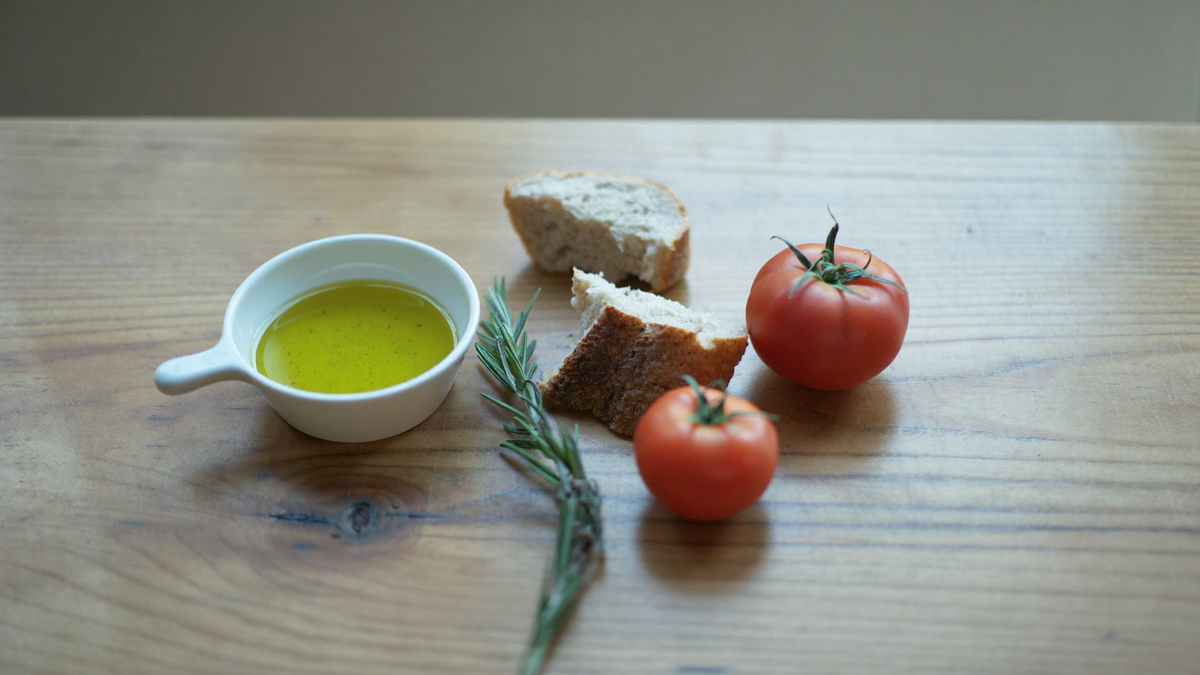
The Mediterranean diet in everyday life: what is established and what is not
The essentials at a glance
The Mediterranean diet is characterized by plenty of vegetables, legumes, fruit, fermented dairy products, nuts, fish, and olive oil, with little meat, processed meat, and processed foods. This is how the 2019 Guide to Nutritional Therapy in Clinics and Practice describes it. According to the same source, there is no strict definition.
There are statements about its effects in German professional sources, but they are brief. The guide lists the Mediterranean diet among the suitable dietary patterns for cardiovascular diseases and attributes possible benefits to it in the case of liver disease, without explaining this classification. That is considerably less than the reputation of this dietary pattern might suggest, and it belongs at the beginning, not at the end.
First, you will read what the Mediterranean diet consists of, followed by every source found, the figures on fat and fish, an overview of the food groups, and a chapter on how to tell that this change does not fit into your everyday life.
What to expect in this article
1. What the Mediterranean diet consists of
2. Why there is no strict definition
3. What the institutions say about it—and what they do not
4. The figures on fat, fish, and vegetables
5. What has been established about olive oil
6. What appears on the table more, less, and rarely
7. What a Mediterranean day actually looks like
8. How to tell that it is not right for you
9. What the change means when shopping
10. How to find out where your levels stand
11. Limitations: what a blood test cannot do
12. What you can change starting tomorrow
Frequently asked questions
Sources
What the Mediterranean diet consists of
The Guide to Nutritional Therapy in Clinics and Practice, co-published by the German Nutrition Society, describes it in two sentences. The first states what is consumed abundantly; the second, what remains rare.
Vegetables, legumes, fruit, fermented dairy products, nuts and seeds, fish, and olive oil are consumed abundantly. Meat and meat products, milk and dairy products, and processed foods with hidden fats are consumed sparingly (Hauner and colleagues, 2019).
Key message
Fermented dairy products are on the favorable side, while milk and dairy products in general are on the limited side. This subtle distinction appears in the source and is omitted from almost every popular presentation.
What is not new about it
The same source notes that the nutrient composition of the Mediterranean diet essentially corresponds to a whole-food diet. This is a remarkably matter-of-fact observation about a dietary pattern marketed as a concept.
In practical terms, this means that anyone who follows the general recommendations is already eating much of what the description specifies. The difference lies less in the foods than in their proportions relative to one another.
What the description does not contain
What the guideline leaves out is just as revealing as the ten groups it names. Grains and bread are absent, potatoes are absent, wine is absent, and there is no information about when or how often people eat.
Anyone who reads that Mediterranean eating includes a glass of red wine with a meal or a late dinner in company will therefore find no basis for this in the source. Such images come from travel reports and marketing, not from the description on which this article is based.
Why there is no strict definition
The guideline is unusually direct at this point. It states that the Mediterranean diet refers to traditional eating in the Mediterranean region, of which many variations existed, and that there is therefore no strict definition (2019).
This is important for anyone who wants to follow a guide. There are no gram amounts, weekly plans, or percentages that an institution identifies as Mediterranean. What circulates are interpretations.
Anyone who finds a list of seven rules for the Mediterranean diet is therefore not looking at an official professional guideline, but at an interpretation. That does not make it wrong, but it changes how much weight it can carry.
What exists instead of a definition
In place of the missing definition, two things together provide more guidance than a list of rules. The first is the list of groups from Chapter 1; the second is the statement that the nutrient composition essentially corresponds to that of the standard diet (Hauner et al., 2019).
This leads to a useful working rule: General reference values apply to quantities, while the list applies to selection. That is exactly how this article is structured, which is why Chapter 4 contains figures that are explicitly not specific to the Mediterranean diet.
What the institutions say—and what they do not
This section lists all the sources that could be documented for this dietary pattern, and there are strikingly few of them.
Documented source
“The Mediterranean diet is characterized by a high content of vegetables, legumes, fruit, fermented dairy products, nuts and seeds, fish, and olive oil.”
Hauner et al., Guideline for Nutritional Therapy in Hospitals and Clinical Practice (LEKuP)
Current Nutritional Medicine 44 (2019), pages 384 to 419
This quotation neither describes nor evaluates anything. The section it comes from contains no statement about what the dietary pattern does. Elsewhere in the same document, however, there is indeed an attribution, and that belongs here.
The four sources in detail
In the chapter on cardiovascular diseases, the same guideline states: All standard diets are suitable, especially the Mediterranean diet. The accompanying overview table lists the standard diet and explicitly the Mediterranean diet in the cardiovascular diseases row (Hauner et al., 2019).
The chapter on non-alcoholic fatty liver disease contains a second sentence: A Mediterranean diet may have benefits (2019). The word “may” appears there exactly as written and is not hedged.
The fourth source is outside this document. The Institute for Quality and Efficiency in Health Care lists the Mediterranean diet on its gesundheitsinformation.de portal and describes it as consisting of plenty of vegetables, fruit, legumes, nuts, olive oil, whole-grain products, fish, and poultry. It goes on to say that a diet containing these foods meets many recommendations for a favorable nutrient composition, and that studies have found that such a dietary pattern may have helped reduce risk factors for cardiovascular disease (IQWiG, status as of 6 August 2025).
What stands out about these sources
Three things. First, there are four sources in total for a dietary pattern about which entire books have been written. Second, none of the sources gives a reason, an order of magnitude, or a level of evidence. Third, IQWiG describes the dietary pattern differently from the guide: whole-grain products and poultry appear there, but not in the guide.
This research did not evaluate individual studies. There are many of them on the Mediterranean diet, but an individual study is not evidence for this editorial team. What counts is the contextualized statement of a specialist organization, and here it is provided in the brief form quoted above.
This article therefore reproduces the sources without presenting them as its own claims. It does not claim that the Mediterranean diet has any effect. It records what two specialist organizations have written about it and how briefly they wrote it.
How this research was conducted
The search was conducted on 28 August 2026 among the sources that count as evidence for this editorial team: the German Nutrition Society, the Federal Centre for Nutrition, the Institute for Quality and Efficiency in Health Care, the consumer advice centres, and, for the general quantity recommendations, the World Health Organization.
None of these sources has a dedicated topic page exclusively on the Mediterranean diet. What does exist are the four mentions quoted above within larger documents. Anyone looking for a detailed institutional assessment of this dietary pattern will not find one in the sources reviewed for this article.
The guide also provides something that is more useful in everyday life than any claim about effects: a description detailed enough to use when shopping. It also states that the nutrient composition essentially corresponds to a balanced diet.
The figures for fat, fish, and vegetables
Because there are no quantity guidelines for the Mediterranean diet itself, the general recommendations are helpful. They do not come from an assessment of this dietary pattern, but they classify its components.
General guidelines, not specific to the Mediterranean diet
400 g
Fruit and vegetables per day, from age ten onward (WHO)
120 g
Fish per meal, once or twice a week (BZfE)
30 %
of energy as fat, just under 70 g at 2,000 kcal (BZfE)
Sources: World Health Organization, Healthy diet, as of 26 January 2026; German Federal Centre for Nutrition, 2026
What else the WHO mentions
The same overview lists further figures that fit the dietary pattern described: at least 25 grams of fiber per day, free sugars below ten percent of energy, saturated fatty acids no more than ten percent, trans fatty acids no more than one percent, and less than five grams of salt per day (WHO, 2026).
These figures apply generally and not specifically to the Mediterranean diet. None of the sources reviewed compares the two, so this article does not do so either.
The gap between recommendation and reality
When it comes to fat, the switch to a Mediterranean diet becomes concrete. The German Federal Centre for Nutrition recommends that up to 30 percent of energy come from fat, or up to 35 percent in cases of extensive exercise and heavy physical exertion. In fact, the same source notes, people in Germany consume about 37 percent of their energy as fat (BZfE, 2026).
This gap of around seven percentage points is why an additional splash of olive oil is not automatically an improvement. Anyone who adds oil without reducing fat elsewhere widens the gap instead of closing it.
This also includes the fat you cannot see. The figure includes both visible and hidden fats, such as those in high-fat sausage or cheese (BZfE, 2026). These two groups are listed on the guideline’s sparse side, so the two sources fit together.
What has been established about olive oil
Olive oil is the symbol of this dietary pattern, and here there really is a statement from a German specialist agency. It is cautiously worded and therefore all the more useful.
The German Federal Centre for Nutrition states that monounsaturated fatty acids are good for health and occur, alongside other fatty acids, for example in rapeseed and olive oil. It goes on to say: More monounsaturated fatty acids from rapeseed or olive oil can favorably influence total cholesterol and bad LDL cholesterol (2026).
Two words in this sentence carry the weight: “can” and “favorably influence.” It does not say that olive oil lowers cholesterol levels, and this article does not say that either.
Why rapeseed oil appears in the same line
What is noteworthy about the source is that it mentions rapeseed oil on an equal footing. In practice, this means that the benefit depends on the type of fatty acids, not on the oil’s Mediterranean origin.
So, anyone looking to make the switch more affordably ends up in the same place with rapeseed oil. The source mentions both oils in the same line.
The other half of the sentence
The same source also describes the opposite direction. According to the BZfE, predominantly saturated fatty acids are found mainly in animal foods such as butter, cream, meat, and processed meat, and they can increase total cholesterol and bad LDL cholesterol in the blood (2026).
Thus, both sources touch on the same point, without the guide giving a reason for its limited side: According to the BZfE, two of the three groups listed there, meat and processed meat as well as dairy products, are typical sources of predominantly saturated fatty acids (2026).
In practice, this is the most important connection in this article: The two sides of the description—the abundant and the rare—concern the same account when it comes to fat. Anyone who addresses only one side has done half the job.
The BZfE also repeatedly lists polyunsaturated fatty acids as a separate group, including omega-6 and omega-3 fatty acids. Accordingly, omega-3 fatty acids are found in fatty sea fish such as herring, mackerel, and salmon, as well as in some vegetable oils such as rapeseed, walnut, and flaxseed oil (2026). Rapeseed oil appears here too, in both groups.
What comes to the table more often, less often, and rarely
The following overview follows the characterization in the guide. It organizes the groups mentioned there and notes what the general recommendations say about them.
| Food group | Level | Note |
|---|---|---|
| Vegetables | abundantly | The WHO recommends at least 400 g per day of fruit and vegetables combined from age ten onward |
| Legumes | abundantly | They provide plant-based protein and fiber. The WHO recommends at least 25 g of fiber per day |
| Fruit | abundantly | Part of the WHO's 400 g recommendation |
| Fermented dairy products | abundantly | That means yogurt and aged cheese. Explicitly distinguished from dairy products in general |
| Nuts and seeds | abundantly | The guide explicitly mentions them together with seeds as a separate group |
| Fish | abundantly | The BZfE specifies one to two meals per week, each consisting of about 120 g |
| Olive oil | abundantly | Within the upper fat limit of around 30 percent of energy. Rapeseed oil provides the same type of fatty acid |
| Milk and dairy products | a little | The guide explicitly lists them on the limited side, unlike the fermented varieties |
| Meat and processed meat | a little | For many households, the biggest practical change on this list |
| Processed foods with hidden fats | rarely | The guide lists it as a separate category alongside meat and dairy products |
This overview shows that seven groups are on the plus side and three on the limited side. That distinguishes the Mediterranean diet from the low-carbohydrate approaches in this series, where the cut list is longer than the plus side.
For making the change, this means adding rather than leaving things out. That is the practical reason this eating pattern is easier to stick to than one with a forbidden-food list.
Why fish counts twice in this list
One line in the table deserves its own explanation. Fish is the only one of the ten groups for which two separate figures are provided, and both concern different nutrients.
The first is fat content. According to the BZfE, herring, salmon, and mackerel from cold salt water contain more than ten percent fat; medium-fat fish such as redfish or trout contain between two and ten percent, while lean fish such as plaice or pike-perch contain less than two percent (2026). It is precisely the fatty fish that provide the omega-3 fatty acids from Chapter 5.
The other is iodine. The same source emphasizes that only sea fish and algae contain high amounts of essential iodine, which the body cannot produce itself. It goes on to say in the same breath that we can also meet our needs through dairy products and foods made with iodized salt, such as sausages and bread products (2026). So anyone who eliminates fish from the week loses a rich, but not the only, source of iodine.
According to the BZfE, labels such as the MSC label for wild-caught fish and the ASC label for aquaculture can help with selection (2026). This is not a nutritional issue, but it belongs to the one line where health and origin overlap most clearly.
What a Mediterranean day looks like in practice
Because there are no quantity specifications, the following days are interpretations of the description, not instructions.
An ordinary day
In the morning, yogurt with nuts and fruit. At lunchtime, lentils or beans with vegetables and olive oil, along with bread. In the evening, salad with aged cheese, olive oil, and lemon. Twice a week, fish is served at lunch or dinner instead of legumes.
Meat appears once or twice this week, in smaller portions than usual. Sausages and ready-made meals remain the exception.
It is about adding, not leaving things out.
What is allowed to remain German on this day
The guide cites foods commonly eaten in the Mediterranean region as its basis and derives the high proportion of monounsaturated fatty acids from olive oil (2019). However, the groups mentioned can also be filled with local representatives: lentils, beans, cabbage, carrots, apples, walnuts, and rapeseed oil belong to the same groups as chickpeas, eggplants, figs, almonds, and olive oil. This is an interpretation, not a requirement of the source.
This is where many changes fail: They are understood as travel cuisine rather than as a shift in proportions. Those who approach it as a shift in proportions shop at their usual store.
A week in which both sides come together
One day shows too little, because fish and meat are spread over the week. Seven dinners as an example, again as an interpretation and not a requirement: lentils with vegetables on Mondays, fish on Tuesdays, roasted vegetables with yogurt and nuts on Wednesdays, bean stew on Thursdays, fish on Fridays, a small portion of meat on Saturdays, and a vegetable skillet with aged cheese on Sundays.
This week includes two fish meals, which falls within the range of one to two portions named by the BZfE (2026). It includes two meals with legumes and one with meat. Both sides of the description are represented without any group disappearing completely.
Lunch is deliberately left open in this framework. Those who eat out rarely have a choice, and a change that also requires restructuring the cafeteria is unlikely to last even half a year.
How to tell that it is not right for you
This dietary pattern has fewer exclusion criteria than the other patterns in this series because it does not eliminate anything essential. There are still three points.
First: You do not tolerate legumes well. They feature prominently in the description, and without them the dietary pattern lacks one of its supporting elements. Second: You do not like fish. One or two meals per week is not much, but it is part of the description. Third: Your household cooks differently. A dietary pattern based on proportions works poorly when only one person at the table follows it.
None of these points is a medical exclusion criterion, and the sources reviewed do not name any such criterion for this dietary pattern. However, all three determine whether a change can be maintained for half a year.
What you should still keep in mind
A nutrient quietly leaves the meal plan when one of the groups described is omitted. According to the BZfE, only sea fish and algae provide substantial amounts of iodine; according to the same source, we also meet our needs through dairy products and foods made with iodized salt (2026).
This is not an argument against making the change, but a call to look more closely at the substitutes. Anyone who eats neither fish nor dairy products and also uses few processed foods eliminates several sources at once, according to this source.
Anyone who avoids fish out of conviction or dislike should discuss this with a medical professional rather than ignore it. This applies especially during pregnancy and breastfeeding, when requirements are different.
Chapter at a glance
The Mediterranean diet is described briefly in the specialist sources reviewed and is likewise assigned only broadly to one category. The 2019 guide names seven groups that appear in abundance and three that remain rare, and notes that their nutrient composition is essentially the same as that of a balanced diet. Those who follow it shift the proportions and do not eliminate anything completely. That is why it is comparatively easy to maintain in everyday life.
What the change means for grocery shopping
An objection regularly comes up with this topic and deserves an honest answer: fish, nuts, and good olive oil are more expensive than pasta with ground meat.
Fictional scenario for illustration
Example: the Berger family, four people
The Bergers want to eat more Mediterranean-style food and initially expect higher costs. Then they shift the proportions instead of changing the shopping list: meat goes on the table twice a week instead of five times, while lentils appear twice and fish once. The three saved meat meals pay for the fish and a better oil. After two months, the shopping bill is about the same, but the composition is different. What has actually changed is the effort: legumes require preparation, and the Bergers now cook ahead on Sundays for two days.
The example shows the calculation that is often missing from this discussion. Eating less meat is the item that funds the others, and it is already on the sparse side in the description.
The item that really increases
What can be offset financially cannot be offset in terms of time. Dried legumes need soaking and cooking, vegetables need washing and chopping, and fish is less forgiving of waiting time than a casserole.
Two options are available, and both are perfectly valid. The first is canned or jarred legumes: they eliminate the need for soaking and belong to the same group. The second is cooking in advance on one day of the week, as in the example above.
Anyone unable to arrange both should acknowledge that before making the change, not afterward. A way of eating rarely fails because of a lack of willingness and often fails because of an hour that is not available in the calendar.
How to find out where your levels stand
A laboratory value measured before making a change is not proof of effectiveness. It is a baseline that can be used to interpret a later measurement in a conversation with a doctor. A capillary blood test from mybody®x (MYBODY Lab GmbH) provides such a baseline.
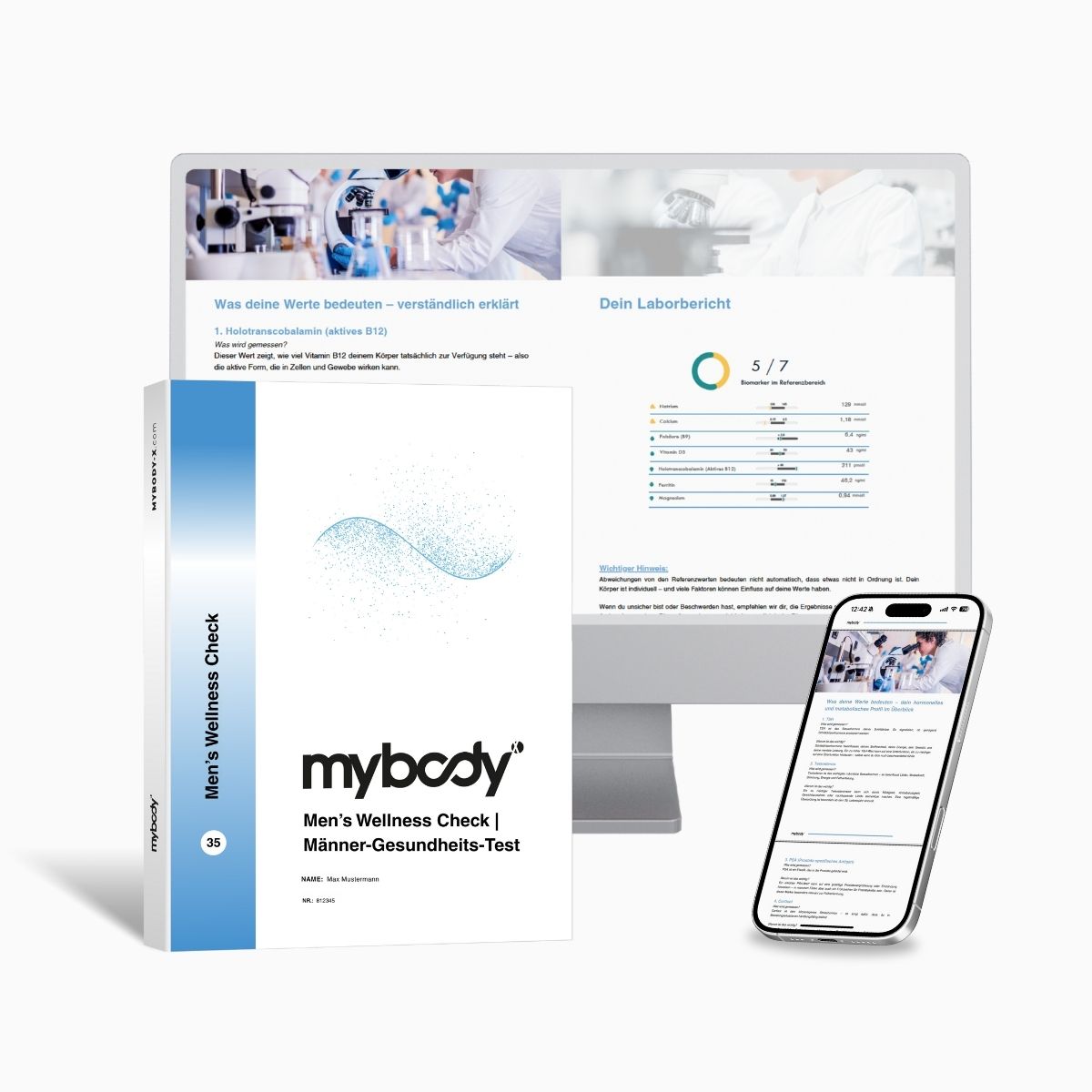
Blood test using capillary blood
Men’s Wellness Check | Men’s Health Test
According to the product page, includes the complete cholesterol profile, as well as testosterone, cortisol, PSA, homocysteine, and liver, kidney, and blood sugar values. The test provides figures for a conversation with a doctor, not a diagnosis. The product page makes no statement about the Mediterranean diet.
Laboratory analysis 3–5 business days after receipt of the sample
Product page information, accessed 28 August 2026
For women, mybody®x offers a separate test with a different focus. It is deliberately not included alongside this one in the article because the two share most of their values, and comparing them in the same table would cause more confusion than clarity.
Limits: what a blood test cannot do
A cholesterol level describes a point in time. Only a second measurement can show whether it changes as a result of dietary changes, and when that measurement makes sense should be discussed with a doctor.
This article does not claim any connection between the Mediterranean diet and a specific value in your test result. What has been established about fatty acids is set out in Chapter 5 and concerns the type of fatty acids, not the dietary pattern as a whole. The classifications in Chapter 3 come from the sources and are neither explained nor quantified there.
What a test measures also does not coincide with what characterizes this dietary pattern. Iodine, for example, the nutrient from Chapter 6, is not among the values included in the test presented here. A test result therefore never answers the question of whether a dietary pattern is suitable; it only shows where a single marker currently stands.
There is also a limitation concerning the article itself. For its description, it relies on a single specialist document from 2019, and for the classification, on four brief references. That is little for a topic of this size, and it is what could be substantiated using the permitted sources.
What you can change starting tomorrow
If you take away just one action from this article, make it this: Replace two meat meals with legumes this week. This shifts both sides of the description at the same time, increasing what is plentiful and reducing what is scarce.
The reason is practical. It is the step that costs nothing extra because it replaces a more expensive item with a cheaper one. And it concerns the group that is most clearly on the low side in the guide.
If you want to take away two actions, add a second one that costs nothing and takes no time: Change the oil you use for daily cooking. For monounsaturated fatty acids, the BZfE lists rapeseed and olive oil as equally suitable, and it also identifies rapeseed oil as a source of omega-3 (2026).
Together, these two steps shift exactly the proportions discussed in the 2019 description. Everything else—the weekly plans, the amounts in grams, and the lists of rules—is interpretation and can therefore fit your everyday life rather than the other way around.
The starting question was what the Mediterranean diet is really about. The evidence-based answer is: a well-described combination and four brief references that assign it to a particular dietary pattern without explaining why. That is less than its reputation suggests, and enough to shop accordingly.
Frequently asked questions
What is included in the Mediterranean diet?
The guide to nutritional therapy in clinics and medical practices describes a high intake of vegetables, legumes, fruit, fermented dairy products, nuts and seeds, fish, and olive oil. At the same time, the diet is characterized by low consumption of meat and meat products, milk and dairy products, and ready-made products containing hidden fats (Hauner and colleagues, 2019). The distinction between fermented dairy products and dairy products in general is noteworthy.
Are there fixed rules or quantities?
No. The same source states that the Mediterranean diet refers to the traditional diet of the Mediterranean region, of which many variants exist, and that there is therefore no strict definition (2019). Anyone who finds lists with fixed weekly plans or quantities in grams is looking at an interpretation, not an official guideline. General recommendations do exist, however, such as eating at least 400 grams of fruit and vegetables per day (WHO, 2026).
Is the Mediterranean diet healthier than others?
None of the reviewed specialist sources makes such a comparison. The 2019 guideline states that the nutrient composition of the Mediterranean diet is essentially the same as that of a balanced diet, identifies all forms of a balanced diet as suitable for cardiovascular disease, including especially the Mediterranean diet, and notes possible benefits for non-alcoholic fatty liver disease. None of these passages provides a rationale or an indication of scale. The IQWiG also refers to studies on risk factors (as of 06/08/2025). Beyond these four brief references, nothing more could be substantiated.
What has been established about olive oil?
The Federal Centre for Nutrition states that monounsaturated fatty acids are good for health and are found, among other things, in rapeseed and olive oil. More monounsaturated fatty acids from rapeseed or olive oil could have a beneficial effect on total cholesterol and “bad” LDL cholesterol (2026). It is noteworthy that rapeseed oil is mentioned on an equal footing: the benefit depends on the type of fatty acid, not the oil’s origin.
Is a Mediterranean diet more expensive?
Not necessarily, because it has two sides. Fish, nuts, and good-quality oil cost more, while meat and sausages are on the downside of the description. Replacing two meat meals per week with legumes helps finance part of the rest of the change. What actually increases is the effort: legumes require more preparation than a ready-made meal.
Next step
A baseline before making the change
If you change your diet and want to compare later, a previous value can serve as a baseline for a future conversation with your doctor. The test provides figures for a medical consultation and does not replace medical evaluation.
View the Men’s Wellness Check Protein-rich foodsRead more
You might also be interested in this
Because legumes replace meat in this dietary pattern, it is worth looking at their protein content.
The countercheck: a dietary pattern whose list of exclusions is longer than its list of benefits.
Sources
- Hauner, H. and colleagues: Guide to nutritional therapy in clinical practice (LEKuP), Current Nutrition Medicine 44 (2019), pages 384 to 419 – dge.de
- Federal Centre for Nutrition (BZfE): Fats (as of 22.07.2026) – bzfe.de
- Federal Centre for Nutrition (BZfE): Fish and seafood, health and environment (as of 23.03.2026) – bzfe.de
- World Health Organization (WHO): Healthy diet, Fact Sheet (as of 26.01.2026) – who.int
- Institute for Quality and Efficiency in Health Care (IQWiG): What can I do myself for my heart and blood vessels? gesundheitsinformation.de (as of 06.08.2025) – gesundheitsinformation.de
The verbatim quotation characterizing it, the statement that there is no strict definition, the description of the nutrient composition, and the associations with cardiovascular diseases and non-alcoholic fatty liver disease come from source [1]. The statements on monounsaturated fatty acids from rapeseed and olive oil, saturated fatty acids, polyunsaturated fatty acids including omega-3 and omega-6, hidden fats, and the figures of up to 30 percent of energy as fat, up to 35 percent during intense physical exertion, and the approximately 37 percent actually consumed come from [2]. The recommendation of one to two fish meals per week of approximately 120 grams each, the fat-content categories of fish species, the note on iodine in sea fish and algae, and the mention of the seals for wild-caught and farmed fish come from [3]. The quantities given for fruit and vegetables, fiber, sugar, saturated fatty acids, trans fatty acids, and salt come from [4] and apply generally, not specifically to the Mediterranean diet. Information on price, measured values, sample type, and laboratory comes from the mybody®x product page, accessed on 28.08.2026; processing times follow the central specification for blood tests. The description of the Mediterranean diet by IQWiG and its reference to studies on risk factors come from [5] and are reproduced exclusively as statements from that source. All sources were accessed and reviewed on 28.08.2026.

mybody®x Editorial & Expert Team
Nutritional science Laboratory diagnostics Blood analysis interpretation Nutrigenetics
This article was created by the mybody®x editorial and expert team. The team combines laboratory diagnostics, nutritional science, and the interpretation of blood analyses. The people who contribute to it are listed on the authors' page.
Published on 28.08.2026 · Last updated on 28.08.2026
The content is intended for general information and does not replace medical advice, diagnosis, or treatment. Reference ranges depend on the laboratory, method, and age; the information on your lab report is always authoritative.



Share now:
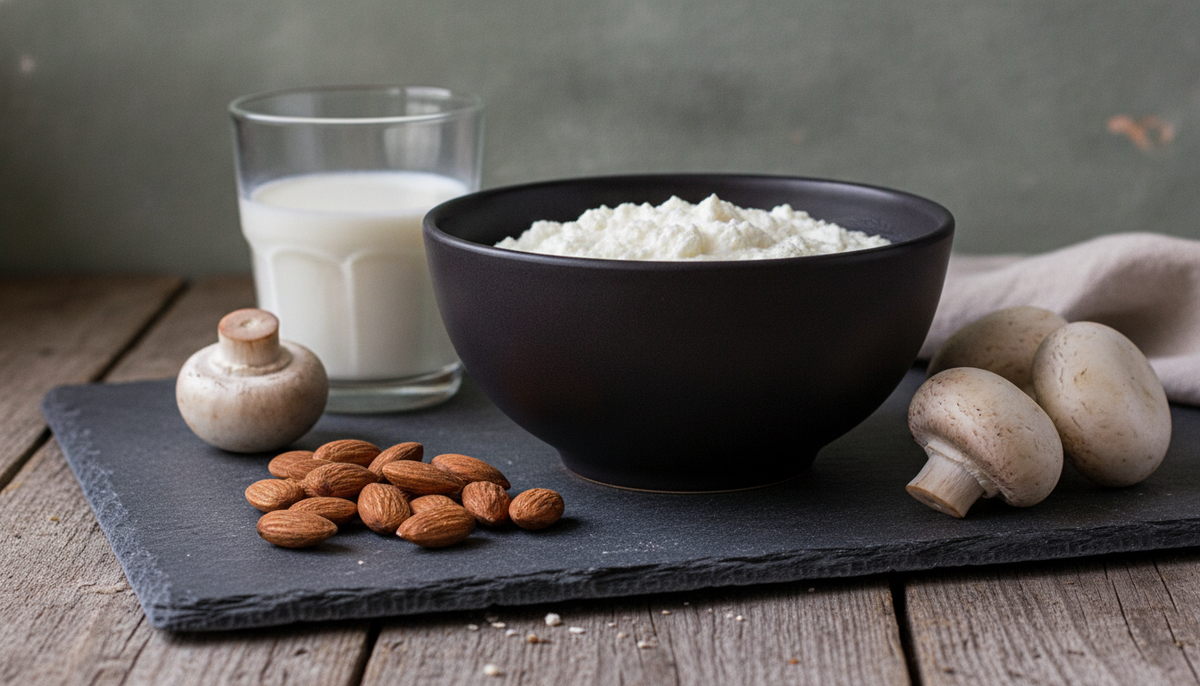
Overview of protein-rich foods: what really matters
Iodine-containing foods and the thyroid: what the numbers say