
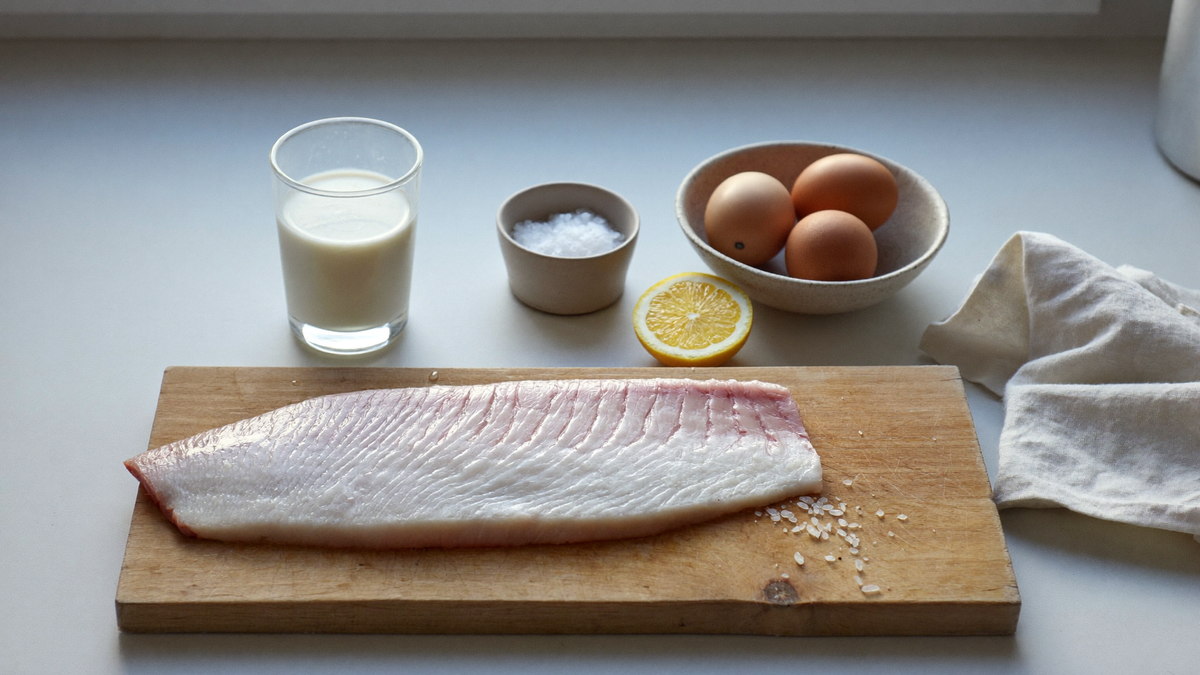
Iodine-containing foods and the thyroid: what the figures say
The essentials at a glance
Since 2025, the German Nutrition Society has recommended 150 micrograms of iodine per day for everyone aged 13 and over. That is less than before, and the reason is not a new requirement but a change in the method of calculation. Despite the lower figure, according to the same source, 32 percent of adults and 44 percent of children and adolescents fall below it.
The greatest leverage lies not on the plate but in the salt. Iodized salt contains an average of 20 micrograms of iodine per gram as stipulated by law, but the industry uses it in only some of its products, and that share is declining.
You will read the current figures, three widespread misconceptions checked against the sources, what is too much, who is at risk of falling short, and an overview of the foods with the highest levels. And the limitation this article states openly: no blood test offered by this provider measures iodine itself.
What to expect in this article
1. What the body needs iodine for
2. How much per day, and why the figure has fallen
3. The state of iodine sufficiency in Germany
4. Where the iodine in everyday life actually comes from
5. Three statements that persist stubbornly
6. What connects iodine and the thyroid
7. How much is too much: algae and the upper limit
8. Who is at risk of falling short
9. Iodine-rich foods at a glance
10. How to interpret your values
11. Limitations: what a blood test cannot do here
12. What you can change starting tomorrow
Frequently asked questions
Sources
What the body needs iodine for
Iodine has one known function in the body, and it is narrowly defined. The Robert Koch Institute describes iodine as an essential mineral that the body cannot produce itself and as indispensable for synthesizing the thyroid hormones triiodothyronine and thyroxine (as of May 28, 2025).
These two hormones are abbreviated as T3 and T4. They appear on every laboratory report concerning the thyroid, and they are why iodine is almost always discussed together with the thyroid.
Key message
The body cannot produce iodine itself. Every microgram the thyroid uses for its hormones has previously been eaten or drunk.
What happens when there is too little
The RKI explicitly names the consequences of an iodine-deficient diet: physical and neurological developmental disorders, reduced cognitive performance, impaired fine motor skills, as well as enlargement of the thyroid and nodular changes in thyroid tissue (2025).
This is a clear list, and it describes a pronounced deficiency. How far Germany is from adequate provision is explained in Chapter 3.
What appears on a test report
When you hold a thyroid test report in your hands, it usually contains three abbreviations. TSH is the hormone the pituitary gland uses to control the thyroid. fT3 and fT4 are the free fractions of the two hormones mentioned by the RKI in its description.
None of these findings states the iodine level. This is not a laboratory error. None of the provider information reviewed for this article and none of the sources lists an iodine level as part of a thyroid function test. What this means for a blood test is explained in Chapter 11.
How much per day, and why the figure has fallen
The current reference values date from 2025. From age 13 onward, the recommended intake is 150 micrograms per day, 220 for pregnant women, and 230 for breastfeeding women (DGE, as of 15 September 2025).
Recommended daily iodine intake, as of 2025
150 µg
from age 13, women and men alike
220 µg
during pregnancy
230 µg
during breastfeeding
Source: German Nutrition Society, Reference Values for Iodine and Iodine FAQ, as of 15 September 2025
Why the recommendation has become lower
Previously, the values for adults were 200 micrograms under age 51 and 180 micrograms from age 51 onward. The DGE explains the reduction by saying that the previous values included an additional allowance intended to improve the inadequate iodine supply of the population in Germany and Austria (2025).
According to the DGE, such an additional allowance does not reflect the scientific approach, because reference values should not be aimed at people with a deficiency. The new value is based on the average requirement.
This is an important distinction for everything else you read about this topic. The figure has fallen because the method of calculation changed, not because the supply situation improved. If you find the old values of 180 or 200 micrograms somewhere, you are looking at a version from before 2025.
The state of iodine supply in Germany
Despite the lowered recommendation, a substantial proportion of the population remains below it. In the same notice, the DGE cites 44 percent of children and adolescents and 32 percent of adults as being at risk of insufficient iodine intake (2025). The consumer advice center cites the same figures and describes the supply situation as needing improvement (as of 19 December 2025).
Documented source
“According to WHO criteria, Germany has a mild iodine deficiency.”
German Nutrition Society
Notice on the new reference values for iodine intake, 2025
This sentence is unusually clear for a professional organization. It comes from the institution itself and is not attributed to any individual.
What the figures are based on
The Federal Centre for Nutrition states the same thing from the other side: studies show that, on average, people in Germany consume only about two thirds of the recommended amount of iodine (as of 25 August 2026).
Two thirds of 150 micrograms is around 100 micrograms. The gap in question is therefore about 50 micrograms per day. That sounds like little, yet it amounts to more than half a portion of pollock.
How the gap is distributed
The average conceals a difference. In its analysis, the Federal Institute for Risk Assessment notes that 45 percent of women and 31 percent of men consume less iodine than the average requirement (2021).
Women fall below this level significantly more often than men, and this coincides with a second figure from Chapter 8: During pregnancy and breastfeeding, the reference value increases further. Looking at both together shows why this group is mentioned separately in all the sources reviewed.
Where the iodine in everyday life actually comes from
This is the point that surprises most people. The most important source is not fish, but salt—not the salt in the household shaker, but the salt in purchased foods.
According to the BZfE, iodized salt has a legally defined iodine content of an average of 20 micrograms of iodine per gram of salt (2026). With up to six grams of table salt per day, the upper limit cited by the DGE, that would theoretically amount to up to 120 micrograms.
Why this calculation usually does not add up
Because most salt does not come from the salt shaker at home, but from bread, sausage, cheese, and processed foods. And the share of iodized salt in these foods is declining: in bread, from 12.7 percent in 2020 to 9.3 percent in 2024, and in sausage products, from 48.1 to 33.9 percent (BZfE, 2026).
The consumer advice center puts the share of salt-containing products made with iodized salt at around 30 percent overall (2025). In other words, only a small proportion of the salt people eat anyway contributes any iodine at all.
This explains the finding from Chapter 3 better than any dietary advice. The gap does not arise because people eat too little salt, but because the salt they eat is too rarely iodized.
The contradiction that explains the gap
A figure from the BfR completes the picture. According to it, around 84 percent of Germany’s population uses iodized salt at home (2021). So it is present in almost every household’s salt shaker.
However, the salt shaker at home accounts for the smaller share. Most salt enters the household already processed, and in that category the proportion was already around 48 percent of meat and sausage products in 2021; according to the BZfE, it is now 33.9 percent. The gap between what people do at home and what ends up on their plates is precisely the gap from Chapter 3.
It says so on the packaging, by the way: For foods made with iodized table salt, this information appears in the ingredients list. For unpackaged goods such as baked goods or sausage, the BZfE advises asking whether iodized salt was used during production (2026).
How much salt is permissible at all
Here, two institutions differ slightly, and both figures are correct. According to the BZfE, the DGE recommends up to six grams of table salt per day, or one level teaspoon. The World Health Organization specifies less than five grams.
In fact, men consume around ten grams per day on average, while women consume more than eight grams (BZfE, 2026). Eating more salt is therefore explicitly not a way to consume more iodine. The way is to use iodized rather than non-iodized salt in the same quantity.
Three statements that persist
Widespread versus supported by evidence
Widespread
“Iodine deficiency has long since become a thing of the past in Germany.”
Supported by evidence
According to WHO criteria, Germany has a mild iodine deficiency; 32 percent of adults and 44 percent of children and adolescents are at risk of insufficient intake (DGE, 2025).
Widespread
“With Hashimoto’s, you have to eliminate iodine from your diet.”
Supported by evidence
The IQWiG writes that a very high iodine intake, for example from an X-ray contrast agent, can trigger symptoms in people with a corresponding predisposition, and adds: In everyday life, however, such high iodine concentrations are not reached through food (as of April 24, 2024).
Widespread
“Algae are the best plant-based source of iodine.”
Supported by evidence
In a market sample conducted by the Verbraucherzentrale, iodine levels ranged from less than 10 to 8,720 micrograms per 100 grams of food (2025). The BZfE considers algae not unreservedly recommendable because of their highly variable and sometimes extremely high iodine content (2026).
What connects iodine and the thyroid
The connection is direct and clearly described in the sources. The IQWiG notes that the thyroid needs this trace element, which is found in foods such as sea fish, dairy products, and eggs (as of April 24, 2024).
And furthermore: If you consume too little iodine over a prolonged period, a normally sized thyroid cannot produce enough hormones and begins to grow. Iodine deficiency is the cause in around 90 percent of all people with an enlarged thyroid (IQWiG, 2024).
What the IQWiG recommends in practice
The recommendation from the same organization is remarkably unspectacular: eat sea fish once or twice a week, such as herring, plaice, or cod, and season food with iodized table salt (2024).
So, two actions, not ten. One is set out in numbers in Chapter 9, the other in Chapter 4.
What applies to existing thyroid disorders
This article deliberately takes a cautious approach here. The Verbraucherzentrale notes that both a deficiency and an excessive intake can cause problems, and that people with thyroid disorders should be particularly cautious (2025).
The sources reviewed for this article contain no information on dietary recommendations for hyperthyroidism. This is neither an all-clear nor a warning, but simply a gap—and one that belongs in a discussion with a doctor, not in a guide.
What the connection does not mean
These sentences do not mean that more iodine results in better thyroid function. The sources describe what happens in the event of a deficiency, and they specify an upper limit at the other end. In between is a range in which more is not better, but simply more.
This article therefore does not claim anywhere that iodine-rich foods prevent or improve thyroid disease. What it reports are the intake recommendations and observations of the organizations mentioned. Anything beyond that should be assessed by a doctor.
How much is too much: algae and the upper limit
There are two figures for the upper limit, and both are correct. At the European level, according to the DGE, a long-term intake of up to 600 micrograms per day poses no health risk to adults (2025).
For Germany, by contrast, the consumer center specifies a maximum amount from all sources of 500 micrograms per day (2025). The lower figure is related to Germany's historical iodine deficiency. Anyone who adheres to 500 is within the safe range under both systems.
Why algae are a category of their own
The German Federal Institute for Risk Assessment has issued its own statement on this. The iodine levels in dried algae and seaweed products are particularly high, ranging from 5 to 11,000 milligrams per kilogram of dry weight. The BfR considers products with an iodine content of 20 milligrams per kilogram or higher unmarketable.
And with a specific calculation: the BfR cites a tested product in which 506 milligrams of iodine per kilogram was found. If a 10-gram portion of it is consumed, according to the BfR this already results in iodine intake ten times higher than the tolerable upper intake level of 0.5 milligrams per day considered safe for Germany.
In the consumer center's market sample, 8 of 19 products exceeded the guideline value of 2,000 micrograms of iodine per 100 grams of dry matter (2025). This is why no algae appear in the overview table in this article.
Why iodized salt does not come close to the upper limit
When looking at 500 micrograms, the question arises whether iodized salt can provide too much. The calculation is quick. According to the BfR, salt may currently have 15 to 25 milligrams of iodine added per kilogram (2021), corresponding to the 20 micrograms per gram in Chapter 4.
At six grams of salt per day, the DGE upper limit, that amounts to 120 micrograms by calculation. Even with the ten grams that men actually eat on average, it would be 200 micrograms. Both figures are well below 500.
The upper limit is therefore not usually reached through salt, but through concentrated sources: algae products, dietary supplements, and iodine-containing medicines or contrast agents. The first of these three groups is the only one found in supermarkets.
Who may be at risk of falling short
Not everyone is equally well supplied with this nutrient. The following comparison summarizes what the sources say about the individual groups.
Probably covered if …
that you eat sea fish once or twice a week. This is the amount cited by IQWiG (2024).
you use iodized table salt at home and look for the indication “iodized salt” when shopping.
Milk and cheese regularly feature in your diet. Both provide significant amounts; see Chapter 9.
Look more closely if …
you follow a vegan diet. The BZfE explicitly identifies this as an increased risk of inadequate intake (2026).
you are pregnant or breastfeeding. The amounts here are 220 and 230 micrograms, respectively, and both expert bodies additionally recommend a supplement.
you mainly drink organic milk. According to the DGE table, it provides about half as much iodine as conventional milk.
What the BZfE says about a vegan diet
The recommendations are specific: generally use iodized table salt or sea salt enriched with seaweed and a defined iodine content; choose foods made with iodized salt, such as bread or plant-based milk, sausage, and meat alternatives; and additionally take an iodine supplement containing 100 micrograms per day (2026).
The same source takes a different view of a vegetarian diet: In that case, a targeted selection of foods can provide sufficient iodine. The difference is milk and cheese, which are absent in the vegan version.
Pregnancy and breastfeeding
The sources agree on this point. For pregnant and breastfeeding women alike, the DGE recommends, in addition to a balanced diet with iodized table salt, a daily supplement containing 100 to 150 micrograms of iodine (2025). IQWiG puts it almost identically: eat an iodine-rich diet and additionally take 100 to 150 micrograms of iodine per day in tablet form (2024).
Even a supplement of this size should be discussed with the medical practice overseeing your care, not decided on based on a blog article.
Iodine-rich foods at a glance
A preliminary note that distinguishes this table from most others: The DGE’s values refer to portions, not 100 grams. No conversion is made here because that is not how the source presents the data. Instead, the last column compares the value with the 150 micrograms from Chapter 2.
| Food | Reference amount | Iodine | Share of 150 µg |
|---|---|---|---|
| Cod | 120 g, one portion | 330 µg | just over two days’ worth |
| Mozzarella | 100 g | 100 µg | two thirds |
| Pollock | 120 g, one portion | 94 µg | just under two thirds |
| Mascarpone | 30 g | 54 µg | just over one third |
| Iodized table salt | 2 g | 40 µg | just over one quarter |
| Milk, conventional | 250 ml | 30 µg | one fifth |
| Alpine cheese | 30 g | 25 µg | one sixth |
| Feta cheese | 30 g | 23 µg | just under one sixth |
| Milk, organic | 250 ml | 15 µg | one tenth |
| Egg, cooked | 60 g, one egg | 9 µg | just under one sixteenth |
Source: German Nutrition Society, iodine FAQ, as of September 15, 2025. All values are per portion. The last column is this editorial team’s comparison with the reference value of 150 µg and does not appear in the source.
The gap in this table is striking. One portion of cod theoretically covers more than two days’ worth, while one egg covers not even one sixteenth. The factor at issue for this nutrient lies between these two rows.
The line for salt is equally striking. Two grams of iodized table salt provide more than one serving of mountain cheese, and two grams is about one-fifth of what is eaten in a day anyway.
What is not included in this table is just as revealing. Vegetables, fruit, grains, and legumes are missing, and not for lack of space. They contribute so little to iodine intake that the DGE does not include them in its overview.
This explains the finding from Chapter 8 on a vegan diet better than any recommendation. Anyone who cuts out fish, milk, and cheese cuts out the three lines with the highest values and keeps only the salt. That is precisely why the BZfE additionally recommends a supplement for this group.
The bigger lever is not on the plate but in the salt that enters the home already processed.
Where you can put your values into context
If this topic has reached you, it was usually through the thyroid rather than iodine. A capillary blood test from mybody®x (MYBODY Lab GmbH) measures the values shown on a thyroid test report—and explicitly not iodine status.
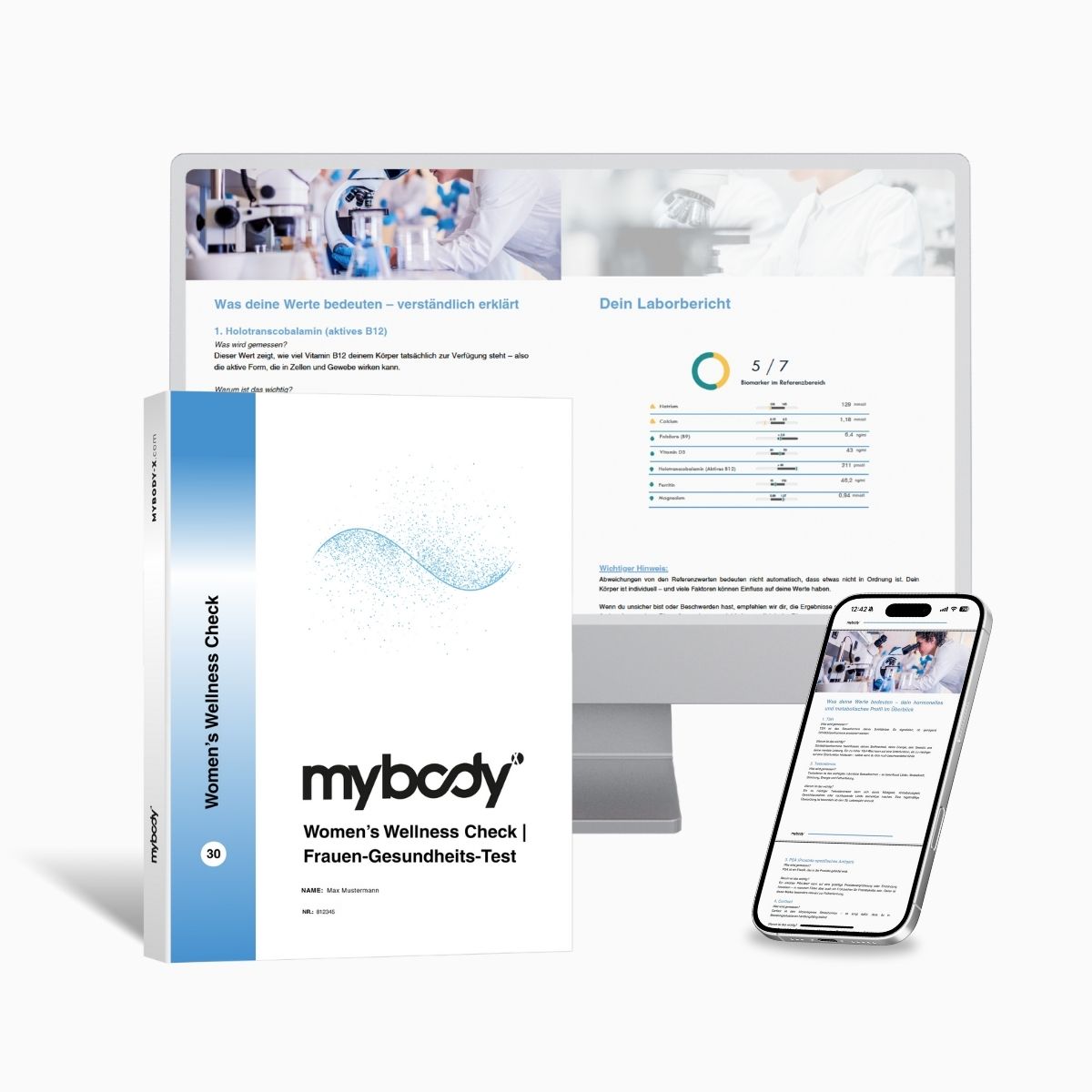
Blood test using capillary blood
Women’s Wellness Check | Women’s health test
According to the product page, it includes 18 values, including TSH, fT3, and fT4, as well as cortisol, prolactin, SHBG, ferritin, vitamin B12, vitamin D, the cholesterol profile, and liver, kidney, and blood glucose values. Iodine is explicitly not included. The test provides figures for a consultation with a doctor, not a diagnosis.
Laboratory analysis 3–5 working days after sample receipt
Information from the product page, accessed 28 August 2026
For men, mybody®x offers a separate test with a different focus. It is deliberately not shown alongside it in this article because the two share a large proportion of their values, and comparing them in the same table would create more confusion than clarity.
Limitations: what a blood test cannot do here
This limitation is stated so clearly here because it is particularly easy to overlook when it comes to iodine. No test offered by this provider measures iodine. The test mentioned above measures TSH, fT3, and fT4—that is, thyroid hormones. That is different from iodine status, and iodine intake cannot be determined from these three values.
The figures in Chapter 3 are not based on blood values. The Verbraucherzentrale describes the data situation in terms of iodine excretion and how many people fall below the estimated average requirement based on that measure (2025). This is a method for population studies, not a self-test for use at home.
And a second limitation concerns the values themselves. A single TSH value describes one point in time. Whether it requires further investigation is determined in the context of symptoms, medical history, and additional tests, and that belongs in a medical practice.
What you can change starting tomorrow
If you take away just one action from this article, let it be this: Look at the salt package in your cupboard and replace it with iodized table salt the next time you shop. The amount stays the same; the iodine content does not.
The reason is the finding from Chapter 4. Of the salt that is consumed anyway, only some contains iodine, and that proportion has fallen in recent years. Your own salt shaker is the part of this calculation that you decide on alone.
The second action costs a little more: eat sea fish once a week. That puts both of IQWiG’s recommendations into your week, bringing you much closer to 150 than to the current average in terms of the figure from Chapter 2.
If you belong to one of the groups from Chapter 8, there is a third step, and it involves a conversation, not a purchase. Pregnancy, breastfeeding, and a vegan diet are the three cases in which all the sources reviewed go beyond food choices.
It began with the question of which foods provide iodine. The evidence-based answer is unremarkable: sea fish, milk, cheese, and iodized salt. The more interesting second answer, which hardly anyone expects, is that the greatest leverage lies not in the choice of foods but in a packet of salt.
Frequently asked questions
How much iodine does an adult need per day?
From the age of 13, the recommended intake is 150 micrograms per day, 220 micrograms for pregnant women, and 230 micrograms for breastfeeding women (DGE, as of September 15, 2025). This value was lowered in 2025; previously, the recommendations were 200 micrograms for people under 51 and 180 micrograms for people aged 51 and over. According to the DGE, the reason was not a change in requirements but the discontinuation of an allowance intended to compensate for the population’s inadequate intake.
Which foods contain the most iodine?
According to the DGE overview, a 120-gram portion of cod provides 330 micrograms, 100 grams of mozzarella provides 100 micrograms, and a 120-gram portion of saithe provides 94 micrograms. Two grams of iodized table salt provide 40 micrograms, 250 milliliters of conventional milk provide 30 micrograms, while organic milk provides 15 micrograms (as of September 15, 2025). All values refer to portions, not to 100 grams.
Do you have to avoid iodine if you have Hashimoto’s?
IQWiG writes that experts assume a very high iodine intake, for example as part of an X-ray examination using iodine-containing contrast media, can trigger symptoms in people with a corresponding predisposition. It explicitly adds: In everyday life, such high iodine concentrations are not reached through food, however (as of April 24, 2024). What applies in an individual case belongs in consultation with the treating medical practice; this article is not a substitute for a medical consultation.
How much iodine is too much?
There are two figures. According to the DGE, at the European level, long-term intake of up to 600 micrograms per day poses no health risk to adults (2025). For Germany, the Consumer Advice Center specifies a maximum amount from all sources of 500 micrograms per day (2025). The lower value is linked to Germany’s historical iodine deficiency. Anyone who adheres to 500 micrograms is within the safe range under both systems.
Are algae a good source of iodine?
They are above all unpredictable. In a market sample conducted by the Consumer Advice Center, iodine levels ranged from less than 10 to 8,720 micrograms per 100 grams of food, and 8 of 19 products exceeded the guideline value of 2,000 micrograms per 100 grams of dry matter (2025). The BfR considers dried algae products containing 20 milligrams of iodine per kilogram or more unfit for sale. For one product tested at 506 milligrams per kilogram, it calculates that a portion of just 10 grams provides an intake ten times higher than the upper limit of 0.5 milligrams per day considered safe in Germany.
Next step
Your thyroid levels in black and white
If you came to this topic through your thyroid, TSH, free T3, and free T4 are the values that matter. The test provides figures for a conversation with your doctor, does not measure iodine, and does not replace medical evaluation.
View Women’s Wellness Check Mediterranean dietRead more
You might also be interested in
There, the sea fish from Chapter 6 appears in a different context, along with its fat content and origin labels.
Milk and cheese appear there again, this time with their protein values.
Sources
- German Nutrition Society (DGE): Selected questions and answers about iodine (as of 15 September 2025) – dge.de
- German Nutrition Society (DGE): New reference values for iodine intake, 2025 report – dge.de
- Consumer Advice Center: Iodine supply is declining again in Germany (as of 19 December 2025) – verbraucherzentrale.de
- Federal Center for Nutrition (BZfE): Salt (as of 25 August 2026) – bzfe.de
- Institute for Quality and Efficiency in Health Care (IQWiG): Iodine-deficiency goiter, gesundheitsinformation.de (as of 24 April 2024) – gesundheitsinformation.de
- Institute for Quality and Efficiency in Health Care (IQWiG): Hashimoto’s thyroiditis, gesundheitsinformation.de (as of 24 April 2024) – gesundheitsinformation.de
- Robert Koch Institute (RKI): Iodine supply (as of 28 May 2025) – rki.de
- Federal Institute for Risk Assessment (BfR): Health risks from excessive iodine levels in dried algae, Opinion No. 026/2007 – bfr.bund.de
- Consumer advice centre: Foods containing algae, a good source of iodine or a risk (as of 26.11.2025) – verbraucherzentrale.de
- Federal Centre for Nutrition (BZfE): Good iodine intake with a vegan and vegetarian diet (as of 17.06.2026) – bzfe.de
- World Health Organization (WHO): Salt reduction, Fact sheet – who.int
- German Federal Institute for Risk Assessment (BfR): Declining iodine intake among the population, model scenarios for improving iodine intake, Opinion No. 005/2021 dated 09.02.2021 – bfr.bund.de
The reference values of 150, 220, and 230 micrograms, the food table, the supplement recommendation for pregnant and breastfeeding women, and the European upper limit of 600 micrograms come from [1]. The former values of 180 and 200 micrograms, the rationale for the reduction, the proportions of 32 and 44 percent, and the statement regarding mild iodine deficiency according to WHO criteria come from [2]. The information on the upper limit of 500 micrograms for Germany and the proportion of approximately 30 percent of iodized products comes from [3]. The iodine content of iodized salt, the recommendation to consume up to six grams of salt, actual salt consumption, the proportions for bread and meat products, and the statement that two-thirds of the recommended iodine intake comes from [4]. The statements about the thyroid, the claim that 90 percent of enlargement cases are caused by it, and the recommendation to consume sea fish and iodized salt come from [5]; the statements about Hashimoto's disease come from [6]. The description of iodine as an essential mineral and the consequences of an inadequate diet come from [7]. The information on algae comes from [8], [9], and [10]; the recommendations for vegan and vegetarian diets come from [10], and the salt recommendation of less than five grams comes from [11]. The proportions of 45 and 31 percent, the figure of 84 percent household use of iodized salt, the proportion of 48 percent for meat and sausage products, and the legally permitted addition of 15 to 25 milligrams per kilogram of salt come from [12]. Information on price, measured values, sample type, and laboratory comes from the mybody®x product page, accessed on 28.08.2026; processing times follow the central guideline for blood tests. All sources were accessed and checked on 28.08.2026.

mybody®x Editorial & Expert Team
Nutritional science Laboratory diagnostics Blood analysis interpretation Nutrigenetics
This article was created by the mybody®x editorial and expert team. The team combines laboratory diagnostics, nutritional science, and the interpretation of blood analyses. Everyone involved can be found on the authors page.
Published on 28.08.2026 · Last updated on 28.08.2026
The content is intended for general information and does not replace medical advice, diagnosis, or treatment. Reference ranges depend on the laboratory, method, and age; the information on your test report is always authoritative.




Share now:
Mediterranean Diet in Everyday Life: What’s Proven and What Isn’t
Magnesium-rich foods: what the numbers actually reveal