
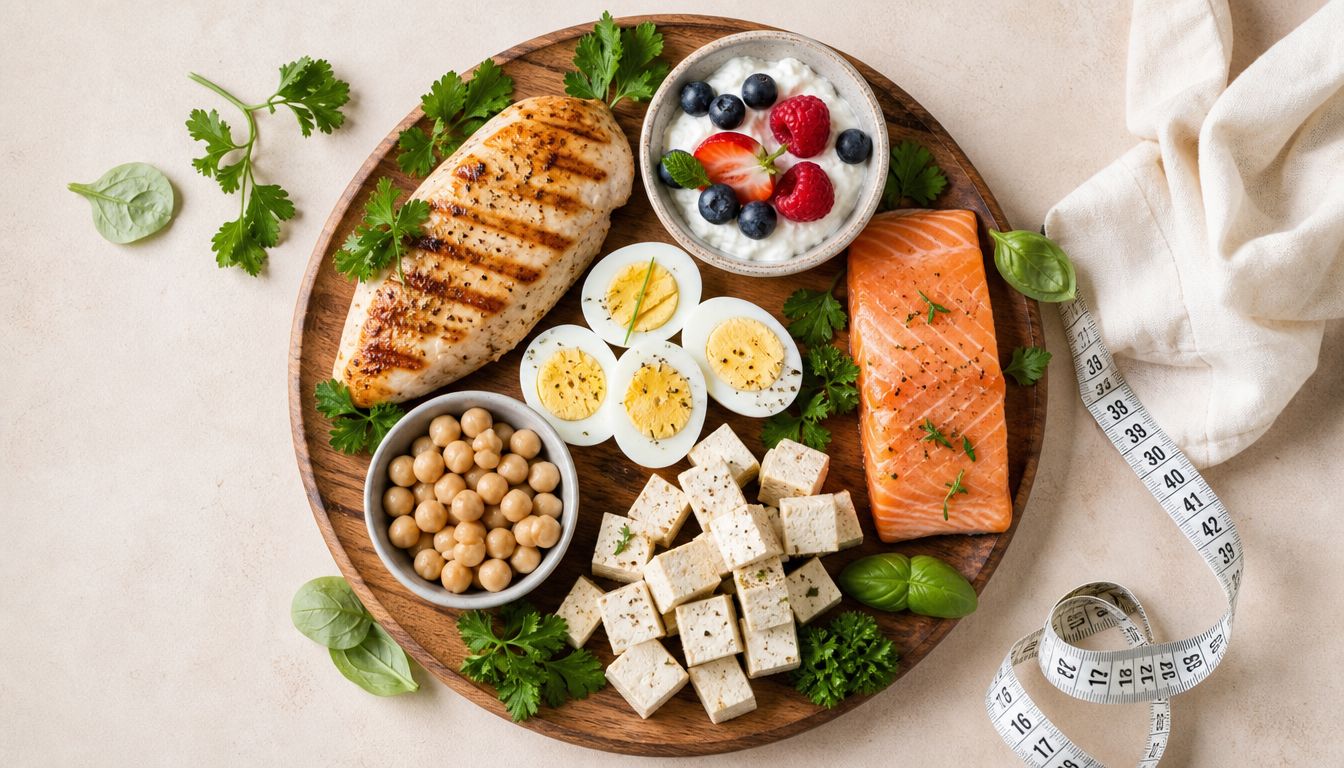
Protein-rich foods for weight loss: how to make it work in 2026
You may know the feeling. In the morning, you resolve to eat “really disciplined today.” You manage to stick with it through lunch. In the afternoon, your energy crashes, hunger hits in the evening, and suddenly the entire diet feels like a battle against your own body again.
This is exactly where it helps to take a different perspective. Not stricter, not eating even less, but eating more intelligently. For many people, protein-rich foods for weight loss are so helpful because they provide more than just calories—they combine satiety, practicality, and muscle preservation.
Even so, not every protein-rich diet works equally well for everyone. One person immediately feels more stable with more quark, eggs, and legumes. Another eats similarly but remains hungry or loses weight more slowly. This isn’t a sign of a lack of willpower. It simply shows that while nutrition follows general rules, it is ultimately always individual.
Why most diets fail and protein is the solution
Many diets don’t fail because you’re “too weak.” They fail because they work against fundamental signals from your body in everyday life. Anyone who is constantly hungry thinks about food more often, is more likely to snack between meals, and rarely maintains a calorie deficit for long.
A typical example: Someone starts highly motivated with salad, rice cakes, and as little fat as possible. The scales may respond briefly at first. Then fatigue, cravings, and the feeling of constantly having to give things up set in. The problem is often not a lack of willpower, but the wrong satiety strategy.
When discipline alone isn’t enough
Protein is often the overlooked lever here. It doesn’t help you lose weight because it magically “melts” fat. It helps because it makes meals more satisfying. You stay full longer, often eat in a more structured way almost automatically, and are more likely to protect your muscle mass while dieting.
Many people don’t fail because of the diet concept itself, but because their eating habits leave them feeling hungry all day.
That’s exactly why a protein-rich approach often feels more realistic than extreme restrictions. Instead of cutting out entire food groups, you structure each meal so it genuinely keeps you going. If you want to understand more deeply why standard diets often fail to reflect real everyday life, the article about the real reasons why a diet without testing fails offers a useful addition.
Protein as a strategic partner
Protein is not a fitness trend when it comes to weight loss, but a practical tool. It suits people who do not want to eat, count, and struggle constantly. Especially if you are familiar with the yo-yo effect, this change in perspective is worthwhile: do not eat as little as possible, but eat in a way that helps your body work with you.
The three pillars of protein’s effect on weight loss
Protein primarily helps with weight loss in three ways. Once you understand them, it quickly becomes clear why high-protein meals are often easier to stick with than classic “light” diet food.

Satiety that lasts longer
The first pillar is satiety. High-protein meals keep many people satisfied for longer than meals consisting mainly of quickly digestible carbohydrates. You notice this immediately in everyday life. A breakfast with a good protein source often feels different from a sweet breakfast that has you thinking about the refrigerator again a short time later.
This is also one of the reasons why protein-focused diets so often work well for weight management. According to the BZfE on weight loss with moderately increased protein intake, a moderately increased protein intake of 1.0 g per kg of body weight instead of the standard DGE recommendation of 0.8 g/kg significantly promotes weight loss when protein provides 20% of daily energy needs. The effect is mediated, among other things, by increased satiety.
A small internal power plant
The second pillar is the thermic effect. Your body has to digest, break down, and process food. With protein, this effort is higher than with some other macronutrients. You can think of it as an internal power plant: the body has to work harder to make the protein usable.
Of course, this does not replace a calorie deficit. But it explains why protein is often so useful when losing weight. It supports not only satiety, but also the energy expenditure involved in processing food.
Muscles protect your basal metabolic rate
The third pillar is often underestimated. When you lose weight, you do not simply want to “weigh less.” You want to lose body fat while avoiding unnecessary muscle loss. Muscles are metabolically active and important for strength, resilience, and everyday life.
A higher-protein diet helps protect lean mass more effectively during a diet. This not only makes the weight-loss process more worthwhile aesthetically, but often more sustainable as well.
Practical rule: At every main meal, ask yourself first: “Where is my protein source?” Only then plan the rest of the plate.
When you look at these three pillars together, it becomes clear why high-protein foods for weight loss are about much more than a list of chicken, quark, and shakes. They target exactly the areas where diets often fall apart in everyday life.
How Much Protein You Really Need to Lose Weight
You’re eating more protein than before, choosing foods such as Skyr, eggs, or legumes, and still wondering: Is that enough? Or is it still too little for you? This is exactly where many people lose sight of the bigger picture, because a number from a fitness post rarely fits your everyday life, your body, and your goal.

The Baseline Isn’t Automatically Your Diet Goal
For healthy adults, the DGE gives 0.8 grams of protein per kilogram of body weight as a general guideline. This amount primarily describes basic requirements. When losing weight, a somewhat higher intake can be beneficial because it better supports satiety and muscle retention.
This is exactly where misunderstandings often arise. “Enough” doesn’t automatically mean “optimal for fat loss.” When you’re in a calorie deficit, your body behaves differently than it does during a period of stable weight. It then needs a diet that not only provides nutrients but also keeps you feeling satisfied and able to manage everyday life.
A Sensible Range Instead of a Magic Number
For many active people, a range of 1.2 to 1.6 grams per kilogram of body weight is a practical guideline. At 70 kilograms, that would be roughly 100 grams per day. This overview of daily protein requirements for weight loss and everyday life shows you how to assess your personal target.
Distribution matters more than perfection. In everyday life, protein often works better when you spread it across several meals instead of eating one very large portion in the evening. It’s like heating your home. Several steady bursts keep the temperature more stable than a short blast of heat at the end of the day.
Why the Same Amount Doesn’t Work Equally Well for Everyone
Two people can eat the same amount of protein and still respond differently. One stays full for a long time, while the other gets hungry again after only a short while. One preserves their muscle mass well while in a calorie deficit, while the other loses muscle more quickly. This is partly due to body weight, activity level, age, muscle mass, metabolism, and also how protein intake is distributed throughout the day.
Genetics and everyday life also play a role. If you sit a lot, train differently, sleep poorly, or are constantly under stress, you often experience hunger, recovery, and weight loss differently. That’s why a high-protein diet isn’t a rigid formula, but more like a dial you need to adjust to suit you.
How to find your own starting point
This breakdown works well for many people in practice:
- You mainly want to eat healthily and maintain your weight. Then the basic guideline is often sufficient.
- You want to lose weight deliberately. Then a moderately higher proportion of protein is often useful.
- You train regularly or want to preserve muscle more effectively while in a calorie deficit. Then it is worth planning a clear focus on protein throughout the day.
For people with a higher body weight, requirements are often based in practice on target weight or a healthy reference weight, rather than simply on current weight. This prevents the calculated amount from becoming artificially high.
You can recognize adequate protein intake by more than just the number of grams. You can also tell by the fact that your meals keep you full for longer, you can stick to your calorie deficit more easily, and your diet fits into your everyday life.
You don't need any specialty products or complicated calculation models for this. A sensible target range, regular meals, and an honest look at your own hunger cues will usually get you further than any rigid standard formula.
The best protein-rich foods for your shopping cart
You're standing in the supermarket, want to lose weight, and reach for whatever seems healthy. A fruit yogurt here, some muesli there, perhaps a salad as well. Once you're home, you often realize: well-intentioned, but not really filling. That's exactly why it's worth taking a clear look at protein sources when you shop. They are often the difference between a meal that keeps you going for two hours and one after which you quickly get hungry again.
There isn't one perfect list for everyone. Two people can buy the same protein-rich foods and still lose weight differently with them. One person may tolerate skyr wonderfully, while another feels better with legumes and tofu. Someone with a stressful office routine may mainly need simple, ready-to-eat options. People who train a lot are more likely to plan larger portions or combine several protein sources per meal. Your shopping list and metabolism need to work together; otherwise, good intentions quickly remain just theory.
Combining plant-based and animal foods sensibly
For many people, a mix of plant-based and animal protein sources works best. Plant-based foods often also provide fiber, while animal sources are frequently especially convenient and protein-rich. So you don't have to choose sides. It's more useful to build your shopping cart around what suits your everyday life, your taste, and your digestion.
A toolbox is a good way to think about it. Eggs, quark, fish, lentils, tofu, and beans do not perform exactly the same function, but they all help you consistently get enough protein. If you want to expand your selection, this overview of protein-rich foods and their sources offers practical ideas.
What Really Works in Everyday Life
Animal-based sources are particularly helpful when you have little time and need something quick and easy to plan:
- Eggs are versatile, easy to prepare in advance, and suitable for breakfast, lunch, or dinner.
- Skyr, quark, plain yogurt, and cottage cheese provide plenty of protein with a moderate calorie count and make cold meals considerably more filling.
- Poultry is an easy staple for many people when preparing stir-fries, bowls, or salads.
- Fish adds variety to hot main meals and can be light or especially filling, depending on the type.
Plant-based sources are particularly useful if you want to stay full longer and have more volume on your plate:
- Lentils, beans, and chickpeas are filling and work well in soups, curries, salads, and spreads.
- Tofu and tempeh can be seasoned in many different ways and work well in a wide range of hot dishes.
- Soy yogurt or higher-protein plant-based drinks can be useful for people who do not tolerate dairy products well.
- Nuts and seeds complement meals well, but because of their energy density, they are better suited as a side than as a main protein source.
- Oats become especially useful when you combine them with quark, Skyr, soy yogurt, or seeds.
Top Protein Sources at a Glance
| Food | Protein profile | Everyday satiety | Particularly practical for |
|---|---|---|---|
| Chicken breast | high | good | Quick main meals |
| Lentils | good | very good | Stews, bowls, meal prep |
| Skyr or quark | high | good | Breakfast, snack |
| Eggs | good | good | Flexible everyday cooking |
| Tofu | good | good | Plant-based hot dishes |
| Chickpeas | good | very good | Salads, curries, snacks |
| Fish | high | good | Varied main meals |
| Cottage cheese | high | good | Bread-based meals, cold dishes |
The table deliberately avoids rigid numbers. For shopping, it’s initially more important how a food works in your everyday life. Can you prepare it quickly? Do you tolerate it well? Does it keep you full without causing cravings later?
This is exactly where personalization becomes practical. If you stay comfortably full until noon after a breakfast with cottage cheese or eggs, that’s a good sign. If legumes keep you full for a long time but dairy products tend to weigh you down, your shopping cart should reflect that. Protein isn’t just something that works on paper. It has to fit into your actual daily routine.
How to easily incorporate more protein into your everyday routine
In everyday life, the perfect plan doesn’t win—the one you actually stick to does. Adding more protein doesn’t mean you have to eat the same three fitness meals over and over.

An ordinary day with better choices
You can start small in the morning. Instead of just choosing toast or cereal, choose a breakfast that keeps you going. This could be yogurt or quark with oats and nuts, or eggs with bread and some vegetables. You don’t have to eat perfectly. You just need to avoid relying on snacks again before lunchtime.
At lunchtime, whether at the office or at home, protein works best when it isn’t complicated. A bowl with legumes, a salad with egg or fish, or leftovers from the night before with tofu or poultry. Anything is better than a “light” lunch that sends you looking for something sweet two hours later.
According to Focus on the effects of a high-protein diet on hunger and satiety, diets in which 18 to 35 percent of total calories come from protein lead to reduced feelings of hunger and greater satiety throughout the day and evening. In particular, overweight men have also reported fewer nighttime and morning cravings.
Smart swaps instead of strict rules
Small swaps in everyday life are often enough:
- Switch up breakfast instead of starting with something sweet. Add eggs, quark, or Greek yogurt.
- Upgrade your snacks instead of eating fruit alone. Combine fruit with cottage cheese, yogurt, or a small portion of nuts.
- Adjust the sides instead of reworking the entire meal. Fewer “empty” extras, more legumes, or an additional source of protein.
- Make dinner more satisfying instead of ending the day with bread and toppings that don’t fill you up. Soups, skillet meals, or bowls with a clear protein base often work better.
A high-protein daily routine doesn’t work through perfection but through repetition. Three or four solid choices a day are often enough.
Preparation beats motivation
If you already know in the evening what you’ll eat the next day, everything becomes easier. Pre-cook legumes, keep yogurt or skyr on hand, store eggs in the refrigerator, and plan one or two simple go-to meals. This way, protein doesn’t become a special task but a normal habit.
Your path to a personalized protein strategy
You follow a plan, consciously eat more protein, and stick with it for several weeks. Someone else in your circle seems to do almost the same thing and loses weight faster. This is especially frustrating because both strategies look similarly effective on paper. In practice, however, not every body responds in the same way.
General recommendations are a starting point, not a personal blueprint. As a rough guide, protein needs are often higher when losing weight than for basic maintenance alone. However, the amount that makes sense for you also depends on how active you are, how well you spread your protein intake throughout the day, how full you feel after meals, and which foods you tolerate well.

Why standard plans often only fit halfway
Protein helps many people lose weight. The path to getting there can still look different. For one person, Skyr in the morning, legumes at lunchtime, and fish in the evening work very well. Another feels better with eggs, tofu, and a smaller total amount, even though both weigh about the same.
There are several reasons for this. Satiety is individual. Digestion is individual. Everyday life, sleep, training volume, and personal preferences also affect how well a high-protein diet ultimately works. There may also be differences in nutrient utilization or in the way someone responds to certain foods.
Protein therefore works a little like a toolbox. Two people may use the same tools, but that does not automatically mean they will achieve the same result.
Anyone who wants to understand more precisely what role genetic differences may play can get a good initial overview in this guide to DNA analysis for a personalized nutrition strategy.
How to find out what works for you
The first step is observation rather than blindly copying. For two to three weeks, pay attention to four simple points: How full do you feel after protein-rich meals, when does intense hunger return, how is your energy throughout the day, and which protein sources agree with you?
You can build on that in a targeted way. If you get hungry again soon after a sweet breakfast, you may need more protein in the morning. If large portions of meat sit heavily in your stomach, yogurt, eggs, tofu, fish, or legumes may be a better foundation. If you train a lot, your needs may differ from those of someone with a sedentary lifestyle.
Another option is a more detailed analysis of your individual circumstances. The NutriCare | INFINITY DNA Test is described by MYBODY Lab GmbH as a test that evaluates genetic indicators related to nutrient utilization, food intolerances, micronutrient requirements, and metabolic type. Such information does not replace sound basic principles, but it can help you tailor your decisions more precisely to your own body.
The important question is not only whether protein helps with weight loss. The more important question is which protein-rich strategy you can implement successfully over the long term.
With moderation instead of extremes
More protein is not automatically better. The right amount is the amount that suits your goal, your health, and your daily routine. Anyone with pre-existing health conditions or uncertainty about making major dietary changes should seek medical or nutritional advice.
Personalization therefore does not mean a complicated special solution. It means adapting the general rules so that they work practically for you. That is where good advice becomes a plan you can actually stick to.
Your takeaway: Take control of your success
If you want to lose weight with protein-rich foods, three things are crucial. First: Protein works in practice because it keeps you full, can help when you are in a calorie deficit, and supports the preservation of muscle. Second: Quantity matters, because there is often a significant difference between general basic needs and targeted weight loss. Third: Your body is individual, so the same strategy can produce different results for two people.
That is precisely the major advantage of this approach. You do not have to go hungry to make progress. Nor do you have to chase every trendy diet. Much more important is that your meals keep you full, fit your daily routine, and are tailored to your personal needs.
Start simple. Build each main meal around a clear source of protein. Honestly observe how your hunger, energy, and eating habits respond. And if you feel that standard recommendations are not enough for you, take it a step further and consider your metabolism more individually. Then you are no longer guessing. You are making more informed decisions.
MYBODY Lab GmbH supports this personalized approach with health analyses covering nutrition, metabolism, DNA, the microbiome, and nutrient status. If you want to do more than read general tips and instead tailor your diet more precisely to your body, you can find relevant information on the MYBODY Lab GmbH website about scientifically backed at-home tests.



Share now:
Balance Your Acid–Base Levels: Your Path to Balance
Boost Your Metabolism and Lose Weight: Your Smart Guide for 2026