

Weight-loss injection costs: recurring bills or a one-time investment in yourself?
Depending on the medication and dosage, you can expect the cost of weight-loss injections to range from €170 to over €300 per month. This is a significant financial burden, especially because treatment must continue without interruption for lasting results. But there is an alternative: a one-time investment to truly understand your body and make healthy decisions in the long term.
The hype surrounding weight-loss injections—and the recurring costs
The trend surrounding weight-loss injections such as Wegovy and Ozempic sounds tempting: seemingly effortless weight loss, almost as if it happens by itself. But what really lies behind the promise of reaching your desired weight simply and quickly?
These medications use active ingredients such as semaglutide, which were originally developed to treat type 2 diabetes. They mimic the effect of a hormone produced by the body that signals satiety to your brain while also slowing gastric emptying. The result: You feel full sooner and for longer, automatically eat less, and lose weight.
Who is the treatment actually intended for?
From a medical perspective, its use is generally appropriate only in cases of severe overweight (obesity). Specifically, this means a body mass index (BMI) of over 30. Sometimes it may be considered from a BMI of 27 if additional conditions such as high blood pressure are present.
But one thing must be understood very clearly: The weight-loss injection only treats a symptom, not the underlying cause. It is expensive temporary support that can never replace a fundamental lifestyle change.
The temptation is great, but the treatment can quickly lead to financial and physical dependence. In contrast, a one-time investment can help you truly understand your own body. While the cost of weight-loss injections accrues month after month, a DNA test from mybody-x provides a lifelong blueprint for your nutrition—a sustainable strategy based on knowledge rather than recurring expenses.
How much does a weight-loss injection really cost? A detailed look
If you are considering treatment with Wegovy, Ozempic, or a similar medication, the financial aspect is naturally a huge concern. It must be said clearly: The cost of weight-loss injections is substantial and, in the vast majority of cases, must be paid entirely out of pocket.
Depending on the active ingredient and manufacturer, you can expect to pay 60 to 100 euros for a single injection. Because the injection is administered weekly, the costs quickly add up: That can easily amount to 240 to 400 euros per month. A typical three-month introductory treatment can therefore cost you between 720 and 1,200 euros, with an average weight loss of 3 to 6 kilograms being realistic during this period. You can also find detailed calculations in this article about the cost of weight loss injections on focus.de.
Why dosage determines your budget
One crucial point that is often overlooked is dosage. Therapy always starts with a low dose so that the body can gradually get used to the active ingredient and side effects can be minimized. Over time, however, the dose is gradually increased to achieve the full effect.
What this means for you is simple:
- Initial costs: At the beginning, the monthly expenses are still manageable.
- Rising costs: Every dose increase also means a higher price per pack. The maintenance dose you need for long-term success is the most expensive.
The financial burden is therefore not a fixed amount but grows over time. Treatment over an entire year can easily exceed 3,600 euros—a recurring expense without any guarantee of lasting success once you stop taking the medication.
Health insurance coverage in Germany? Usually not
In Germany, the situation is quite clear: Medications primarily intended for weight loss are considered lifestyle products. Therefore, statutory health insurance providers do not normally cover the cost of weight loss injections. You should therefore expect to finance the entire treatment yourself.
This is a major difference from other medical examinations, where the question of costs often looks different—find out, for example, how the cost of a complete blood count is handled. This clear rule makes careful financial planning all the more important.
Which factors influence the cost of treatment

Anyone who opts for a weight-loss injection quickly realizes that the cost is anything but a fixed flat rate. Various components determine how much you ultimately have to pay. It is important to understand that the medication price alone is only part of the overall bill.
The first major difference lies in the medication itself. There are medicines such as Ozempic, which are actually approved for type 2 diabetes, and others such as Wegovy, which were specifically developed for weight loss. This is naturally reflected in the price.
In Germany, the price ranges are considerable: An Ozempic pre-filled pen with a 0.25 mg dose costs around €79.79. With Wegovy, you start at around €171.93 even at the lowest dose of 0.25 mg—at the maximum dose, the cost can be as high as €301.91. This article about Wegovy costs from Augsburger Allgemeine provides a detailed overview.
Dose increases and additional costs
Another major price driver that is often overlooked is the gradual dose increase. You always start with a small amount to allow the body to slowly adjust and minimize side effects. However, to achieve the full effect, the dose must be increased gradually. Each of these stages also means a price jump when you pick up the next pack from the pharmacy.
What many people forget to include in their calculations are the additional costs that can quickly add up. Medical supervision, private prescription fees, and pharmacy costs must be factored into your budget.
So always keep the bigger picture in mind when making your decision:
- Choice of medication: Medicines explicitly approved for weight loss are generally more expensive.
- Necessary dosage: The higher the dose, the higher the monthly expenses.
- Additional services: Doctor visits, prescription fees, and other expenses are added on top.
These factors make it clear that the financial burden is not static. Careful planning is essential to avoid being surprised by ongoing costs later.
The cost comparison: weight-loss injection versus DNA analysis
When you think about the cost of a weight-loss injection, you mainly see one thing: an ongoing financial commitment. A DNA test, on the other hand, is a one-time investment in knowledge that benefits you for a lifetime. Let's compare the two approaches directly to make the difference clear.
A weight-loss injection is like an expensive subscription model for your health. As long as you pay and inject, you may see results. The problem? As soon as you stop, not only does the hunger return, but often the lost weight does too. You pay month after month for an effect that lasts only as long as you take the medication.
A DNA test is the exact opposite. It is like buying a personal map for your body. You invest once and receive a lifelong guide that shows you exactly how your metabolism works and which diet truly suits you.
Ongoing costs versus one-time investment
Let's compare the figures: The monthly expenses for a weight-loss injection quickly add up to thousands of euros per year—and that happens every year. A DNA test costs only a fraction of that, just once. Yet this one-time expense gives you the power to take control of your health instead of depending on a medication.
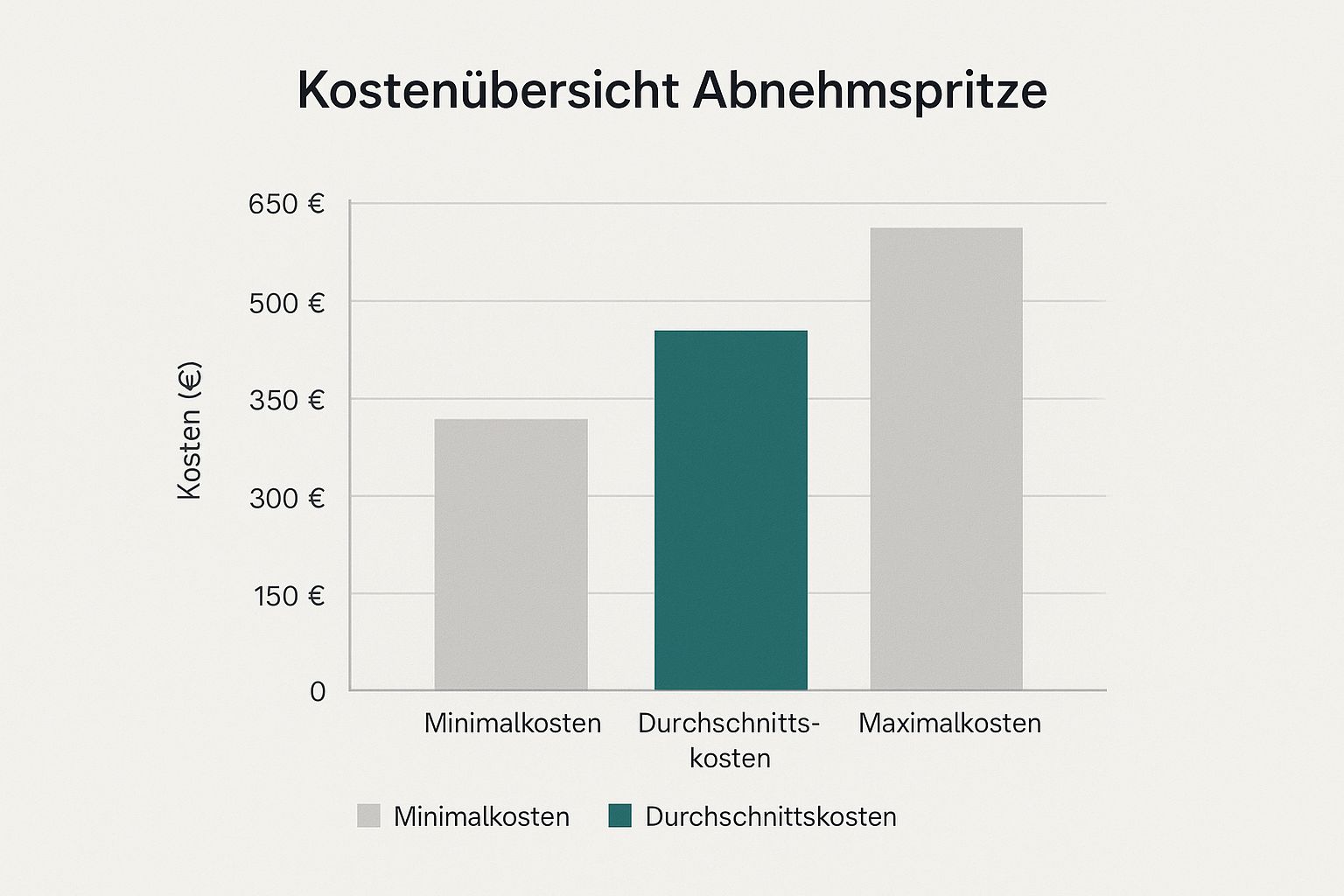
You can see it clearly: The cost of the injection is an ongoing financial burden. So the question is not only what is cheaper, but which approach will benefit you more in the long term.
Costs and benefits compared directly
This table clearly illustrates the difference between a short-term solution with ongoing costs and a one-time, sustainable investment.
| Feature | Weight-loss injection (e.g., Wegovy) | DNA analysis for nutrition |
|---|---|---|
| Type of cost | Recurring monthly | One-time investment |
| Total cost (1 year) | Approx. €2,000–€3,800 | Approx. €170–€400 |
| Duration of effect | Only while in use | Valid for life |
| Approach | Combating symptoms (hunger) | Identifying causes (genetics) |
| Sustainability | Low (yo-yo effect risk) | High (knowledge & self-competence) |
| Dependence | High (from the medication) | Low (you are your own expert) |
Ultimately, it comes down to choosing between short-term symptom suppression and long-term self-determination through knowledge. You either keep investing in a medication or invest in yourself once—an approach based on understanding and personal responsibility.
Would you like to know more precisely what lies behind the cost of a DNA test and the immeasurable value it can have for your health? Our article contains all the important information you need.
Why knowledge about your DNA is the smarter investment
Weight-loss injection or DNA analysis? This question is about much more than a simple price comparison—it is a fundamental decision about your path toward a healthier you. While the cost of a weight-loss injection is a recurring monthly expense, a DNA test is a one-time investment in knowledge that will stay with you for life.
You can think of it this way: The weight-loss injection is like a bandage. It treats a symptom—hunger—and creates an external aid that you quickly become dependent on. Once the treatment ends, the underlying problem is often still there. The dreaded yo-yo effect usually follows soon after.
A DNA analysis, on the other hand, puts you in the driver’s seat. Instead of suppressing symptoms, you learn to understand the causes rooted deep within your body. You benefit from this knowledge in the long term instead of only benefiting from medication in the short term.
From a one-size-fits-all approach to a personal blueprint
A genetic analysis gives you deep, personal insights that a one-size-fits-all treatment can never provide. You finally discover how your body really works.
- Your metabolic type: Are you someone who processes carbohydrates, fats, or proteins particularly well? This knowledge is the absolute foundation for a diet that adapts to your body—not the other way around.
- Individual nutrient requirements: Find out which vitamins and minerals are personally essential for you. This allows you to specifically prevent deficiencies and boost your energy.
- Genetic predispositions: Identify tendencies toward intolerances such as lactose or gluten intolerance before any noticeable symptoms appear.
This knowledge lays the foundation for a sustainable health strategy based not on medication, but on understanding and personal responsibility. It is about supporting your body rather than manipulating it. The science behind this is called nutrigenetics, by the way. If you want to delve deeper, our article explains what nutrigenetics is and how it determines your life.
With this highly personalized blueprint, you can shape not only your weight but your overall health positively in the long term. You make decisions precisely tailored to your genetic predispositions—an investment in yourself that pays off every single day.
Risks and side effects are about more than just money
When deciding whether to use a weight-loss injection, cost should never be the only criterion. It is much more important to keep the health aspects in mind, because this type of treatment has a profound effect on your body—and the consequences go far beyond the financial aspect.
Many people who use the injection report unpleasant side effects. Gastrointestinal problems are unfortunately not uncommon, especially at the beginning of treatment. These include, in particular:
- Nausea and vomiting: This is often the most common reaction while the body first adjusts to the new active ingredient.
- Diarrhea or constipation: The injection slows stomach emptying, which can significantly disrupt digestion.
- General discomfort: Many people simply feel tired and far from fit during the initial phase.
The effect ends with the last injection
Perhaps the most important point you should consider is sustainability—or rather, the lack thereof. The injection’s effect is directly tied to regular use. As soon as you stop treatment, your normal feeling of hunger returns, and the lost pounds often come back faster than you can imagine.
This yo-yo effect is not just frustrating. It clearly shows that the injection only treats a symptom and does not address the actual cause of your excess weight. This can quickly lead to dependence on the medication simply to maintain the weight you have achieved.
So the effect only lasts as long as you take the medication. If you stop taking it, most patients regain weight. Although common side effects such as nausea and diarrhea usually subside over time, the long-term effects are the real cause for concern. Since the medications are still relatively new on the market, little is known so far about their long-term effects. You can find more information about the study results in this survey on weight-loss injections. A smart decision for your health should therefore consider not only the cost of weight-loss injections, but also prioritize your long-term well-being.
Your questions about the cost of weight-loss injections—briefly answered
The decision to use or not use a weight-loss injection raises many questions, especially financial ones. We’ve summarized the most important answers for you so you can clearly see what to expect.
What monthly costs should I expect?
Set aside a substantial amount each month. Treatment with medications such as Wegovy starts in Germany at around €170 for the starting dose and can quickly rise to over €300 for the higher maintenance dose. Realistically, ongoing costs range from €240 to €400 per month.
Will health insurance cover it?
Unfortunately not, in most cases. Medications used solely for weight loss are classified by statutory health insurers as so-called lifestyle drugs. In plain terms: you have to pay for the entire treatment out of pocket.
Is this a one-time expense?
Quite the opposite. The cost of weight-loss injections is not a one-time expense, but a lasting financial burden. To maintain the effect, you have to use the injection continuously. If you stop, the notorious yo-yo effect often kicks in. This makes the injection more like an expensive subscription than a sustainable solution for your health.
Ultimately, it’s not just about what it costs, but what it brings you in the long term. A quick fix with an ongoing bill, or a one-time investment in your personal health knowledge?
Is there a sustainable alternative?
Absolutely. Instead of spending money month after month treating the symptoms, you can tackle the root causes of your weight problem. A one-time investment in DNA analysis gives you a lifelong roadmap for your metabolism. You learn how your body really works, laying the foundation for lasting health—without recurring costs and with benefits that last a lifetime.
You can also find even more answers in our FAQ section.
Discover the power of your genes instead of relying on expensive subscriptions. With a test from mybody-x, you make a one-time investment in knowledge that will help you make healthy decisions for a lifetime.



Share now:
Healthy snacking – the best alternatives for more energy and fewer cravings
Weight-loss injection experiences in 2025: All the information, opinions & alternatives