


Find your perfect meal plan with a diet type test
ca. 18 Minuten

A diet type test is your personal user guide to optimal nutrition. It analyzes which foods and nutrients your body can process best, based on your unique biological makeup. So instead of clinging to blanket diet rules, you get a tailored guide built around factors such as your DNA, your gut microbiome, or your metabolism. This way, you can finally find out which fuel is right for your engine.
Why standard diets often fail and what your body really needs
You’ve tried countless diets—low-carb, intermittent fasting, paleo—but long-term success just doesn’t seem to follow. You’re not alone. The promises are always big, but the results are often frustratingly short-lived. The reason is actually quite simple: a one-size-fits-all solution can’t work because everyone’s body has its own unique blueprint.
Think of your body as a highly complex vehicle. A sports car needs different fuel than a truck or an electric car. It’s the same with us. A diet type test helps you decode the user manual for your metabolism and finally fuel it properly.
Your individual blueprint matters
Your body is a complex system influenced by various factors that determine how you respond to food. Three pillars are especially important in determining your personal dietary type:
- Your genetic makeup: Your DNA determines whether, for example, you use carbohydrates or fats more efficiently for energy.
- Your gut microbiome: The trillions of bacteria in your gut don’t just control digestion; they also influence your mood and immune system.
- Your current metabolism: Your lifestyle, stress levels, and past eating habits shape how your body processes nutrients today.
If you ignore these individual factors, you’re effectively working against your own biology. A test gives you the data you need to finally work with your body instead of against it.
A diet that suits you
Awareness of such personalized approaches is also reflected in current nutrition trends. In Germany, the dietary landscape has changed significantly in recent years. Only 12 percent of people still eat meat every day, while health is a key consideration in food choices for an impressive 91 percent.
This is exactly where a nutrition type test comes in. It doesn't give you rigid rules, but a scientifically sound foundation. This lets you make informed decisions that truly suit your body and your goals.
It's about understanding your body and giving it exactly what it needs to stay healthy, energized, and perform at its best. Personalized nutrition isn't a short-term trend, but the key to lasting well-being.
The different testing methods and which one is right for you
The term “nutrition type test” is like a big umbrella covering a wide range of different analysis methods. Each test looks at your body from a different perspective and provides specific answers. To help clarify things, we'll introduce the most important methods and show you which questions they can really answer.
This is a quick way to find out which approach best suits your personal health goals - whether you want to lose weight sustainably, boost your energy, or simply plan wisely for the future.
DNA metabolism analysis: Your genetic blueprint
Imagine having a personal instruction manual for your body. That's exactly what a DNA metabolism analysis is. It examines your genes to uncover innate predispositions that remain stable throughout your life. So this test doesn't tell you what you ate yesterday, but how your body generally works and responds to certain nutrients.
- What is analyzed? Your DNA is obtained from a simple saliva sample. The lab then takes a close look at specific gene variants that regulate your metabolism.
- What questions does the test answer? Does your body use fats or carbohydrates more efficiently for energy? Are you prone to the dreaded yo-yo effect? What is your individual need for vitamins such as B12 or D? And are you genetically more suited to endurance or strength training?
This test is the ideal choice if you're looking for a long-term strategy based on your innate predisposition. It gives you a rock-solid foundation for decisions that will support you for years to come. If you'd like to learn more about how it works, you'll find detailed information in our article on at-home DNA tests.
Microbiome analysis: A look into your gut ecosystem
While your DNA is your genetic hardware, you can think of the microbiome as the software that runs every day and constantly adapts. A microbiome analysis takes a close look at the community of trillions of bacteria in your gut. These tiny helpers are absolutely essential for your digestion, immune system, and even your mood.
Your gut is a dynamic ecosystem. Its composition is influenced by your diet, stress, and lifestyle, so it can change over time.
An analysis of your microbiome therefore gives you a snapshot of your current gut health.
- What is analyzed? A small stool sample is used to determine the diversity and balance of your gut bacteria.
- What questions does the test answer? Do you have enough “good” bacteria on board? Are there signs of an imbalance (dysbiosis)? How well can you actually digest fiber or produce important nutrients yourself?
This test is perfect for you if you’re struggling with digestive issues, want to strengthen your immune system, or simply want to understand how your diet affects your inner balance.
Blood tests for nutrients and food sensitivities
Blood tests are like a current snapshot of your body. They show you in black and white what’s going on in your system right now. Unlike DNA analysis, which sheds light on your lifelong predisposition, a blood test measures your current nutrient status or possible immune reactions.
- Nutrient analyses: These tests measure the levels of vitamins (e.g., vitamin D, B12), minerals (e.g., iron, magnesium), or important fatty acids in your blood. They’re ideal for detecting hidden deficiencies or excesses that often lie behind fatigue or other nonspecific symptoms.
- Food sensitivity tests (IgG4): These measure your immune system’s response to certain foods. An elevated IgG4 level may indicate that your body is responding to a food with a low-grade inflammatory reaction, which can lead to vague symptoms such as bloating or skin problems.
The following graphic makes it clear why a data-driven analysis is often far superior to a one-size-fits-all diet approach.
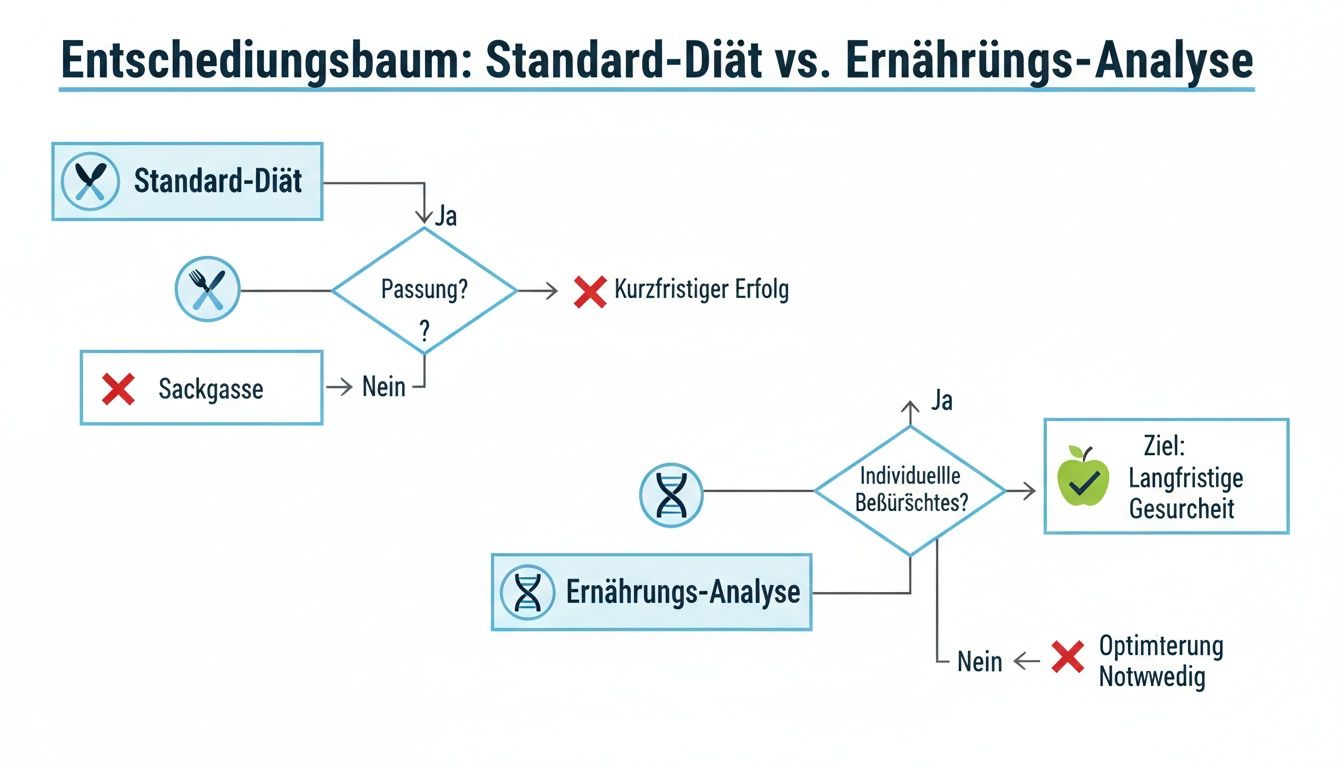
The decision tree makes it clear: a well-founded analysis usually leads straight to your goal, while standard diets often end in a dead end.
Which nutrition type test suits your goal?
Each test provides unique insights and has its place. Which one is right for you depends solely on your personal goals.
The following table gives you a quick overview to help you find the right method for you.
| Test type | What is analyzed? | Ideal for which goal? | Example of an insight |
|---|---|---|---|
| DNA metabolism analysis | Your genes (from saliva) | Long-term weight loss, fitness optimization, longevity | You learn whether your body is genetically more likely to use fats or carbohydrates as its primary energy source. |
| Microbiome analysis | Your gut bacteria (from stool) | Digestive problems, immune support, general well-being | You discover whether you’re missing important bacterial strains responsible for producing B vitamins. |
| Nutrient blood test | Vitamins & minerals (from blood) | Combat fatigue, boost energy, address deficiencies | The test reveals an acute vitamin D deficiency that could explain your winter fatigue. |
| Intolerance test | IgG4 antibodies (from blood) | Unexplained symptoms, skin problems, bloating | You discover that your body reacts strongly to cow’s milk products, which could be causing your skin problems. |
Ultimately, it’s about moving from guesswork to knowledge. Instead of blindly trying diets, the right test gives you a tool to truly understand your body and give it exactly what it needs.
How personalized nutrition can really change your everyday life
The results of a nutrition type test are far more than just dry data. They’re your personal compass for greater well-being, energy, and quality of life. But how exactly does this knowledge translate into your everyday life? Let’s look at a few concrete examples that show just how powerful these insights can be.

Just imagine that your DNA metabolism analysis reveals that, for genetic reasons, your body uses fats much more efficiently than carbohydrates to produce energy. This one piece of information can turn your entire approach to losing weight upside down. Instead of struggling with low-fat products that never really satisfy you, you could make a conscious change to your meal plan.
From knowledge to practical application
Of course, this doesn’t mean you should eat nothing but butter and bacon from now on. It’s about making smart adjustments that suit your genetic blueprint.
- Your breakfast: Instead of sugary cereal that sends your blood sugar soaring, scrambled eggs with avocado and a little salmon could be the perfect choice. That way, you start the day feeling full and energized, without the usual midmorning slump.
- Your lunch: A large salad with chicken breast, nuts, seeds, and a high-quality olive oil dressing gives you the energy you need for the afternoon without making you tired.
- Your dinner: Steamed vegetables with a piece of fish or tofu provide valuable protein and healthy fats to support overnight recovery.
With these small but meaningful changes, you’re no longer working against your body. You’re giving it exactly the fuel it can use best. The result? Often not only sustainable weight loss, but also more stable energy levels and far fewer cravings.
A nutrition type test often reveals the “why” behind your past failures. It shows you that perhaps it wasn’t a lack of discipline, but simply the wrong strategy for your unique metabolism.
More than just losing weight: boosting energy and well-being
Personalized nutrition goes far beyond weight. Suppose a microbiome analysis shows that you lack certain “good” gut bacteria that are important for producing B vitamins and regulating your mood. This could be the hidden cause of your constant fatigue or digestive problems.
With this knowledge, you can take targeted action. You could add more prebiotic foods such as leeks, onions, or asparagus to your diet, which serve as food for the beneficial microbes in your gut. At the same time, you could choose probiotic foods such as plain yogurt, kefir, or sauerkraut to increase the diversity in your gut.
These targeted adjustments can trigger a chain reaction: improved digestion leads to better nutrient absorption, which in turn strengthens your immune system and can reduce inflammation in the body. In the long term, you benefit not only from more energy, but often also from clearer skin and greater overall vitality.
An objective foundation for your health
Current figures underscore the need for such an objective basis. The 2023 DKV Report shows that only 31 percent of Germans consider themselves overweight, even though, according to the Federal Statistical Office, 53 percent are actually overweight. A nutrition type test offers a valuable, data-based perspective that goes beyond subjective impressions and also takes genetic differences in metabolism into account. You can find out more about the study results on health perceptions in Germany at dkv.com.
Ultimately, it's about taking responsibility for your own health – with the right tools and knowledge. These practical examples show that personalized nutrition doesn't have to be a complicated set of rules, but can be a way to make a big difference in your everyday life with small, targeted steps.
How easy it is to take the test at home
When you think of lab analysis, do you immediately picture doctor's appointments, waiting rooms, and complicated procedures? Understandable, but luckily, the reality is quite different with a modern nutrition type test. Getting your personal health data is straightforward and discreet, and fits into your daily routine – you can do everything comfortably from home.
We'll now show you step by step just how easy it really is.

The whole process is designed so you can do it safely without any medical knowledge. Just a few clearly explained steps, and you're ready to lay the foundation for your very own health strategy.
Step 1: Collecting your sample – easy and quick
After you place your order, a small test kit will arrive right at your door. Inside, you'll find everything you need. Depending on which test you chose, the sample collection method may differ slightly, but one thing always stays the same: it's child's play and completely painless.
- Saliva sample (for DNA analysis): Simply put a small amount of saliva into the tube provided. It only takes a few minutes. We also explain exactly how to do it in our guide, how a saliva test works.
- Blood sample (for nutrient tests): Don't worry, there's no blood flowing everywhere. A tiny, painless prick to your fingertip with an automatic mini lancet is all it takes. A few drops on the test strip are enough for a complete analysis.
- Stool sample (for microbiome analyses): This is handled hygienically and discreetly too. Use the swab and the enclosed collection paper to take a tiny sample—without any mess.
Once the sample is in the tube, activate your kit online using a unique code. This is important because it means your sample is pseudonymized. In other words, the lab never knows your name, only this code. So your privacy is 100% protected.
Step 2: Analysis at a certified laboratory
You can return your sample free of charge in the enclosed return envelope. Then the scientific work begins. Your sample doesn’t end up just anywhere, but at a highly specialized, ISO-certified laboratory in Germany.
This certification is more than just a stamp—it’s a rigorous mark of quality. It guarantees that all analyses are performed to the highest scientific standards using state-of-the-art technology. This is where your DNA is sequenced, your blood is tested for biomarkers, or the diversity of bacteria in your gut is analyzed.
An ISO-certified laboratory not only ensures the accuracy of your results, but also promises reliability. You can be absolutely sure that your data is based on a solid scientific foundation.
Step 3: Your personal results report—clear and actionable
A few weeks later, the moment arrives. But you won’t receive an incomprehensible lab report full of technical jargon. Instead, you’ll get a comprehensive, easy-to-understand results report. The mybody-x report is designed to help you really understand the complex workings of your body.
We visualize your results with charts and clear explanations. But most important are the specific, actionable recommendations. You’ll learn not only what your values mean, but above all how to put this knowledge into practice in your everyday life—with personalized nutrition plans, food recommendations, and practical lifestyle tips. This report is your very own roadmap to a healthier future.
What to look for when choosing a test provider
The health testing market is growing rapidly, and so is the number of providers. But not all tests are created equal. The quality of your results and the protection of your sensitive data depend largely on choosing the right partner. To make an informed decision about your health, you should look for a few key criteria.
Think of it like buying a car: you wouldn’t just choose any model without first looking at engine performance, safety standards, and the manufacturer’s warranty. It’s similar with a nutrition type test. It’s about the precision of your body’s “engine analysis” and the security of your personal “vehicle data.”
Laboratory quality and scientific accuracy
The heart of every test is the laboratory. A crucial, non-negotiable quality criterion is the partner lab’s ISO certification. This international standard ensures that all analytical processes are standardized, validated, and carried out to the highest scientific standards.
- ISO 9001: Indicates a certified quality management system. It ensures that processes are transparent and results are reproducible.
- ISO 15189: Specifically for medical laboratories. This standard sets the highest requirements for staff competence and technical equipment.
Providers such as mybody-x work exclusively with certified laboratories like these in Germany. This gives you confidence that your results are based on precise scientific work, not estimates.
Data protection and safeguarding your privacy
Your health data is among the most sensitive information there is. A reputable provider takes its protection extremely seriously. Two key terms here are GDPR compliance and pseudonymization.
GDPR compliance is not just a legal requirement, but a clear commitment to protecting your data. It ensures that your information is used only for the agreed purpose and stored securely.
Pseudonymizing your sample is even more important. This means that before your sample goes to the lab, your name is replaced with a unique code. The lab staff therefore never have access to your personal data, such as your name or address. After the analysis, your biological sample is properly destroyed. This ensures your privacy is protected at all times.
Understandable results and genuine support
A good nutrition type test gives you more than just a table of raw data. You need a partner who can explain the complex results in an understandable way and won’t leave you to figure it all out on your own.
Look out for the following:
- Detailed results report: Does the report include clear charts, easy-to-understand explanations, and scientific background information?
- Specific recommendations for action: Do you get personalized tips for your nutrition, lifestyle, or training?
- Personal consultation: Does the provider offer the opportunity to speak with experts if you have questions?
Eating habits in Germany are becoming increasingly varied, from vegetarian to low-sugar. A 2023 Statista survey shows that only 13 percent of people completely avoid meat, while many others want to optimize their protein intake. A qualified provider like mybody-x, whose analyses are carried out in ISO-certified laboratories, provides the scientific foundation for addressing these individual goals. You can read more about dietary types in Germany at Statista.
A provider that meets these criteria shows that it truly wants to support you on your journey to better health. If you’d like to learn more about how safe and transparent these methods can be, you’ll find more information in our article about online DNA tests.
Frequently asked questions about the nutrition type test
Now that we’ve taken a deep dive into the world of personalized nutrition, you may still have a question or two. That’s completely normal. Here, we answer the most common questions we hear, so you can take the next step toward better health with a clear mind and confidence.
How scientific are these tests, really?
This is the most important point of all, because a scientific foundation is essential. Reputable providers like mybody-x rely exclusively on established, scientifically recognized methods. For example, DNA analysis uses a process known as genotyping, while microbiome tests often use 16S rRNA sequencing—both gold standards in research.
These analyses are carried out exclusively in ISO-certified specialist laboratories. This certification guarantees that everything meets the highest standards: precise, repeatable, and scientifically sound. So the recommendations you receive are not based on guesswork, but on robust, evidence-based data and current studies.
Who benefits most from a test like this?
Basically, a nutrition type test is beneficial for anyone who wants to take their health into their own hands and make informed decisions. However, there are a few situations in which you can benefit from it especially:
- You’ve tried countless diets without success: The test finally gives you the “why” and shows you a strategy that truly suits your unique metabolism.
- You want to take your athletic performance to the next level: Find out what fuel your body needs to sustainably improve recovery and performance.
- You’re struggling with unexplained symptoms: Whether it’s digestive problems, constant tiredness, or low energy, an analysis can uncover hidden causes.
- You want to invest in your longevity proactively: Understanding your body today can help you make the right choices for a healthy tomorrow.
A test gives you an objective basis for moving from guesswork to targeted action. It’s about finally making decisions based on facts about your own body.
What happens to my sensitive data and my sample?
Data protection and your privacy are top priorities. With trustworthy providers like mybody-x, the entire process is protected by strict security measures from start to finish. Your sample is immediately pseudonymized. This means the laboratory never sees your name, only a unique code.
All data processing strictly complies with the GDPR, and every transfer is securely encrypted. After the analysis, your biological sample is properly and completely destroyed. And to be clear: your personal data will never be shared with third parties without your explicit consent. Your privacy is therefore protected at all times.
Do I have to completely overhaul my life after the test?
No, not at all! The goal isn’t to turn your life upside down, but simply to make it smarter. The test doesn’t give you a rigid diet plan, but a personal user manual full of valuable insights.
Often, it’s the small, targeted adjustments that make the biggest difference in the end. You might find that your body responds much better to healthy fats than to carbohydrates, or that certain vegetables are especially good for your gut flora. It’s about making more mindful everyday choices that work for you - without radical restrictions or the constant feeling that you have to go without something.
Are you ready to decipher your body’s user manual and take your health to a new, scientifically grounded level? Discover the right analysis for your goals at mybody-x.


