

Treating cellulite for smoother-looking skin
If you want to treat cellulite specifically, you can’t avoid a holistic approach. The goal is to change the structure of your subcutaneous fatty tissue from within. The key to visibly smoother-looking skin lies in combining smart nutrition, the right training, and personalized analyses. Forget short-term miracle cures—we’re focusing on what really matters.
What cellulite really is and why almost every woman has it
Almost every woman is familiar with it, but very few know what lies behind so-called orange-peel skin. Before we dive into treatment strategies, we need to understand the basics. Cellulite is not a disease and is only partly related to your body weight. It is a natural change in the skin’s structure caused by the interaction of several factors.
Imagine your subcutaneous tissue as a grid. In women, the connective tissue fibers run perpendicular to the skin’s surface, almost like small columns. Fat cells are located between them. When these fat cells grow or the connective tissue loses its elasticity, the fat deposits push upward through the gaps. The result: the characteristic dimples and waves we know as cellulite.
The main causes: genetics, hormones, and lifestyle
Whether you have cellulite and how pronounced it is depends on a mix of genetic predisposition and lifestyle habits.
- Genetic predisposition: Your DNA determines how firm and elastic your connective tissue is naturally. Some women simply have stronger tissue, while others have weaker tissue. This is one of the main reasons why some are hardly affected, while others struggle with it from a young age.
- Hormonal influences: The female hormone estrogen plays a decisive role here. It causes fat reserves to accumulate preferentially around the thighs and buttocks and can further loosen the connective tissue. That’s why cellulite can become more pronounced during puberty, pregnancy, or menopause.
- The small difference: Men got lucky. Their connective tissue fibers are arranged in a net-like, crisscrossed pattern, which makes the tissue much more stable. That’s why cellulite is extremely rare in men.
Weak connective tissue is like a net that is too soft—it can no longer effectively hold the underlying fat cells in place. So the goal is to strengthen this net from within.
Cellulite is a major issue in Germany. Estimates suggest that more than 90 percent of women are affected. It usually appears on the thighs, buttocks, and abdomen. Because it is purely a cosmetic phenomenon, health insurance providers do not cover the cost of treatment. You can find out more about the medical background of cellulite on mooci.org.
Your lifestyle also plays a major role. An unbalanced diet, too little exercise, or a sluggish lymphatic system can worsen the situation. Water and metabolic waste products then accumulate in the tissue, making the dimples even more visible. So the first step toward improvement is to find out which of these factors has the greatest impact on you.
Countless half-truths circulate about cellulite. It’s time to set the record straight:
Myths about cellulite and what’s really true
| Myth | What’s really behind it |
|---|---|
| “Only overweight women have cellulite.” | False. Even very slim women can have cellulite because the structure of connective tissue and hormones play a greater role than body weight alone. |
| “Creams can cure cellulite.” | Unfortunately, no. Special creams can temporarily smooth and moisturize the skin’s surface, but they cannot change the deeper structure of the connective tissue. |
| “Drinking lots of water flushes cellulite away.” | Drinking enough water is important for healthy skin and metabolism. It can improve the appearance of the skin, but it can’t “flush away” cellulite. |
| “Liposuction is the best solution.” | Liposuction removes deeper fat, not the superficial fat cells responsible for cellulite. In some cases, it can even make the problem worse. |
| “There’s absolutely nothing you can do about it.” | That’s not true! A targeted combination of diet, exercise, and the right skincare can significantly improve the appearance of cellulite. |
As you can see, it’s not about fixing a single “flaw,” but about supporting your body holistically.
Strengthening connective tissue from within
If you want to combat cellulite effectively, superficial treatments rarely achieve the desired results. The best strategy starts from within—with a diet that specifically builds and strengthens your connective tissue. It’s not about strict deprivation, but about giving your body the right nutrients it needs for firm skin.
Think of your connective tissue simply as a stable network that keeps your skin smooth and elastic. The most important fibers in this network are made of collagen. For your body to produce this collagen at all, it needs certain building blocks—above all, specific amino acids.
Building blocks for firm connective tissue
Two of the most important amino acids for a strong collagen structure are lysine and proline. Without these two, your body cannot build a stable collagen network.
- Lysine is found primarily in legumes such as lentils and chickpeas, as well as in quinoa and pumpkin seeds.
- Proline can be produced by the body to some extent, but you can optimally support this process with foods such as eggs, cottage cheese, and wheat germ.
This infographic nicely summarizes how the right foods can pave the way to stronger connective tissue.
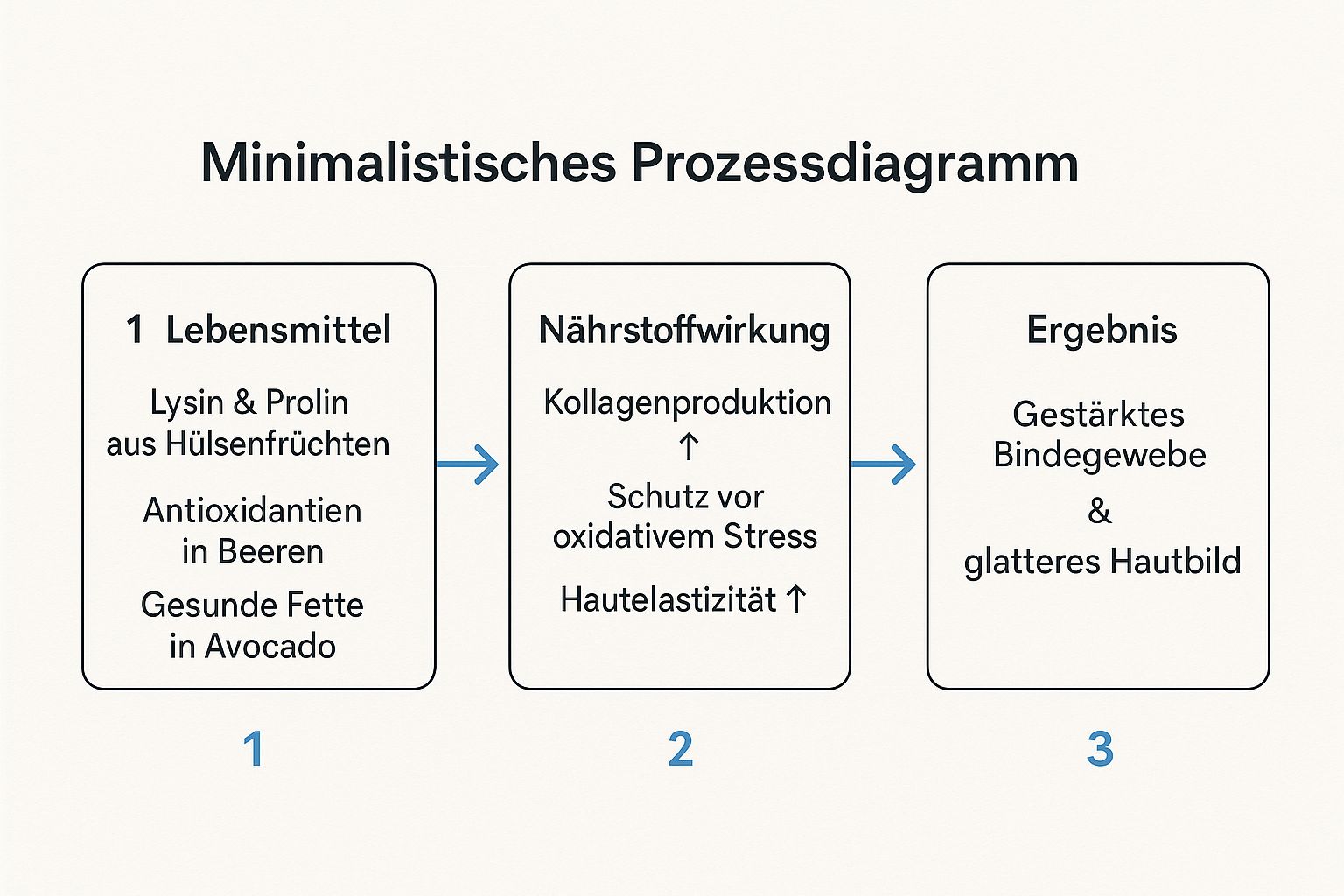
As you can see, the nutrients in your food have a direct impact on collagen production and the protection of your skin cells. The result can be visibly smoother-looking skin.
Shields against cell damage
But it is not enough to provide only the building blocks. You must also protect your connective tissue from harmful influences. This is where antioxidants come in. They act as a shield against free radicals—aggressive molecules produced by stress, UV rays, or an unhealthy lifestyle that attack your collagen fibers.
Think of antioxidants as bodyguards for your skin cells. They intercept attackers before they can cause damage and weaken your connective tissue.
You can find especially high amounts of these valuable protective substances in:
- Berries: Blueberries, raspberries, and strawberries are true powerhouses.
- Green vegetables: Spinach, kale, and broccoli provide plenty of vitamin C in addition to antioxidants, which is also essential for collagen production.
- Nuts and seeds: Walnuts and flaxseeds in particular are excellent choices.
The role of fats and what you should avoid
The right fats also play a major role in your skin’s elasticity. Healthy omega-3 fatty acids, found in fatty fish (e.g. salmon), flaxseeds, and walnuts, have anti-inflammatory effects and stabilize cell membranes. In our article, you can read more about how important omega-3 fatty acids are for your body.
On the other hand, there are also things that actively damage your connective tissue. Sugar and highly processed foods can effectively “sugar-coat” collagen fibers through a process called glycation. This makes the fibers stiff and brittle, thereby promoting the development of cellulite. Reducing these foods is therefore a crucial step toward healthy, firm connective tissue.
Get firmer skin with targeted training
Exercise is an absolute must if you want to get your cellulite under control, but the right kind of training matters. Many people believe that jogging for hours is the solution, but endurance training alone will hardly make the dimples disappear. The key to success lies in a smart combination that addresses the causes directly.

The real game changer is targeted strength training. Think of your muscles as an internal support corset located directly beneath the fatty tissue. As you build these muscles, they increase in volume and stretch the skin from within. The result: the skin’s surface becomes smoother and the dimples are visibly reduced—almost as if you were pulling a bedsheet taut.
Strength training: The foundation for smooth skin
Don’t worry, you don’t have to become a bodybuilder. The goal is controlled exercises that specifically strengthen the muscles in your thighs and buttocks—exactly where cellulite usually appears. With the right workout, you can achieve the best results here.
An effective plan for working out at home could look like this:
- Squats: The absolute classic for a toned butt and firm legs. Focus on proper technique and only go as low as feels comfortable for you.
- Lunges: They not only train the large muscles but also improve your balance and coordination. A true all-rounder!
- Glute Bridges: Ideal for specifically activating the gluteal muscles. To make the exercise more challenging, you can simply place a small weight on your pelvis.
It’s best to incorporate these exercises into your routine two to three times a week. Three sets of 12–15 repetitions per exercise are a great guideline. Remember: consistency beats intensity!
A strong muscle is like an internal support corset. It smooths the skin from within and creates a firm contour that makes cellulite less visible.
Fascia training as the perfect addition
Alongside your muscles, you shouldn’t forget your connective tissue either. This is where fascia training comes in. Fasciae are the fine layers that surround your muscles and organs. If they stick together, this can disrupt lymphatic flow and even make cellulite worse.
You can gently loosen these adhesions with a foam roller. Roll slowly over your thighs and buttocks, applying targeted pressure. This stimulates circulation, boosts the metabolism in the tissue, and makes the connective tissue supple again. It’s best to set aside a few minutes after strength training or on rest days.
Of course, genetics also play a role in how quickly you build muscle. If you’re curious and want to better understand how your body responds to training, take a look at our article about the link between muscle building and DNA tests. With this knowledge, you can tailor your training even better to your needs and achieve the best possible results for firmer-looking skin.
What do skincare products and professional treatments really do?
Okay, you’ve got your diet under control and established a solid training program. Great! Now you’re probably wondering what all those creams, massages, and expensive studio treatments are about. The anti-cellulite market is a real jungle, and it’s hard to see what really helps and what’s just empty promises.
Here’s a little fun fact: The global market for cellulite treatments was estimated at around 2.4 billion US dollars in 2024. And it continues to grow, at rates of up to 11% per year! So it’s no wonder that new methods such as shockwave and laser therapies are constantly emerging. You can read more about market developments in cellulite treatments on gminsights.com.
Skincare as a valuable addition
Let’s start with the basics: anti-cellulite creams. It’s important to be clear that they’re not miracle cures. But as a supplement, they can noticeably improve the appearance of the skin if you stick with them. Some active ingredients have proven particularly useful:
- Caffeine: A true classic. Caffeine stimulates microcirculation in the skin and helps flush excess water from the tissue. The result? The skin looks temporarily firmer and smoother.
- Retinol (vitamin A): Retinol is the gold standard when it comes to collagen production. With regular use, it can strengthen connective tissue and firm the skin structure from within.
My practical tip: It’s not just about the cream, but also how you apply it. Massage the products in vigorously every day using circular motions. The massage itself promotes circulation almost as effectively as the active ingredient!
Simple helpers for home
In addition to creams, there are a few simple mechanical tricks you can easily incorporate into your routine to really get your lymphatic flow and circulation moving.
Dry brushing is a brilliant and incredibly affordable method. Take a few minutes before showering to brush your skin with a soft natural-bristle brush. Always use long, gentle strokes toward the heart. This not only boosts circulation but also exfoliates dead skin cells—your skin will look fresher immediately.
Targeted massages are just as effective, either with your hands or a fascia roller. They can help release adhesions in the connective tissue and help your body eliminate metabolic waste products more quickly.
Ultimately, skincare is only one part of the overall concept. To really understand what care your skin needs, it is worth looking at your genetic predisposition. With a skincare DNA analysis, you can find out whether you are genetically prone to collagen breakdown, moisture loss, or oxidative stress, and tailor your skincare products perfectly to your needs.
An overview of professional treatments
If you are prepared to invest a little more, there are of course professional treatments as well. Shockwave therapy, for example, uses high-energy sound waves to stimulate collagen production and strengthen connective tissue. Professional lymphatic drainage can also work wonders for getting rid of stubborn water retention.
But be aware: These methods often require several sessions to achieve visible results, and the costs can quickly add up. Honest advice beforehand is essential.
Understanding your genetics as the key to smoother skin
You eat healthily, exercise regularly, and yet the cellulite simply refuses to disappear? The feeling is incredibly frustrating and can quickly make you doubt your approach. The real reason often lies much deeper than what diet or exercise alone can influence—it lies in your DNA.
Your genes are something like the blueprint for your body. They determine how strong your connective tissue is by nature, how well your body produces collagen, and how it responds to certain nutrients and skincare ingredients. This explains exactly why some people have smoother skin than others despite a relaxed lifestyle. So instead of continuing to feel your way in the dark and follow general tips, you can use this knowledge to your advantage.
What your genes reveal about your skin
A DNA analysis shows you precisely where your individual weaknesses lie. It deciphers which genetic predispositions are particularly important for your skin health.
- Collagen breakdown: Is your body perhaps inclined to break down collagen faster than others? If so, a diet rich in the amino acids lysine and proline is all the more important for you.
- Oxidative stress: How well can your body actually defend itself against free radicals that attack connective tissue? This tells you whether you should place greater emphasis on antioxidant-rich foods.
- Skin elasticity: Your genes also reveal how naturally elastic your skin is. With this knowledge, you can tailor your skincare routine accordingly.
Imagine your DNA as a personal user manual for your body. It provides crucial clues about which levers you need to adjust to make a real difference—far beyond generic advice.
It’s quite remarkable: Although cellulite is so common, there is a great deal of uncertainty about what really helps. A 2021 Statista survey showed that more than half of women in Germany rarely or never use anti-cellulite products. The reasons range from doubts about their effectiveness to the high cost.
This is exactly where the mybody-x Skincare DNA Metabolism Test comes in. Instead of spending money on products that may not even suit your skin type, you invest in knowledge about your own body and receive a clear roadmap tailored precisely to your genetic predisposition.
From analysis to targeted action
This screenshot gives you a brief insight into what such an analysis can look like:

The analysis provides you with specific, easy-to-understand recommendations tailored directly to your genetic results.
Instead of continuing to try out different strategies at random, you receive a personalized report. It tells you exactly which nutrients, skincare approaches, and small changes in your daily routine will be most effective for you. You’ll find out whether your focus should be on strengthening collagen, protecting against oxidative stress, or improving skin hydration.
Would you like to explore the topic in greater depth? In our in-depth article, you'll learn more about how a DNA analysis can influence your diet and health. This will finally make your fight against cellulite targeted—and, above all, effective.
Everything you've always wanted to know about cellulite
To wrap up, I've compiled the most frequently asked questions we repeatedly receive in consultations. Here you'll find clear and honest answers so you can start with realistic goals and stay motivated.
Can cellulite ever be completely eliminated?
Honestly? No, completely and permanently eliminating cellulite is usually unrealistic. But that's not really the point.
More importantly, the key insight is this: significantly improving your skin's appearance is absolutely achievable! It's about optimizing the appearance of your skin so that you feel truly comfortable again—not about chasing a flawless ideal.
Think of it as a journey toward the best version of your skin, not a battle against a flaw. Every small step forward is a win for you.
When can I expect to see the first results?
Your most important tool is patience. If you stick consistently to your diet and exercise regularly, you will often feel and see the first positive changes after just four to eight weeks. Many people describe their skin as already feeling firmer and tighter by then.
However, visible improvements in deeper dimples take a little more time, often several months. Don't let that discourage you! Every body is different, and genuine, lasting results simply need time to become established.
Can a hormone test really help with cellulite?
Absolutely! A hormone test can be a crucial piece of the puzzle. Hormones, especially estrogen, play a huge role in the stability and structure of your connective tissue.
So if you're still stuck despite all your efforts, an undiscovered hormonal imbalance could be sabotaging your progress. A test can provide clarity. Targeted hormone balancing is an important building block of a holistic approach and can significantly accelerate your results.
Are you ready to stop guessing and finally know what your skin really needs? The mybody-x Skincare DNA Metabolism Test decodes your genetic predisposition and gives you a clear roadmap. Discover which nutrients and skincare strategies work best for you personally and start your journey to smoother skin today.



Share now:
Omega-3 Test: Find out what’s truly good for your body
Biological age test: What your result really reveals