

Men’s health is reflected in seventeen values
The key points at a glance
A panel is not a miscellany. The seventeen values in the Men’s Wellness Check are arranged into six groups, and each group answers a different question.
Once you understand this, you read a set of findings differently: not line by line, but by group. According to IQWiG, an individual value is always only one component.
You will read the cited source verbatim, three documented details, three common statements in a fact check, the six groups compared, and what even seventeen values leave open.
What to expect in this article
1. What distinguishes a panel from a list of values
2. The documented source
3. The seventeen values at a glance
4. Three documented details
5. Why the values are grouped
6. Three statements in a fact check
7. What each group answers
8. The core in one sentence
9. The value that is called only lipoprotein
10. Comparing the groups
11. What seventeen values cannot do
12. Who can benefit from a panel
13. The Men’s Wellness Check in detail
14. Limitations: what a panel also leaves open
15. What matters in a panel
Frequently asked questions
Sources
What distinguishes a panel from a list of values
A list of values is an enumeration. A panel is a selection with a rationale behind it.
The difference becomes apparent as soon as you have a set of findings in front of you. Anyone who reads line by line looks for deviations and ends up with seventeen individual judgments. Anyone who reads by group has six questions, each with an answer.
That is exactly how mybody®x’s (MYBODY Lab GmbH) Men’s Wellness Check is structured. The product page itself organizes the seventeen values into six blocks, and that organization is the actual subject of this article.
What this article does not do: It does not tell any man which values he should have measured. That question belongs in a medical practice familiar with his medical history. What it does do is explain how an existing panel is structured.
The documented source
The sentence that underpins the entire panel logic does not appear in a product text, but at IQWiG.
Documented source
“It must always be considered together with other values, symptoms, and findings from other examinations.”
Institute for Quality and Efficiency in Health Care
Understanding laboratory values correctly, as of 02/04/2025
The preceding sentence from IQWiG reads: An individual laboratory value is always only one component of an overall diagnosis (as of 02/04/2025). Read together, the two sentences provide the rationale for every panel.
But they also define the limit. Alongside other values, the statement explicitly mentions symptoms and findings from other examinations. A panel provides neither, regardless of how many values it contains.
So, one panel is one half of the statement. The other half emerges in conversation with a medical practice, and without it, the findings remain incomplete.
The seventeen values at a glance
The product page lists the values in six blocks. We reproduce them here as they appear there, without rearranging them.
Hormones: testosterone, cortisol, and TSH. Heart and lipid metabolism: total cholesterol, HDL cholesterol, LDL cholesterol, triglycerides, lipoprotein, and homocysteine.
Liver and kidneys: gamma-GT, GPT, and cystatin C. Metabolism and inflammation: long-term blood sugar HbA1c and CRP.
Vitamins and iron: 25-OH vitamin D3 and ferritin. Preventive screening: prostate-specific antigen, or PSA for short.
Added together, that is three plus six plus three plus two plus two plus one, for a total of seventeen. The number in this article’s title can therefore be verified and is not an advertising claim.
Three documented details
Three details from the sources reviewed. They provide context and do not constitute a diagnosis.
Documented information
17 values
lists the Men’s Wellness Check in six groups according to the product page (mybody®x, accessed 19.08.2026)
5 blood values
the Health Examination Directive specifies from age 35: the lipid profile and fasting plasma glucose (G-BA, in force since 12.02.2021)
9–140 µg/l
the IQWiG gives as the ferritin reference range for women over 18; for men over 18, 18–360 µg/l (as of 20.03.2025)
The third detail is included here for a specific reason. It shows that the same value is interpreted within different ranges for men and women, which is precisely why separate panels exist at all.
Why the values are grouped
The grouping is not cosmetic. It reflects the fact that several values answer a question together, whereas individually they do not.
This is most apparent in lipid metabolism. Total cholesterol alone says little, because it can conceal very different distributions of HDL, LDL, and triglycerides. Only the four together provide a meaningful picture.
The same applies to the liver and kidneys. Gamma-GT and GPT concern the liver and respond to different triggers, while cystatin C concerns kidney function. The three are grouped together because, collectively, they cover the area in which the body breaks down and excretes substances.
With hormones, the grouping is even a warning. Testosterone, cortisol, and TSH influence one another, and none of the three can be meaningfully interpreted without the other two.
What the grouping does not mean
The grouping does not mean that an unusual group indicates a disease. The IQWiG states: An abnormal laboratory value alone does not allow conclusions to be drawn about a disease, and there are often harmless reasons for it (as of 02.04.2025).
Nor does it mean that the groups are equally important. Which group matters in a particular situation depends on the question someone brings, not on the order on the sheet.
Ultimately, this does not mean that the groups are complete. Each could be supplemented with additional values, and every selection is a selection.
Three statements in a fact check
These three statements come up as soon as a men’s panel is discussed.
Checked against the evidence
Widespread
“Seventeen values tell you more than five.”
Documented
More values mean more rows, not more information. IQWiG states that a laboratory value must always be considered together with symptoms and findings from other examinations (as of 2 April 2025). A panel provides none of these other examinations.
Widespread
“This is a substitute for the check-up.”
Documented
In addition to laboratory values, a health check-up includes a medical history, physical examination, blood pressure measurement, and medical consultation. Its purpose is the early detection of diseases of significant public-health importance (G-BA, effective 12 February 2021). A panel provides none of these.
Widespread
“Men’s values and women’s values are the same.”
Documented
Several reference ranges are separated by sex. For hemoglobin, IQWiG gives 13.5 to 17.8 g/dL for men over 18 and 11.5 to 16.0 g/dL for women over 18 (as of 20 March 2025).
What each group answers
Each of the six groups can be reduced to one question. These questions are the actual substance of the panel.
The hormone group asks about the interplay of three regulatory systems. Testosterone, cortisol, and TSH have in common that they can fluctuate depending on the time of day and that their values are only comparable under comparable conditions.
The heart and lipid metabolism group asks how the body transports fats and how a metabolic intermediate called homocysteine fits into this. With six values in one group, this is the panel’s largest group.
The liver and kidney group asks about the organs that process and excrete substances. Cystatin C is the value that assesses kidney function independently of muscle mass.
The metabolism and inflammation group asks about two time scales at once: HbA1c reflects a longer period, while CRP reflects a very short one. Reading both in one group means placing two different clocks side by side.
The vitamins and iron group asks about two values that are frequently discussed among the general population. The screening group consists of a single value, PSA, making it the smallest and, at the same time, the most sensitive group.
The core in one sentence
At this point, the topic can be brought together.
A panel answers six questions, not seventeen. The values are grouped because they say less individually than they do together.
This sentence has a practical implication for reading a report. Anyone who singles out one line and evaluates it is doing exactly what the cited source warns against.
It also affects expectations. Six answers are six answers, not an overall statement about health. A report cannot provide such a statement, regardless of its length.
The value simply called lipoprotein
At this point, we make something transparent rather than smoothing it over.
In the heart and lipid metabolism group, there is one value that the product page lists solely as “lipoprotein,” without any further specification. We therefore reproduce the term exactly as given and do not interpret it.
The reason is simple: “lipoprotein” is a general term. HDL and LDL are themselves lipoproteins, and they already appear as separate lines in the panel. The product page does not indicate which additional parameter is meant by this term.
We could speculate at this point. We do not do so because speculation has no place in a text that takes figures and sources seriously. The name must be clarified with the laboratory, and this paragraph will be replaced once it has been clarified.
For reading your own report, this means: The laboratory report lists the full name along with the unit and reference range. The report itself is always authoritative, not the product description.
The groups compared
The table compares which group asks which question and which time frame underlies it. It provides context and does not make a diagnosis.
| Group | Values according to the product page | The question behind it | What to bear in mind |
|---|---|---|---|
| Hormones | Testosterone, cortisol, TSH | How do three regulatory systems relate to one another? | Time of day and collection conditions affect the values; the product page provides no guidance on this |
| Heart and lipid metabolism | Total cholesterol, HDL, LDL, triglycerides, lipoprotein, homocysteine | How does the body transport fats? | The four lipid values only provide a complete picture together; the term “lipoprotein” is unspecified |
| Liver and kidneys | Gamma-GT, GPT, cystatin C | How do remodeling and excretion work? | Cystatin C assesses kidney function independently of muscle mass |
| Metabolism and inflammation | HbA1c, CRP | What is revealed over a long period, and what over a short period? | HbA1c levels reflect glucose control over the past 3 months (MSD Manual, as of December 2025) |
| Vitamins and iron | 25-OH-Vitamin D3, ferritin | How do two much-discussed values compare? | The ferritin reference range depends on sex: men over 18 years: 18–360 µg/l (IQWiG, as of 20 March 2025) |
| Screening | PSA | What does a single screening value show? | The panel’s most sensitive value; its interpretation belongs exclusively in a medical practice |
The last line deserves special attention. A PSA value is not something you can interpret on your own at home, and the question of what follows from it can only be answered at a medical practice.
The first line is the second issue. For hormones, the time of day and the circumstances of the sample matter. The product page provides no information on this, and anyone using the test should follow the instructions included with it.
What seventeen values cannot do
The number seventeen sounds complete. It is not.
A blood count—that is, a count of the blood cells—is not included. Vitamin B12 and folate are not included. The minerals magnesium, calcium, zinc, and selenium are not included. fT3 and fT4, in addition to TSH, are not included.
This list is not a criticism, but a description. Every panel makes a selection, and that selection becomes visible in the composition once you know what to look for.
What is still missing is the second part of the IQWiG sentence: symptoms and findings from other examinations. Neither appears on any laboratory report, and both are part of the interpretation.
The difference compared with the women’s panel
A comparison makes the choice clear. According to the product page, the Women’s Wellness Check includes 18 values and is put together differently.
There, in addition to TSH, you will find fT3 and fT4, as well as prolactin, SHBG, and vitamin B12. Testosterone, homocysteine, and PSA are not included.
The difference is therefore not a matter of more or less, but of being different. Both panels address different questions, and each leaves something unaddressed that is included in the other.
Who benefits from a panel
The comparison concerns whether a panel put together in this way adds anything in your situation.
It makes sense for you if …
You want to make use of your entitlement to the health check-up and also document several groups.
You want to bring figures with dates and laboratory details to a consultation at the practice.
You understand the group logic and will not read a finding line by line.
You know that a PSA value can only be interpreted at a medical practice, and you intend to do that.
Probably not if …
You have symptoms. In that case, the issue is clarification at a medical practice.
You want to replace the health check-up with it. That is not possible and is not what it is intended for.
You have a specific question about exactly one value. In that case, a panel is an unnecessary detour.
You are already undergoing evaluation. In that case, the practice that started it should continue it.
The Men’s Wellness Check in detail
A capillary blood self-test does not provide a diagnosis and does not replace medical evaluation. It provides documented laboratory values with a date.
The following information comes from the product page, accessed on 19 August 2026. The value “Lipoprotein” is listed there without any further specification and is reproduced here unchanged.
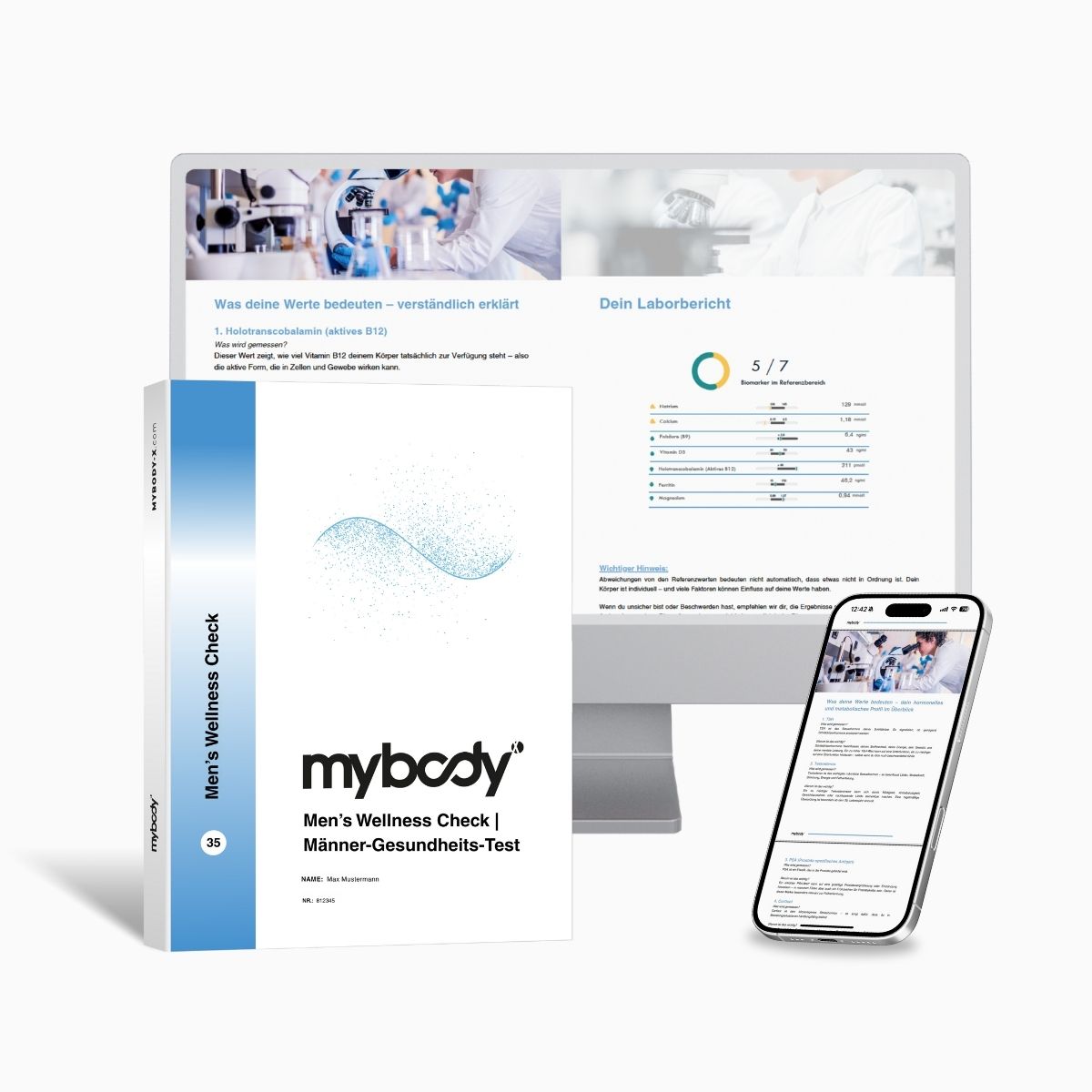
Blood test from capillary blood
Men’s Wellness Check | Men’s Health Test
Lists 17 values from the same sample in six groups: testosterone, cortisol, TSH, total cholesterol, HDL, LDL, triglycerides, lipoprotein, homocysteine, gamma-GT, GPT, cystatin C, HbA1c, CRP, 25-OH vitamin D3, ferritin, and PSA. What the test does not do: It does not replace a health check-up or medical evaluation, and contains no complete blood count, vitamin B12, minerals, or fT3 or fT4. It does not provide a diagnosis.
Laboratory analysis 3–5 working days after sample receipt
Information from the product page, accessed 19 August 2026
Chapter at a glance
The panel lists 17 values in six groups and therefore answers six questions, not seventeen. It neither replaces the health check-up nor medical evaluation, and contains neither a complete blood count nor minerals. The PSA value belongs exclusively in a medical assessment.
Limitations: what a panel still leaves open
The first limitation is stated in the cited source. A laboratory value must always be considered together with symptoms and findings from other examinations (IQWiG, as of 2 April 2025). This panel does not provide those findings.
The second limitation is substitution. A health check-up includes a medical history, physical examination, and blood pressure measurement, and its purpose is the early detection of diseases of significant importance to public health (G-BA, effective 12 February 2021).
The third limitation is the unspecified designation. Until it is clarified which parameter is meant by “Lipoprotein,” this value remains uninterpretable in this article. The designation on your own laboratory report is authoritative.
The fourth limitation concerns hormones. Their levels depend on the time of day and the sampling conditions, and the product page provides no specifications on this. Anyone using the test should follow the enclosed instructions.
The fifth boundary is diagnosis. All the interpretations in this article are for classification and do not constitute a diagnosis. A diagnosis is made in a doctor’s office from several components, and no self-test can anticipate it.
What matters in a panel
If you take away just one thing from this article, let it be this: Read a report by group, not by line.
The seventeen values in the Men’s Wellness Check are arranged into six groups, each answering a different question. Four lipid values together provide one picture, three hormone values influence one another, and the HbA1c value reflects a different period than CRP.
And the sentence that stands above everything comes from IQWiG: A lab value must always be considered together with other values, symptoms, and findings from other examinations (as of April 2, 2025). No panel provides symptoms or other examinations, which is why every report ends with a conversation.
Frequently asked questions
Which seventeen values are included in the Men’s Wellness Check?
According to the product page (accessed August 19, 2026), they are testosterone, cortisol, and TSH; total cholesterol, HDL cholesterol, LDL cholesterol, triglycerides, lipoprotein, and homocysteine; gamma-GT, GPT, and cystatin C; HbA1c and CRP; 25-OH vitamin D3 and ferritin; and the prostate-specific antigen PSA.
What does the value “Lipoprotein” refer to?
The product page lists it without any addition, so we reproduce the designation unchanged without interpreting it. Lipoprotein is a generic term that also includes HDL and LDL, which already appear as separate lines in the panel. The parameter in question is stated on the lab report with its full name, unit, and reference range.
Does the panel replace the check-up from age 35?
No. In addition to lab values, the health check-up includes a medical history, physical examination, blood pressure measurement, recording of vaccination status, and medical consultation. Its purpose is the early detection of diseases of public health importance (G-BA, effective February 12, 2021). A panel provides none of this and does not replace the entitlement.
How does the men’s panel differ from the women’s panel?
It is neither more nor less, but differently composed. According to the product page, the Women’s Wellness Check includes 18 values, including fT3, fT4, prolactin, SHBG, and vitamin B12, but neither testosterone nor homocysteine nor PSA. Each panel leaves out something that the other one includes.
Can I interpret a PSA value myself?
No. The PSA value is the most sensitive value in the panel, and what follows from it can only be answered in a doctor’s office. In general, an abnormal lab value alone cannot indicate a disease, and there are often harmless reasons for it (IQWiG, as of April 2, 2025).
Next step
Six groups from one sample
The Men’s Wellness Check measures 17 values from capillary blood across six groups. It neither replaces the health examination nor a medical evaluation and does not constitute a diagnosis. PSA levels should be medically interpreted.
To the Men’s Wellness CheckRead more
You might also be interested in
The panel’s most sensitive value in detail.
What statutory health insurance covers and why.
Sources
- Institute for Quality and Efficiency in Health Care (IQWiG): Understanding laboratory values correctly, as of April 2, 2025 – gesundheitsinformation.de
- IQWiG: Ferritin, as of March 20, 2025 – gesundheitsinformation.de
- IQWiG: Hemoglobin, as of March 20, 2025 – gesundheitsinformation.de
- Federal Joint Committee (G-BA): Guideline on health examinations for the early detection of diseases, effective February 12, 2021 – g-ba.de
- MSD Manual, professional edition: Diabetes mellitus, Brutsaert EF (as of December 2025) – msdmanuals.com
The verbatim quotation about considering values, symptoms, and findings together, the statement that they are a building block of an overall diagnosis, the note about harmless reasons for abnormal values, and the explanation of the reference range are taken from source [1]. The ferritin reference ranges are from [2], and the hemoglobin reference ranges are from [3]. The scope and purpose of the health examination are taken from [4]. The information about the three-month period covered by HbA1c is from [5]. The list of the seventeen values, their grouping, the lists of values for both Wellness Checks, and information about price, sample type, and laboratory come from mybody®x product pages, accessed on August 19, 2026; processing times follow the central requirements for blood tests. All sources were accessed and reviewed on August 19, 2026.

mybody®x Editorial & Medical Expert Team
Laboratory diagnostics Blood analysis interpretation Nutritional science Nutrigenetics
This article was created by the mybody®x editorial and medical expert team. The team combines laboratory diagnostics, nutritional science, and the interpretation of blood analyses. The people who contribute to it are listed on the authors page.
Published on August 19, 2026 · Last updated on August 19, 2026
The content is for general information and does not replace medical advice, diagnosis, or treatment. Reference ranges depend on the laboratory, method, and age; the information on your test report is always authoritative.




Share now:
Transferrin complements the iron panel.
Twenty-two values show your amino acid status