

Gluten intolerance self-test: Step by step
A gluten intolerance self-test is a rapid blood test that is performed at home using a small drop of blood from the fingertip and provides initial indications of celiac disease within 10 to 20 minutes. The test measures antibodies against tissue transglutaminase (tTG-IgA) or deamidated gliadin peptides (DGP) in the blood. Clinically validated products such as the Patris Health® celiac disease self-test achieve an accuracy of at least 96.7%. This means you receive a first, reliable indication in less than half an hour of whether consulting a doctor for further evaluation would be advisable. However, performing a gluten intolerance self-test does not mean making a diagnosis. It is the first step in a medical process.
How do you correctly perform the gluten intolerance self-test?
Before starting the test, it is worth taking a brief look at the principle behind it. The test works according to the same basic principle as a pregnancy test: A sample is applied to a test cassette, and after a defined waiting period, one or two lines show the result. The difference lies in the sample. Instead of urine, you use a small drop of blood from the fingertip.
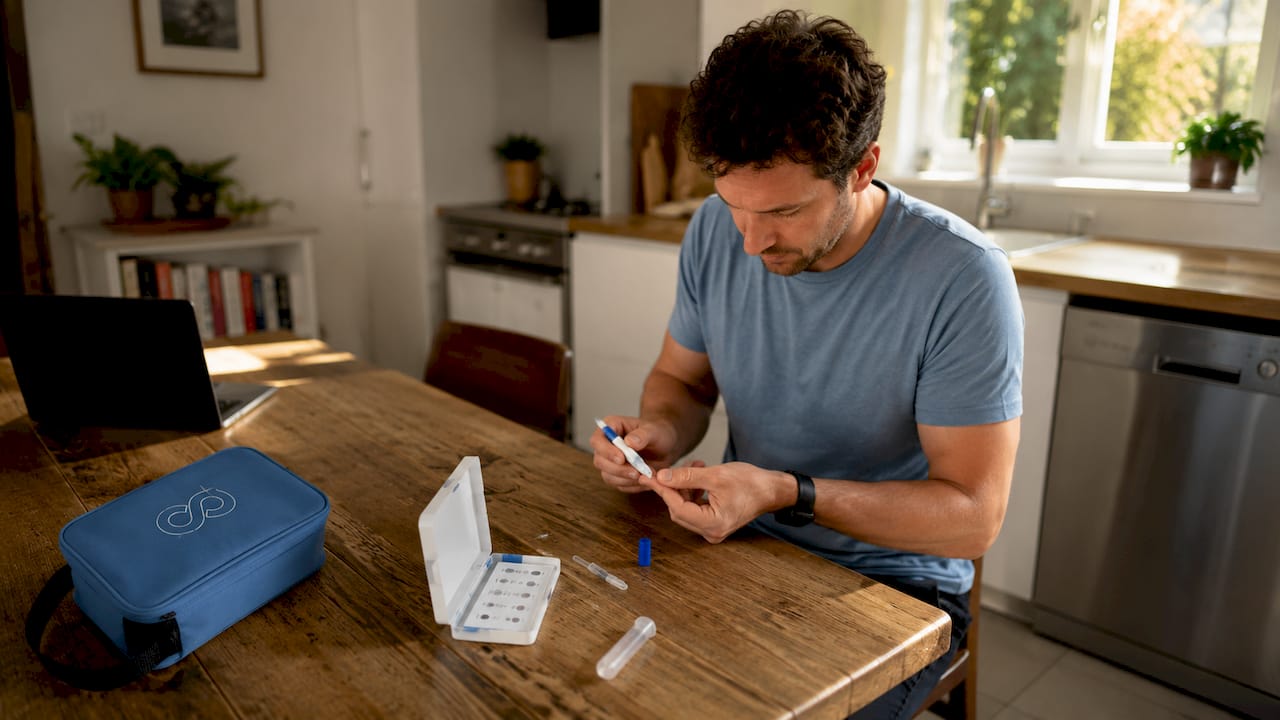
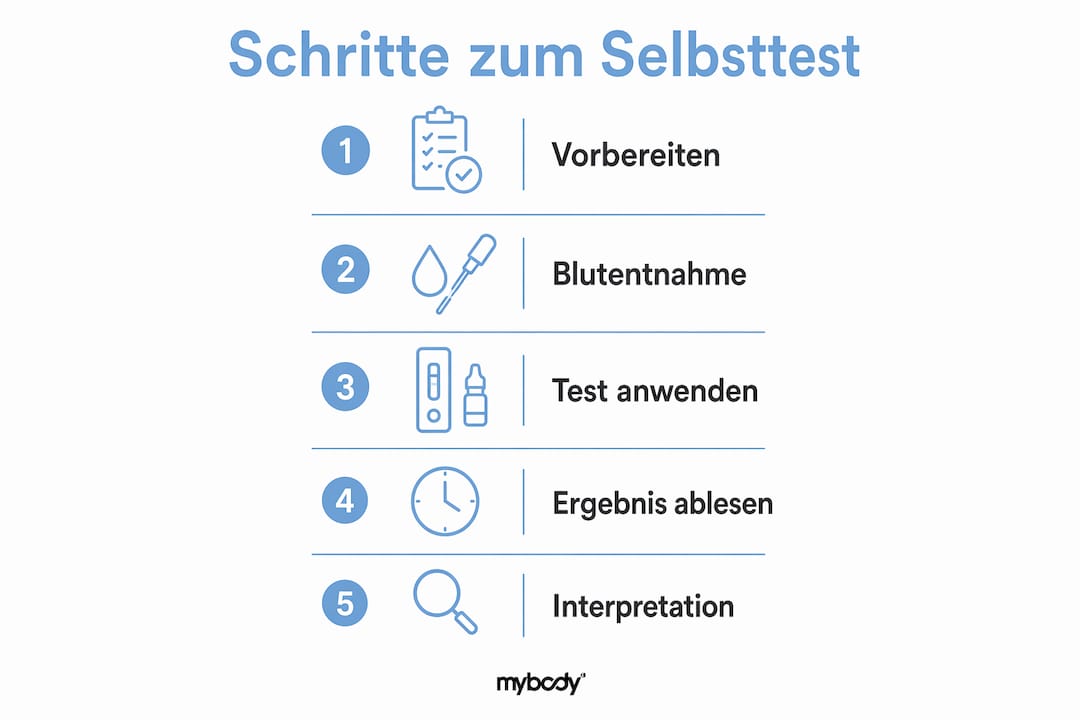
The procedure is divided into clearly defined steps. All necessary materials—including the lancet, capillary tube, buffer solution, and test cassette—are included in the kit. No medical training is required to use the test correctly.
Step-by-step instructions:
- Wash and dry your hands. Warm hands promote blood circulation and make blood collection easier. Briefly rub the finger to stimulate the capillaries.
- Disinfect the finger. Use the enclosed disinfectant wipe and let the finger dry completely before continuing. Residue can affect the result.
- Prick the finger with the lancet. Press the lancet against the side of the fingertip (not the pad) and trigger the puncture. The side of the fingertip is less sensitive and provides enough blood.
- Collect the blood. Fill the capillary tube with blood up to the marked line. Gently squeeze the finger if the blood flow slows.
- Prepare the sample. Add the blood from the capillary tube to the included buffer solution and briefly mix the two by gently swirling.
- Apply the sample. Drip the prepared solution into the designated opening of the test cassette. Keep the cassette horizontal while doing so.
- Wait and read the result. Read the result after the specified waiting time, usually after 10 to 20 minutes. A result read after more than 20 minutes is no longer valid.
Pro tip: Perform the test in the morning before eating. Although fasting does not directly affect the result, you are more focused and make fewer errors while performing the test.
The most common errors during use are too little blood in the capillary tube, reading the result too early, and applying too large a sample volume. All three errors lead to invalid or inaccurate results. Read the package insert in full before you begin, not while performing the test.
What must you be sure to observe before the test?
The most important prerequisite for a meaningful result is your diet in the weeks before the test. The body produces tTG-IgA antibodies only when it regularly consumes gluten. Anyone who has switched to a gluten-free diet before taking the test risks a false-negative result.
- Continue eating a gluten-containing diet: You must continue eating bread, pasta, baked goods, and other gluten-containing foods until the time of the test. Antibodies can only be detected if gluten is actively consumed.
- Do not follow a gluten-free diet before the test: Anyone who has been gluten-free for weeks must resume eating gluten for several weeks before the test to build up enough antibodies. This so-called gluten challenge usually lasts four to six weeks.
- Observe the recommended age: Most self-tests are designed for adults. In children under two, antibody production is not yet fully developed. For children, always consult a pediatrician first.
- Check how the test is stored: Store the test kit at room temperature between 4 and 30 degrees Celsius. Heat, cold, or direct sunlight can damage the reagents and make the result unusable.
- Check the expiration date: An expired test kit does not provide reliable results. Check the date on the packaging before opening the test.
Pro tip: If you have been eating gluten-free for more than two weeks, wait before taking the test. Instead, start a controlled gluten challenge and take the test only after four to six weeks. Taking the test too early will only waste money and produce no useful result.
For an overview of testing methods, it is worth consulting further resources that identify and compare different approaches to detecting gluten intolerance.
How do you interpret your test result correctly?
Reading the result follows a simple pattern, but the interpretation is more complex than it may seem at first glance.
Possible results at a glance:
- Positive result (two lines): The test detected antibodies against tTG-IgA or DGP. This indicates possible celiac disease, but is not a diagnosis. You should see a doctor promptly, who will arrange blood serology and, if necessary, a small-intestinal biopsy.
- Negative result (one line): No antibodies detected. This does not necessarily mean that you do not have gluten intolerance. Negative tests do not rule out celiac disease, especially if you ate gluten-free before the test or the condition is still at an early stage.
- Invalid result (no line or incorrectly positioned line): The test has failed. The usual causes are too little blood, incorrect application, or a damaged test kit. Repeat the test with a new kit.
Important: A positive self-test result is no reason to panic, but it is a clear signal to take action. Have the result medically confirmed before permanently changing your diet.
A negative test in the presence of persistent symptoms such as bloating, diarrhea, fatigue, or skin rashes should not reassure you. Similar symptoms can also be caused by irritable bowel syndrome or lactose intolerance. Only a doctor can make a definitive assessment based on a combination of medical history, blood tests, and a biopsy.
Another important point: There is no specific self-test for non-celiac gluten sensitivity (NCGS). This form of gluten intolerance, in which those affected react to gluten without detectable celiac antibodies, is a diagnosis of exclusion. It can only be diagnosed by a doctor after celiac disease and wheat allergy have been ruled out.
Self-test or medical diagnostics: When is each option useful?
Self-testing and medical diagnostics are not mutually exclusive. They complement each other. A self-test is the quick, anonymous first step. Medical evaluation is the necessary second step.
| Feature | Self-test | Medical diagnostics |
|---|---|---|
| Location | At home | Doctor's office or laboratory |
| Duration | 10 to 20 minutes | Several days to weeks |
| Cost | 15 to 30 euros | Partially covered by health insurance |
| Accuracy | Up to 97.03% (tTG-IgA) | Very high due to the combination of several tests |
| Diagnostic certainty | Guidance, not a substitute | Definitive diagnosis possible |
| Gold standard | No | Yes (small-intestinal biopsy) |
| Detects NCGS | No | Yes (by exclusion) |
The Patris Health® test is CE-certified, clinically validated, and manufactured in France. With an accuracy of 97.03%, it is one of the most reliable home tests available. However, this also means that the result can be incorrect in nearly 3 out of 100 cases. That is not sufficient for a definitive diagnosis.
The combination of medical history, blood values, and a small-intestinal biopsy is the medical gold standard when celiac disease is suspected. No home test can replace this combination. What a home test can do: It gives you an indication of whether seeing a doctor is urgent, or it can dispel an initial suspicion enough for you to consider other causes of your symptoms.
Pro tip: If you have a positive self-test, continue eating gluten until a doctor confirms or rules out the diagnosis. Starting a gluten-free diet too early can distort blood serology and make the biopsy unusable.
For a detailed introduction to the various testing methods for gluten intolerance, you can find further information on mybody x to help you choose the right next step.
Key findings
A gluten intolerance self-test provides initial indications of celiac disease within 10 to 20 minutes, but does not replace a medical diagnosis based on blood serology and biopsy.
| Point | Details |
|---|---|
| Gluten-containing diet before the test | Eating gluten-free before the test puts you at risk of a false-negative result. |
| Test accuracy of up to 97.03% | Clinically validated tests such as Patris Health® are reliable, but not error-free. |
| Repeat an invalid result | Insufficient blood or incorrect application leads to invalid results. Use a new test. |
| Have a positive result evaluated by a doctor | A positive test is an indication, not a diagnosis. A doctor’s visit and biopsy are necessary. |
| NCGS cannot be detected by a self-test | Non-celiac gluten sensitivity is a diagnosis of exclusion and requires medical evaluation. |
What I really think about gluten self-tests after years of experience
At mybody x, we regularly see people switch to a gluten-free diet immediately after receiving a positive self-test result. This is understandable, but counterproductive. Anyone who changes their diet after a positive home test, before the doctor has confirmed the diagnosis, compromises the subsequent diagnostic process. Antibody levels fall, the biopsy shows no clear findings, and in the end there is no definitive diagnosis.
The most common mistake we observe is not performing the test incorrectly. It is misunderstanding what the test can do. A home test is a screening tool. It tells you: “See a doctor.” It does not tell you: “You have celiac disease.”
What really convinces me about gluten self-tests is their role as a gateway. Many people put off seeing a doctor for years because of vague symptoms such as fatigue, bloating, or skin problems. A positive home test gives them a concrete reason to finally take action. That is the true value of these tests.
At the same time, we see that a negative result can sometimes create a false sense of security. Anyone who has been living gluten-free for weeks and then takes the test will almost inevitably receive a negative result. But that does not mean everything is fine. Take symptoms seriously, even if the test is negative, and see a doctor: that is the right approach.
— mybody x
Reliable self-tests and advice at mybody x

If you are looking for an initial indication of possible gluten intolerance, mybody x offers tested self-tests and well-founded information to help you take the next step. More than 11,300 satisfied customers trust the scientifically validated analyses and personalized advice. All tests can be conveniently carried out at home, with free shipping from 49 euros and transparent results. Get started now at mybody-x.com and gain clarity about your health before making permanent changes to your diet.
FAQ
What exactly does a gluten self-test measure?
A gluten self-test measures antibodies against tissue transglutaminase (tTG-IgA) or deamidated gliadin peptides (DGP) in finger-prick blood. The body produces these antibodies when gluten damages the lining of the small intestine in people with celiac disease.
How long does a celiac disease self-test take?
The procedure, including the waiting time, usually takes 10 to 20 minutes. A result read after more than 20 minutes is no longer valid and should not be interpreted.
Can I take the test if I already eat gluten-free?
No. If you already follow a gluten-free diet, you may no longer have detectable antibodies in your blood. In this case, gluten exposure for four to six weeks is necessary before the test can provide meaningful results.
What does a positive test result mean?
A positive result indicates the presence of celiac disease antibodies and may suggest possible celiac disease. It is not a diagnosis. The next step is to see a doctor for blood serology and, if necessary, a small-intestinal biopsy for confirmation.
Does the self-test also detect non-celiac gluten sensitivity?
No. Non-celiac gluten sensitivity (NCGS) cannot be detected with self-tests because they only detect celiac disease-specific antibodies. NCGS is diagnosed by a doctor through a process of exclusion, after celiac disease and wheat allergy have been ruled out.



Share now:
Home Test Kit Guide: How Your Self-Test Works
Which vitamin deficiency causes muscle pain? Find the