
Nutrient deficiency test experiences: Find the cause of your
You get enough sleep, drink water, and make an effort with your diet. Yet in the morning you still feel as if the handbrake is on. Your mind is foggy, your circulation takes a while to get going, and at some point you wonder whether this has simply become “normal.”
This is exactly where many searches for nutrient deficiency test experiences begin. Not out of curiosity alone, but because a vague feeling should finally be given a name. Many people describe it similarly: For a long time, they thought they were simply stressed, sensitive, or not morning people. Only a test turns suspicions into measurable information.
Tired and drained despite getting enough sleep
You go to bed on time, sleep long enough, and still wake up as if your body did not really make use of the night. Your mind takes too long to get started, your legs feel heavy, and even simple tasks require more energy than they used to.
This is how many real experiences with a nutrient deficiency test begin. Not because there is an immediate dramatic symptom, but because a feeling gradually takes hold over weeks or months: Something is not right. Everyday life continues, but as if running on low power.
Fatigue is an imprecise signal. It may be related to stress, sleep quality, psychological strain, infections, hormones, or lifestyle. Nutrients are also part of the picture. They work in the background, much like small helpers in a workshop. If one of them is missing over a longer period, everything continues to function, but less smoothly.
Many people affected describe it in much the same way: “For a long time, I thought this was simply my normal state.” That is exactly where the difference between suspicion and measurement becomes important. In everyday life, a deficiency often does not feel like a clearly recognizable deficiency, but rather like exhaustion, difficulty concentrating, paleness, or declining stamina.
Why testing often helps more than guessing
Symptoms alone are not enough. They provide clues, but not a clear answer. Anyone who takes supplements based on suspicion is working a bit like someone who randomly replaces parts when a warning light is flashing, without first checking what is actually affected.
Targeted tests based on a specific suspicion are more useful. Broad, all-around checkups may seem reassuring at first, but they do not automatically help in everyday life. What matters is whether the measured value fits your symptoms, your diet, your stage of life, and what you can actually change afterward.
Fatigue is a signal, but not yet a diagnosis.
That is why so many people are interested in real experiences. People do not just want to know whether a test works technically. They want to know whether a laboratory result can ultimately lead to a noticeable change. This connection between symptoms, test results, and everyday life is precisely what matters.
This state is a common reason to take a closer look at the topic. If you first want to assess your symptoms more broadly, it can help simply to take a structured look at possible causes of fatigue despite getting enough sleep.
What your body is really trying to tell you
The human body needs more than enough calories. It also needs the right building blocks, in the right amount and at the right time. When individual nutrients are lacking, the effects in everyday life are often vague. You are not suddenly ill, but you are not really in your usual form either.
That is precisely what makes the topic so tricky. A deficiency rarely feels clear-cut. It tends to appear as a pattern of minor disruptions that come together to form a bigger picture. Sometimes it is concentration, sometimes resilience, and sometimes the feeling of not quite getting back on your feet despite maintaining a sensible daily routine. Many experiences with nutrient tests begin at this point—not with a clear diagnosis, but with the feeling: Something is not right.

The usual suspects in everyday life
In the Content Owner's experience, Vitamin D, followed by magnesium, vitamin B12, and iron, appear particularly often in analyses. This is deliberately presented as the provider's practical experience, not as general population statistics.
Why these particular levels so often come up is easy to understand. They influence functions you feel every day: energy, muscles, concentration, recovery, and oxygen transport. When something gets out of balance, it often does not produce a loud warning signal, but rather a gradual decline in performance.
- Vitamin D often becomes noticeable in everyday life through persistent lack of energy or the feeling of not quite getting going.
- Magnesium is often associated with muscle discomfort, inner restlessness, or reduced resilience.
- Vitamin B12 can easily be overlooked, even though exhaustion or concentration problems may make further evaluation worthwhile.
- Iron or ferritin often plays a role when fatigue, paleness, or a decline in performance persists.
Why a healthy diet is not always the complete answer
A balanced diet remains the foundation. Nevertheless, it does not answer every question. The absorption, storage, and use of nutrients also depend on life stage, medication, digestion, sun exposure, training load, and eating habits. Two people can eat similarly and still end up with different laboratory values.
That is why a test is not intended to confirm symptoms, but to put them into context. It helps turn a vague feeling into a question that can be investigated. That is the point at which experiences become genuinely useful. People report not only numbers on a laboratory report, but also whether an abnormal result later led to an understandable action and a noticeable change.
Practical rule: Nonspecific symptoms need to be interpreted first. Measuring is often more useful than guessing.
It is also important to remember that symptoms overlap considerably. Fatigue may be related to iron. But it may also be associated with vitamin B12, vitamin D, sleep quality, stress, or other causes. A test does not completely distinguish between these possibilities, but it helps sort them out. It works a little like a map. You cannot see every detail yet, but you can identify the direction in which it makes sense to proceed.
If you want to compare different ways of investigating the issue, take a look at this overview for choosing suitable nutrient deficiency tests.
If a test actually reveals a vitamin D deficiency, a product such as Vitamin D3 K2 Complex | Shield may be a practical follow-up option. According to the product description, it combines D3 with K2 and is intended for use after DNA or blood testing when a deficiency has been confirmed.
The different testing methods at a glance
Anyone searching for nutrient deficiency test experiences quickly encounters very different options: a medical practice, home test, rapid test, saliva sample, or urine sample. This can be confusing because everything sounds similar, but does not have the same evidential value.
What is considered reliable
For a nutrient deficiency test, venous blood collection is considered the most diagnostically reliable standard method. Depending on the question, whole blood, serum, or plasma is used. Laboratory-based methods are superior to self-assessments or non-validated rapid tests because they reflect deficiencies biochemically and provide an objective basis. This is how the Nuhr Medical Center describes it in its overview of nutrient deficiency tests.
This is the reference point. From there, you can better assess other methods. “Practical” does not automatically mean bad. But practicality and reliability are two different questions.
Comparison of nutrient testing methods
| Method | Accuracy | Convenience | Typical use |
|---|---|---|---|
| Venous blood draw | Very high, medical standard | Lower, because an appointment and sample collection are required | Targeted laboratory assessment when there is a specific suspicion |
| At-home dried blood spot test | Good, provided the sample is collected properly and analyzed in a laboratory | High, because you collect the sample yourself | Practical assessment without visiting a medical practice |
| Capillary rapid test | More indicative than definitive | High | Initial rough assessment |
| Urine or tissue sample | Suitable for specialized questions | Varies | Supplementary diagnostics depending on the question |
| Saliva test | Not the typical method for assessing classic nutrient deficiencies | High | More suitable for test areas other than the classic nutrient panel |
Where at-home tests can be useful
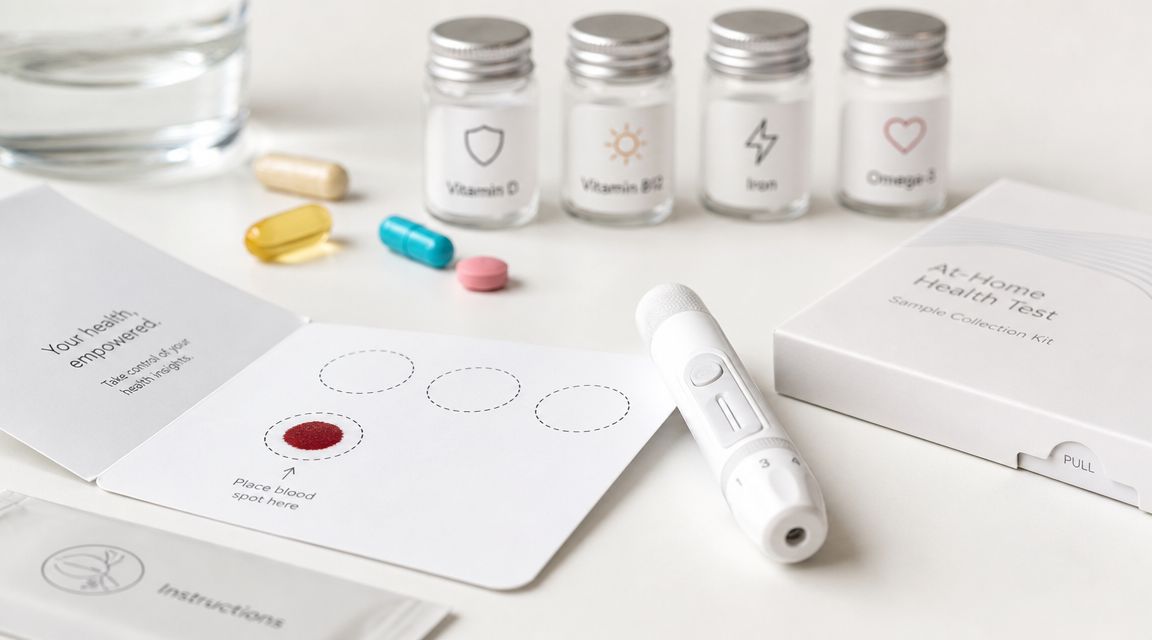
At-home dried blood spot tests are the most practical starting point for many people. You do not have to arrange an appointment, can collect the sample at your own pace, and still receive laboratory analysis. What matters is not where the sample is collected, but where and how the sample is analyzed.
At-home rapid tests that advertise a simple instant result are something else. They can provide an indication, but they do not replace proper laboratory analysis.
Anyone who wants to understand not only their current laboratory values but also how their body processes nutrients may find a genetic perspective a useful supplement. According to the product description, the Longevity | ALL IN ONE DNA Test from mybody®x analyzes genetic risk factors for aging, inflammation, nutrient utilization, and metabolism. It is not a substitute for blood values, but rather a different level of interpretation.
If you want to compare test types directly, you can find a concise overview in the article on choosing different nutrient deficiency tests.
Personal experience A customer shares her story
A story often makes the topic clearer than any technical description. Not because individual cases prove everything, but because they show what laboratory values feel like in real life.

When fatigue suddenly no longer felt normal
Anna, 36 years old, had felt constantly exhausted for months. Then hair loss was added to the picture. She did not feel acutely ill. Rather, it was as if her body were becoming quieter. Less energy, less resilience, less of a feeling of being fully herself.
At first, she did what many people do. She attributed it to everyday life, lack of sleep, mental strain, and a stressful period. Only when nothing changed did she want to investigate it more closely.
The test revealed three abnormal values:
- Vitamin D at 11 ng/ml
- Ferritin at 8 µg/l
- Vitamin B12 at 178 pg/ml
These figures come from the case history provided by the content owner. This is precisely where many people's view of their symptoms changes. A vague “I just don't feel well” becomes a verifiable constellation.
The turning point was not just the result
People often think the actual experience is the laboratory report. In reality, the change usually begins afterward. Values alone are only of limited help if no one explains what they mean in practical terms.
Anna received a personalized plan for targeted supplementation. That is the crucial difference between taking random action and implementing a sensible approach. Do not simply take just anything; act based on specific results.
“Realizing that my symptoms had a measurable cause changed everything.”
This sentence from the briefing describes quite well why so many nutrient deficiency test experiences are emotionally charged. It is not just about a deficiency. It is about relief. Finally, there is something tangible.
What changed after twelve weeks
After 12 weeks of targeted supplementation, Anna's levels were, according to the case history provided:
| Parameter | Before | After |
|---|---|---|
| Vitamin D | 11 ng/ml | 44 ng/ml |
| Ferritin | 8 µg/l | 28 µg/l |
| Vitamin B12 | 178 pg/ml | 380 pg/ml |
At the same time, according to the case description, her energy and hair growth improved significantly. This, too, is important to put into perspective. People do not immediately feel every biochemical process. But when several issues exist at the same time and are addressed specifically, the difference can become clearly noticeable in everyday life.
The content owner also reports that many customers say, surprised: They thought they were simply not morning people, but in fact there was a measurable nutrient status behind it. Such feedback does not replace a general medical statement. However, it shows why home tests are the first step out of mere guesswork for many people.
If you want to know how other people generally experience using it at home, you can find additional insights in the experiences with at-home blood tests.
Choose and carry out your test correctly
The choice of test often determines whether you ultimately gain real clarity or just end up with more questions. A good nutrient test works like a well-organized toolbox. You do not need everything—only the tools that fit your problem.
That is precisely why it is worth pausing briefly before ordering. Are you mainly concerned about fatigue, hair loss, concentration problems, or a plant-based diet? Then the values measured should match those concerns. Panels that are too broad can quickly seem impressive, but they do not automatically help more in everyday life than a carefully targeted test.
How to recognize a useful test
A meaningful nutrient deficiency check does not simply measure “random vitamins.” It assesses parameters that are genuinely often relevant to typical symptoms, such as ferritin, active vitamin B12 (holotranscobalamin), and 25-OH vitamin D. It is also essential that the sample is evaluated in a certified laboratory. Labor Berlin explains in its nutrient deficiency check the role reliable laboratory analyses play in interpreting such values.
One simple question can help you choose: At the end, do you receive only numbers, or also an understandable explanation of what those numbers mean in your everyday life?
What you should look for:
- Clear measurements instead of vague promises. A reputable provider clearly states what is being tested.
- Laboratory analysis instead of a purely app-based assessment.
- An easy-to-understand report explaining the most important values.
- Practical guidance, so you know what to do with the results next.
How to make collecting a sample at home more relaxed

Many people feel unsure before their first finger prick. That is normal. However, experience with home tests repeatedly shows that collecting the sample itself is usually not the difficult part. Preparation makes the difference.
You can think of it like cooking. It is not the last minute that makes the difference, but whether everything is ready beforehand.
A few simple steps can help:
- Warm your hands. This usually helps the blood flow more easily.
- Have everything ready beforehand. The lancet, sample card, swab, and bandage should be within reach.
- Press only gently. Squeezing too hard can distort the sample.
- Read the instructions in full before you begin. Many errors occur not during collection, but because of rushing.
A clean sample is achieved above all through calmness, preparation, and precise steps.
Reading results without driving yourself crazy
Many people look at the colored markers first and immediately draw their own conclusions. Understandably. It is more helpful to view the values as pieces of a puzzle. A single piece does not yet show the whole picture.
The reference range is often misunderstood. It describes the range in which measured values commonly fall. However, it does not automatically answer why you currently feel exhausted or unable to concentrate. This requires considering the context of your symptoms, lifestyle, and multiple laboratory values.
Providers such as mybody x blood test combine at-home testing, laboratory analysis, and specific guidance for the next steps. According to the information provided, the company works with ISO-certified laboratories in Germany and supplements the results with personalized recommendations and coaching. For many people, this combination of measurement and explanation is precisely the point at which a finding becomes an actionable plan.
For guidance on which test suits your needs, the overview which nutrient test is right for you can help.
Conclusion: Your guide to greater well-being
A nutrient test is not a miracle cure. But it can be a very good starting point if you have not felt quite like yourself for some time. The key is not the test as a product, but the shift from supposition to knowledge.
Many nutrient deficiency test experiences revolve around exactly this. People realize that they have spent a long time explaining away their symptoms. Only when a laboratory value is added does a vague feeling become a specific question: What is my body really lacking, and what should I do about it now?
That is the real value of tests like these. You are no longer left in the dark and do not have to take supplements at random. You gain a more objective basis for making decisions.
If you are experiencing persistent fatigue, concentration problems, hair loss, or a general feeling that “something isn’t right,” it makes sense to take a closer look. Not panic-stricken. Not blindly. But deliberately.
Ultimately, it is not about optimizing every value as if it were in a spreadsheet. It is about understanding your body better and deriving practical steps for everyday life. That is often where noticeably greater well-being begins.
If you no longer want to guess your nutrient status but want to assess it on a sound basis, take a look at the mybody x blood test. This allows you to objectively put symptoms such as fatigue or dips in performance into perspective with a laboratory analysis from home and make further decisions based on concrete values.



Share now:
Hormone test costs: How to find the best option
Progesterone deficiency symptoms: Recognize the signs and take action