

Vitamin C for the skin and your radiant complexion
When it comes to skincare, vitamin C is a true powerhouse. It acts like an invisible shield that not only protects your skin from daily environmental stressors but also actively helps keep it firm and radiant. In short, it is a multitasker for a healthy complexion.
Why vitamin C is the key to healthy skin

Imagine your skin had a personal bodyguard watching over it 24/7. That is exactly what vitamin C is. Every day, our skin has to defend itself against invisible aggressors—from UV rays and fine particulate matter to exhaust fumes. All these influences produce aggressive molecules in the skin known as free radicals.
These free radicals are tiny troublemakers that attack and weaken our skin cells. Their favorite target? Collagen—the supporting structure that keeps our skin firm and elastic. When this structure is damaged, the effects quickly become visible: fine lines, reduced firmness, and a dull complexion are signs of premature skin aging.
Vitamin C’s dual protection mechanism
This is where vitamin C’s ingenious dual strategy comes into play. It is not just a passive protector but an active contributor to your skin’s health.
-
As a powerful antioxidant: Vitamin C captures these aggressive free radicals before they can cause any damage. It neutralizes them, protecting skin cells from oxidative stress. If you would like to explore this topic in more depth, read our article on antioxidant effects.
-
As a collagen booster: At the same time, vitamin C is an essential cofactor in collagen production. Without vitamin C, the body cannot build a stable collagen network. An adequate supply therefore stimulates repair processes and helps strengthen the skin’s supporting structure from within. The result is visibly firmer, smoother skin.
This dual approach makes vitamin C one of the most effective and best-researched ingredients in modern skincare. It not only protects against new damage but also helps reduce existing signs of skin aging.
What does this mean for your skincare routine?
Integrating vitamin C into your daily skincare routine is therefore far more than just a trend—it is a smart, scientifically proven choice for long-term skin health. But how can you find out whether your skin has a particular need for this powerful active ingredient? Your genes have the answer. With a Skincare DNA Metabolism Analysis, you can understand how well your body naturally produces collagen or protects itself from oxidative stress, and tailor your skincare routine perfectly to these needs.
In the following sections, we’ll take a closer look at how this powerful active ingredient works at the cellular level and how you can find the perfect product for your individual skincare needs.
How Vitamin C Really Changes Your Skin Cells

We have already come to know vitamin C as your skin’s bodyguard. But its true superpower only unfolds deep inside, in the skin cells themselves. There, it is far more than just a protector—it is an active director that controls the key processes behind a youthful appearance.
So let’s take a look behind the scenes and understand what vitamin C really does for the skin at the cellular level.
Imagine your skin’s collagen framework as a stable, finely woven net. It gives the skin support and elasticity. But for this net to remain strong and flexible, it needs an indispensable builder: vitamin C. It is what is known as a co-factor for two enzymes (prolyl and lysyl hydroxylase), which ensure that collagen fibers are properly cross-linked and stabilized.
Without vitamin C, these fibers become weak and unstable. The result? The skin loses firmness, and wrinkles develop. But when the body is well supplied, collagen production is actively stimulated—the result is visibly firmer, plumper skin.
The Brightening Agent for an Even Complexion
But vitamin C is not just a builder; it is also a remarkably clever regulator. Many of us know the problem: unwanted pigmentation spots or simply an uneven skin tone. In most cases, this is caused by an overproduction of the skin pigment melanin.
And this is exactly where vitamin C comes in. It specifically inhibits an enzyme called tyrosinase, which plays a key role in melanin production. By slowing down the activity of this enzyme, it helps normalize excessive production.
The result is a visibly more even complexion. Existing pigmentation spots can be lightened, while the development of new discoloration is prevented—for a clear, radiant complexion.
The Different Faces of Vitamin C
If you have ever looked into vitamin C serums, you have surely noticed that there is not just one vitamin C. There are different forms, each with its own strengths. Making the right choice is crucial for effectiveness and tolerability.
- L-Ascorbic Acid: This is the purest and strongest form of vitamin C. It works quickly and effectively, but it has one drawback: it is quite unstable and can easily irritate sensitive skin.
- Vitamin C derivatives: Names like Ascorbyl Glucoside or Ascorbyl Tetraisopalmitate may sound complicated, but they refer to more stable and gentler forms. They first need to be converted into their active form in the skin, making them ideal for beginners or sensitive skin types.
Another important factor is a serum's pH level. L-Ascorbic Acid needs a very acidic environment (ideally below pH 3.5) to penetrate the skin optimally. This can be a real challenge for the skin barrier. Derivatives, on the other hand, are often effective in more neutral formulations and are therefore significantly better tolerated.
Every skin type is unique and reacts differently. Your genetic predisposition plays a huge role in how well your skin naturally produces collagen or protects itself from oxidative stress. The mybody-x Skincare DNA Stoffwechsel Test can show you exactly what your skin needs on a genetic level and whether an active ingredient like vitamin C might be particularly important for you.
Find the right vitamin C product for your skin type
The world of skincare products can be quite overwhelming, especially when it comes to vitamin C for the skin. But don't worry—simply think of this section as your personal shopping advisor. Together, we'll find out which product is truly right for you and your skin's needs.
The right concentration makes all the difference
The first and most important step is choosing the right concentration. Because when it comes to this, more is definitely not always better. Every skin type is different and tolerates different strengths.
- For beginners and sensitive skin (5–10%): If you are just starting out with vitamin C or your skin tends to react easily, a lower concentration is ideal. This gives your skin gentle antioxidant protection without overwhelming it.
- For experienced users and more resilient skin (15–20%): Higher concentrations are true powerhouses. They are perfect for specifically targeting dark spots, fine lines, or a dull complexion.
To make your decision easier, we have summarized the most common concentrations and their ideal applications in a table.
| Which vitamin C concentration is right for you? | A comparison of the different vitamin C concentrations and their suitability for various skin types and skin concerns. | |
|---|---|---|
| Concentration | Ideal for | Primary effects |
| 5–10 % | Sensitive skin, beginners | Antioxidant protection, prevention, gentle brightening |
| 10–15 % | Normal to oily skin, mild hyperpigmentation | Collagen boost, targeted brightening, glow effect |
| 15–20 % | Non-sensitive skin, advanced users | Intensive treatment of wrinkles and hyperpigmentation |
| Over 20% | Very resilient skin, targeted application | Maximum effectiveness, but high potential for irritation |
This overview will help you make an initial assessment. Always remember to start slowly and observe how your skin reacts.
What to look for in the formulation
At least as important as the concentration are the “supporting ingredients” in the serum. Vitamin C is a true team player! It works best when combined with other antioxidants such as vitamin E and ferulic acid. This trio stabilizes one another and amplifies the protective effect against free radicals many times over.
The following infographic shows you exactly what measurable effects vitamin C can achieve in the skin.
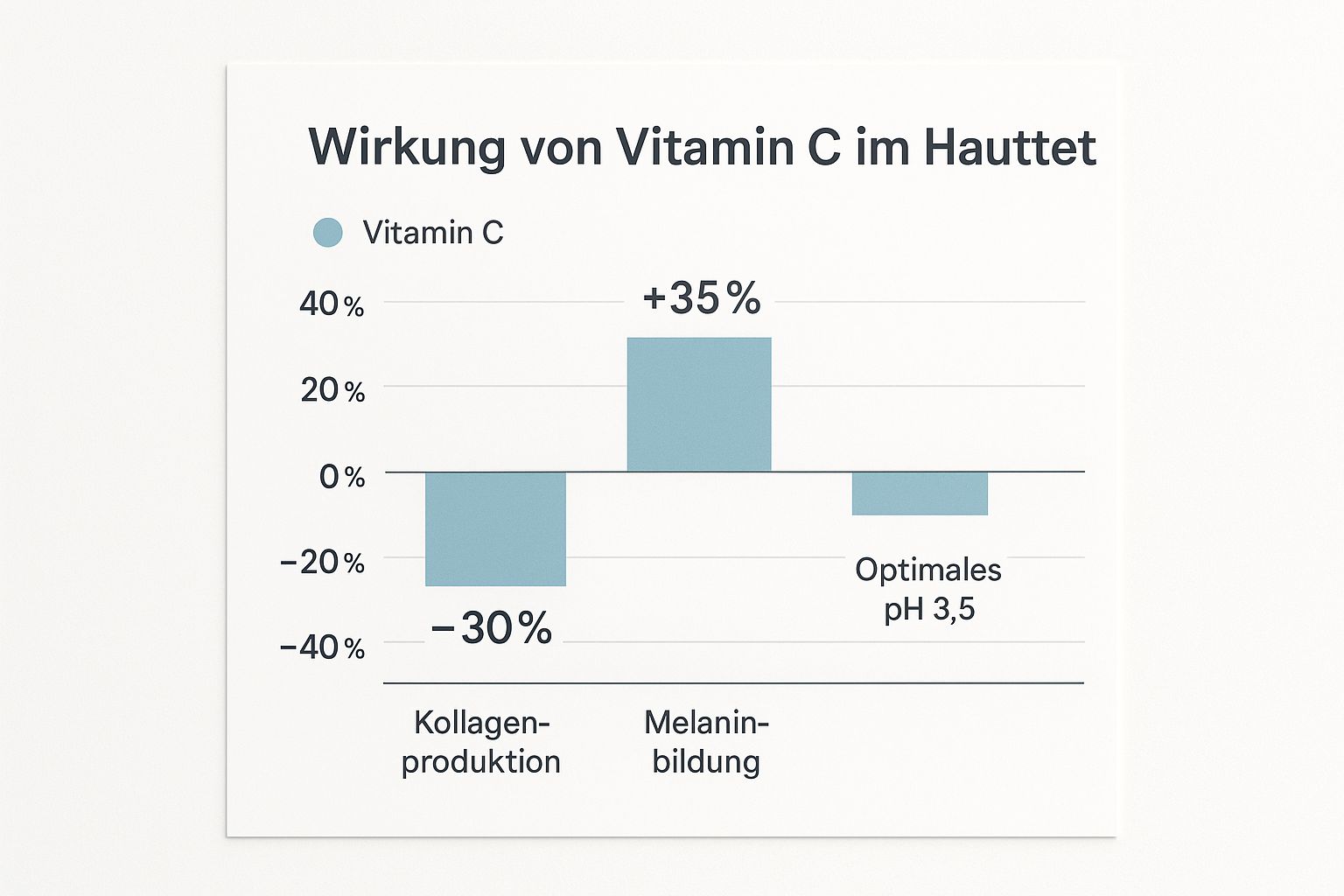
The numbers speak for themselves: Vitamin C not only improves skin firmness by promoting collagen production, but also creates a more even complexion by regulating melanin production.
Packaging matters more than you think
Vitamin C is a bit of a diva—the active ingredient is extremely sensitive and reacts quickly to light and oxygen. As a result, it loses all its power. Good packaging is therefore not a luxury but an absolute must. Make sure to choose dark, opaque glass or an airtight pump dispenser. This ensures that your serum remains effective down to the last drop.
The acidic nature of pure ascorbic acid (often with a pH between 2.5 and 3.5) is one reason why stabilized vitamin C derivatives such as Ascorbyl Glucoside are frequently used here. They protect against rapid loss of active ingredients. Improper storage can halve its effectiveness within just a few hours, which is why the German market places great emphasis on light- and airtight packaging.
But even the best product can only unleash its full potential when it matches your individual skin profile. Your genes play a major role in determining how your skin responds to active ingredients, how quickly it breaks down collagen, and how well its own protective system functions.
With an Anti-Aging & Skincare DNA skin type analysis, you can find out whether your skin has a genetically determined need for additional support from vitamin C. This helps you make decisions perfectly tailored to your body and invest in skincare that truly makes a difference.
How to get the most out of your vitamin C
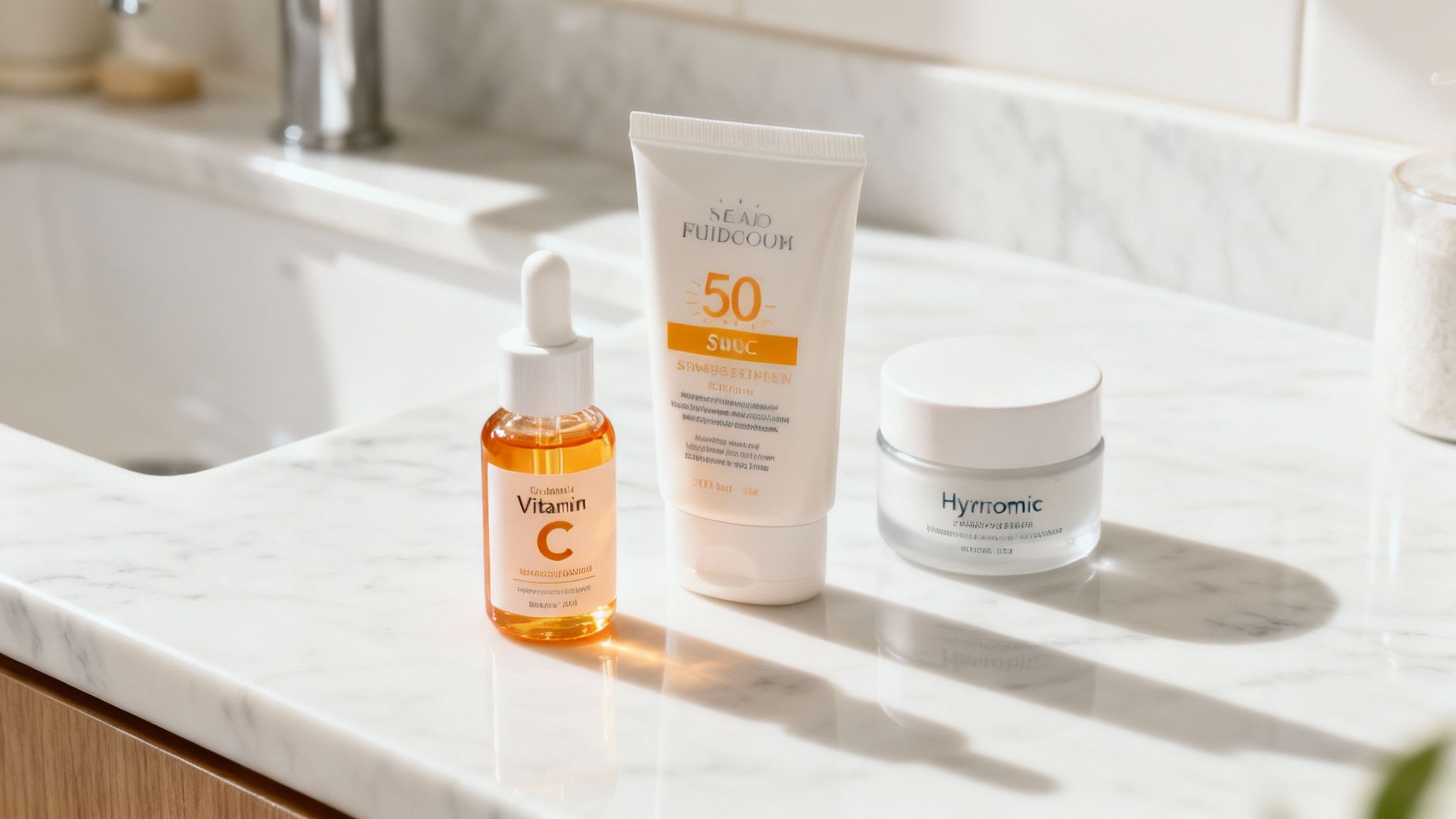
Finding a good product is one thing. Using it in a way that allows it to deliver its full benefits is the crucial next step. The good news: Adding vitamin C for the skin to your daily skincare routine is fortunately very easy when you know a few golden rules.
The best time for your vitamin C serum? Clearly, in the morning. Think of it as a protective shield that you put on right after waking up. Applying it to dry skin after cleansing allows the active ingredient to absorb optimally and prepares your skin for the day. This way, it is protected from UV radiation and environmental stress from the very beginning.
An absolute must after vitamin C serum is a broad-spectrum sunscreen with a high sun protection factor (SPF 30 or higher). These two are an unbeatable power duo against premature skin aging. Vitamin C neutralizes the free radicals that sunscreen cannot block, while SPF protects the skin from direct UV damage.
Your step-by-step morning routine
An effective routine doesn't have to be complicated. With this simple order, you can ensure that each active ingredient does exactly what it is supposed to do:
- Cleansing: Always start with a clean face. A gentle cleanser removes dirt and sebum from the skin and prepares it to absorb everything that follows.
- Vitamin C serum: Apply a few drops to your dry face, neck, and décolleté, then gently pat it in. Give the product a moment to absorb fully.
- Moisturizer: A good moisturizer locks in the valuable active ingredients and supplies the skin barrier with everything it needs.
- Sunscreen: The most important final step! Apply plenty of sunscreen to protect your skin and maximize the benefits of vitamin C.
Which active ingredients work well with vitamin C—and which do not?
Vitamin C is a real team player, but not with everyone. Some active ingredients take its effects to the next level, while caution is advised with others.
Good partners are:
- Hyaluronic acid: This moisture magnet plumps the skin and keeps it looking supple. Combining it with vitamin C is completely unproblematic and gives you a radiant, optimally hydrated complexion.
- Vitamin E & ferulic acid: As mentioned above, these two antioxidants stabilize the sensitive vitamin C and boost its protective effect many times over.
- Niacinamide: People used to think the two were incompatible. However, newer studies show that you can use them together in the same routine without any problems. It is best to leave a little time between the individual steps.
Here’s what you should watch out for:
It is best not to combine vitamin C in the same application with strong chemical exfoliants (such as AHA/BHA) or retinol. This can quickly overwhelm and irritate the skin and weaken its protective barrier. A smart solution: vitamin C in the morning, retinol or exfoliants in the evening. This way, your skin gets the best of both worlds without becoming stressed.
The popularity of vitamin C in skincare is no coincidence, by the way. Studies show that around 60% of people in Germany use products containing this active ingredient at least once a day. With consistent use for at least eight weeks, clinical tests demonstrated improvements in skin elasticity of up to 25% and a reduction in fine lines of around 15%. You can read more about these exciting results at dr-aesthetik.de.
Want to strengthen your skin not only from the outside but also from within? Discover in our guide which antioxidant foods can provide your skin with additional protection and strength.
Decoding your skin’s genetic code
While creams and serums work on the surface, the true blueprint of your skin health lies much deeper: in your DNA. You could say that your genes are the invisible architect determining how your skin responds to the world outside.
They determine how quickly your body breaks down the collagen that provides support, how well your innate shield against oxidative stress functions, and how sensitive you are to UV rays and environmental toxins. And this is exactly where we come in, moving from general skincare to a strategy that truly suits you.
More than just your skin type – what your genes reveal
Every person is unique, and the same goes for our skin. You may naturally have an exceptionally robust skin barrier, while a friend may be genetically predisposed to faster collagen breakdown. For her, targeted intake of vitamin C for the skin is no longer a nice extra, but an absolute must to strengthen her skin structure over the long term.
Imagine knowing exactly where your skin’s genetic strengths and weaknesses lie. This knowledge is the key to making your skincare routine not only effective but also highly efficient.
The mybody-x Skincare DNA Metabolism Test analyzes precisely these individual genetic factors. It gives you exclusive insight into your skin’s blueprint and shows you what needs it naturally has. Instead of groping in the dark and trying one product after another, you get a clear, scientific basis for your decisions.
From analysis to targeted action
With the knowledge from your DNA analysis, you can finally tailor your skincare—and your diet—more precisely. For example, the test can show whether you have a predisposition to an increased need for antioxidants. If so, consistently applying vitamin C in the morning underneath sunscreen would be especially valuable for you to optimally protect your skin cells.
These insights give you the power to strengthen your skin from the inside and outside:
- Care from the outside: You can deliberately choose active ingredients such as vitamin C because you know that your skin benefits from them genetically.
- Support from within: You can adjust your diet and put vitamin C-rich foods on your plate more often to further stimulate collagen production.
This approach transforms your skincare from a guessing game into a precise strategy. You invest in products and habits that are demonstrably tailored to your body’s individual needs. If you’d like to explore this topic in greater depth, you’ll find a detailed article in our knowledge portal about the connection between DNA and skin health.
Your questions about vitamin C in skincare—answered briefly and clearly
You’ve already read a lot about the power of vitamin C for your skin. Even so, questions keep coming up in everyday life. To help you feel confident and get the most out of your skincare routine, we’ve answered the most frequently asked questions for you here.
How often should I use vitamin C?
For the best results, daily use is ideal. It’s best to incorporate your vitamin C serum into your morning routine. This allows it to fully unleash its antioxidant power and protect your skin throughout the day from stress caused by UV rays and air pollution—like an invisible bodyguard.
When will I see the first results?
Skincare is not a sprint but a marathon. Sure, you may notice a certain “glow” immediately after application, but truly profound changes require some patience.
- After 4–8 weeks: This is often when the first results appear. Your skin tone looks more even, and you simply look fresher.
- After 3–6 months: If you stick with it, your skin's appearance may visibly improve. Fine lines may look reduced and dark spots lighter as collagen production goes into high gear and the skin renews itself.
So stay consistent! Every skin type is different, and the natural renewal process simply takes time.
Why does my vitamin C serum sometimes tingle on my skin?
Do not worry, a slight tingling is quite normal with highly concentrated serums containing L-ascorbic acid, especially at the beginning. This is due to the low, acidic pH (often below 3,5), which is necessary for the vitamin C to penetrate the skin effectively in the first place.
However, if it becomes uncomfortable, your skin turns red, or feels irritated, that is a clear stop signal. The concentration is probably too high for you, or the formulation does not suit your skin. Take a break or switch to a gentler vitamin C derivative with a more skin-friendly pH.
Listen to your skin: A slight tingling is okay, but pain or severe redness is not. Your skin tells you exactly what it needs.
How should I store my serum so it does not go bad?
Vitamin C is a bit of a diva—it likes neither light, heat, nor air. If stored incorrectly, it oxidizes quickly, loses its effectiveness, and in the worst case may even irritate your skin.
Three golden rules for storage:
- Cool and dark: Your bathroom cabinet is the perfect place. The sunny windowsill is off-limits.
- Always seal it properly: Screw the cap tightly back on immediately after every use. This minimizes the amount of oxygen that gets in.
- Pay attention to the color: A fresh serum is usually clear or light yellow. If it turns dark yellow or even brown, it has oxidized. Then it belongs in the trash.
Is vitamin C right for my skin at all?
That is the crucial question. Vitamin C is a real benefit for many people, but whether it is the holy grail for you depends on your genetic predisposition. Your DNA determines how well your body builds collagen, how strong your natural protection against oxidative stress is, and how you respond to certain active ingredients.
Instead of guessing your way through the cosmetics jungle to find the right product for you, mybody-x lets you take a look at your personal blueprint. The Skincare DNA Metabolism Test analyzes your genes and tells you whether a powerhouse active ingredient like vitamin C is particularly important for your skin. This way, you can make decisions that really suit you.



Share now:
Are oats healthy? Facts, nutritional values & tips for you
Recognize nutrient deficiency symptoms and address them effectively