
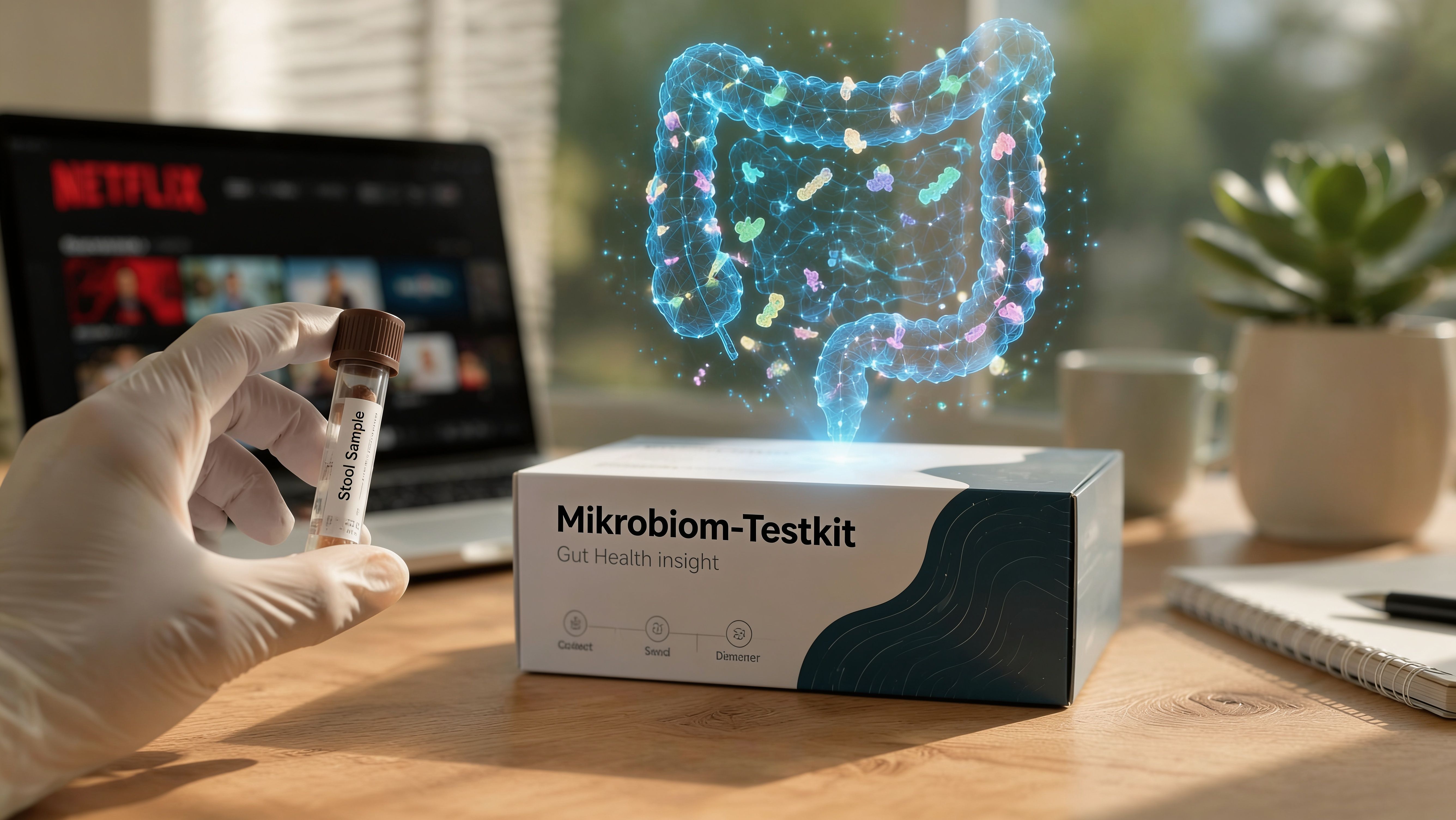
Microbiome analyses: Netflix documentary causes demand to increase tenfold
You have watched the Netflix documentary and are now Googling gut flora, the microbiome, and self-tests. You quickly realize that enthusiasm is high, the claims contradict one another, and somewhere in between, you simply want to understand what is genuinely beneficial for your body.
This is exactly where it is worth slowing down for a moment. The microbiome is a fascinating and relevant topic, and for many people it is a good starting point for becoming more health-conscious. But not everything said about gut tests is automatically medically sound. That is why you need both: openness to new findings and a sober view of quality.
The Netflix effect and your gut
A documentary is playing in the evening. The next day, you are reading ingredient lists, Googling gut flora, and wondering whether a microbiome test could finally provide answers. This is exactly how the Netflix effect surrounding “Hack Your Health: The Secrets of Your Gut” begins.

Since the documentary premiered on Netflix, interest in gut microbiome analyses has increased significantly. This is hardly surprising. The documentary combines science with an everyday question that concerns many people: What is actually happening in my gut, and does it have anything to do with my well-being?
The short answer is: Yes, the topic is relevant. The longer answer is more important.
A documentary can spark curiosity, make connections visible, and bring a health topic out of the niche. But it cannot replace careful context. This is exactly where many readers become uncertain. There is often a gap between motivating storytelling and reliable health information.
You therefore do not have to choose between blind hype and outright rejection. A middle ground makes more sense. Take the documentary’s attention as a starting point, then calmly examine which claims are well supported by science, which promises sound too sweeping, and how to recognize a high-quality test.
This also helps answer a very practical question: Is an analysis like this even worthwhile for you? If you first want to understand the financial considerations, the article when a microbiome test is covered by health insurance and when it is not offers a helpful overview.
The hype itself is therefore neither a warning sign nor a seal of approval. Above all, it shows that many people are taking their gut health more seriously. That is a good start. It only becomes truly useful when curiosity turns into an informed decision. Clear quality criteria are essential here, and this is precisely where an arbitrary trend test differs from a well-founded analysis such as the one offered by mybody®x.
What exactly is the microbiome
The microbiome is the entirety of the microorganisms that live in and on your body. The gut is mentioned particularly often because a large proportion of these microorganisms are found there. They include bacteria as well as other tiny inhabitants.
The easiest way to understand this is to think of a garden. A healthy garden does not contain just one plant. There is diversity, interaction, and balance. The same applies to the gut: It is not a single bacterial species that determines everything, but the interplay of many species.

Why diversity matters so much
A key term is diversity. This refers to the variety of gut bacteria species. This diversity is considered an important marker of a stable, resilient system. According to the SR report on the microbiome, gut health, and research, around 70% of the immune system is located in the gut. High diversity among gut bacteria is crucial for strengthening this immune response and reducing the risk of chronic inflammation.
This explains why the topic concerns so many people. The gut is not simply a digestive tube. It is closely connected to immune function, metabolism, and your overall well-being.
What influences your microbiome in everyday life
Many readers stumble over the same question at this point: Does this mean that every sensation in your stomach comes directly from the microbiome? No. It is not that simple.
This perspective is more helpful:
- Digestion: Gut bacteria are involved in processing nutrients.
- Immune system: The gut is an important training ground for the body's defenses.
- Everyday life and diet: What you eat regularly influences the environment in your gut.
- Stressors: Stress, an unbalanced diet, or recurring symptoms may be reasons to take a closer look.
Anyone who would like to read more deeply into the fundamentals will find a good introduction in the article What is the microbiome.
What an analysis can actually examine
A microbiome analysis attempts to make this inner ecosystem more visible. Depending on the test, it may examine, among other things, bacterial diversity or the overall picture of gut health. The Darmflora MIKROBIOM-Test Complete from mybody®x analyzes overall gut health, including bacterial diversity, leaky gut, inflammatory markers, and dysbiosis. The results provide a basis for targeted nutrition and probiotic recommendations and can be carried out at home.
A microbiome test is not a glimpse into a crystal ball. It is more like taking stock: you see what your inner garden currently looks like and where care might be useful.
Recognizing quality in the testing jungle
After the Netflix hype, something very human often happens. Someone becomes curious, searches for a microbiome test, and suddenly finds themselves among sleek websites, sweeping health claims, and price differences that are difficult to assess. This is exactly where justified interest becomes blind trend-buying.
Because curiosity is a good starting point. It just isn't enough to help you make a decision.
Some providers present their analysis as a look behind the scenes of every aspect of your health, but ultimately deliver mainly attractively designed charts and generic standard advice. Others work transparently, explain their method openly, and make clear where a test's informative value begins and where it ends. For you as a customer, that makes a big difference.
Critical voices from the scientific community should therefore be taken seriously. Commercial microbiome analyses have also been viewed skeptically for years, partly because of the costs and partly because of exaggerated expectations. If you spend money on a test, you should know whether you are buying only marketing or a genuinely useful basis for your next steps.

How to recognize a reliable provider
Look at the quality of the procedure first. Packaging is quickly done. Laboratory work is not.
| Criterion | Why it matters |
|---|---|
| Clear methodology | The provider should clearly explain which markers or bacterial groups are examined and which questions the test cannot answer. |
| Certified laboratory | Laboratory standards help determine whether samples are processed properly and results are produced reliably. |
| Data protection | Health data is among the most sensitive data there is. A reputable provider explains how it is stored and protected. |
| Understandable evaluation | A good report translates laboratory values into clear statements instead of leaving you alone with technical terms. |
| Practical recommendations for everyday life | Results only become useful when they lead to concrete, realistic steps for nutrition and lifestyle. |
A good microbiome test works like a careful inventory of a garden. It is not about selling you a miracle solution. It is about accurately assessing its condition and deriving sensible care recommendations from it.
Three questions to ask before buying
Before ordering, check three points:
-
Will I receive an understandable evaluation, or just a colorful overview?
Good reports explain connections and put results into context. -
Is the analysis method described transparently?
If it remains unclear how the sample is examined, an important basis for trust is missing. -
Can I actually use the results in everyday life?
The test should help you better assess your diet, habits, or the next medical steps in everyday life.
If you would like to understand more precisely how providers differ, the article on comparing differences between microbiome tests can help.
Reputable providers do not promise miracles. They show you what the test can do and are equally clear about its limitations.
The most common misconception
Many people confuse strong interest in the microbiome with a medically conclusive diagnosis. A test can provide insights. It can reveal patterns. It can offer starting points for nutrition and gut balance. However, it does not replace medical evaluation in the case of severe, new, or persistent symptoms.
This clear perspective is precisely what defines quality. That is why mybody®x does not rely on vague health promises, but on transparent analyses, easy-to-understand reports, and recommendations that can actually be used in everyday life. This turns the Netflix effect into more than mere curiosity. It becomes the starting point for an informed decision.
Your path to an at-home analysis
If, after careful consideration, you decide to have an analysis performed, the practical process is usually much simpler than many people think. The sample is collected at home, discreetly and at your own pace.

This is typically how the process works
The process begins with ordering the test kit. You then receive all the materials at home. It is important to take a moment of quiet before collecting the sample and read the instructions carefully. This reduces errors and makes the sample more meaningful.
The actual process usually looks like this:
- Receive the test kit: You check that all the materials are included.
- Collect the sample: The sample is collected hygienically at home.
- Pack the sample: Everything is securely sealed according to the instructions.
- Send it in: The sample is sent to the laboratory.
- Wait for the analysis: The result is provided after the laboratory analysis.
With the mybody®x microbiome test, the results are normally available within a few weeks of the sample arriving. This is helpful because you do not have to wait forever for feedback, while also understanding that laboratory analysis takes time.
What to keep in mind when collecting the sample
Many uncertainties arise not when ordering, but immediately before submitting the sample. That is normal. A few simple points can help:
- Read the instructions in advance: Do not wait until the moment you collect the sample.
- Work cleanly: Hygiene is important to ensure that the sample remains usable.
- Check the labeling: This helps prevent mix-ups.
- Send promptly: The sooner the sample arrives at the laboratory, the smoother the process.
If you want to go through the process step by step, the guide How to perform a microbiome test at home can help.
What helps many people overcome their hesitation
For some people, the whole thing sounds uncomfortable at first. In practice, however, it is mainly a matter of organization. You do not have to go to a medical practice, sit in a waiting room, or explain anything spontaneously on site.
That is exactly what makes at-home self-tests appealing to many people. They provide an easy first step into a health topic that is otherwise often only discussed when symptoms are already significantly disruptive.
Understanding and correctly interpreting the results
A microbiome analysis report often seems complex at first glance. Many bacterial names, charts, and classifications. The important thing is not to try to interpret every single line in isolation. It is more useful to look at the overall picture.
These points are usually the most important
Three levels are particularly helpful in many reports:
-
Microbiome diversity
This is about how broad the range of bacteria in your microbiome is. -
Noticeable patterns
Some analyses show whether certain groups are more or less represented. -
Relevance to everyday life
The real value arises only when the findings become concrete guidance for your diet and habits.
A good results document translates data into everyday language. It shows you not only what was measured, but also what practical significance it might have for you.
What the test is not intended to do
At this point, a clear boundary is important. A microbiome analysis is not a diagnosis of disease. It is a tool for assessing your gut health and can provide ideas for lifestyle and dietary changes.
If you have severe pain, blood in your stool, persistent diarrhea, or other significant symptoms, you should seek medical evaluation. A self-test is not a substitute for this.
How to read the report effectively
Ask yourself these questions as you read:
-
What stands out in the overall picture?
Not every minor detail is relevant. -
Which recommendation can I implement right away?
Small, clear steps are more effective than radical plans. -
Does this fit with my symptoms and habits?
A report is useful when you relate it to your everyday life.
If you view the result as a starting point rather than a final verdict, you will use the test more realistically and, in most cases, more effectively.
From knowledge to action: your personal plan
A microbiome report is valuable only when it leads to concrete changes. This is exactly where many people get stuck. They have data, but no clear next step.
The most important lever is often surprisingly down-to-earth: your daily diet. A varied, plant-rich diet with 20 to 30 different plant-based foods per week directly promotes the diversity of gut bacteria, as the article about the Netflix documentary and gut flora at Omni-Biotic explains.
Turning the findings into an everyday system
You do not have to eat perfectly from one day to the next. A manageable plan is much more useful.
-
More variety instead of perfection:
For one week, keep track of how many different plant-based foods you actually eat. This is often more informative than any general diet rule. -
Make recommendations concrete:
If your report recommends increasing plant diversity, in everyday life this might mean trying different legumes, varying the nuts you eat, using herbs more often, or switching up side dishes. -
Implement it step by step:
One additional component at breakfast, a new type of vegetable at dinner, a different snack. This creates lasting change.
A simple start for one week
| Everyday situation | Practical idea |
|---|---|
| Breakfast | Vary oats, flaxseeds, berries, and nuts |
| Lunch | More legumes or a variety of vegetable side dishes |
| Dinner | Try different herbs, salads, and fermented side dishes |
| Snacks | Vary fruit varieties and seeds more often |
Many people benefit from support in this process. Not because they cannot read the recommendations, but because implementation becomes easier when someone helps set priorities. Good providers therefore do not leave you alone with the report, but support you in turning it into a workable plan.
The best nutrition plan is not the strictest one. It is the one you can stick to in your real life.
Your partner for well-founded health insights
The hype surrounding the documentary has a positive side. It encourages people to take their bodies more seriously and question connections that often go unnoticed in everyday life. That is exactly how genuine health literacy can develop—provided you take the next step carefully.
With a microbiome analysis, it therefore matters not only that testing is carried out, but how. A sound process, understandable results, protection of sensitive data, and sensible interpretation make the difference between a short-lived trend and useful health information.
What ultimately matters
When choosing a provider, pay attention to these points:
- Laboratory quality: Analyses should be conducted in certified facilities.
- Data protection: Health data require high security standards.
- Understandable reports: You should be able to make use of the results.
- Practical relevance: Recommendations need to fit into your everyday life.
- Support: Professional guidance is especially helpful with more complex topics.
mybody®x fits precisely within this framework because the provider combines at-home self-tests with laboratory analysis, privacy-conscious processing, and practical presentation of results. This is especially helpful when you want to know not just whether a trend sounds interesting, but what you can actually do with the insights.
Ultimately, a microbiome test is not an end in itself. It is useful when it helps you better understand connections and make informed decisions about nutrition, recovery, and well-being.
If you want to take a holistic view of your health, mybody x blood test offers not only gut analyses but also at-home self-tests for nutrients, hormones, and intolerances. This allows you to look beyond isolated symptoms and gradually gain a better understanding of your body.



Share now:
How to Boost Your Metabolism and Lose Weight: Your Guide
Foods that boost metabolism: 8 effective boosters