

Longevity: Meaning of a healthy, long life
Don't imagine your life like a candle that simply burns down. Instead, see it as a high-quality battery that you can consciously maintain, nurture, and recharge. That's the essence of longevity : It's not about simply accumulating as many birthdays as possible. It's about filling those years with energy, mental clarity, and genuine joy .
More than just growing old: What longevity really means
The term "longevity" comes from English and simply means longevity. However, its modern meaning goes much, much deeper. Essentially, the goal is to close the gap between your lifespan and your healthspan as much as possible.
Your lifespan is simply the total number of years you live. Your healthspan, on the other hand, describes the time you feel truly well – healthy, active, and free from chronic illnesses that restrict you in your daily life. The real goal, therefore, isn't to somehow reach 100, but to still have the energy for a long walk in the park at 95.
The crucial difference
To make this more tangible: Imagine two people, both 85 years old. One requires daily care, and their quality of life is severely impacted by various illnesses. The other still manages their own household, pursues their hobbies, and enjoys spending time with their family. Both have reached an impressive lifespan, of course. But their healthspans couldn't be more different.
And that's precisely where Longevity comes in. It's a proactive approach that empowers you to take control of your health. You'll learn how to protect your cells and slow down your biological clock a little through smart choices in nutrition, exercise, and stress management.
Longevity means not only adding years to life, but also adding life to the years.
The following table clearly illustrates the difference between the sheer number of years lived and the quality of those years. It demonstrates why it is so important to consider both aspects.
Lifespan vs. healthspan at a glance
| aspect | Lifespan | Healthspan |
|---|---|---|
| definition | The total number of years a person lives. | The number of years a person lives in good health and without major limitations. |
| focus | Quantity of life | Quality of life |
| Goal | Maximizing life years | Maximizing healthy, active, and independent years |
| measurement | Chronological age | Biological age, absence of chronic diseases, physical and mental fitness |
| Example | A person lives to be 100 years old. | A person is still fit at 90, travels and manages their daily life alone. |
Ultimately, the table shows that it is not just how old we get that matters, but above all how we get old.
This graphic illustrates the current gap between average life expectancy and the number of years we actually spend in good health.
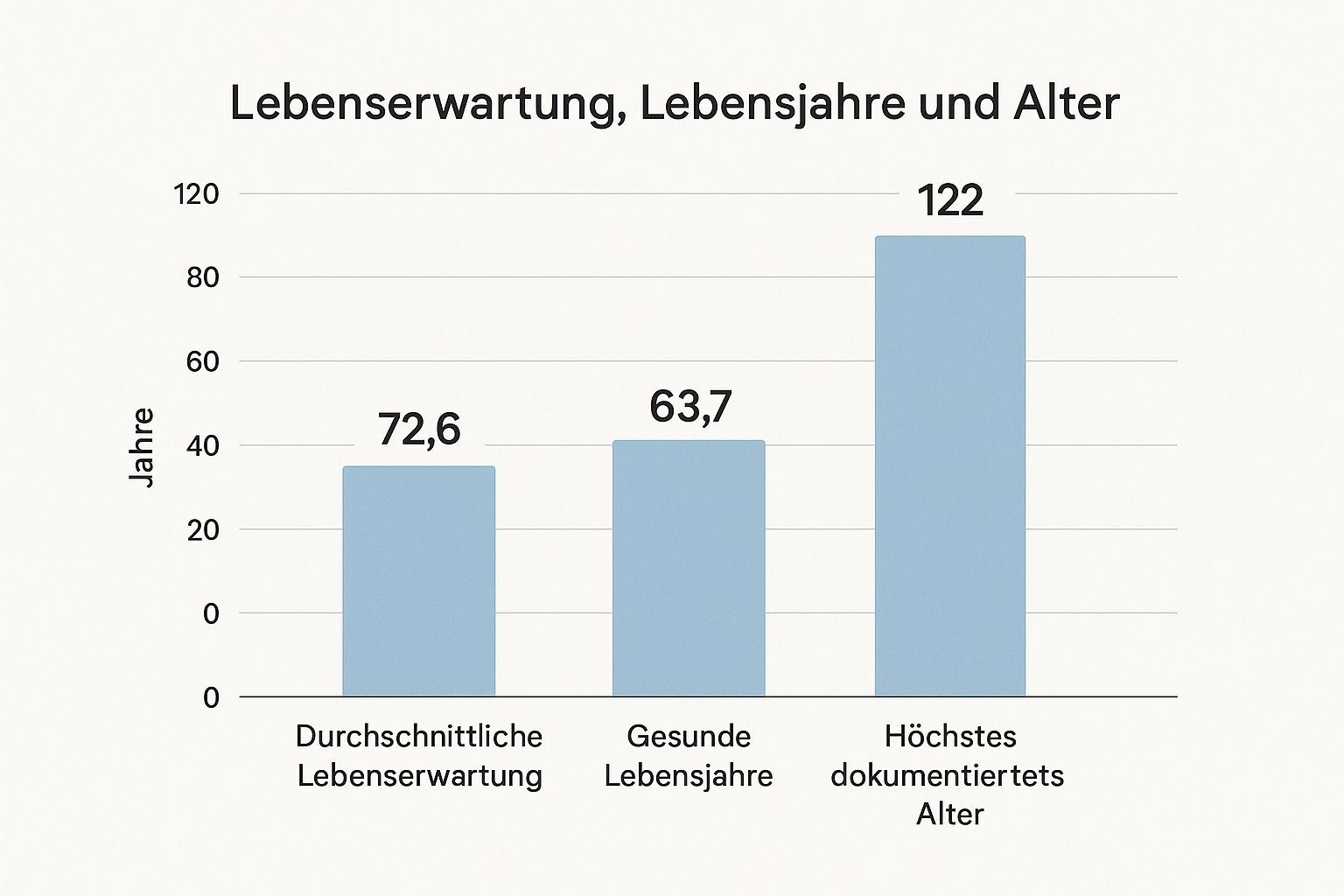
The data speaks for itself: On average, we spend almost an entire decade in a state where our health is already compromised. This is precisely the gap that Longevity aims to close.
The three pillars of your longevity
Longevity is not a product of chance. It is the result of a fascinating interplay of three fundamental areas that shape our lives day after day.
Imagine your genes as the foundation of your house – they provide a basic structure. Your lifestyle and microbiome, on the other hand, are the architects and craftsmen who design, maintain, and modify this house.
These three pillars don't operate independently, but rather constantly influence each other. A healthy lifestyle, for example, can positively influence the activity of certain genes. Conversely, a stressed gut can throw your overall well-being off balance. The true meaning of longevity lies precisely in this: understanding this complex interplay and using it to your advantage for your own health.
Your genes as a blueprint
Your DNA is the genetic blueprint you inherited from your parents. It determines certain predispositions—for example, how your body reacts to specific nutrients or how susceptible you are to certain health issues. Some people metabolize caffeine extremely quickly, while others have a genetic predisposition to higher cholesterol levels.
But here's the crucial message: Your genes are not your destiny. They may hand you the cards, but how you play them is entirely up to you.
This is precisely where epigenetics comes into play – the science of how your behavior and environment can influence the activity of your genes. A longevity DNA analysis from mybody-x provides you with valuable insights into your unique predispositions and helps you tailor your health strategy.
Your lifestyle as your most important tool
While you can't change your genes, you have complete control over your lifestyle every day. This pillar is the biggest lever and encompasses four core areas that directly influence your healthspan:
- Nutrition: What you eat provides the building blocks for every single cell in your body. A nutrient-rich, balanced diet can reduce inflammation and protect your cells. You can find out more in our comprehensive article on the right longevity diet .
- Exercise: Regular physical activity is a true fountain of youth. It strengthens your cardiovascular system, maintains your valuable muscle mass, and even keeps your cognitive abilities sharp.
- Sleep: The truly important repair and regeneration processes take place during sleep. Good sleep is absolutely essential for a stable hormonal balance and mental clarity.
- Stress management: Chronic stress leads to the release of hormones like cortisol, which can cause massive cell damage in the long run. Techniques such as meditation, breathing exercises, or simply spending time in nature are incredibly powerful tools to counteract this.
Every decision – from your choice of lunch to your evening routine – is a direct investment in your future health. Your lifestyle is the key to making the most of your genetic potential.
The microbiome: your invisible partner
The third, often underestimated pillar is your gut microbiome – a fascinating community of trillions of microorganisms that populate your digestive tract. For a long time they were ridiculed, but today we know: these tiny helpers play a huge role in your health.
They not only support your digestion, but also produce vital vitamins, train your immune system, and even communicate directly with your brain via the gut-brain axis. A diverse and balanced microbiome is therefore a clear indicator of good health and a crucial factor for longevity.
Your DNA: The blueprint for your healthy life
Your genes are not your destiny. They are much more than that: a kind of personal instruction manual for your body. Have you ever wondered why some people tolerate certain foods perfectly while others don't? Or why one person is instantly recovered after exercising, while another suffers from muscle soreness for days? The answer is often deeply embedded in your DNA.
Your genetic predisposition plays a role in countless processes in your body. It determines how your metabolism works, which nutrients you particularly need, and how you react to stress or exercise. This is also why one diet works wonders for your friend but completely backfires on you.
From general advice to personal strategy
Sure, general health tips are a good start, but they often only scratch the surface. The real key to a long and, above all, healthy life lies in knowing your own needs. Imagine being able to glance at this very personal instruction manual and finally understand what your body truly needs to function at its best.
This is precisely where we come in. A Longevity DNA analysis from mybody-x is like looking under the hood of your body. Instead of groping in the dark and trying one diet after another, you get clear, scientifically sound facts about yourself.
Your DNA is like a map. It shows you where potential obstacles lie, but also which paths are particularly easy for you. With this knowledge, you can choose the best route for your health journey and reach your destination safely.
What your saliva reveals about you
A simple saliva test is all it takes to give you precise insights. For example, you'll learn how your body processes fats or carbohydrates, or whether you have a genetically determined higher need for certain vitamins. This isn't just nice extra information – it's pure gold for your health.
With this knowledge, you can finally stop following generic advice. Instead, you make informed decisions based on your unique genetic code. That's the difference between hoping and knowing.
- Nutrition in a nutshell: Find out which distribution of fats, carbohydrates and proteins is ideal for your metabolic type.
- Targeted nutrient deficiencies: Recognize if you have a predisposition to a deficiency of certain vitamins or minerals and counteract it early.
- Training that truly works: Understand which sport best suits your genetic profile to achieve your fitness goals directly.
By fully exploiting your genetic strengths and specifically supporting your weaknesses, you take control of your healthspan.
If you would like to delve even deeper into the fascinating world of genetics and its influence on your metabolism, you can learn more about DNA metabolic analysis in our article .
How your hormones control your vitality

Besides your DNA and lifestyle, there's a third, incredibly powerful force that directs your vitality and well-being every day: your hormones. Think of them as the invisible conductors in your body. They set the pace for your energy levels, your mood, your sleep, and how well you cope with stress.
This delicate orchestra of neurotransmitters is essential for optimal longevity . However, over the years, stress or an unbalanced diet can disrupt this delicate equilibrium. You might then experience this as persistent fatigue, irritability, or a feeling of simply not being as resilient as before.
The most important players in the hormone orchestra
Two hormones play a particularly central role when it comes to your perceived age and energy levels: cortisol and DHEA. They can be seen as opposing forces, and their balance is crucial for your healthspan.
- Cortisol, the stress hormone: In short-term stress, cortisol is vital for survival. It makes you alert and productive. However, chronic stress leads to permanently elevated cortisol levels, which promotes inflammation, disrupts sleep, and can noticeably accelerate the aging process.
- DHEA, the "youth hormone": DHEA is a precursor to other important hormones such as testosterone and estrogen. It acts as a natural antagonist to cortisol, strengthens stress resistance, and is closely linked to vitality and a strong immune system. The catch: DHEA production declines steadily from around the age of 25 .
An imbalance between these two hormones is often the real reason why you feel older and more exhausted than you actually are.
A balanced hormonal system is the foundation for your daily energy and resilience. If cortisol consistently dominates, your vitality suffers directly.
How to regain clarity
But you don't have to remain in the dark. A hormone test from mybody-x provides you with a precise and valuable snapshot of your internal state. Instead of just guessing at symptoms, you receive concrete data about the true state of your hormonal balance.
This analysis provides the perfect foundation for taking targeted countermeasures. The results will help you understand exactly where you need to focus your efforts: Is it a matter of stress management? Do you need more restful sleep? Or are there aspects of your diet that you should adjust?
Just as a genetic analysis shows you which diet is ideal for you, a hormone test gives you concrete indications of your current needs. For example, you might find that you should pay more attention to relaxing activities or consume certain nutrients more specifically.
By restoring your hormonal balance, you lay one of the most important foundations for more energy and a high quality of life well into old age. If you'd like to learn how genetics and nutrition interact, our article explains how a DNA test can improve your diet .
How our life expectancy has doubled in 150 years
Imagine you were born 150 years ago. Reaching the age of 80 would have been almost unimaginable back then – an absolute exception. Today, it's a tangible reality for most of us. This development is not only impressive, it shows us one thing above all: how strongly our knowledge and lifestyle influence our lifespan.
Let's take a brief trip back in time to understand this. The very first official mortality table for Germany, dating from 1871/1881, paints a bleak picture: The average life expectancy for newborn boys was a mere 35.6 years . For girls, at 38.5 years, the situation was hardly better.
Today, according to data from the Federal Statistical Office for 2022/2024, these figures have exploded to 78.5 years for men and 83.2 years for women . Our life expectancy has therefore more than doubled.
This enormous leap forward is no accident. It is the direct result of achievements that we often take for granted today.
What has given us these extra years
The reasons for this enormous increase in life expectancy are manifold, but three factors were decisive:
- Improved hygiene: Clean drinking water and functioning sewage systems were the death knell for many deadly infectious diseases.
- Better nutrition: Access to sufficient food and knowledge about important nutrients have drastically reduced deficiencies and made our bodies more resilient.
- Medical progress: vaccinations, antibiotics and modern therapies have taken the sting out of diseases that were often a death sentence in the past.
This historical shift impressively demonstrates that longevity is not a static concept . We have the ability to actively shape and extend our lifespan and healthspan.
Today we stand at a new turning point. The great leaps forward through hygiene and simple medicine have been made. Now it's about filling the years gained with the highest possible quality of life. Today we have tools like longevity DNA analysis or hormone tests that give us deeper, very personal insights into our bodies.
Instead of simply fighting illnesses when they occur, we can proactively optimize our health. The meaning of longevity thus shifts from simply extending lifespan to the targeted improvement of our healthspan. If you're curious about how others are shaping their personal journey to more healthy years, you can read more about different longevity experiences here.
Your personal roadmap to more healthy years

Knowledge is the first step, but real change only begins when you take action. The modern meaning of longevity is precisely this: taking responsibility for your own health. Instead of passively waiting, you actively shape your future.
Your journey to more healthy and vibrant years begins with one crucial point: a deep understanding of your own body. General advice is a good start, but the real key to noticeable success lies in personalized insights.
Know your starting point
Before you begin, you need to know where you stand. It's about gathering valuable data about yourself that will serve as a solid foundation for all further steps.
-
Discover your genetic potential: A longevity DNA analysis from mybody-x is like a personal map of your body. It reveals which nutritional and lifestyle strategies are most effective for you and where your individual strengths and weaknesses lie.
-
Assess your current status: Hormone tests from mybody-x provide you with a precise snapshot of your inner balance. You'll immediately see if stress or other factors are affecting your vitality and where you should focus your efforts.
With this solid data, you no longer have to guess, but can take targeted action. The combination of your genetic predisposition and your current hormone levels gives you a roadmap that is precisely tailored to you.
Your health is not a matter of chance. It is the result of conscious decisions based on an understanding of your unique body. Use the tools of modern science to actively shape your quality of life.
The core message is quite simple: Take the reins. Your goal should be not just to count the years you have, but to fill them with maximum energy and joy. Start today to build your personal health strategy on a solid foundation of knowledge and data.
You ask, we answer: Everything you need to know about longevity
Here we've compiled some of the most frequently asked questions about longevity . This will give you even more clarity for your own personal path.
Biological vs. chronological age – what is the difference?
Think of your chronological age like the number of candles on your birthday cake. It's a simple number that indicates how long you've been on this earth.
Biological age is much more interesting. It's like a quality control report for your body and cells – a true measure of how fit your systems really are.
By adopting a conscious lifestyle, you can lower your biological age so that it is significantly younger than your chronological age. This is precisely one of the central goals when we talk about longevity.
Can I really influence my genes?
You can't change your DNA itself, the pure sequence of genes. But—and this is the crucial point—you have massive control over which of your genes are even "switched on" in the first place. Welcome to the world of epigenetics!
Imagine your diet, exercise, and stress levels as light switches. They control specific genetic instructions, turning them on or off. A longevity DNA analysis from mybody-x is like the wiring diagram for your house: it shows you where your personal switches are located, so you can use them effectively.
Do I have to become extreme to live a long, healthy life?
No, absolutely not. Longevity isn't about radical diets or inhumane training plans that you can't stick to anyway.
The trick is to integrate smart and sustainable habits into your daily life. Habits based on solid scientific data and, above all, on understanding your own body. It's about consistency and smart choices, not perfection. Even small but targeted adjustments add up over the years to a tremendous gain for your healthspan.
The key lies in understanding your body and giving it exactly what it needs. It's a journey of self-responsibility that rewards you with more energy and a better quality of life.
Where should I start?
The smartest first step? Gather data. Instead of blindly guessing what might work for you, you create a solid knowledge base about yourself.
A hormone test from mybody-x provides you with a snapshot of your current state, while a longevity DNA analysis reveals your long-term genetic predispositions. Armed with this information, you can take targeted and truly effective action.
Are you ready to put your health on a solid, scientific foundation? At mybody-x you'll find in-depth analyses that help you truly understand your body and actively take control of your longevity.


Share:
L-thyroxine side effects: Important information & tips for you
When to take vitamin D – the optimal time for your health