

At-home milk protein allergy test: Understand your body’s signals
If you notice your body rebelling after a glass of milk or a creamy yogurt, you’re not alone. Often, the suspicion is that dairy products simply don’t agree with you. A milk protein allergy test can help shed light on the matter and provide you with initial concrete indications of whether the proteins in milk are actually causing your symptoms. Today, you can even take such tests conveniently at home by having your blood tested for specific antibodies. With the mybody®x blood test, you can find out what might be behind your symptoms and take charge of your well-being.
When your body overreacts to milk
Do you often feel unwell after enjoying cheese, yogurt, or a latte? Many people know the feeling, but the causes can vary widely. A true milk protein allergy is far more than just mild discomfort—it is a targeted and often severe defensive reaction by your immune system.
Think of your immune system as an overprotective bodyguard. Normally, it recognizes harmless guests such as milk proteins and lets them pass. With an allergy, however, it mistakenly sounds the alarm. It classifies these completely harmless proteins as a threat and launches a massive defensive response. This misfire triggers the production of antibodies and sets off an entire cascade of reactions that can manifest in a wide range of symptoms.
Typical symptoms of a milk protein allergy
Reactions can look very different from person to person and affect entirely different areas of your body. This often makes it tricky to correctly identify the symptoms. The most common signs include:
- Skin problems: Hives, eczema, severe itching, or sudden skin redness.
- Gastrointestinal symptoms: Abdominal pain, bloating, nausea, vomiting, or diarrhea.
- Respiratory symptoms: A runny or blocked nose, constant sneezing, or, in rarer cases, even asthma symptoms.
Cow’s milk allergy is one of the most common food allergies, especially among children. In Germany, about 2–3% of infants and toddlers are affected. The tricky part is that around half of them develop symptoms with a delay, sometimes only up to 48 hours later. This makes it extremely difficult for parents to establish any connection between the bottle of milk and the skin rash. You can find more background information about cow’s milk allergy on Wikipedia.
One thing is crucial to understand: A milk protein allergy is an immune system issue. Your body fights against the proteins in milk. Lactose intolerance, on the other hand, is purely a digestive problem. Your body simply lacks the enzyme needed to break down milk sugar (lactose).
This distinction is fundamental because it determines how to properly address your symptoms and what the next diagnostic steps should be.
Milk protein allergy vs. lactose intolerance at a glance
Many people confuse allergies and intolerances, even though they are two completely different things. The following table helps you see the key differences at a glance.
| Characteristic | Milk protein allergy | Lactose intolerance |
|---|---|---|
| Trigger | Proteins (e.g., casein, whey protein) | Milk sugar (lactose) |
| Body system | Immune system (defense response) | Digestive system (enzyme deficiency) |
| Reaction time | Immediately or delayed by up to 48 hours | Usually 30 minutes to a few hours |
| Symptoms | Skin rash, shortness of breath, gastrointestinal problems | Stomach pain, bloating, diarrhea |
| Amount required | Even tiny traces can be enough | Small amounts are often tolerated |
In short: With an allergy, your immune system overshoots the mark, while with an intolerance, your digestion is simply overwhelmed.
While small amounts of milk sugar can often still be digested without problems in the case of lactose intolerance, even a tiny drop of milk in coffee can trigger a severe reaction in the case of an allergy. If you want to learn more about how different reactions to foods manifest themselves, read our comprehensive article on food allergy testing. The first and most important step toward improvement is always knowing the exact cause of your symptoms.
Finding the right test for your symptoms
If you suspect that you react to milk protein, the jungle of testing options can be quite confusing. There are various ways to find out what is behind your symptoms. The key is to understand how the different tests work and which one makes the most sense for your specific situation. The mybody®x blood test was developed precisely for this purpose: to give you a clear and understandable insight.
The classic route often leads to a doctor, who usually performs a skin prick test. Tiny amounts of milk protein are dripped onto your skin, which is then lightly scratched. Redness or swelling indicates a possible allergic reaction. This method tests for an immediate immune response.
The difference between IgE and IgG antibodies
To understand the testing procedures, we need to briefly discuss two important players in your immune system: the IgE and IgG antibodies. Think of them as two different security teams in your body.
- IgE antibodies (the rapid response team): They are responsible for classic immediate allergies. Your body produces them when it classifies an allergen as an acute threat. The reaction usually occurs within minutes to a few hours, with symptoms such as hives, swelling, or breathing difficulties.
- IgG antibodies (the undercover investigators): These antibodies are associated with delayed reactions that often occur only hours or even days after consumption. The symptoms are usually chronic and diffuse, such as constant fatigue, headaches, or digestive problems.
This decision tree can help you make an initial assessment of whether your symptoms could indicate an intolerance.
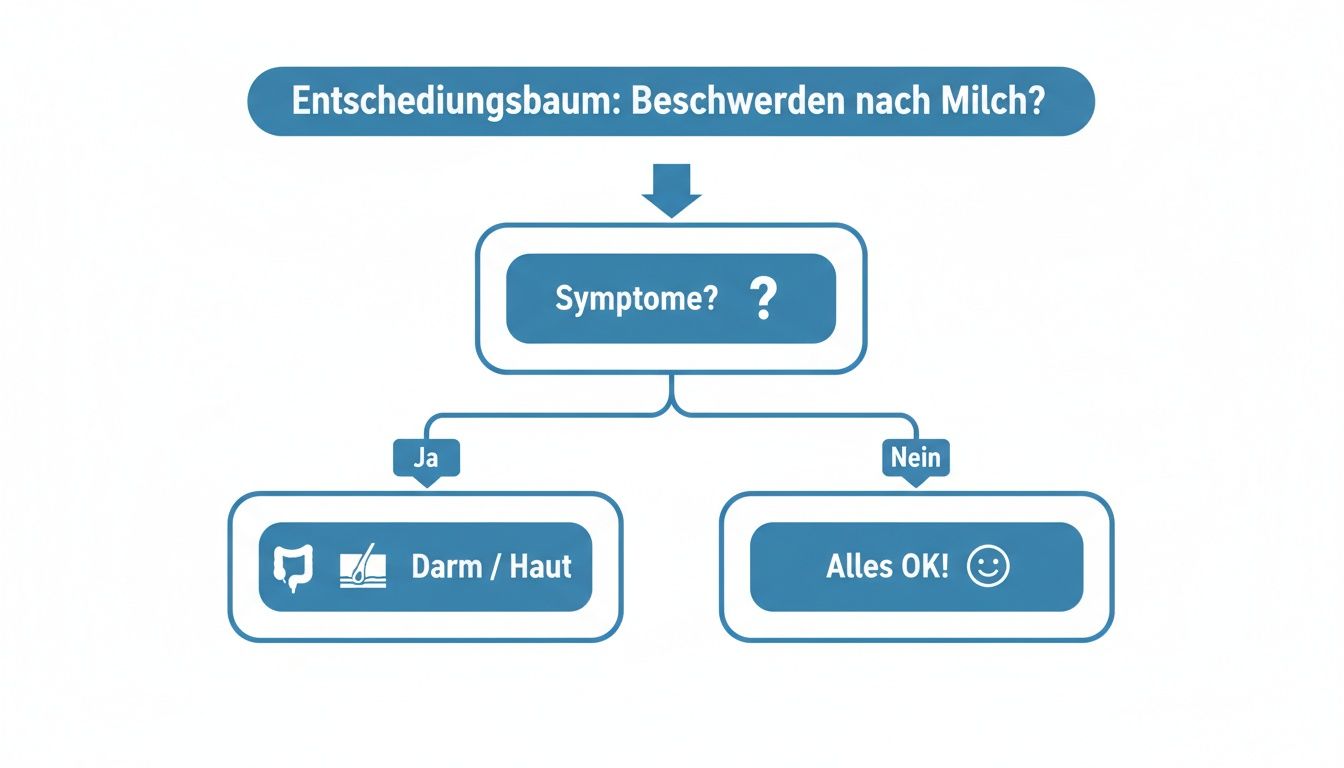
The graphic shows that recurring digestive or skin symptoms after consuming dairy products can be an important indication that you should investigate further.
When each test is useful
A blood test for specific IgE levels is often the next step when a true allergy is suspected. It measures the concentration of the “rapid response team” in your blood. Medical diagnosis in Germany often combines IgE blood tests, skin tests, and sometimes a medically supervised oral challenge, in which you deliberately consume dairy products. Learn more about the diagnostic guidelines for cow’s milk allergy on springermedizin.de.
An IgG antibody test, such as the mybody®x home test, takes a different approach. It does not focus on classic immediate allergies, but on possible triggers of delayed and chronic symptoms—in other words, the work of the “undercover investigators.”
Such a milk protein allergy test based on IgG4, such as the mybody®x intolerance test, can provide valuable information if you suffer from unexplained symptoms and suspect a connection to your diet. It is not an allergy diagnosis in the traditional sense, but a tool for identifying potential triggers of intolerance reactions. Such symptoms are often mistakenly attributed to lactose intolerance. In our article, you can learn more about how to identify and test yourself for lactose intolerance.
How the mybody®x home test works
Do you feel that dairy products could be behind your symptoms, but don’t want to wait weeks for a doctor’s appointment? A milk protein allergy test for home use is designed specifically for this purpose. It puts you back in control and enables you to find initial answers quickly and easily. The mybody®x intolerance test was developed so that you can perform it safely and easily yourself.
The entire process is designed for clarity and convenience, without requiring any medical knowledge. We have optimized every step so that you always feel confident—from ordering to receiving your result in your inbox.

Your path to clarity in three steps
The path from your first suspicion to clear certainty is easier than you might think. We guide you through the entire process with easy-to-understand instructions:
-
Order online and receive your test kit: You can conveniently order your mybody®x test kit online. Within a few days, it will arrive discreetly packaged directly in your mailbox. The kit contains everything you need to collect your sample.
-
Easy blood collection at home: The heart of the test is a tiny blood sample from your fingertip. Don’t worry, it’s far less unpleasant than it sounds. Using a small, low-pain lancet, you collect just a few drops of blood. The illustrated instructions guide you precisely through every step.
-
Send in your sample and receive your result: You then securely package your sample in the prepaid return envelope and send it to our certified German partner laboratory. There, your sample is analyzed according to the highest scientific standards. As soon as your result is ready, we will notify you by email.
A blood test at home may feel unfamiliar at first, but our system has been tried and tested thousands of times. Data security and analytical accuracy are our absolute top priorities. Your result is scientifically sound and gives you a reliable basis for all further steps.
Maximum safety and precision
We know that health matters are all about trust. That’s why we work exclusively with ISO-certified specialist laboratories in Germany. Your data is handled strictly in accordance with the requirements of the GDPR and is protected at all times. The mybody®x test therefore offers you not only convenience, but also the assurance of professional and precise analysis.
The sample collection itself is designed so that anyone can do it easily. If you still feel unsure, we have created a detailed guide to give you additional confidence. You can find all the important information on how to perform the procedure correctly in our guide Performing a blood test at home. This way, you’ll be fully prepared and can take the first important step toward greater well-being into your own hands.
What your test result really means
At last, you’re holding your report in your hands—a crucial moment on your journey toward greater well-being. But what do you do with the information now? Don’t worry, your mybody®x result is not incomprehensible technical jargon, but a clear guide. We’ll help you interpret it correctly and plan the next steps.
Your report shows how strongly your immune system reacts to certain food proteins by producing IgG4 antibodies. A high concentration of these antibodies against milk protein does not necessarily mean that you have a classic allergy. Rather, it is a strong indication that your body is actively responding to this protein, which may lead to chronic, low-level inflammatory processes and the symptoms you have observed.
From numbers to action: How to interpret your report
The result is the starting point, not the destination. Consider an elevated value an invitation from your body to take a closer look. This is not about a lifelong ban, but about finding your balance again through a conscious adjustment to your diet and discovering your own personal tolerance threshold.
A typical mybody®x report gives you a clear overview of your reaction to various foods.
The visual representation with the traffic-light system immediately clarifies where action may be needed—as here with the pronounced reaction to cow’s milk.
Your personal roadmap: the elimination diet
A positive result from an milk protein allergy test based on IgG4 is the perfect foundation for a targeted elimination diet. It sounds stricter than it is. Essentially, you avoid the foods your body reacted strongly to for a certain period of time, giving it a break.
Here’s how to put it into practice:
- Elimination phase (4–6 weeks): Consistently avoid all products containing milk or milk proteins. Read ingredient lists carefully, as milk proteins are often hidden in ready-made meals, sauces, or baked goods.
- Observation phase: During this time, keep a food diary. Record what you eat and how you feel each day. Do symptoms such as bloating, skin problems, or fatigue improve? This observation is invaluable.
- Challenge phase (reintroduction): After the elimination phase, you deliberately reintroduce milk protein. Start with a small amount, such as a spoonful of yogurt. Carefully observe how your body reacts over the next 72 hours.
- Finding your tolerance threshold: If no symptoms occur, you can gradually increase the amount. If the symptoms return, you have found your personal tolerance threshold.
The important thing is: You are the expert on your body. The test provides the scientific data, but your personal experience during the dietary change is what counts. It's about finding an eating pattern that makes you feel good and that you can maintain in the long term. Your mybody®x result is your personal compass on this journey.
From knowledge to action: Tips for your everyday life
A positive test result is the first step—now the exciting part begins: bringing this knowledge into your everyday life. The good news is that changing your diet doesn't mean giving anything up; it's an opportunity to discover new, delicious foods and enjoy them much more mindfully. It's about making smart choices and finding the right alternatives for you.
Your most important tool is a trained eye for the ingredients list. Milk protein can hide under many names, such as casein, whey powder, or lactalbumin. Over time, you'll become a real expert at uncovering these hidden dairy traps in ready-made meals, baked goods, or even processed meats.

Discover the variety of plant-based alternatives
Fortunately, supermarket shelves are now full of delicious dairy-free options. You don't have to give up anything—you can simply get creative.
- In coffee or cereal: Oat, almond, or soy drinks are fantastic alternatives. Simply try different varieties to find your favorite—some taste nuttier, while others are more neutral.
- When cooking and baking: Coconut milk gives curries a wonderfully creamy texture. Unsweetened plant-based drinks are excellent for pancakes or light sauces.
- For enjoyment: Yogurt and cheese are now available made from almonds, cashews, or soy. The selection is constantly growing and offers something for every taste.
Although the labeling of milk proteins is regulated by law, product recalls still occur because of missing declarations. Milk components can also be hidden as carriers in processed foods, increasing the risk of unintentional consumption. Learn more about the importance of allergen labeling from DAAB.
Ensure your nutrient supply
If you avoid dairy products, you may wonder how to meet your calcium requirements. Fortunately, it’s easier than many people think, because nature offers numerous powerful sources of calcium.
Calcium is essential for strong bones and teeth. But cow’s milk is far from the only source. Many plant-based foods are rich in this important mineral and provide you with plenty of it.
Just make sure to include these foods regularly in your meal plan:
- Leafy green vegetables: Kale, broccoli, and arugula are true calcium powerhouses.
- Nuts and seeds: Almonds, chia seeds, and sesame paste (tahini) provide a substantial amount.
- Legumes: Chickpeas and white beans are not only sources of protein but also of calcium.
- Fortified products: Many plant-based drinks and yogurts are additionally fortified with calcium.
- Mineral water: Take a look at the calcium content of your water—some varieties contain more than 150 mg per liter.
With a balanced, varied diet, you can ensure that your body gets everything it needs. Your milk protein allergy test is therefore the starting point for a more mindful and often even more diverse way of eating.
Frequently asked questions and answers
When it comes to health tests for use at home, many questions often come to mind. That’s completely normal—you want to make sure you’re making the right decision for yourself and your body. That’s exactly why we’ve collected the most important and frequently asked questions about the milk protein test here and provided clear, easy-to-understand answers.
Our goal is to provide you with all the information you need so that you feel well informed and confident. Let’s clear up the typical uncertainties together and see how the test can support you on your journey toward greater well-being.
How reliable is a home test like this compared with a doctor’s test?
A home test such as the one from mybody®x is a scientifically validated screening procedure. You should know: Your blood sample does not end up just anywhere; it is analyzed in a German specialist laboratory certified according to ISO standards—the same laboratories that many medical practices also work with. The test precisely measures the concentration of IgG4 antibodies against milk proteins in your blood.
Consider it a valuable first step to support a suspicion and provide you with a basis for a targeted dietary change. However, a classic type I allergy diagnosis based on IgE antibodies must be carried out by a doctor. They can perform additional procedures such as skin tests or an oral food challenge. The at-home test is therefore a useful supplement, but not a substitute for medical evaluation, especially in the case of acute or severe symptoms.
What is the difference between a milk protein test and a lactose test?
That is a very important question, because two completely different things are being examined here. The best way to think of it is as follows:
- Milk protein test (IgG4): This concerns a reaction of your immune system to the proteins in milk. Your body mistakenly classifies them as “foreign” and produces antibodies. This can lead to delayed symptoms such as skin problems, fatigue, or digestive issues.
- Lactose intolerance test: This test checks for a genetic predisposition to a digestive problem. It looks at whether your body has difficulty producing the enzyme lactase due to your genes. You need this enzyme to break down milk sugar (lactose).
In short: One test detects a possible immune reaction, while the other detects a possible enzyme deficiency. Although both can cause stomach discomfort, the underlying causes are completely different.
Do I need to change my diet before the test?
No, quite the opposite! For a truly meaningful result, it is important that you eat normally in the weeks before the test. You should therefore also consume dairy products, provided you tolerate them reasonably well. The reason is simple: Your immune system can only produce antibodies if it regularly comes into contact with the corresponding protein.
If you have completely avoided dairy products for a longer period of time, your IgG4 levels may decrease and the test may no longer provide a clear result. It is therefore best to continue eating as usual so that the test can accurately reflect your body’s current response.
This is how you ensure that the result reflects your body’s actual response and provides you with a reliable basis for your next steps.
Are you ready to take the first step and finally gain clarity about your symptoms? The at-home tests from mybody®x offer you a simple, scientifically sound way to better understand your body.
Discover your personal path to greater well-being now at mybody-x.com



Share now:
How magnesium naturally and effectively helps with menstrual cramps
At-home hormone test: what a single result tells you—and what it doesn’t