

Do a DNA analysis at home for weight loss
You want to know how a home DNA analysis works in practice: What arrives in the package, how do you collect the sample correctly, and when will the result be available?
It works in six steps: choose a test, unpack the kit, collect a saliva sample, register, send it in, and put the results into practice. One rule is crucial: do not eat, drink, smoke, brush your teeth, or chew gum for at least 30 minutes before collecting the sample. It takes around 20 to 25 working days for the report to arrive.
It’s best to read this article as a checklist alongside the test kit: first the process overview, then the step-by-step instructions, followed by the most common mistakes, data protection, and an honest assessment.
What to expect in this article
Step 1: Choose the right test
Step 2: Order and unpack the test kit
Step 3: Collect the saliva sample correctly
Step 4: Registering and sending in the sample
Step 5: Waiting for and understanding the analysis
Step 6: Turning results into everyday life
Common mistakes when collecting a sample
Data protection: What happens to the sample and data?
How to do a DNA analysis with mybody®
Putting it into perspective: What the test can—and cannot—do
Conclusion
Frequently asked questions (FAQ)
Sources
This overview shows the process with a realistic time estimate. You will be actively occupied with it for less than half an hour—the rest is shipping and laboratory time:
| Step | What you do | Time required | What matters |
|---|---|---|---|
| 1. Choose | Check the scope, laboratory, and data protection | 10–20 minutes | Know your question; don’t count markers |
| 2. Unpack | Check that the kit is complete | 2–4 working days for shipping | Store the registration code securely |
| 3. Collect sample | Saliva or cheek swab | Approx. 5 min. (+ 30 min. waiting period) | Fast, sufficient material, label it |
| 4. Send in | Register the code, return envelope | Approx. 5 minutes | Without registration, the sample cannot be assigned |
| 5. Analysis | Access the report in the online portal | Approx. 20–25 working days | Read the explanatory texts, not just the bars |
| 6. Put into practice | Derive two or three changes | Ongoing | A little sustained effort beats a lot of short-term effort |
There are four phases between ordering and receiving the report:
Order
Choose a test; the kit arrives by post within a few working days.
Collect sample
Saliva or cheek swab, while fasting, approximately five minutes.
Send in
Register online first, then send it to the laboratory in the prepaid return envelope.
Result
After approximately 20–25 working days in the secure online portal.
How does a home DNA analysis work?
A home DNA analysis takes place in six steps: choose a test, unpack the kit, collect a saliva sample, register and send it in, wait for the analysis, and put the results into practice. You need neither a doctor’s appointment nor a blood draw.
The technical core is unremarkable: Cells from the oral mucosa float in your saliva. The laboratory extracts DNA from their cell nuclei and reads selected genetic variants.
According to Abraham and colleagues (2012, BMC Medical Genomics), saliva samples are a viable alternative to blood samples as a DNA source for genotyping. The saliva sample is therefore not a compromise in quality, but a practical simplification.
Key point: The quality of your result is determined almost entirely during the five minutes of sample collection. Everything before and after that is selection and logistics.
This article explains the process. The assessment of the methods is provided in Losing weight with DNA, and the biology is covered in DNA, hunger, and weight.
What you need for at-home DNA analysis
What you need
- ✓ The complete test kit – tube or swab, instructions, code, return envelope
- ✓ 30-minute abstinence period – no eating, drinking, smoking, brushing your teeth, or chewing gum
- ✓ Five uninterrupted minutes – preferably in the morning before breakfast
- ✓ A ballpoint pen – for your name and collection date
- ✓ Internet access – for online registration
- ✓ A mailbox within reach – the sample is sent out the same day
- ✓ Five minutes for the fine print – the privacy policy
What you don't need: fasting overnight, a referral, or prior medical knowledge.
Step 1: Choose the right test
Choose the test based on the question you want answered—not the number of genetic variations. More markers are of no use if the additional chapters do not relate to your goal.
What specific goal are you pursuing?
If your goal is “losing weight,” you need chapters on carbohydrate and fat metabolism, satiety behavior, tendency to regain weight, and response to exercise—not necessarily an analysis of caffeine metabolism or endurance potential.
Where and how is the analysis performed?
Reputable providers name the laboratory, location, and certification. The ISO/IEC 27001 standard is relevant because it concerns information security—that is, how your data is handled. If there is no information about the laboratory at all, that's a warning sign. You can find out how long the sample and raw data are stored in the Privacy chapter.
What does the result look like?
A report you don't understand won't help you. Look for clear explanations for each genetic variant and specific recommendations for action; reputable providers show sample pages in advance. Allow around 20 to 25 working days from receipt of the sample.
Step 2: Order and unpack the test kit
The test kit arrives as a regular postal package—discreetly packaged, with no refrigeration. Unpack it right away and check the contents before opening anything.
What’s included in the test kit
- ✓ Collection kit – saliva tube with funnel or sterile cotton swabs
- ✓ Stabilizing fluid – keeps the DNA stable during transport
- ✓ Illustrated instructions – take precedence over all general guides, including this one
- ✓ Registration code – as a card or barcode
- ✓ Label for filling in – for your name and collection date
- ✓ Prepaid return envelope – for sending it to the laboratory
- ✓ Consent and privacy information – required
If anything is missing, contact the provider before collecting the sample. A return envelope can be sent later—a sample that has been sitting for days cannot be salvaged.
Keep the registration code somewhere you can find it again. It is the only key that will later connect your pseudonymized sample to your account. Store the unopened kit in a dry place at room temperature until collection.
Step 3: Collect the saliva sample correctly
Sample collection is the only step where you can make a mistake. Set aside five quiet minutes and follow the instructions in the kit exactly.
Key point: For at least 30 minutes before providing the saliva sample, do not eat, drink, smoke, brush your teeth, or chew gum. This is the single most important rule in the entire guide.
The 30-minute waiting period and why it matters
Food remnants, drinks, toothpaste, and smoke introduce foreign substances and foreign DNA into your mouth. Both can interfere with the analysis—and food remnants additionally dilute the proportion of your own oral mucosal cells.
The easiest time to collect the sample is in the morning, immediately after getting up, before coffee, breakfast, and brushing your teeth. That way, the required waiting period is automatically met.
Variant A: Saliva tube with funnel
With the tube method, spit through the attached funnel until the fill line is reached—it takes two to five minutes. The fill level is what matters, not the foam: Let the tube stand briefly and add more once the foam has settled. Then remove the funnel, screw the lid on tightly—this releases the stabilizing fluid in many systems—and gently swirl.
Variant B: Cheek swab with a swab
For a cheek swab, rub it firmly and rotate it along the inside of your cheek for at least 30 seconds. The goal is not saliva, but to dislodge cells from the oral mucous membrane. Do not touch the swab tip with your fingers; if two swabs are included, use one for each side of your mouth.
Labeling and closing the tube
Label the tube immediately with your name and the collection date, even if a barcode is attached—when several people in the household are being tested, this is the only safeguard against mix-ups. Finally, check that the lid is tightly closed: A leaked sample will arrive at the laboratory unusable.
Step 4: Registering and sending in the sample
Registration links your sample to your analysis account. Without this step, the laboratory has an anonymous tube that no one can assign to you. You will usually find the registration code on the inside of the lid or on an enclosed card; enter it in the online portal before sending the package.
Registration: what to look out for
Enter your date of birth and sex correctly when asked—some analyses use these for reference values. Photograph the code before sending the package back: If the shipment is lost, it is your only proof.
Returning the sample: preferably the same day
The kit usually includes a prepaid return envelope. Ideally, mail it on the day you collect the sample, or by the following day at the latest—until then, keep the package at room temperature, not in the car.
Step 5: Waiting for and understanding the analysis
For DNA metabolism tests, it usually takes around 20 to 25 business days between sending in the sample and receiving the result. During this time, the sample is processed in the laboratory, the DNA is isolated, and the gene variants being tested are read. The result then appears in the online portal, usually also as a PDF report.
Key message: A DNA report describes genetic predispositions—not measurements. It does not say how your metabolism is working today, but what starting point you bring with you.
How a report is structured
Most reports are divided into chapters such as energy metabolism, nutrient utilization, sports, and satiety. Each analysis identifies the gene variant, your result, and an interpretation.
Read the report all the way through once before changing anything—the overall impression is more meaningful than individual findings.
Step 6: Turning the results into everyday life
The real benefit only comes at this point: A report that sits unread in the portal changes nothing. Pick two or three points that fit your everyday life and put them into practice for at least eight weeks. Trying to change more at once almost always leads to giving up in practice.
What you can specifically derive
You can adjust the composition of your meals based on indications of nutrient metabolism, and your type of training based on indications related to exercise behavior—these are levers, not rules. Keep track of what you changed and check after two months whether your weight, energy levels, or sense of hunger has changed.
An unfavorable genetic variant is not a verdict, and a favorable one is not a free pass: genetic effects on body weight are small when considered individually and are outweighed by diet, exercise, and sleep.
Common mistakes when collecting a sample
Almost all unsuccessful submissions are due to the same five recurring causes. Knowing them helps you avoid weeks of delay caused by a request for a replacement sample.
Mistake 1: Too little sample material
The most common reason for an unusable sample is a tube that is not filled enough. Foam does not count toward the volume—the liquid below the marking is what matters.
Mistake 2: Contaminated sample
Food residue, toothpaste, coffee, or smoke introduce foreign DNA and interfering substances. The 30-minute abstinence period is therefore not a formality but the single most important factor in sample quality.
Mistake 3: Failure to register
An unregistered sample cannot be assigned to an account in the laboratory. It remains there until someone gets in touch.
Mistake 4: Sending it in too late
Stabilization solutions keep DNA stable for a long time, but the clock starts ticking when the sample is collected. A sample left in a drawer for two weeks produces poorer results.
Mistake 5: Heat in summer
A mailbox in the midday sun can reach temperatures at which DNA breaks down more quickly. In midsummer, it is therefore better to mail your sample in the morning.
Key message: Abstinence, sufficient material, and prompt return shipping—together, they take less than ten minutes of effort.
Data protection: What happens to your sample and data
With a DNA test, you hand over the most personal category of data there is. That is why how your sample and data are handled is the most important selection criterion—more important than the price or the number of analyses.
Under Article 9 of the EU General Data Protection Regulation (GDPR, 2016), genetic data are considered a special category of personal data. Their processing is permitted only with explicit consent or under a statutory exception. An provider must therefore tell you in advance who performs the analysis, where the laboratory is located, how long the data will be stored, and whether they will be shared.
The German legal framework: Genetic Diagnostics Act
In Germany, the Genetic Diagnostics Act (GenDG) regulates genetic examinations for medical purposes and requires a medical referral, written consent, and the right not to know. Metabolism and nutrition tests are deliberately not medical examinations in this sense—they do not diagnose or predict illness. Therefore, the GDPR remains the decisive standard.
Pseudonymization in the laboratory
Reputable providers separate the sample from the individual's identity. The laboratory receives only a barcoded tube; the link to your name is kept separately in the ordering system. That is why you enter a code during registration instead of writing your name on the sample.
Deletion and destruction of the sample
What matters is what happens after the analysis. According to the provider, mybody® (MYBODY Lab GmbH) destroys the saliva sample and DNA sequence two months after the analysis. You should review these six points in the privacy policy before ordering.
Data protection checklist before ordering
- ✓ Where is the analysis performed—in the EU or in a third country?
- ✓ Is the sample processed pseudonymously?
- ✓ When are the sample and DNA data destroyed?
- ✓ Is data shared with third parties or used for research?
- ✓ How can you withdraw your consent and request deletion?
- ✓ Is transmission in the customer account encrypted?
According to the Federal Commissioner for Data Protection and Freedom of Information (BfDI), health data is among the most strictly protected information. You have the right to access, correct, and delete your data at any time.
Key message: Check data protection before ordering, not afterward. Once a DNA sample has been analyzed, it cannot be retrieved retroactively.
What this looks like specifically at mybody®
The steps described above apply to every reputable provider. mybody® (MYBODY Lab GmbH) analyzes samples in an ISO 27001-certified laboratory, transmits data using SSL encryption, and processes samples pseudonymously. For weight loss, the WeightLoss | The SLIM DNA test is the right place to start.
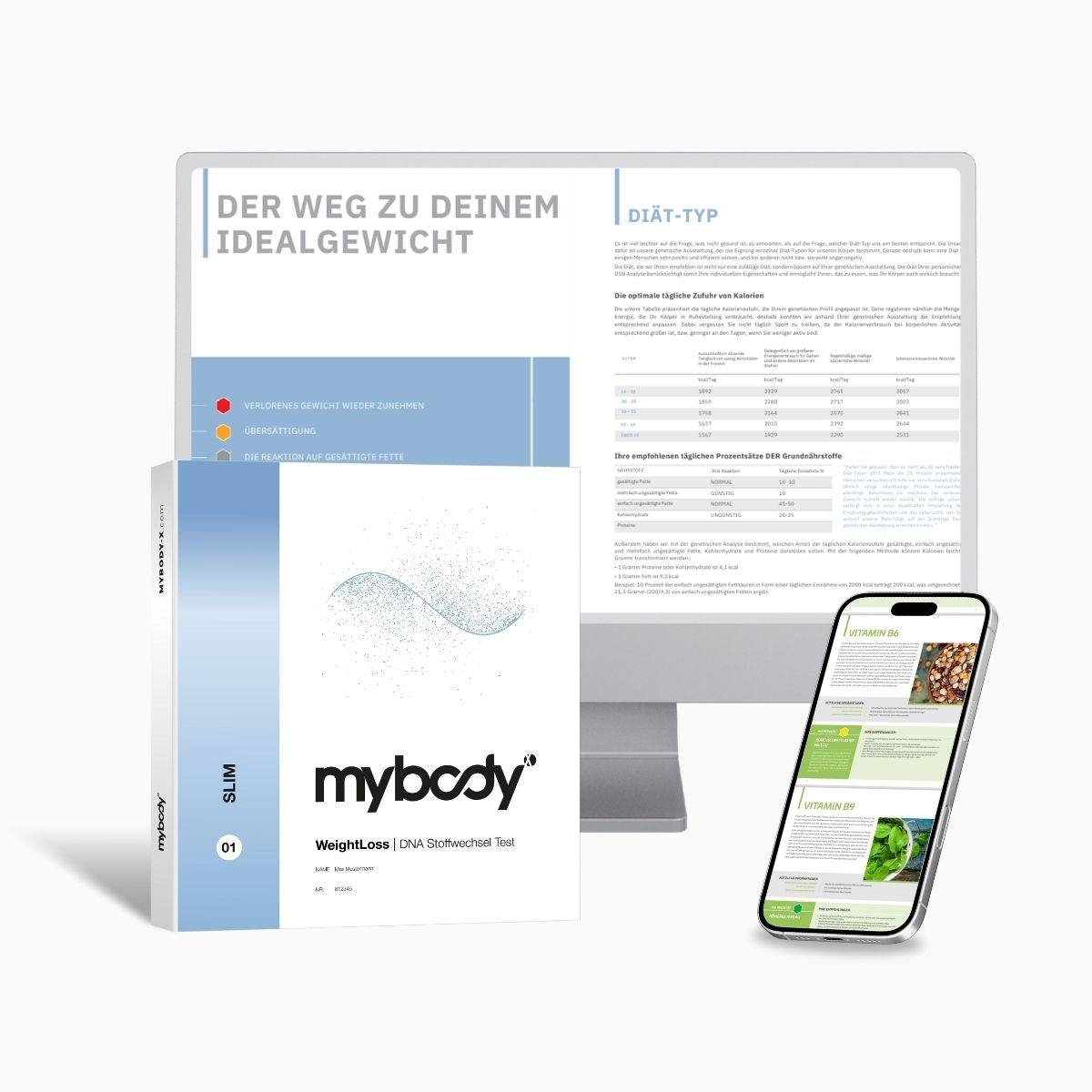
WeightLoss | SLIM DNA test
DNA metabolism analysis from a saliva sample collected at home: more than 80 genetic variations, evaluated in 24 analyses across 5 chapters spanning around 140 pages. Among other things, the report assesses energy metabolism, nutrient utilization, and sports behavior.
Price: €169.00 · Sample type: Saliva (at home) · Processing time: approx. 20–25 business days · Laboratory: ISO 27001 certified, GDPR compliant
View the DNA testYou can find more comprehensive variants in the DNA metabolism test collection and on the healthy weight loss topic page.
Information about the price, sample type, processing time, and scope comes from the mybody® product page (as of July 2026) and may change. A DNA test does not replace a medical diagnosis.
Putting it into perspective: What the test can—and cannot—do
A DNA metabolism test provides a structured description of your genetic starting point. It can explain why certain strategies have worked better for you than others in the past.
What it cannot do: diagnose a condition. It does not predict illness, replace medical evaluation, or forecast weight-loss success. Above all, it does not override the energy balance—according to the Institute for Quality and Efficiency in Health Care (IQWiG), weight loss occurs regardless of the dietary approach through a sustained energy deficit.
The benefit therefore lies not in prediction, but in fit: a plan that suits your predisposition and everyday life is more likely to be followed over the long term. If you are severely overweight, have pre-existing conditions, or take medication, planning should be handled by a doctor.
Conclusion
A home DNA analysis consists of four phases: ordering, collecting the sample, sending it in, and reading the results. The active effort takes around ten minutes; the waiting time is 20 to 25 business days.
Quality is determined by a single moment: collecting the sample. Don’t eat, drink, smoke, or brush your teeth for at least 30 minutes beforehand—and provide enough material and return it promptly.
Data privacy is just as important: Find out in advance where the analysis is carried out and when the sample and data are deleted. And keep in mind that the report is a guide—the implementation happens in the kitchen, not in the laboratory.
Frequently asked questions (FAQ)
Try the process yourself
The WeightLoss | The SLIM DNA Test analyzes more than 80 genetic variants in 24 reports—a saliva sample collected at home, with ISO 27001-certified and GDPR-compliant analysis. It does not replace a medical diagnosis.
View the SLIM DNA Test All DNA metabolism testsYou might also be interested in this
→ Losing weight with DNA: what the method can do
The evidence on gene-based nutrition plans—considered objectively.
→ DNA, hunger, and weight: the biology behind them
How genetic variants influence appetite, satiety, and fat storage.
→ Healthy weight loss: the basics
Energy balance, protein, and everyday practicality instead of short-term diets.
Sources
- Abraham, J. E. et al. (2012): “Saliva samples are a viable alternative to blood samples as a source of DNA for high throughput genotyping” (BMC Medical Genomics 5:19). pubmed.ncbi.nlm.nih.gov
- Genetic Diagnostics Act (GenDG): Act on Genetic Testing in Humans – requirement for physician involvement, consent, and the right not to know. gesetze-im-internet.de
- Regulation (EU) 2016/679 (GDPR), particularly Article 9 – genetic data as a special category of personal data. eur-lex.europa.eu
- Federal Commissioner for Data Protection and Freedom of Information (BfDI): Data protection in the areas of health and social services. bfdi.bund.de
- ISO/IEC 27001:2022 – Standard for information security management systems. iso.org
- IQWiG / gesundheitsinformation.de: “Programs and medications for weight loss” – energy deficit and the effectiveness of weight-loss strategies. gesundheitsinformation.de
- German Nutrition Society (DGE): “Eat and drink well – the DGE recommendations.” dge.de
The suitability of saliva as a source of DNA is supported by [1], the legal framework by [2] to [4], and the certification by [5]; energy balance and nutritional fundamentals are based on [6] and [7]. Product information from mybody® (MYBODY Lab GmbH) is sourced from mybody-x.com (as of July 2026).

mybody® Editorial & Expert Team
This post was created by the mybody® editorial and expert team, which brings together expertise in nutrigenetics, DNA analysis, nutritional science, and data protection. Learn more about our team on our editorial and authors page.
Published on July 27, 2026 · Last updated on July 27, 2026
Medical notice: This post is intended for general information and does not replace medical advice, diagnosis, or treatment. A DNA metabolism test is not a medical diagnostic test: it does not diagnose or predict diseases and does not replace laboratory testing. If you are severely overweight, have pre-existing conditions, take medication, or have persistent symptoms, please consult a doctor.




Share now:
Losing weight with DNA: How well does the method really work?
Carbohydrates: Are they good or bad for you?