

Cortisol Deficiency Symptoms in Women: How to Recognize the Signs Early
Do you often feel inexplicably exhausted, listless, and burned out even though you actually get enough sleep? These could be more than just the usual symptoms of cortisol deficiency in women. The signs range from extreme fatigue and muscle weakness to dizziness, low blood pressure, and even menstrual irregularities. The tricky part is that these symptoms are often so nonspecific that we quickly dismiss them as normal everyday stress.
Always Tired? What’s Behind Cortisol Deficiency in Women

Think of cortisol as your body’s battery. This vital hormone, produced in the adrenal glands, is your personal energy manager. It wakes you up in the morning, helps you cope with stress, regulates your blood pressure and blood sugar, and keeps inflammation under control. A healthy cortisol level ensures that you stay fit and focused throughout the day.
But when this “battery” runs low, your entire system starts to falter. The result is often profound exhaustion that cannot simply be slept off. It feels as if you are going through life with the handbrake permanently on.
Take the First Warning Signs Seriously
Cortisol deficiency rarely develops overnight. In most cases, the symptoms gradually appear and are so varied that they are easily misinterpreted. At first, you may notice only that you recover much more slowly after exercising or that even minor stressful moments completely throw you off balance.
Cortisol deficiency is more than just fatigue. It affects your metabolism, immune system, and psychological resilience. Ignoring your body’s signals can lead to serious health problems in the long term.
Especially in women, the symptoms of cortisol deficiency are often more complex. Many report a strong feeling of weakness, loss of appetite, and unexplained weight loss. Muscle weakness, low blood pressure, and dizziness are also common.
Particularly alarming: Studies show that chronic stress can lead to a relative cortisol deficiency in 20 to 25 percent of those affected. Especially in women, menstrual irregularities and reduced libido can also become noticeable as clear signs. You can find out more, for example, at helios-gesundheit.de.
Why It’s Important to Take a Closer Look
Because the symptoms are so nonspecific, it is all the more important to pay attention. Instead of accepting constant exhaustion as “normal,” you should get to the bottom of the cause. A cortisol deficiency can point to deeper underlying problems that require targeted diagnostic testing. A mybody-x hormone test can provide you with some important initial clues.
A few questions can give you some initial clues:
- Energy level: Do you already feel exhausted first thing in the morning, right after waking up?
- Stress resilience: Do little things upset you more quickly than they used to?
- Physical condition: Are you suffering from unexplained weight loss, low blood pressure, or a constant craving for salty foods?
If you recognize yourself here, it may be worth taking a closer look at your hormone balance. In our article, you can learn more about the different causes of chronic fatigue.
Tracing the roots of the problem
A cortisol deficiency rarely appears out of nowhere. It is usually the result of a gradual process in which the body's stress axis slowly gets out of sync. To truly understand the symptoms of cortisol deficiency in women, we need to dig deeper—because the causes often lie in the hormonal control system of our bodies.
In general, medicine distinguishes between two main forms that can cause cortisol production to stall. Simply imagine your adrenal glands as small, highly specialized factories that produce cortisol on command. In primary adrenal insufficiency, also known as Addison's disease, the problem lies directly in the factory itself: The adrenal glands are damaged and can no longer produce enough, no matter how loudly the instructions are given.
When the executive office in the brain falls silent
Secondary adrenal insufficiency is a completely different story. Here, the factory—the adrenal gland—is actually in great shape. The problem lies one level higher, in the executive office—the brain. More precisely, the pituitary gland no longer sends enough instructions in the form of the regulatory hormone ACTH. Without this instruction, the adrenal glands slow down their work. This form is actually more common than the primary form.
By far the most common cause of primary adrenal insufficiency is an autoimmune disease. The immune system goes haywire and mistakenly attacks the body's own adrenal tissue. In 80 to 90 percent of cases of Addison's disease, this kind of attack by the body itself is behind it.
But there are other contributing factors as well. Persistent, chronic stress can effectively drain the adrenal glands. Long-term use of certain medications, especially high-dose cortisone, can also shut down the body's own production. If you want to explore the role of the stress hormone in greater depth, our article explains what cortisol actually is.
The often-overlooked congenital adrenal hyperplasia (CAH)
Cortisol deficiency requires particular vigilance in women, as it may indicate congenital adrenal hyperplasia (CAH). This is a congenital metabolic disorder in which an enzyme defect impairs cortisol production in the adrenal glands from birth.
Although severe forms do exist, the milder “late-onset” variant often remains undetected for a long time and only becomes apparent during puberty or adulthood. The tricky part is that symptoms such as menstrual irregularities, acne, or increased body hair are often mistakenly attributed to polycystic ovary syndrome.
Late-onset CAH is anything but rare: It is estimated that around one in 200 to 1,000 girls and women in Germany is affected. In over 90 percent of these cases, the enzyme 21-hydroxylase, which is essential for cortisol production, is missing. The symptoms can severely impair quality of life, but the greatest challenge is that an estimated 90 percent of cases go unnoticed because the signs are so nonspecific. You can find more information about these connections in the findings of the German Society of Endocrinology, which are available here.
As you can see, the possible causes are varied. A purely symptom-based self-diagnosis is therefore almost impossible and not advisable either. Only targeted diagnostic testing can truly shed light on the situation. A hormone test from mybody-x can be an important first step in providing valuable insights into your cortisol levels.
Interpreting symptoms correctly and distinguishing between alternatives
Do you constantly feel tired, struggle with your weight, and simply lack motivation? The tricky part is that many symptoms of cortisol deficiency in women are unfortunately anything but clear-cut. Your body sends signals that could also point to entirely different health issues. Self-diagnosis is therefore not only difficult, but can quickly lead you down the completely wrong path.
That is precisely why it is so important to understand which other conditions can cause very similar symptoms. Think of these “look-alikes” as tracks in the sand: At first glance, they may look the same, but they come from completely different animals. Only those who look closely can recognize the small but crucial differences.
The most common look-alikes of cortisol deficiency
If you notice typical symptoms of cortisol deficiency, it is wise to also consider other possible causes. Carefully distinguishing between them is the key to finally finding the right solution for your symptoms.
The most common conditions with overlapping symptoms include:
- Underactive thyroid (hypothyroidism): Extreme fatigue, weight gain, constantly feeling cold, and lack of energy are classic symptoms. Since the thyroid and adrenal glands work closely together within the hormonal system, disorders affecting them can look remarkably similar.
- Iron deficiency: Persistent fatigue, pale skin, difficulty concentrating, and shortness of breath during exertion can indicate either cortisol deficiency or iron deficiency. Women in particular are more frequently affected because of menstruation.
- Chronic fatigue syndrome (CFS): This complex condition is characterized by debilitating fatigue lasting for months that does not improve even with rest. The symptoms overlap significantly with those of adrenal insufficiency.
It is crucial to understand that your body is an interconnected system. A symptom such as fatigue can have countless causes. Taking a comprehensive look at your blood values, as enabled by a hormone or nutrient test from mybody-x, helps put the puzzle together.
If you would like to learn more about which blood values can provide insights into fatigue, you will find detailed information in our guide.
A special focus on PCOS
Another important differential diagnosis that specifically affects women is polycystic ovary syndrome (PCOS). This hormonal disorder causes symptoms such as weight gain or excessive hair growth, which can easily be confused with those of cortisol deficiency.
PCOS is anything but rare. In Germany, about five to ten percent of women of childbearing age are affected—around one million women. Although the primary cause here is an excess of male hormones (androgens), the symptoms can strongly resemble those of cortisol deficiency. Affected women often also suffer from metabolic problems such as type 2 diabetes, elevated blood lipid levels, and high blood pressure.
The psychological burden caused by visible symptoms such as excessive body hair, obesity, and the infertility often associated with them severely limits self-esteem and quality of life. You can learn more about these complex connections in the female hormonal system, as discussed, for example, by the Professional Association of German Nuclear Medicine Physicians.
These examples make it clear how crucial precise diagnostics are. A simple hormone test from mybody-x, which you can conveniently perform at home, can provide valuable initial clues. It helps you weigh different possible causes against one another and prepare thoroughly for a conversation with your doctor.
How low cortisol is reliably tested
Do you recognize yourself in these symptoms and wonder whether low cortisol could be behind your constant exhaustion? That is a very important first step. But a feeling alone is not a diagnosis—a targeted test is the only way to finally get clarity and show you in black and white what is really going on in your body.
The path to clarity is a bit like detective work, where different clues have to be pieced together. Your body has an internal clock, and the hormone cortisol follows this rhythm precisely. That is why choosing the right time for the test is the absolute key to getting a result you can rely on.
Why the morning moment determines everything
Think of your cortisol level as a wave in the sea. It builds up overnight and reaches its highest point in the early morning, directly after waking. Experts call this the cortisol awakening response. This morning peak is essentially your natural kickstarter, giving you the energy you need for the day. Over the course of the day, the wave gradually ebbs and reaches its lowest point around midnight—so you can wind down and sleep.
A meaningful cortisol test must capture this exact morning peak. A measurement in the afternoon would paint a completely inaccurate picture because levels are naturally much lower by then. Ideally, the measurement should be taken immediately after waking, around 6 to 9 a.m..
This natural rhythm also explains why, when you have low cortisol, you feel so sluggish and exhausted, especially in the morning. Your body is missing the crucial “starting signal” in the form of a strong cortisol surge. This is a classic sign of weakened adrenal function.
More than just one value: the diagnostic puzzle
A single cortisol value is a strong indication, but for a truly comprehensive diagnosis, doctors often examine a whole set of values. These help identify the exact cause of cortisol deficiency symptoms in a woman and rule out other possible problems.
Important laboratory values that are often checked alongside cortisol include:
- ACTH (adrenocorticotropic hormone): This is the regulatory hormone sent from the brain to the adrenal glands. If ACTH is high but cortisol is low, the problem is probably directly in the adrenal glands (primary insufficiency). If both levels are low, the cause is more likely in the brain (secondary insufficiency).
- DHEA-S: This hormone is also produced in the adrenal glands and is an important precursor to our sex hormones. Low DHEA levels can explain additional symptoms such as loss of libido or depressed moods.
- Sodium and potassium: Cortisol also plays a role in regulating your mineral balance. A deficiency can lead to low sodium and high potassium—which also explains the typical craving for salty foods.
The following graphic illustrates how complex the causes of fatigue can be. It shows why a test is so crucial for clearly distinguishing cortisol deficiency from other causes such as thyroid problems or PCOS.
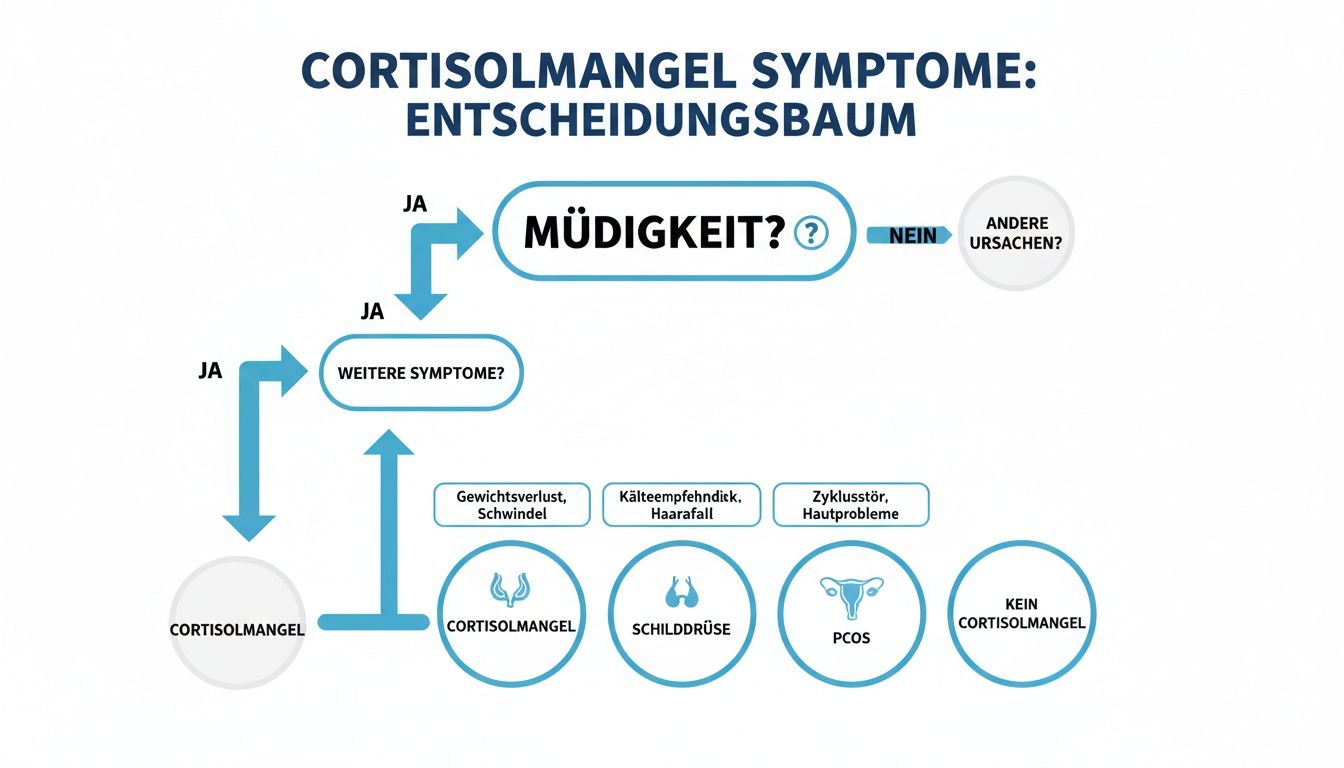
As you can see, fatigue is a central piece of the puzzle, but it can point in very different directions. This underscores how important accurate diagnostics are.
Your first step toward greater clarity: a test for home use
The thought of crowded waiting rooms and blood draws can cause additional stress—and stress is the last thing you need right now. This is exactly where a mybody-x self-test can provide an incredibly valuable initial orientation. Of course, it does not replace a medical diagnosis, but it is a powerful tool for supporting your suspicion and taking matters into your own hands.
With the mybody-x hormone test, you can measure your cortisol and DHEA levels comfortably at home. You simply collect the sample painlessly using saliva and then send it to the laboratory. This gives you an initial but extremely valuable indication of your hormone status.
Such a test helps you regain control and prepare perfectly for a conversation with your doctor. With a specific result in hand, you can describe your symptoms much more precisely and discuss the next steps together. If you would like to learn more about how easily you can measure your cortisol levels at home, you’ll find all the important information here.
Practical strategies for everyday life with cortisol deficiency

A diagnosis of cortisol deficiency can initially throw you off balance. But above all, it is the starting point on your journey back to greater energy and enjoyment of life. Now you have the opportunity to specifically support your body and actively address the symptoms of cortisol deficiency in women. With the right combination of medical treatment and smart everyday strategies, you can noticeably improve your well-being.
This section is intended to serve as a practical guide and show you how to optimally combine medical support with a mindful lifestyle.
Medical treatment – the foundation for your stability
When a doctor diagnoses adrenal insufficiency, hormone replacement therapy is usually unavoidable. The missing cortisol is replaced with medication, typically hydrocortisone tablets. The aim is to imitate the hormone’s natural rhythm throughout the day as closely as possible.
The right dosage is essential. It is tailored individually to you and may fluctuate depending on your stress level, physical exertion, or if you have an infection. Close coordination with your doctor is therefore essential for successful treatment.
Don’t think of hormone replacement therapy as a short-term fix, but as long-term support for your body. It creates the stable foundation on which you can build with further lifestyle changes.
Your lifestyle – your strongest tool
In addition to medical treatment, you have it in your own hands to ease the strain on your adrenal glands and conserve your energy reserves. Your lifestyle is your most powerful tool for bringing your body back into balance. It’s not about strict prohibitions, but about making small yet consistent adjustments in your daily life.
You can think of it this way: Hormone therapy charges your battery to a baseline level. Your daily habits then determine how efficiently you use this energy and how quickly the battery runs out again.
Stress management as a shield for the adrenal glands
Chronic stress is one of the biggest drains on your adrenal glands’ energy. Targeted stress management is therefore not a nice optional extra, but a central component of your strategy.
Here are some proven methods that you can easily integrate into your everyday life:
- Mindfulness and meditation: Even a few minutes a day can work wonders and calm your nervous system. Apps like Calm or Headspace offer guided meditations that are also ideal for beginners.
- Gentle exercise: Instead of completely exhausting yourself during workouts, focus on restorative activities. Yoga, tai chi, or simple walks in nature have been shown to lower cortisol levels.
- Mindful breaks: Schedule regular, short breaks throughout the day. Simply look away from the screen for a moment and take a deep breath—this already helps reduce the biggest spikes of stress.
Nutrition that nourishes your adrenal glands
What ends up on your plate has a direct impact on your hormones and energy levels. A nutrient-rich diet can strengthen your adrenal glands and alleviate cortisol deficiency symptoms in women.
Pay attention to these cornerstones of an adrenal-friendly diet:
- Stable blood sugar: Avoid sugar and “fast” carbohydrates that cause your blood sugar to spike. Instead, choose complex carbohydrates from whole-grain products, legumes, and vegetables. Ideally, combine them with protein and healthy fats at every meal.
- Important nutrients: Your adrenal glands need certain vitamins and minerals to function properly. Particularly important are vitamin C (in bell peppers and broccoli), B vitamins (in nuts and whole grains), magnesium (in leafy green vegetables and pumpkin seeds), and zinc (in oats).
- Regular meals: Don’t skip meals! Eating regularly keeps your blood sugar level stable and prevents your body from having to release additional cortisol to make energy available.
By putting these practical tips into practice, you are actively taking control of your well-being. This creates the best conditions for a life with more energy and balance.
Your next step toward greater well-being
Now you know quite a lot about the symptoms of cortisol deficiency in women—from the first subtle signs and the causes to diagnosis. Knowledge is power, but putting it into practice is what brings about change. Consider this section your personal guide back to greater energy and joy in life.
Listen to your body. Constant fatigue, lack of motivation, or the feeling that you simply can’t go on are not normal conditions you have to accept. These are important signals that deserve to be heard. The path to improvement begins right here: by taking responsibility for your health into your own hands.
Take control with the mybody-x hormone test
The thought of doctor’s appointments and complicated examinations can quickly become overwhelming. But the first step toward greater clarity doesn’t have to be complicated. That’s exactly why we developed the mybody-x hormone test—a simple and discreet way to gain an initial yet crucial insight into your hormone balance from the comfort of your home.
Imagine being able to get an initial indication of your cortisol and DHEA levels with a simple saliva sample, taken comfortably in the morning. No stress, no waiting room. That’s exactly what this test makes possible. It is your tool for turning a vague feeling into tangible information you can use to take the next step.
The test is designed to fit seamlessly into your everyday life. After taking the sample easily, you send everything to our certified specialist laboratory in Germany. Shortly afterward, you receive an easy-to-understand report showing you where you stand.
This report is more than just a number. It is the perfect foundation for a focused conversation with your doctor. With specific values in hand, you can explain your symptoms much more clearly and work together to find the right strategy for your health.
Take the first step now. Don’t resign yourself to exhaustion any longer. Get the clarity you deserve and pave the way to a life with more strength and energy.
What you may still be wondering: The most frequently asked questions about cortisol deficiency
After reading so much information about cortisol deficiency symptoms in women, you probably still have a few specific questions on your mind. That’s completely normal! That’s why we’ve collected the most common concerns here and answered them briefly and concisely to clear up any remaining uncertainties.
Can I manage a cortisol deficiency through diet alone?
Put simply: a nutrient-rich diet that keeps your blood sugar stable is essential for relieving strain on your adrenal glands. It is an incredibly powerful tool for easing symptoms and simply helping you feel better overall.
But—and this is crucial—medically diagnosed adrenal insufficiency (such as Addison’s disease) is a serious condition. It absolutely requires hormone replacement therapy under medical supervision to correct the deficiency. So, view a balanced diet and a healthy lifestyle as essential support—but never as a substitute for medical treatment.
How quickly will I notice an improvement if I take action?
We hear this question often, because anyone who constantly feels exhausted naturally wants to get back on their feet quickly. With well-adjusted hormone replacement therapy, many women report a noticeable boost in energy after just a few weeks. The feeling of finally being “recharged” again can be a huge relief.
Measures such as targeted stress management or an adapted diet require a little more patience. They tend to work over the long term and create the stable foundation on which medical treatment can work optimally. This sustainably improves your quality of life.
Is adrenal fatigue the same as cortisol deficiency?
There is often a great deal of confusion here. The term “adrenal fatigue” describes, in everyday language, a state of deep exhaustion caused by ongoing stress. Medically speaking, however, this term is not recognized and is highly controversial scientifically.
By contrast, cortisol deficiency (also known as adrenal insufficiency) is a clearly defined condition that can be confirmed through laboratory tests. Here, doctors can see in black and white that the adrenal glands are producing too little cortisol.
Although the symptoms may be similar, something completely different may be behind them. A hormone test, such as the one from mybody-x, can help shed light on the situation. It shows whether your exhaustion may be “just” stress-related or whether there is actually a clear hormonal disorder behind it—and that is the first step toward the right solution.
Are you ready to gain clarity and find out what your body is trying to tell you? With a hormone, nutrient, or intolerance test from mybody-x, you can easily have important levels checked from the comfort of your home. This gives you a reliable basis for all your next steps. Take charge of your health and find out what is really behind your symptoms. Learn more and order your test at https://mybody-x.com.



Share now:
What can you do about iron deficiency to regain your energy?
Your complete guide to minerals and trace elements