

Sleep and metabolism: The connection explained simply
Sleep is one of the strongest regulators of human metabolism. It controls hormones such as leptin and ghrelin, affects insulin sensitivity, and gives microbially mediated metabolites their daily rhythm. Anyone who understands the connection between sleep and metabolism quickly recognizes that poor sleep is not merely an energy problem. It deeply affects appetite regulation, blood sugar control, and gut health. Current research, such as that published in the Journal of Clinical Investigation, shows that even brief sleep restriction alters the daily rhythms of 90 blood metabolites. This is no small matter. Anyone who truly wants to understand their metabolism cannot overlook the subject of sleep.
How sleep influences the hormonal regulation of metabolism
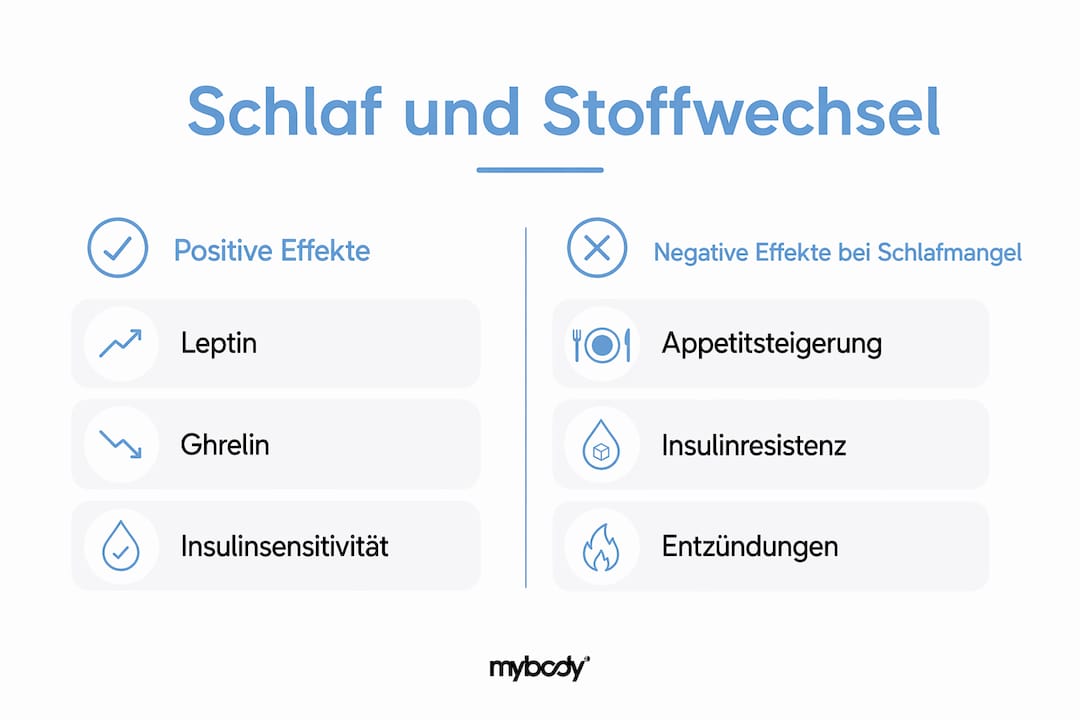
Sleep directly regulates two key appetite hormones: leptin and ghrelin. Leptin signals satiety to the brain. Ghrelin triggers hunger. When you sleep too little, leptin levels fall and ghrelin levels rise. The result is biologically driven hunger that can hardly be suppressed through willpower alone.
Insulin is also affected. Sleep deprivation reduces the insulin sensitivity of the body's cells. This means that the same amount of sugar in the blood requires more insulin to be processed. In the long term, this significantly increases the risk of type 2 diabetes.

Stress hormones also play a role. Cortisol, the stress hormone produced by the adrenal cortex, rises when sleep is poor. Elevated cortisol promotes the storage of abdominal fat while simultaneously inhibiting fat burning. This mechanism explains why sleep deprivation is so directly linked to weight gain.
The role of central neuronal control centers is even less well understood. Research shows that somatostatin-like systems in the brain coordinate energy expenditure, memory, and even aging processes during sleep. Sleep is therefore not a passive state, but an active regulatory process.
- Leptin decreases with sleep deprivation: The satiety signal is lost
- Ghrelin increases: Hunger rises, especially for calorie-dense foods
- Cortisol increases: Abdominal fat accumulation is promoted
- Insulin sensitivity decreases: Blood sugar control deteriorates
- Neural control centers: Regulate energy expenditure through somatostatin-like signals
Pro tip: If you wake up hungry in the morning despite having eaten enough, it is worth taking a look at your sleep quality. Often, the cause is not a calorie deficit but a hormonal imbalance caused by poor sleep.
What role do microbial metabolites and circadian rhythms play?
Sleep acts as a central timekeeper that regulates not only basic energy intake but also complex metabolic rhythms, including microbial metabolites. This is a finding that has barely reached the general public yet. However, it has far-reaching implications for our understanding of gut health and metabolism.
Microbial metabolites are metabolic products produced by gut bacteria. They include short-chain fatty acids such as butyrate, as well as tryptophan derivatives, which are precursors of serotonin and melatonin. These substances fluctuate rhythmically throughout the day. If you do not get enough sleep, these rhythms lose their regularity.
A study of 9 healthy adults showed that reducing sleep duration from 8.5 to 4.5 hours already changes the circadian rhythms of 90 metabolites in the blood. Many of these are substances derived from microbes. This means that sleep deprivation directly affects the gut and its contribution to metabolism.
| Metabolite | Function | Effect of sleep deprivation |
|---|---|---|
| Butyrate | Gut protection, anti-inflammatory effects | Rhythm disrupted, production altered |
| Tryptophan derivatives | Precursor of serotonin and melatonin | Shifted circadian rhythm |
| Short-chain fatty acids | Energy supply to intestinal cells | Circadian patterns become less regular |
The connection between sleep and microbiome is bidirectional. The microbiome influences sleep quality through neurotransmitter precursors. Poor sleep disrupts the microbiome. Anyone who wants to break this cycle must address both ends.
Pro tip: Blood tests that measure markers which fluctuate with the time of day produce more accurate results when the time of collection is standardized. Sleep deprivation on the night before a blood draw can distort metabolic values.
How much sleep does metabolism really need?
According to an observational study of 23,475 adults, the optimal sleep duration for a healthy metabolism is about 7 hours and 18 minutes on weekdays. This value is not a coincidence. It marks the point at which insulin sensitivity is best.
The relationship between sleep duration and metabolic risk follows an inverted U-shaped curve. Too little sleep increases the risk of diabetes. But too much sleep, meaning significantly more than 9 hours, is also associated with poorer insulin sensitivity. This is counterintuitive and often overlooked.
| Sleep duration | Metabolic risk | Insulin sensitivity |
|---|---|---|
| Under 6 hours | Increased | Significantly worsened |
| 7–8 hours | Low | Best |
| Over 9 hours | Increased | Worsened |
Recommendations for sleep duration should be individualized. Chronotype, age, and health status all play a role. Someone who naturally gets tired later in the evening has a different optimal bedtime than an early riser. Individualized sleep recommendations are therefore more useful than rigid guidelines.
Sleep hygiene is not a luxury. Regular sleep times, a dark bedroom, and avoiding screens before bedtime measurably improve sleep quality. Anyone who wants to boost their metabolism should start here before trying dietary supplements or diets.
How do sleep disorders such as sleep apnea harm metabolism?
Sleep disorders and sleep deprivation are not the same thing. This is an important distinction that is often blurred in practice. Obstructive sleep apnea, or OSA for short, is a distinct condition with its own metabolic effects.
Among people with type 2 diabetes, the prevalence of OSA is 81.25 percent. More severe sleep apnea is associated with greater insulin resistance. The mechanism is well understood: nighttime breathing pauses lead to intermittent hypoxia, meaning brief periods of oxygen deficiency. This activates the sympathetic nervous system and triggers stress hormone release.
- Intermittent hypoxia caused by breathing pauses activates the sympathetic nervous system
- Stress hormone release promotes insulin resistance
- Sleep fragmentation prevents restorative deep-sleep phases
- Chronic inflammation markers increase in untreated OSA
Extending sleep alone does not solve the problem. A study by Washington University showed that a one-hour increase in sleep duration in people with overweight improved sleep health but produced no measurable improvements in insulin sensitivity. This means that anyone with a sleep disorder must have it treated. Sleeping more is not enough.
If sleep apnea is suspected—that is, loud snoring, pauses in breathing, or extreme daytime sleepiness despite getting enough sleep—a doctor should be consulted. Polysomnography in a sleep laboratory provides clear diagnoses in this case. Treatment with CPAP devices has been shown to improve insulin sensitivity in many patients.
How can you make practical use of the connection between sleep and metabolism?
Sleep quality matters more than sleep duration alone. This is the most important practical insight from current research. Someone who sleeps for 8 hours but wakes frequently or snores benefits metabolically less than someone who sleeps deeply and continuously for 7 hours.
- Keep regular sleep times: Go to bed at the same time every day and get up at the same time. Even on weekends. Irregular sleep schedules disrupt the circadian rhythm and therefore the metabolic clocks.
- Adjust your sleep environment: Darkness, cool temperatures (around 18 degrees Celsius), and silence promote deep sleep phases. A set for undisturbed sleep with a sleep mask and earplugs can help with exposure to light and noise.
- Limit evening eating to a specific time: Late, heavy meals burden the metabolism at night and can worsen sleep quality. Leaving at least 2–3 hours between the last meal and bedtime is advisable.
- Actively reduce stress: Chronic stress increases cortisol and worsens sleep quality. Breathing exercises, meditation, or regular exercise have been shown to lower cortisol levels.
- Have sleep disorders evaluated: Anyone who feels exhausted during the day despite good sleep hygiene or has weight problems should have a sleep disorder ruled out. Untreated OSA sabotages every attempt to improve metabolism through sleep.
Anyone who wants to understand which factors influence metabolism most strongly in their individual case can benefit from a personalized analysis. Sleep is one factor among many, but it is one of the most powerful.
Key findings
Sleep controls metabolism through hormones, microbial metabolites, and circadian rhythms simultaneously. Sleep duration alone, without quality and without treating sleep disorders, offers little metabolic benefit.
| Topic | Details |
|---|---|
| Optimal sleep duration | Approximately 7 hours and 18 minutes reduce the risk of diabetes most effectively. |
| Hormones and appetite | Sleep deprivation increases ghrelin and decreases leptin, biologically driving hunger. |
| Microbial metabolites | Sleep restriction disrupts the circadian rhythms of more than 90 metabolic compounds in the blood. |
| Sleep apnea and insulin | OSA is very common in people with type 2 diabetes and increases insulin resistance through hypoxia. |
| Sleep extension alone | More sleep without treating sleep disorders does not measurably improve insulin sensitivity. |
What I have really learned after years of working with sleep data
Many people who come to mybody x have already tried everything: diets, dietary supplements, exercise. And yet their weight remains stagnant or their blood sugar remains difficult to manage. In a surprisingly high proportion of these cases, there is an underlying sleep problem that no one had considered.
What surprised me most personally: It is not sleep deprivation itself that is most often overlooked. It is sleep apnea. Many people affected sleep for 7 or 8 hours and still feel exhausted. They think their sleep is good. But the pauses in breathing fragment deep-sleep phases so severely that the body never truly rests metabolically.
The second blind spot is the microbiome. The finding that sleep deprivation disrupts the daily rhythms of microbial metabolites turns conventional nutritional advice on its head. You can have the best diet in the world. If your sleep is poor, your gut still will not produce the metabolic compounds it should.
My honest advice: Before addressing your metabolism through diets or supplements, have your sleep professionally assessed. And if you want to interpret lab results, remember that the timing of the blood draw and the quality of your sleep the night before can affect the results.
— mybody x
Your metabolism deserves an honest analysis
Poor sleep leaves traces in your lab results, your weight, and your energy levels. But sleep is only part of the picture. mybody x offers ISO-certified analyses that examine metabolism, the microbiome, hormones, and nutrient status together, so you know where the real leverage lies for you.

More than 11,300 people have already discovered with mybody x what is really slowing their bodies down. With a metabolism analysis, you receive no generic recommendations, but concrete insights into your personal situation. Starting at 49 euros, including free shipping, with a money-back guarantee if no result is obtained. Visit mybody-x.com and find out what your metabolism is telling you right now.
FAQ
What Is the Connection Between Sleep and Metabolism?
Sleep regulates hormones such as leptin, ghrelin, and insulin, which control hunger, satiety, and blood sugar. Poor sleep directly disrupts these processes and increases the risk of weight gain and type 2 diabetes.
How Much Sleep Do I Need for a Healthy Metabolism?
A study of 23,475 adults shows that approximately 7 hours and 18 minutes of sleep per night best support insulin sensitivity. Both significantly less and significantly more sleep increase metabolic risk.
Can Sleep Deprivation Permanently Damage Metabolism?
Persistent sleep deprivation worsens insulin sensitivity, increases cortisol, and disrupts microbial metabolic rhythms. Whether these changes can be fully reversed depends on how long and how severely sleep was impaired.
Does Sleeping More Help If I Have Metabolic Problems?
More sleep alone does not measurably improve insulin sensitivity when a sleep disorder such as sleep apnea is present. Metabolic improvements only occur once the sleep disorder itself is treated.
How Are Gut Health and Sleep Connected to Metabolism?
Lack of sleep disrupts circadian rhythms of microbially derived metabolites such as butyrate and tryptophan derivatives. This impairs gut health and, consequently, an important part of metabolic regulation.



Share now:
Improve your metabolism: Your honest guide without myths
Boost Your Metabolism: Your 4-Week Plan for 2026