

Metabolomics analysis explained: Your body in profile
Metabolomics is the systematic study of small molecules, known as metabolites, that are produced, consumed, or excreted during metabolism. These molecules reflect in real time how your body responds to diet, stress, medication, and environmental influences. Modern methods such as nuclear magnetic resonance spectroscopy (NMR) and mass spectrometry (MS) enable the simultaneous measurement of hundreds to thousands of metabolites in a single sample. This means metabolomics analysis provides something that no genetic test alone can: a direct view of a person's current biological state, shaped by lifestyle, the microbiome, and the environment. For personalized medicine, this is a turning point.
Which techniques and methods are used in metabolomics?
The two central analytical methods in metabolomics are NMR spectroscopy and mass spectrometry. Both measure metabolites, but in fundamentally different ways. Understanding their differences helps you assess which method is suitable for which research question.
NMR spectroscopy: non-destructive and reproducible
NMR spectroscopy uses magnetic fields to make molecules in a sample visible. One key advantage is that NMR preserves samples intact, so the same sample can be measured multiple times. However, its sensitivity is lower than that of mass spectrometry methods. NMR is particularly well suited to quantitative standard measurements and longitudinal monitoring, where reproducibility matters more than depth.

Mass spectrometry: high sensitivity, broad range
Mass spectrometry, especially when combined with liquid chromatography (LC-MS) or gas chromatography (GC-MS), offers significantly higher sensitivity and resolution. It can also detect metabolites at very low concentrations. This makes LC-MS and GC-MS the preferred tools for exploratory studies in which as many compounds as possible need to be detected simultaneously.
| Feature | NMR spectroscopy | Mass spectrometry (LC-MS / GC-MS) |
|---|---|---|
| Sensitivity | Moderate | Very high |
| Sample preservation | Yes, non-destructive | No, the sample is consumed |
| Metabolite coverage | Limited | Very broad |
| Reproducibility | Very high | High, method-dependent |
| Bioinformatics effort | Low | High |
| Typical application | Standardized longitudinal measurements | Exploratory profiling |
Targeted versus untargeted analysis
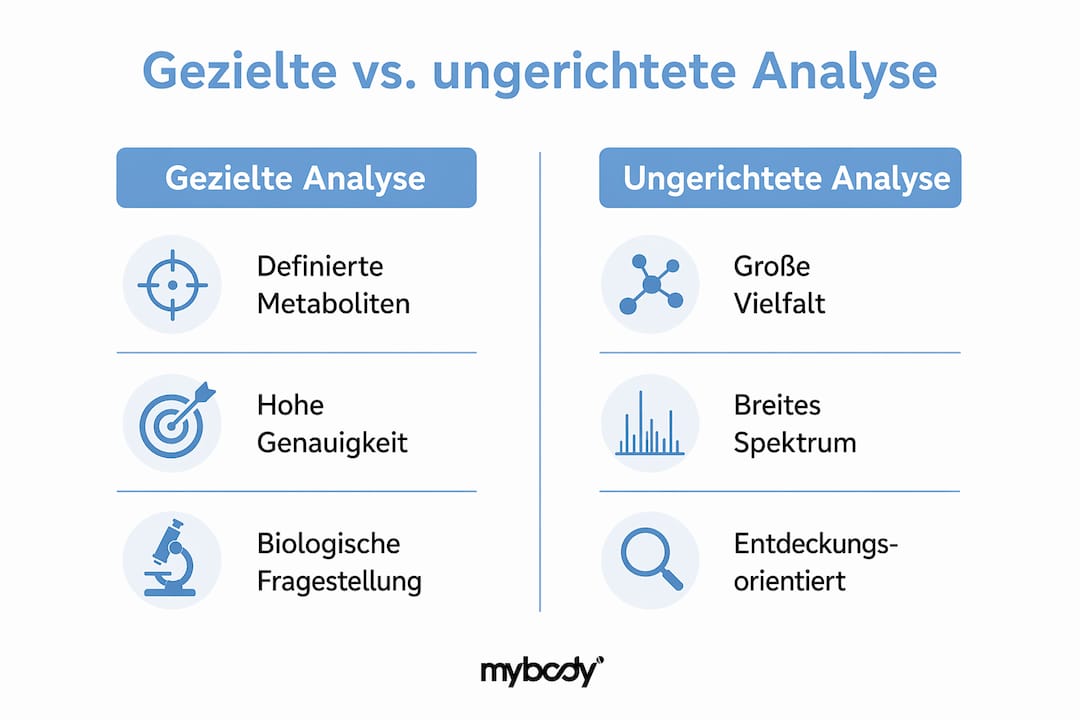
Targeted analyses measure defined metabolites with high accuracy, while untargeted approaches capture as many compounds as possible simultaneously and therefore require complex bioinformatics. Targeted metabolomics is useful when you have a specific question, for example: What is the butyrate level in the gut? Untargeted metabolomics is suitable for discovering new biomarkers when you do not yet know what you are looking for.
Expert tip: Always choose the analytical method based on the biological question. If you want to monitor a known marker, targeted measurement is the better choice. If you want to discover new relationships, you need an untargeted approach.
Which sample types are suitable for metabolomic analyses?
Not every sample provides the same information. Choosing the biological matrix is one of the most important steps before any metabolomic measurement. Plasma, serum, and urine provide different metabolic information, and no matrix is universally superior.
The most common sample types at a glance:
- Blood plasma: Contains a broad range of metabolites from the liver, kidneys, muscles, and gut. Plasma is considered the standard matrix for systemic metabolic profiles.
- Blood serum: Similar to plasma, but without clotting factors. Small differences in composition may be relevant depending on the research question.
- Urine: Primarily reflects renal excretion products. Urine is easy to collect and well suited to nutritional studies and kidney function markers.
- Stool: Particularly valuable for analyzing gut metabolism. Stool samples contain metabolites produced directly by the gut microbiome, such as short-chain fatty acids.
- Saliva and cerebrospinal fluid: Niche matrices for specific research questions, such as oral health or neurological diseases.
An often underestimated factor is sample handling. Metabolites are unstable and change rapidly if samples are not cooled immediately and processed promptly. Storage errors can distort measurement results more than inaccuracies in the analytical instrument. This is not a theoretical issue: in practice, even short delays in cooling have been shown to measurably alter the concentration of certain amino acids.
Expert tip: Always match the sample type to the research question. For a gut health profile, a stool sample is more informative than blood. For a systemic metabolic profile, plasma is the first choice.
mybody x offers deeper insight into microbiome analysis and gut health through its own laboratory analyses, which apply precisely this sample logic.
How does metabolomics support research into gut health?
The gut is not a passive digestive organ. It is an active metabolic system that produces hundreds of compounds every day, with effects extending far beyond the gut. The gut microbiome is increasingly understood as an independent metabolic organ whose function can be measured directly through metabolomics.
Three groups of metabolites are at the center of research:
-
Short-chain fatty acids (SCFAs): Butyrate, propionate, and acetate are produced when gut bacteria ferment dietary fiber. Butyrate, propionate, and acetate are considered key markers of gut health and energy metabolism. Butyrate directly supplies energy to intestinal lining cells and strengthens the intestinal barrier.
-
Tryptophan derivatives: Tryptophan is converted in the gut into various compounds, including serotonin and indole derivatives. Tryptophan derivatives influence immunity and the intestinal barrier, making them direct bridges between nutrition, the microbiome, and the immune system.
-
Bile acid derivatives: These compounds regulate fat digestion and glucose metabolism. Altered bile acid profiles occur in obesity, type 2 diabetes, and inflammatory bowel diseases.
The connection between nutrition, the microbiome, and the metabolomic profile is not a one-way street. What you eat changes your microbiome. Your microbiome changes which metabolites are produced. And these metabolites influence how your immune system, brain, and energy metabolism function. Bioinformatic methods such as multivariate statistics and machine learning help evaluate these complex data patterns and identify biologically interpretable patterns. mybody x explains more about how a microbiome analysis works in practice in a dedicated article.
What practical applications does metabolomics offer for your health?
Metabolomics is no longer merely a research tool. Its applications range from the early detection of diseases to personalized nutritional counseling. Here are the key areas where metabolomic data are already being used today:
-
Early detection of metabolic diseases: Altered metabolite profiles often appear years before clinical symptoms. Type 2 diabetes, fatty liver disease, and metabolic syndrome leave characteristic patterns in blood plasma that can be detected through targeted metabolomics.
-
Personalized nutrition: Metabolomics combines genetic information with environmental and lifestyle influences and shows how genes are actually expressed. This means that two people with the same genotype can respond completely differently to the same diet because their metabolic profiles differ.
-
Pharmaco-metabolomics: This field examines how individual metabolic profiles can predict responses to medications. Metabolic fingerprints link raw data with clinical application, particularly in complex diseases such as cancer or autoimmune disorders. Researchers at Med Uni Graz have shown that metabolomic profiles can predict treatment response better than genetic data alone.
-
Cancer research: Tumor cells fundamentally alter their metabolism, a phenomenon known as the Warburg effect. Metabolomic analyses help identify tumor-specific biomarkers and monitor treatment progression.
-
Aging research and longevity: Metabolomic profiles change with age. Certain compounds, such as NAD precursors or specific amino acids, correlate with biological aging. The connection to mitochondrial health is particularly relevant, as mitochondria are central players in energy metabolism.
-
Monitoring the progression of chronic diseases: Metabolomic measurements can show whether a treatment is working before conventional clinical parameters change. This gives doctors and patients feedback earlier.
The strength of metabolomics lies in the fact that it does not work in isolation. It combines genomics, microbiome research, and clinical data into an integrated picture. Anyone who wants to analyze their metabolism in a targeted way will find a structured introduction to practical application at mybody x.
Key Insights
Metabolomics provides the most direct view of a person’s biological state because it measures what is actually happening in the body, not merely what is genetically possible.
| Topic | Details |
|---|---|
| Definition of Metabolomics | Systematic measurement of small metabolic molecules as a real-time reflection of biological state. |
| Main Methods | NMR is suitable for reproducible measurements, while LC-MS and GC-MS are suited to broad exploratory profiles. |
| Sample Selection | Plasma, urine, and stool provide different information; the choice determines the significance of the results. |
| Gut Health | Butyrate, propionate, and tryptophan derivatives are key markers of microbiome function and immunity. |
| Applications | Early detection, personalized nutrition, pharmacometabolomics, and longevity research. |
What Metabolomics Can Really Do—and What It Cannot
From my experience with metabolomic health data at mybody x, one thing is clear: metabolomics is the most honest measurement tool we have for human metabolism. It measures not what could theoretically happen, but what is happening right now. This is a fundamental difference from genetic tests, which describe risks but provide no certainties.
And yet there are limitations that receive too little attention. Metabolite profiles are highly dynamic. Poor sleep, an unusual meal, or physical stress on the day before sample collection can shift measurement values. This does not mean that metabolomics is unreliable. It means that context must always be taken into account.
What impresses me about developments in recent years is this: combining microbiome analysis with metabolomics has fundamentally changed our understanding of the gut. We now see that dietary recommendations that work for one person may be ineffective or even counterproductive for another. This is no longer just a theory. Metabolomic profiles demonstrate it concretely.
The greatest challenge remains interpretation. Raw data from an LC-MS measurement is of little value on its own. Only bioinformatic analysis, clinical context, and an understanding of sample quality turn it into actionable knowledge. Those who underestimate this draw false conclusions. Those who understand it have an exceptionally powerful tool at their disposal. CP-1’s mitochondrial health checklist clearly shows how metabolomic insights can be translated into practical health strategies.
— mybody x
Your metabolic profile with mybody x
Understanding the fundamentals of metabolomics is the first step. The second is knowing your own values.

mybody x offers ISO-certified laboratory analyses for metabolism, the microbiome, and nutrient status, conveniently from home. With a stool or blood sample, you receive a scientifically evaluated profile of your metabolic markers, including specific dietary and lifestyle recommendations. More than 11,300 customers have already gained a better understanding of their health with these analyses. The analyses comply with the GDPR, and samples are destroyed after evaluation. Find out what a metabolic analysis can specifically mean for you, and discover which analysis best suits your question.
FAQ
What is metabolomics in simple terms?
Metabolomics is the science of measuring small molecules involved in metabolism, known as metabolites, to reflect an organism’s current biological state. It shows how diet, the microbiome, and the environment are currently affecting the body.
What is the difference between targeted and untargeted metabolomics?
Targeted metabolomics measures a defined group of known metabolites with high accuracy. Untargeted metabolomics captures as many compounds as possible simultaneously and is used when new biomarkers are to be discovered.
Which samples are used for metabolomic analyses?
Blood plasma, serum, urine, and stool are the most common sample types. Each matrix provides different information: plasma for systemic profiles, stool for gut metabolism markers.
Why is sample handling so important?
Metabolites are chemically unstable and change rapidly after collection. Immediate cooling and rapid processing are essential to ensure that measurement results reflect the body’s actual condition.
How does metabolomics support gut health?
Metabolomic analyses measure short-chain fatty acids such as butyrate and propionate, as well as tryptophan derivatives, which are produced directly by the gut microbiome. These markers show how well the microbiome functions and how it affects the immune system and intestinal barrier.



Share now:
How to recognize a folic acid deficiency: Symptoms, tests &
Tips for Interpreting Test Results: How to Read Health Tests Correctly