
The essentials at a glance
The at-home health testing market has become confusing: DNA, blood, microbiome—everywhere you see "certified," "laboratory-tested," and "scientific." How are you supposed to tell who really works professionally and who merely sounds convincing?
In short: You can recognize a good provider by six things—an ISO-certified laboratory, genuine data protection (GDPR), subject-matter experts behind the analyses, easy-to-understand reports, honest promises, and complete transparency. mybody® meets these criteria: analysis in an ISO-certified laboratory in Germany, GDPR-compliant, technically reviewed by its own team—with results in 3–5 (blood), 5–10 (microbiome), or 15–25 business days (DNA). It is best to read this article as a checklist you can use to evaluate any provider.
What to expect in this article
1. Why "ISO-certified" really matters for health tests
2. Six criteria for a reputable provider
3. What data security means for health data
4. Why experts make the difference
5. How mybody® applies the criteria
6. Which test is right for which goal?
7. What self-tests can—and cannot—do
8. Frequently asked questions
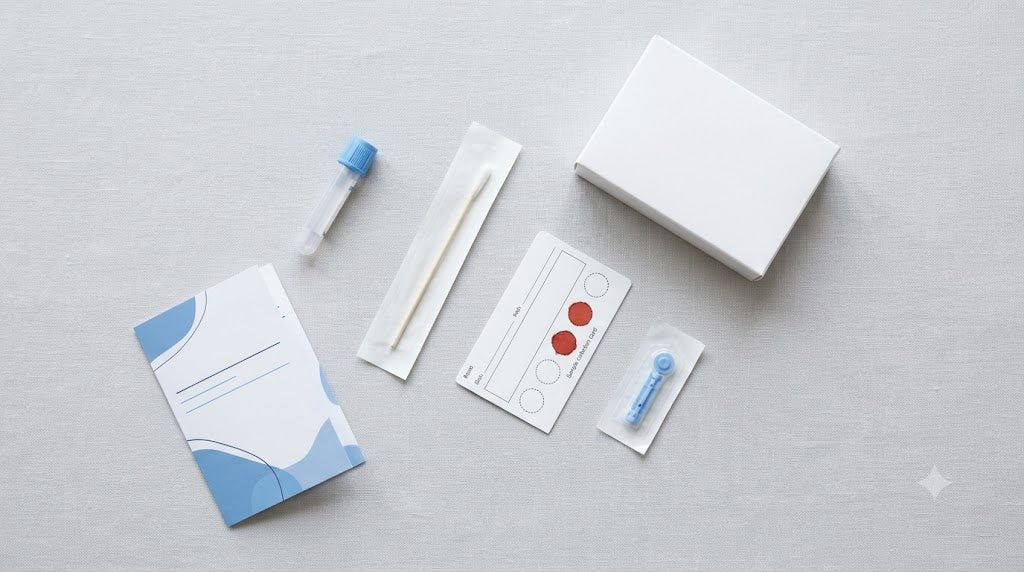
The three test categories at a glance
"Health test" is not the same as every other health test. Depending on your question, you need a different sample type—and your result will arrive at a different speed. All three are analyzed at mybody®'s ISO-certified laboratory in Germany.
Category
| What it shows | Sample type | Result | Price | from |
|---|---|---|---|---|
| DNA metabolism | Genetic predisposition (nutrition, fitness) | Saliva | 15–25 business days | €169 |
| Blood test (nutrients) | Current vitamin & mineral levels | Capillary blood (fingertip) | 3–5 business days | from €139 |
| Microbiome | Gut microbiome composition & diversity | Stool | 5–10 business days | €139 |
| Rapid tests (individual markers) | e.g., vitamin D, ferritin, TSH | Blood spot | 3–5 business days | €14.50 |
How an ISO-certified at-home test works
Why "ISO-certified" really matters for health tests
"ISO-certified" sounds good—but what does it actually mean? ISO standards are internationally agreed rules governing how a laboratory must operate so that its results are reliable and reproducible. Three standards are particularly relevant for health tests.
The DIN EN ISO 15189 standard is specifically for medical laboratories—it governs quality and competence in medical examinations. ISO/IEC 17025 applies generally to testing and calibration laboratories and ensures that a laboratory performs measurements with technical competence. And ISO/IEC 27001 concerns information security—that is, the protection of your sensitive data. In Germany, the German Accreditation Body (DAkkS), as the national body, monitors whether laboratories comply with these requirements.
What this means for you: A provider that works with a certified laboratory uses transparent, tested standards rather than its own opaque procedures. With a home test, you hand over both a sample and your trust; the quality of the laboratory determines how much your result is ultimately worth.
It is also useful to understand the difference between “certified” and “accredited”: Certification confirms that a laboratory operates a quality management system according to a standard. Accreditation by an official body such as DAkkS goes further and additionally attests to technical competence for specific procedures. As a consumer, the most important thing is that the provider is specific—and does not stop at a vague “laboratory-tested” claim.
Why a laboratory located in Germany is an advantage
The laboratory’s location is more than just a detail. If your sample is analyzed in Germany, strict German and European data protection law applies—your sensitive data is not subject to the jurisdiction of a country with weaker regulations. There is also a practical advantage: Shorter shipping routes mean that samples reach the laboratory faster and under more stable conditions, which benefits the quality of the analysis. A named German location is therefore a double plus—for data protection and reliability.
Key point: ISO standards such as 15189, 17025, and 27001 demonstrate that a laboratory measures competently and protects your data. Without a certified laboratory, any result is only as good as the provider’s promise.
How to recognize a reputable provider: 6 criteria
You can use these six points to assess any provider—whether it offers DNA, blood, or microbiome testing. The more boxes checked, the more trustworthy the provider.
- ✓ ISO-certified laboratory – ideally with a named location (e.g. Germany) and a clearly stated standard.
- ✓ Genuine data protection – GDPR-compliant, pseudonymized samples, and a clear explanation of what happens to your data.
- ✓ Professional review by experts – It is clear who is responsible for and reviews the content.
- ✓ Understandable reports – Results you can interpret without a degree, accompanied by specific recommendations.
- ✓ Honest promises – No “miracle cure,” but a clear statement of what the test can and cannot do.
- ✓ Transparency – Methodology, processing time, imprint, and accessible support are openly available.
Because these six points directly determine the quality of your result, it is worth taking a closer look at each one.
1. ISO-certified laboratory with a named location
The most important criterion. A reputable provider states where the analysis is carried out (e.g., “in Germany”) and is not reluctant to name the underlying standard or accreditation. Be cautious of wording that only says “laboratory-tested” or “to the highest standards” without being specific—this is often marketing without substance.
2. Genuine, verifiable data protection
For health and genetic data, simply saying “secure” is not enough. A good provider explains specifically that it operates in compliance with the GDPR, pseudonymizes samples, encrypts data transfers, and deletes samples after analysis. If this information is missing or difficult to find, that is a warning sign.
3. Professional review by identifiable experts
Who is responsible for the content? A trustworthy provider transparently explains that experts in fields such as genetics, nutritional science, or laboratory diagnostics review the analyses and recommendations. Anonymous health content without identifiable people responsible for it is less reliable in case of doubt.
4. Understandable, actionable reports
A result is only useful if you understand it. Good reports translate technical terms into clear language and provide specific recommendations for action instead of leaving you alone with raw data. Before you buy, check whether sample reports or explanations are available.
5. Honest promises instead of miracle cures
A provider’s credibility is often shown by what they don’t promise. “Cures X,” “guaranteed weight loss,” or “detects every disease” are red flags. Trustworthy providers clearly state that their tests are for guidance and do not replace a medical diagnosis.
6. Full transparency (methodology, duration, support)
How is it measured, how long does it take, who is liable, and how can you reach support? An imprint, clear processing times, and accessible customer service are the foundation of trust. If they are missing, you should become skeptical—especially with a product you entrust with your health data.
How to recognize pure marketing promises
Exaggerated superlatives without evidence, countdown discounts that pressure you to buy, “recommended by doctors” without naming them, or comparison lists that somehow always make the same provider the winner—all of this is more about selling than informing. A good test sells itself through verifiable facts, not urgency. When in doubt, quietly check every provider against the six criteria above instead of letting yourself be guided by the loudest promise.
Reputable provider vs. warning signs at a glance
This comparison helps you assess any provider in just a few seconds.
| Characteristic | Reputable provider | Warning signs |
|---|---|---|
| Laboratory | ISO-certified, named location (e.g., Germany) | only “laboratory-tested,” with no standard or location specified |
| Data protection | GDPR compliance, pseudonymization, and deletion stated | none or vague information |
| Experts | identifiable team of experts, professional review | anonymous content, no responsible parties named |
| Reports | clear, with specific recommendations | raw data only, with no context |
| Promises | honest, does not replace a diagnosis | “Miracle cures,” guarantees of healing |
| Transparency | legal notice, clear terms, accessible support | no legal notice, no support |
What data security means for health data
Health data—and especially your DNA—are among the most sensitive information of all. That is why data protection is not a secondary issue when choosing a provider, but a key criterion.
Reputable providers operate in compliance with the GDPR and protect their systems according to standards such as ISO/IEC 27001, the international standard for information security. Three questions are crucial: Are your samples processed using pseudonyms? Is transmission encrypted? And what happens to your sample after the analysis?
At mybody®, samples are sent using pseudonyms, transmission is SSL-encrypted, and the saliva sample and DNA sequence are completely destroyed two months after the analysis is completed. These are exactly the kind of specific commitments you should look for with every provider—not just the word “secure.”
Important to know: Under the GDPR, health data are considered a particularly protected category. You have the right to know which data are stored and can request their deletion. A reputable provider makes these rights clear and does not sell your data to third parties. If a provider grants itself rights to use your genetic data commercially, you should read the fine print very carefully.
Why experts make the difference
A single laboratory result is of little use on its own. Its real value only emerges when experts put the numbers into context and translate them into clear, actionable recommendations. This is precisely where a reputable provider differs from a mere measurement factory.
That is why you should ask: Who is behind the content? Are health claims professionally reviewed? At mybody®, a team working in the fields of nutrigenetics & DNA metabolic analysis, gut science & the microbiome, blood analysis interpretation, nutritional science, and laboratory diagnostics is responsible both for writing and professionally reviewing the content. You can find out who is behind it on the authors page.
Search engines and AI systems now also assess health content based on whether it is backed by verifiable expertise. For you as a reader, this offers a practical advantage: Where transparent experts are involved, recommendations are more likely to be professionally sound and up to date—instead of merely sounding persuasive.
Key takeaway: Certified measurements plus professional interpretation by identifiable experts—that is the difference between a number and a decision-making aid.
How mybody® meets the criteria
mybody® (operated by MYBODY Lab GmbH) analyzes all tests in its ISO-certified laboratory in Germany, complies with the GDPR, and has the content professionally reviewed. The company has been active since 2016, launched its consumer offering in 2022, and is now represented in several countries; more than 11,000 people have already used the tests. Here is what this looks like for each category:
DNA metabolic tests (saliva sample)
The DNA metabolic tests reveal your genetic predisposition related to nutrition, weight, and fitness—analyzed from more than 700,000 genetic variants. From the affordable entry-level option (WeightLoss SLIM, €169) and the comprehensive all-round analysis (NutriCare INFINITY, €269) to the complete package (Longevity ALL IN ONE, €369 instead of €629). Results in 15–25 business days.
Sample type: Saliva · Valid once (genes do not change)
Nutrient blood tests (capillary blood)
The VitalCheck Complete (€169 instead of €199) measures 15 biomarkers—including vitamin D3, B12, folate, magnesium, ferritin, and blood lipids—from a drop of capillary blood taken from your fingertip. This shows your current status, while the DNA test reveals your genetic predisposition. Results in 3–5 business days.
Sample type: Blood drop (fingertip) · Snapshot (repeatable)
Microbiome tests (stool sample)
The microbiome tests analyze the composition and diversity of your gut flora—from the Basic Test (€139) to Complete, including leaky gut markers (€189). Because the gut is closely connected to digestion, nutrient absorption, and the immune system, this category complements DNA and blood testing to provide a well-rounded picture. Results in 5–10 business days.
Sample type: Stool · Snapshot (repeatable)
The same quality standards apply across all three categories: the same ISO-certified laboratory, the same data protection rules, and the same professional review. So you do not have to choose between a “good” and a “less good” test—only between the questions you want answered. This removes much of the uncertainty from the decision.
Which test is right for which goal?
The choice depends on your question. Do you want to understand your genetic predisposition—for example, how you process carbohydrates or caffeine? Then a DNA metabolism test is the right place to start. It is worthwhile as a one-time test because your genes do not change.
Do you want to know your current status—whether you are currently low in vitamin D or iron? Then you need a blood test, because nutrient levels change with your diet and the season. And if you have digestive issues or questions about gut health, the microbiome test provides the right answer.
Imagine feeling constantly tired despite eating a “healthy” diet: A blood test shows acute deficiencies, the DNA test explains your predisposition, and the microbiome reveals how well you actually absorb nutrients. Genetic predisposition combined with current measurements provides the most complete picture—which is why many people combine the categories.
A blood test is often a sensible starting point because it is affordable and delivers results quickly. The DNA test is worthwhile as a one-time, permanently valid foundation, while the microbiome test is the right choice especially for digestive issues. What matters is not testing as much as possible, but asking the question that really concerns you right now—and then choosing the right test for it.
How to get the most out of your test
Even the best certified test is only as good as the sample that arrives at the lab—and how you handle the result. With a few simple steps, you can make your test genuinely meaningful.
Follow the instructions precisely. With a fingertip blood test, for example, it is important to collect the sample cleanly and at the recommended time; saliva and stool samples have similar small but important requirements. A correctly collected sample is the foundation of a reliable result.
Think in terms of connections, not individual values. A single value is rarely the whole story. Only in the context of your diet, lifestyle, and—in the case of repeated tests—changes over time does a meaningful picture emerge. That is exactly what the professionally reviewed recommendations in the report are for.
Turn the result into concrete steps. The real value comes from deriving and implementing one or two actions from the recommendations—instead of filing the report away. And if any values are unusual, take them to your next doctor’s appointment. That is how a number becomes real change.
What ISO-certified self-tests can—and cannot—do
However reliably a certified laboratory measures, a self-test remains a tool for orientation, not a substitute for a medical diagnosis. It shows you predispositions, values, and connections, but does not diagnose diseases.
A reputable provider will tell you this honestly instead of promising a cure. If you have specific or persistent symptoms, they should be medically evaluated—a self-test can usefully complement that evaluation, but not replace it. This honesty is itself a quality feature.
When used appropriately, certified self-tests are still a powerful tool: They create a starting point, make changes over time visible, and give you a sound basis for conversations—whether with yourself about your lifestyle or with a doctor about unusual results. The key is to see them as part of a larger picture, not as a final verdict.
Conclusion: How to find the right provider
The best provider of health tests is not the one with the loudest promises, but the one with an ISO-certified laboratory, genuine data protection, identifiable experts, understandable reports, honest statements, and complete transparency. Use these six criteria as a checklist for every provider you are considering.
mybody® meets these criteria across all three categories: DNA (saliva), blood (capillary), and microbiome (stool), analyzed in an ISO-certified laboratory in Germany, GDPR-compliant, and professionally reviewed. Which test is right depends solely on your question—the quality behind it remains the same.
My advice: Take your time to go through the six criteria, note your specific question, and then choose the category that answers it. This will help you make an informed decision instead of being guided by the loudest marketing. In the end, that is the best protection for your health and your money. And if you are unsure which test is right for you, customer support can help you assess your options before you commit.
Frequently asked questions about ISO-certified health tests
Test with a provider that meets the criteria
ISO-certified laboratory in Germany, GDPR-compliant, professionally reviewed: Choose the test that matches your question.
You might also be interested in
→ DNA Test for Nutrition & Metabolism: Eat According to Your Genetics
How your genes determine what is good for you – and which DNA test is right for you.
→ The Most Reliable Microbiome Tests for Your Gut Flora
How a microbiome test works and how to understand your results.
Sources
- DAkkS – German Accreditation Body: Medical laboratories / DIN EN ISO 15189 (explanation of accreditation). dakks.de
- DAkkS – German Accreditation Body: Accreditation of testing and calibration laboratories (ISO/IEC 17025). dakks.de
- DataGuard: ISO/IEC 27001 – Information security in the healthcare sector. dataguard.de
- Art. 9 GDPR – Processing of special categories of personal data (including health data). dsgvo-gesetz.de
The statements on laboratory quality and accreditation are based on DAkkS [1][2]; the data protection information is based on ISO/IEC 27001 [3] and Art. 9 GDPR [4]. The specific mybody® details (prices, sample type, processing times) are taken from the respective product pages on mybody-x.com.
mybody® Editorial & Expert Team
Editorial & expert review of health content (MYBODY Lab GmbH)
The content is created and reviewed in collaboration with scientists and professionals from medicine, nutrition, and laboratory diagnostics. Learn more about the team: mybody® Authors.
Published: 19.07.2026 · Last updated: 19.07.2026
Medical disclaimer: This article is for general information and does not replace medical advice, diagnosis, or treatment. Self-tests are for guidance only and do not constitute a medical diagnosis. If you have health-related questions, please consult a doctor.



Share now:
DNA Test for Nutrition & Metabolism: Eat According to Your Genetics
Weight Gain from Stress and Sleep Deprivation: What Happens in Your Body