
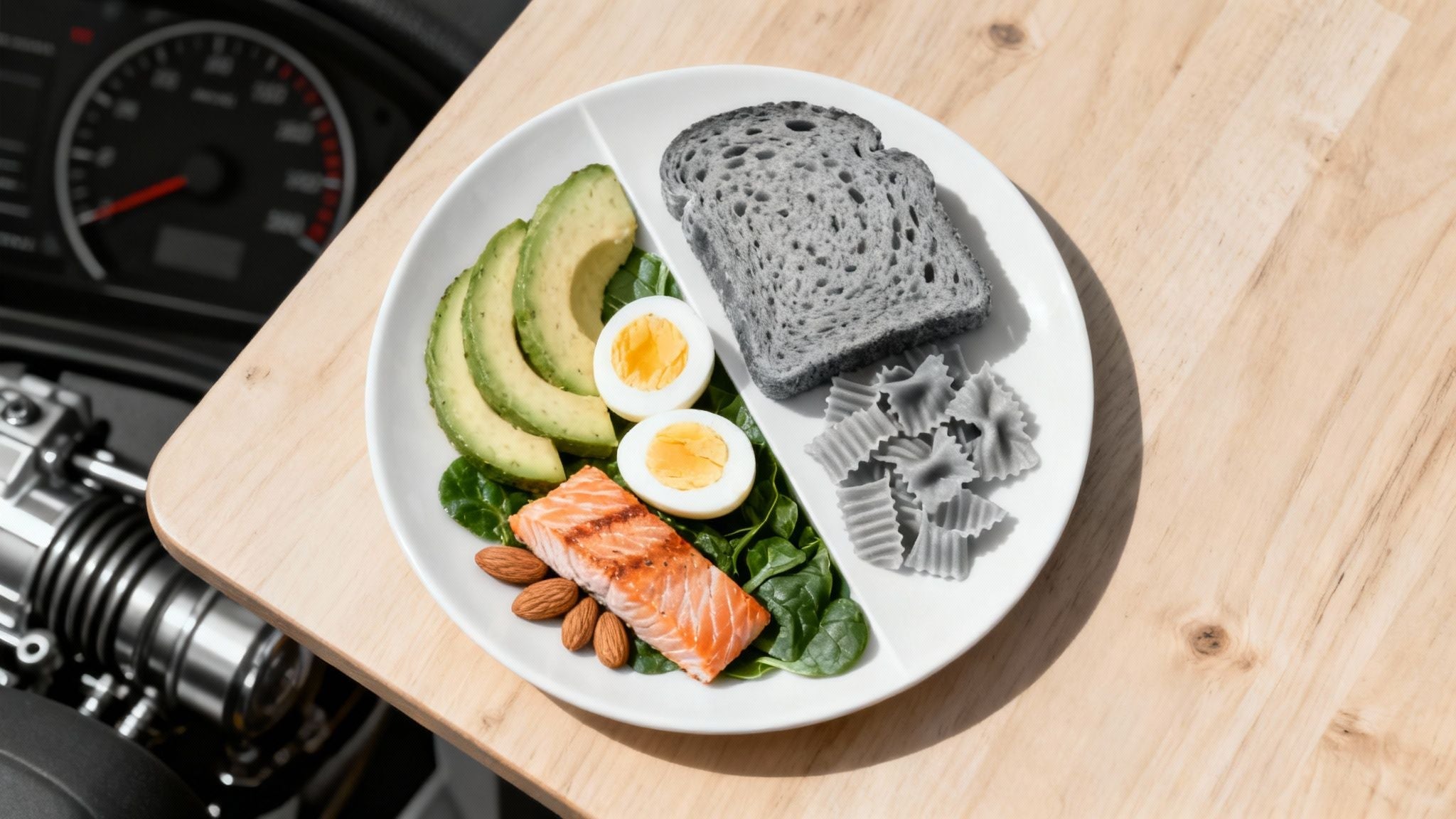
What is a low-carb diet and how does it work?
What is a low-carb diet, anyway? Basically, it is quite simple: You significantly reduce the amount of carbohydrates and eat more protein and healthy fats instead. This simple swap can have surprisingly positive effects on your body and your overall well-being.
Your metabolism shifts into a higher gear
Think of your body as a clever hybrid engine. It can run on two different fuels: either sugar from carbohydrates or fat. For most of us, the engine runs almost constantly in “sugar mode” because our typical diet is full of bread, pasta, rice, and sweets. That provides quick energy, but it is often unreliable—you probably know it from the classic afternoon slump or sudden cravings.
With a low-carb diet, you consciously choose to switch the engine over. By giving your body fewer carbohydrates, you encourage it to access its second, often much more efficient energy source: fat.
From sugar mode to fat mode
This shift is a completely natural process. As soon as less sugar is available, your body begins converting stored body fat and fats from your diet into so-called ketone bodies. These ketones are excellent fuel for your brain and muscles. The state in which your body primarily uses fat as an energy source is called ketosis.
The core of low carb is freeing the body from its dependence on fast sugar. Instead, it learns to use its vast fat reserves as a constant, stable source of energy.
This exact shift is the key to the many benefits that go far beyond simply losing weight. You give your body the chance to become metabolically flexible again, just as it naturally should be. Instead of constantly craving the next sugar rush, it simply draws on its internal reserves. If you want to understand the role of the individual nutrients even better, take a look at our guide to fats, carbohydrates, and protein.
So what happens when your engine finally runs in fat mode? You benefit from:
- More stable energy: No more extreme blood sugar fluctuations that make you tired and rob you of your concentration.
- Less cravings: Proteins and fats keep you feeling full for much longer and more effectively than carbohydrates. The urge for unhealthy snacks often disappears all by itself.
- Mental clarity: Many people report sharper focus because the brain loves the steady energy supply provided by ketones.
The cornerstones of a low-carb diet
Okay, the “why” behind low carb is clear—but what does it actually look like on your plate? What can you eat, and what should you leave on the shelf? Don’t worry, this isn’t about strict prohibitions but about shifting the focus: away from empty calories and toward foods that truly nourish you and keep you full.
From now on, the foundation of your meals consists of three strong pillars: high-quality protein, healthy fats, and fiber-rich vegetables. Think of it like a sturdy house: protein from meat, fish, and eggs forms the load-bearing walls, healthy fats from avocados, nuts, and quality oils create the solid foundation, and vegetables provide a protective shell containing all the essential vitamins and minerals.
What belongs on your plate
With a low-carb diet, you focus on foods that keep your blood sugar levels stable and provide you with energy for a long time. Instead of fast-acting carbohydrates that first give you a boost and then leave you crashing, you rely on consistent, dependable sources of energy.
- Protein sources: Meat, poultry, fish, seafood, and eggs are perfect. They not only provide valuable amino acids for your muscles but also keep you feeling full for a really long time.
- Healthy fats: Avocado, olive oil, nuts, seeds, and fatty fish such as salmon are absolutely essential. Fat is your new primary source of energy and is essential for healthy cells.
- Vegetables: Leafy greens, broccoli, cauliflower, zucchini, and bell peppers should become your best friends. They are packed with vitamins, minerals, and fiber but low in carbohydrates.
The following graphic illustrates really well how your metabolism changes through this transition—from a sugar-dependent system to an efficient fat-burning machine.
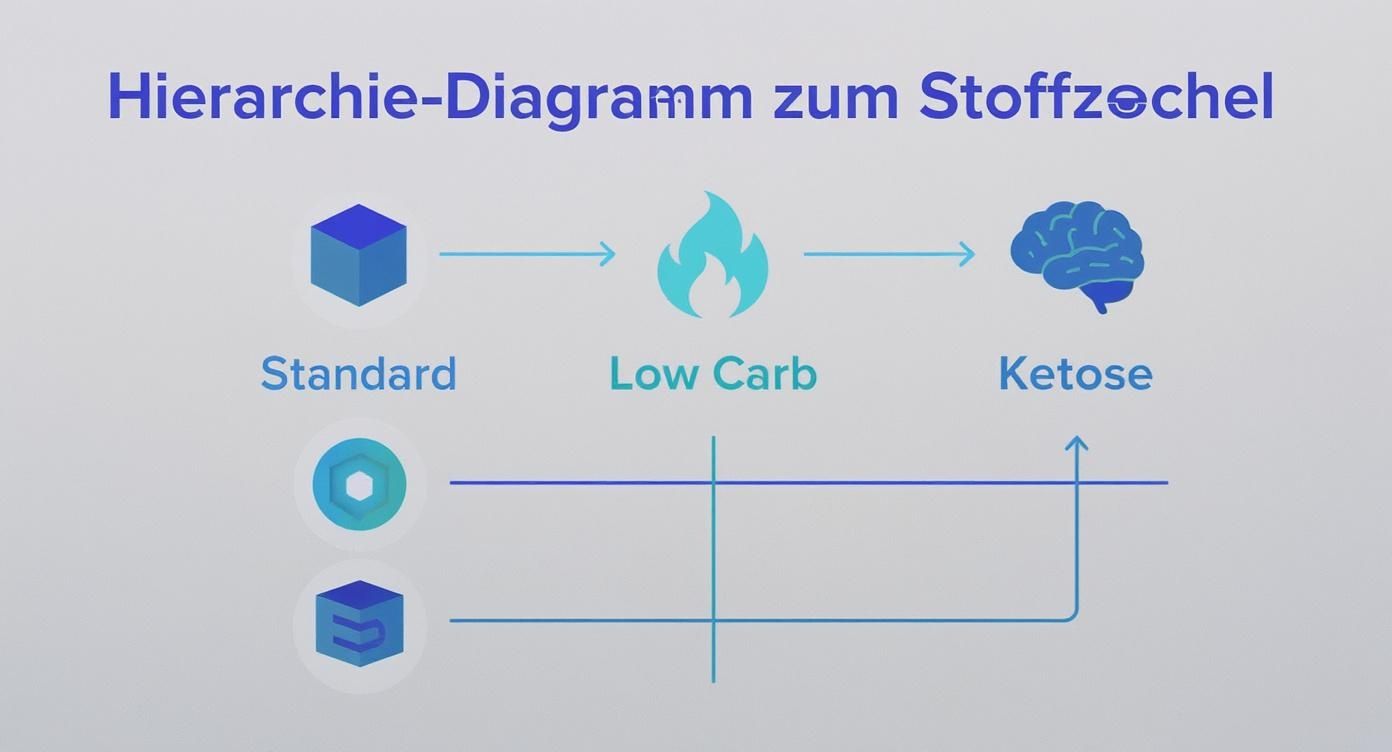
You can clearly see the transformation here: away from the standard diet (sugar as the primary energy source) toward using fat as a clean fuel (the flame), and in the next step even toward ketosis, where your brain itself switches to this highly efficient fuel.
The key to success is simple: Processed carbohydrates and sugar have to go. Specifically, that means less bread, pasta, rice, potatoes, and, of course, sweets.
These are exactly the foods that send your blood sugar on a roller coaster and trigger constant cravings. By reducing them, you finally give your body the chance to switch into a stable fat-burning mode.
Food overview for starting your low-carb journey
This table shows you which foods to prioritize and which to reduce to successfully get started with a low-carb diet.
| Foods to prioritize | Foods to reduce |
|---|---|
| Meat, fish & seafood | Bread, pasta & pastries |
| Eggs in all varieties | Rice, potatoes & grains |
| Green vegetables (spinach, broccoli) | Sugary drinks & juices |
| Avocado, olives & nuts | Sweets, cake & ice cream |
| High-quality oils (olive and coconut oil) | Fruit with a high sugar content (bananas) |
| Berries in moderation (raspberries) | Processed convenience foods |
Of course, this list is only a starting point. The more consistently you stick to the left column, the sooner you will feel the positive effects.
You can find a detailed overview that makes shopping much easier in our comprehensive guide to suitable low-carb foods. We have listed everything for you there.
How your body benefits from fewer carbohydrates
Why do so many people swear by low carb? The answer is simple: The benefits go far beyond simply losing weight. When you give your body fewer carbohydrates, you trigger a whole cascade of positive effects that can fundamentally improve your well-being.

Perhaps the most important point is the stabilization of your blood sugar level. If you eat a lot of carbohydrates, your blood sugar shoots up—only to crash again shortly afterward. You surely know this constant up and down: it leads to fatigue, difficulty concentrating, and the dreaded afternoon cravings.
A low-carb diet breaks this vicious cycle. Since proteins and fats have little effect on blood sugar, your energy level remains much more stable throughout the day. Sudden cravings for something sweet? Often a thing of the past.
More Than Just Weight Loss
But you don’t feel the positive effects only in everyday life. In the long term, you do your metabolic health a huge favor.
- Improved insulin sensitivity: Your body no longer has to constantly produce huge amounts of insulin to control blood sugar. This can significantly reduce the risk of metabolic diseases such as type 2 diabetes.
- Mental clarity: Many people report better focus and less “brain fog.” No wonder—your brain loves the steady energy supply from fats and the ketones produced when burning fat.
- Reduced inflammation levels: A diet rich in sugar and simple carbohydrates can fuel low-grade inflammation in the body. Low carb helps reduce these inflammatory markers.
By switching to fat as your primary energy source, you give your body the opportunity to regulate itself. You take a proactive role in your health and strengthen your well-being from the inside out.
This switch from sugar-burning to fat-burning mode is the central mechanism. If you want to explore the topic in more depth, read our article about how you can intentionally switch your metabolism to fat burning.
By reducing carbohydrates, you signal to your body that it can finally tap into its huge energy reserves—your body fat. This makes low carb not only an effective way to lose weight, but also a holistic strategy for greater vitality and health.
Which low-carb approach is really right for you?
You can already see: low carb is not always the same. Forget rigid rules or complicated plans. Think of it instead as a kind of building-block system from which you select exactly the pieces that fit your life, your everyday routine, and your goals.
There is no single right way—only the right way for you. Whether you start moderately or choose the strict version right away depends entirely on your body, your lifestyle, and your personal goal. But the basic idea always remains the same: fewer carbohydrates. The “how much” makes all the difference.
From moderate to strict keto
Broadly speaking, there are three main approaches, which differ in how many carbohydrates end up on your plate each day:
-
Moderate low-carb diet: Here, you consume around 50 to 130 grams of carbohydrates per day. This approach is perfect for getting started because it is less strict and still allows you a good selection of vegetables and even small amounts of fruit. You experience the positive effects without having to turn your whole life upside down.
-
LCHF (Low-Carb High-Fat): With this version, you reduce your carbohydrate intake to less than 50 grams per day. The name says it all: The focus is clearly on healthy fats, which become your body's new primary energy source.
-
Ketogenic diet (keto): This is the strictest form. Only 20 to 30 grams of carbohydrates per day are allowed. The goal? To bring your body into what is known as ketosis—a metabolic state in which it primarily burns fat instead of sugar. If you want to delve deeper into the topic, our article on the keto diet explains everything you need to know.
What is your goal? Do you want to lose weight quickly and completely reset your metabolism? Then keto could be interesting for you. Are you looking for a sustainable, healthy lifestyle that you can maintain over the long term? Then a moderate approach is often the better and more relaxed path.
By the way, the low-carb idea is not a new trend in Germany. It became known through the Atkins diet as early as the 1970s. Today, scientific studies generally define low carb as a diet containing less than 130 grams of carbohydrates per day, while very strict forms such as LCHF set the limit at less than 50 grams. You can find out more about the history and definition of low carb if you want to understand the background in greater detail.
Successfully following a low-carb diet in everyday life
The theory sounds great, but in practice things often look different. How can you really stick to a low-carb diet when your everyday life consists of the cafeteria, the bakery around the corner, and pasta parties with friends? Don't worry—with a few clever tricks, it will be much easier than you think.

The key to success is good preparation. Meal prep is your best friend, so you don't fall into the carb trap on stressful days. Simply set aside some time on the weekend, cook larger portions of chicken, fish, and vegetables in advance, and put together your meals for the next few days. That way, you'll always have something healthy on hand.
Smart Tips for Everyday Life
The change begins when you shop. Make it a habit to read labels to uncover hidden sugar. You'll be amazed at where it hides—even in savory products.
Eating out is not a problem either. In most restaurants, you can simply replace side dishes such as potatoes, fries, or rice with a side salad or an extra portion of vegetables. Don't hesitate to ask—many kitchens are very flexible these days.
The biggest hurdle is often not the diet itself, but the power of habit. It is about developing new routines that are good for you and fit effortlessly into your life.
This is a real challenge, especially in Germany. Only around 2% of Germans meet the criteria for a healthy lifestyle, which of course includes their diet. At the same time, awareness is growing: more and more people are consciously buying sugar- and fat-reduced products. If you would like to learn more about the challenges and trends in Germany, you can find fascinating insights here.
To make your meals truly satisfying and nutrient-rich, high-quality proteins are essential. They keep you full for longer and help prevent cravings.
A very simple way to increase your protein intake is to smartly enhance your dishes. A high-quality collagen powder like 'Collagen Protein' from mybody-x.com is flavorless and mixes perfectly into shakes, yogurt, or even your morning coffee. This way, you start the day with plenty of protein without consuming unnecessary carbohydrates, while also supporting your skin, hair, and joints.
Your most frequently asked questions about a low-carb diet
A new way of eating always raises questions. So, to wrap things up, we want to address the ones that may still be on your mind. Here, we dispel myths and give you clear, concise answers so you can get started safely and with confidence.
Is a low-carb diet suitable for everyone?
For the vast majority of healthy adults, low carb is a safe and highly effective way to manage your weight or simply feel better. However, your health should always come first.
If you have pre-existing conditions such as kidney disease or diabetes, are pregnant, or are breastfeeding, you should always discuss such a major change with your doctor or a nutritionist first. This will ensure that the method works optimally for you and that you avoid risks.
Do I have to give up fruit completely on a low-carb diet?
No, absolutely not! It is not about giving up radically, but about making smart and conscious choices. Many fruits are true nutritional powerhouses, but some also contain a lot of sugar.
- Ideal for low carb: Berries such as raspberries, strawberries, or blueberries are relatively low in sugar and packed with important antioxidants. They fit perfectly into a moderate low-carb plan.
- Enjoy in moderation: However, you should consider sugary fruits such as bananas, grapes, or mangoes an occasional treat.
The key lies in balance. You do not have to give up everything. Instead, you learn to choose the foods that best support your goals.
How do I deal with the “low-carb flu”?
Perhaps you have already heard of the so-called “low-carb flu” or “keto flu.” It may sound alarming at first, but it is a completely normal process. During the first few days of the transition, symptoms such as headaches, fatigue, or irritability may occur.
It simply means that your body is currently switching its metabolic engine from sugar to fat. To make this phase as comfortable as possible, you should focus on two things: drinking enough and replenishing your electrolytes. A pinch of good salt in your water or a hearty, homemade broth can work wonders here and give your body exactly what it needs during this transition.
What role does protein play in a low-carb diet?
Proteins are your most important allies on this journey. They are absolutely crucial to success because they keep you feeling full for a long time and thereby prevent cravings.
They also protect your valuable muscle mass, especially if you want to lose weight. High-quality, low-sugar protein sources are therefore the foundation of a balanced low-carb diet. With enough protein, you feel energized and satisfied while your body burns fat.
Would you like to understand exactly how your body responds to certain diets and what type of metabolism you have? The tests from mybody-x.com provide scientifically based insights into your body, enabling you to tailor your diet perfectly to your individual needs. Find out what really works for you and take control of your health at https://mybody-x.com.



Share now:
The Best Metabolism Tests 2025 – Expert Comparison
What is the yo-yo effect? Recognize the causes and maintain your weight long term