

Why Dieting Without Testing Fails: The Real Reasons
A diet without an individual analysis usually fails because it simply ignores the personal causes of excess weight and instead relies on blanket restriction. Anyone who simply eats less without understanding why the body reacts the way it does is fighting against themselves. Classic diet programs such as low-carb diets, intermittent fasting, or calorie-deficit plans work in the short term for many people. In the long term, however, research paints a different picture: behavior, daily life, and psychology determine success or failure—not the choice of diet. So the reason dieting without testing fails has less to do with missing lab values than with a lack of practicality in everyday life.
Why does dieting without testing fail so often?
Classic diets fail because of severe restriction, which leads to the yo-yo effect through intense cravings. This is not a failure of willpower. It is biology. When the body consistently receives less energy than it needs, it responds with stronger hunger signals and a reduced basal metabolic rate. The brain interprets calorie reduction as a threat and counteracts it.
Then there is the psychological side. Many diets only change eating habits temporarily, not the underlying causes such as stress or reward systems. Anyone who eats out of frustration in the evening will still do so after three weeks of dieting. The diet has not changed the pattern; it has only suppressed it.

The Yo-Yo Effect: What Really Lies Behind It
The yo-yo effect is real, but less dramatic than it is often portrayed. Recent assessments by the German Center for Diabetes Research show that the yo-yo effect does not cause lasting damage such as muscle loss or a permanently slowed metabolism. This is good news. It means that anyone who starts again after a failed diet does not begin in a worse position than before.
What nevertheless makes the yo-yo effect problematic is the psychological exhaustion. Repeated failure lowers motivation for the next attempt. And this is precisely where the real problem lies: not in the body, but in confidence in one's own ability to change.
The most common mechanisms that cause diets without planning to fail:
- Too large a calorie deficit leads to cravings and low energy after just a few weeks
- A lack of satiety strategies turns hunger into a constant state instead of an exception
- Unchanged eating habits combined with restriction create inner resistance
- Unrealistic expectations make normal plateaus feel like failure
- Not knowing how to handle relapses turns a bad day into surrender
Pro tip: Plan a “flex day” each week from the outset, when you deliberately take it easier. This reduces psychological pressure and increases the likelihood that you will maintain your routine during the other six days.
Are personalized tests really the key to success?
Personalized tests such as DNA analyses or microbiome examinations promise a great deal. The reality is more nuanced. Genetic tests usually produce only minor effects; weight loss is primarily achieved through a calorie deficit and behavioral change. This does not mean that tests are worthless. But anyone who takes a DNA test and then changes nothing about their everyday life has not invested their money wisely.
There is simply no reliable evidence that biomarker-based nutrition approaches are more successful in the long term for healthy people than conventional strategies. Short-term metabolic reactions can be observed. Long-term effects have not yet been demonstrated. This is the current state of scientific knowledge.
What tests can and cannot do
| What tests can do | What tests cannot replace |
|---|---|
| Detect nutrient deficiencies | Behavior change in everyday life |
| Show genetic tendencies | Consistent implementation |
| Identify intolerances | Stress management |
| Clarify individual starting point | Long-term motivation |
| Provide targeted recommendations | Integrating habits into everyday life |
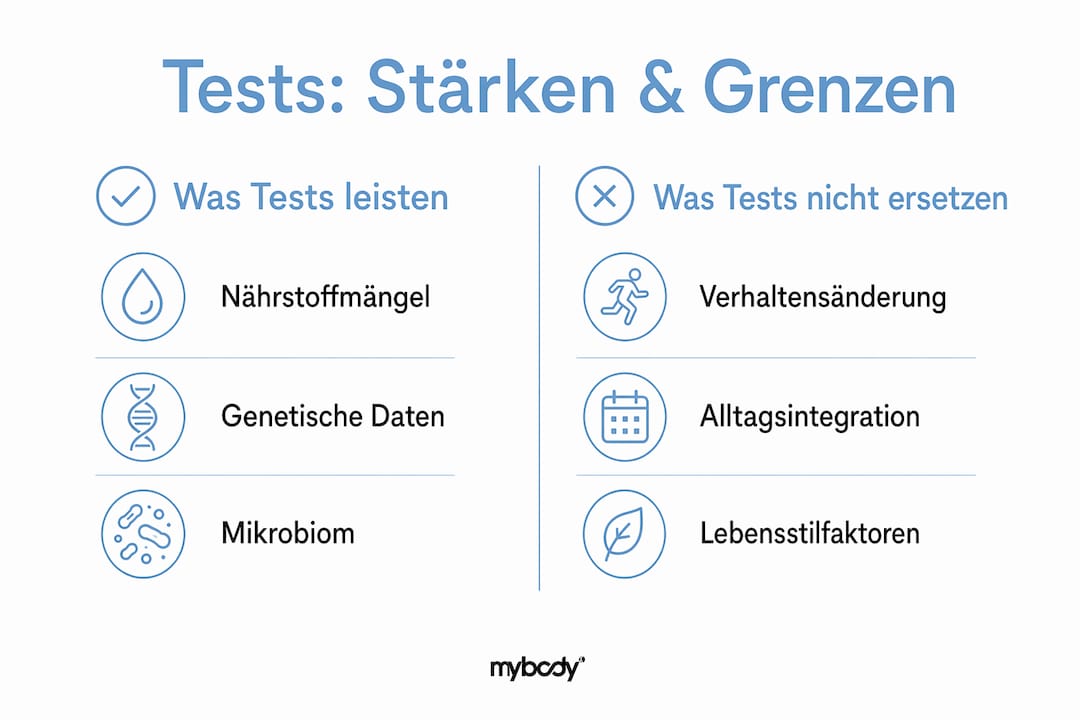
Lab tests are medical tools. They offer no clear advantage in everyday life for healthy people if they are not put into practice. Anyone who uses a DNA test to postpone the work of changing their behavior is using the tool incorrectly. Tests can help define the starting point more precisely. You have to take the journey yourself.
In everyday life, the effects of genetic variants are largely overshadowed by lifestyle factors. In other words: Poor sleep, chronic stress, and little exercise can derail even the best-intentioned nutrition plan, no matter how personalized it is. This overview of DNA tests explains more about how DNA tests can be used sensibly in nutrition.
Why do diets fail so quickly in everyday life?
The most important success variable in a diet is adherence—the ability to follow the rules over the long term—not the exact macronutrient distribution or the choice of a trendy diet. This is especially clear with strict approaches. With time-restricted eating, also known as Time-Restricted Eating, only 7.7% of participants maintain the method over the long term. The tighter the rules, the sooner the routine breaks down.
Everyday life is not a laboratory. Stress, illness, travel, invitations to meals, poor sleep: all of these happen. A diet that works only under ideal conditions is not a diet that works.
The four biggest everyday barriers
- Stress and exhaustion reduce the ability to make conscious decisions. After a long day at work, tired people reach for what they are used to, not what they planned.
- Social situations such as restaurant visits or family celebrations can derail rigid plans. Anyone without flexible rules will fail at the first birthday cake.
- Lack of routine turns healthy eating into a daily decision-making task. Decisions consume energy. Routines do not.
- Unrealistic expectations about timing make plateaus feel like failure. Fat loss is slow. People who see no change after two weeks often give up, even though their bodies have already begun to respond.
Pro tip: Write down three specific situations in which you typically fail, for example “Alone at home in the evening” or “After working overtime.” Then think of one simple alternative action for each situation. This is not a diet plan, but behavioral design.
Strict diet rules lead to low adherence, and low adherence reinforces the vicious cycle of failure. Anyone who has “failed” once tends to write off the entire day or week. This all-or-nothing thinking is one of the most common reasons for unsuccessful diets.
Which strategies really work in the long term?
The only thing that works permanently is what can be integrated into everyday life and maintained over the long term. That may sound banal, but it is the core of every successful dietary change. No plan survives its first contact with real life if it allows no exceptions.
Realistic target margins, saturation strategies, and flexibility are crucial for long-term success. Specifically, this means that anyone who completely eliminates their favorite food will eventually eat it in large quantities. Those who plan it in moderation remain more stable over the long term.
What really helps: Concrete approaches
- Keep your favorite foods, but adjust portion sizes. Bans create cravings.
- Take sleep seriously. Poor sleep increases hunger hormones and reduces impulse control; this is not a myth.
- Make exercise a habit, not a punishment. Three short walks a day have a greater effect than one weekly ordeal at the gym.
- Plan for plateaus. After 4–6 weeks, almost everyone's weight stagnates. That is normal. Those who know this do not give up.
- Treat relapses as data. A bad day shows which situation is difficult, not that the person has failed.
| Strategy | Why it works |
|---|---|
| Flex rules instead of bans | Reduces psychological pressure and cravings |
| Optimize sleep | Directly regulates hunger and satiety hormones |
| Build routines | Saves decision-making energy for difficult moments |
| Plan for plateaus | Prevents frustration and giving up prematurely |
| Analyze relapses | Makes weaknesses visible instead of creating shame |
Many people expect quick results and ignore the fact that fat loss happens slowly. Perseverance is more important than perfection. Anyone who internalizes this has already taken the most important step. You can also find tips for maintaining a stable weight after a diet in this guide to avoiding the yo-yo effect.
Managing expectations is crucial. Anyone who knows from the outset that plateaus are normal will not interpret them as failure. Anyone who knows that a relapse is not the end will get back on track. This is not a motivational speech. It is psychology.
Key insights
Diets do not fail because of a lack of testing, but because of poor practicality in everyday life, unrealistic expectations, and insufficient flexibility in implementation.
| Topic | Details |
|---|---|
| Main cause of failure | Overly strict rules and a lack of integration into everyday life significantly reduce adherence. |
| The role of tests | DNA and biomarker tests provide insights, but they do not replace behavior change. |
| Yo-yo effect | Does not cause lasting damage, but weakens motivation for future attempts. |
| Adherence as the key | The ability to stick to a strategy long term is more important than the diet itself. |
| Practicality in everyday life | Flex rules, sleep, and routines are concrete levers for sustainable success. |
What I really think after years of working with diet data
At mybody x, we see every day what happens when people are holding a test result but do not know what to do with it. The result ends up in a drawer. The old routine remains. This is not an accusation; it is a systemic problem.
The honest truth: A DNA test or microbiome report is not a nutrition plan. It is a starting point. Anyone who believes a test means the work is done will be disappointed. Anyone who uses it to get started more strategically and then sticks with it consistently has a real advantage.
What bothers me about the current debate is the hype around personalization without a focus on implementation. Many providers sell tests as the solution. But the solution is behavior. Tests can inform behavior. They cannot replace it.
What really matters: If you know your daily routine, identify your weak points, and have a strategy that still works under stress, you do not need a perfect plan. You need one that is good enough. And the courage to simply keep going after a setback.
— mybody x
mybody x: When you want more than just a diet
Anyone who wants to understand what is really going on in their body will find an offering at mybody x that goes beyond generic nutrition advice. mybody x's ISO-certified laboratory analyses reveal nutrient deficiencies, genetic tendencies, and metabolic characteristics that often go unnoticed in everyday life.

The difference: The results come with specific nutrition recommendations that can be integrated into everyday life, not abstract lab values without context. More than 11,300 satisfied customers and a 4.77-star rating speak for themselves. Anyone curious about what lies behind their previous dieting attempts can start with a targeted analysis at mybody-x.com that provides real answers.
FAQ
Why do most diets fail in the long term?
Most diets fail because they are too strict and cannot be integrated into everyday life. Adherence is the decisive factor, not the choice of diet type.
Does a DNA test really help with weight loss?
A DNA test can reveal genetic tendencies, but it does not replace behavior change. Genetic effects are strongly overshadowed by lifestyle factors in everyday life.
What is the yo-yo effect, and how dangerous is it?
The yo-yo effect describes weight regain after a diet. According to current research, it does not cause lasting physical harm, but it does weaken motivation for future attempts.
How many people actually stick with strict diets?
With time-restricted eating, only 7.7% stick with the method long term. The stricter the rules, the faster the routine breaks down.
What matters more: the right diet plan or following through?
Implementation matters more. A flexible plan you follow 80% of the time beats any perfect plan you abandon after three weeks.
Recommendation
- Losing weight genetically: How a DNA test can really help – mybody®x
- Metabolic analysis for weight loss: Your path to your desired weight – mybody®x
- Losing weight without giving things up really works: How to find your balance – mybody®x
- Metabolism testing for weight loss: Your personal guide to success – mybody®x



Share now:
Self-diagnosis feature: Understand your health proactively
Find out your metabolic type: Your guide for 2026