

Healthy Eating: The ABCs of Nutrition
Few topics are as overloaded with terminology as nutrition: glycemic index, nutrient density, NOVA, reference values. Anyone who wants to know what healthy eating means first stumbles over terms—and then over contradictory advice.
Healthy eating is not a list of permitted foods, but a pattern over weeks. The German Nutrition Society (DGE) describes it using a few key points: predominantly plant-based, favor whole grains, eat vegetables and fruit every day, regularly eat legumes and nuts, use plant oils instead of solid fats, eat little meat, sugar, and salt, and drink mostly water. Everything else is detail.
Use this article as a reference guide: first the DGE recommendations, then the ABCs of nutrition from amino acids to sugar, followed by critical nutrients, everyday practicalities, and how to interpret blood test results.
What to expect in this article
What does the DGE specifically recommend?
The ABCs of nutrition: A to L
The ABCs of Nutrition: M to Z
Which nutrients are critical in Germany?
How can this become a sustainable everyday routine?
This is how you see where you really stand
Context: What a test can—and cannot—do
Conclusion
Frequently asked questions (FAQ)
Sources
First, the building blocks of every meal. The values apply to healthy adults and are intended as guidelines:
| Building block | Function in the body | DGE reference value (adults) | Good sources |
|---|---|---|---|
| Carbohydrates | Source of energy for the brain and muscles | More than 50% of energy intake | Whole-grain bread, oats, potatoes |
| Protein | Building material for muscles, enzymes, and hormones | 0.8 g per kg of body weight (1.0 g from age 65) | Legumes, dairy products, eggs, fish |
| Fat | Carrier of fat-soluble vitamins, energy storage | Around 30% of energy intake | Rapeseed oil, olive oil, nuts, oily sea fish |
| Fiber | Food for gut bacteria, longer-lasting satiety | At least 30 g per day | Whole grains, legumes, vegetables, nuts |
| Water | Transport medium for every metabolic process | Around 1.5 liters of beverages per day | Water, unsweetened tea |
Four principles underpin almost all dietary recommendations:
Pattern rather than individual cases
What matters is not the individual meal, but what is on your plate over the course of weeks.
Predominantly plant-based
According to the DGE, vegetables, fruit, whole grains, legumes, and nuts should make up the largest proportion by quantity.
Practical rather than perfect
A diet only works if you can stick to it: practicality beats strictness.
Nutrients requiring attention
Vitamin D, iodine, folate, iron, B12, and omega-3 deserve attention in Germany.
What does healthy eating actually mean?
Healthy eating refers to a pattern that reliably supplies the body with energy, protein, fats, vitamins, minerals, and fiber while keeping the risk of diet-related diseases low. The key word is pattern: recommendations apply to the overall composition over weeks, not to individual foods.
Whether you eat a frozen pizza on a Tuesday evening is irrelevant to your health. Whether it is your standard dinner is not. This dissolves the question of “good” and “bad” foods: what matters is frequency, quantity, and what the food replaces.
Key message: Healthy eating is a pattern, not a moral judgment. What matters is the overall composition over weeks – not an individual meal or the name of an ingredient on the packaging.
Why there is no “one right” dietary approach
Very different dietary styles can be beneficial: a Mediterranean diet, a vegetarian or well-planned vegan diet, or an omnivorous diet with plenty of vegetables. Their similarities outweigh their differences – plenty of plant foods, little highly processed food, and moderate amounts of sugar and salt. Age, activity level, pregnancy, and illnesses only modify this in certain details.
Why clean-eating rules often backfire
Strict purity rules – “nothing processed,” “no carbohydrates after 6 p.m.” – rarely last long and promote all-or-nothing thinking. Small, repeatable changes are more effective: replacing white bread with whole-grain bread and adding legumes twice a week measurably changes nutrient intake.
What does the DGE specifically recommend?
The German Nutrition Society (DGE) translates scientific reference values into food-based recommendations: how often and how much you should eat from each food group. What is new is that environmental impact is also taken into account alongside health. The following summary conveys them in essence.
A summary of the DGE recommendations in essence
- ✓ Eat vegetables and fruit daily – at least five servings
- ✓ Choose whole grains – bread, pasta, oatmeal
- ✓ Eat legumes at least once a week – lentils, beans, chickpeas
- ✓ Eat a small handful of nuts daily – unsalted
- ✓ Consume milk and dairy products daily – sources of calcium and iodine
- ✓ Eat fish once or twice a week – including oily sea fish
- ✓ Limit meat and processed meat – no more than 300 grams per week
- ✓ Prefer plant-based oils – especially rapeseed oil, as well as flaxseed and olive oil
- ✓ Drink around 1.5 liters daily – preferably water
- ✓ Use sugar- and salt-rich products sparingly – as a supplement, not a staple
According to the World Health Organization (WHO), adults should consume less than 5 grams of salt per day, equivalent to around 2 grams of sodium. However, according to the Robert Koch Institute (RKI, 2016), the estimated daily sodium intake in Germany had a median of 4.0 grams for men and 3.4 grams for women.
How the DGE reference values differ from the recommendations
Reference values quantify how many milligrams or micrograms of a nutrient a group needs on average; recommendations translate this into portions. For everyday life, the second level is more useful: no one eats micrograms; everyone eats meals.
The ABCs of nutrition: A to L
The following glossary explains the terms you encounter on packaging and in nutrition texts—each entry is understandable on its own.
A for amino acids
Amino acids are the building blocks of proteins; the body cannot produce nine of them itself. Grains and pulses complement each other particularly well in their amino acid profiles—lentils with bread.
B for fiber
Fiber consists of indigestible plant components; it regulates digestion, prolongs satiety, and has beneficial effects on blood sugar and blood lipids. The DGE specifies at least 30 grams per day, while the EFSA specifies 25 grams. Soluble bulking agents such as psyllium husk bind water and require sufficient fluids.
C for cholesterol
The body needs cholesterol for cell membranes, bile acids, and hormones—and produces most of it itself. For blood cholesterol levels, fat quality matters more than the amount of cholesterol: saturated fatty acids affect LDL more strongly than foods such as eggs.
D for gut microbiome
The gut microbiome is the totality of microorganisms in the intestine; fiber is their food source. The practical lever is plant diversity over the course of the week, not quantity alone.
E for protein
Protein is the building material for muscles, enzymes, hormones, and antibodies. According to the DGE, the reference value for people aged 19 to 65 is 0.8 grams per kilogram of body weight, and 1.0 grams from age 65 onward.
F for fats and fatty acids
Fat provides energy, transports vitamins A, D, E, and K, and builds cell membranes. The DGE states that fat should account for around 30 percent of energy intake, linoleic acid for 2.5 percent, and alpha-linolenic acid for 0.5 percent.
Key point: For fat, quality matters more than quantity. Replacing saturated with unsaturated fatty acids—butter with rapeseed oil—works better than cutting fat indiscriminately.
G for glycemic index
The glycemic index describes how much a food raises blood sugar compared with glucose. Portion size, preparation, fat, protein, and fiber can change it significantly—making it of little use as a measure.
P for pulses
Pulses—lentils, beans, chickpeas, soy—combine protein with fiber, iron, folate, and potassium. The DGE recommends at least one serving per week.
I for iodine (Jod)
Iodine is a trace element that the thyroid needs to produce its hormones. Because the soil in Germany is low in iodine, iodized salt, sea fish, dairy products, and eggs are the most important sources.
According to the German Nutrition Society (DGE, 2025), the reference value for iodine intake in adults is 150 micrograms per day. At the same time, around 32 percent of adults and 44 percent of children and adolescents in Germany are at risk of insufficient iodine intake.
J like Yo-Yo Effect
The yo-yo effect describes repeated weight gain after a diet; contributing factors include reduced energy expenditure and rules that cannot be maintained.
K like Carbohydrates
Carbohydrates are the most important source of energy for the brain and muscles; the DGE assumes they provide more than 50 percent of energy intake, while the EFSA specifies 45 to 60 percent. The source is crucial: Whole grains and legumes provide dietary fiber.
L like Food Processing (NOVA)
The NOVA classification categorizes foods according to their degree of industrial processing. Processing is not inherently unfavorable: Frozen vegetables, whole-grain flour, and plain yogurt are processed and beneficial.
The ABCs of Nutrition: M to Z
The second half helps with interpreting labels and advertising claims.
M like Micronutrients
Micronutrients are vitamins, minerals, and trace elements: They provide no energy but regulate countless metabolic processes. Because they are widely distributed, variety is the best strategy for meeting nutritional needs.
N like Nutrient Density
Nutrient density describes how many vitamins, minerals, and dietary fibers a food provides per calorie. Vegetables, legumes, and whole grains have high nutrient density, while confectionery has low nutrient density.
O like Omega-3 Fatty Acids
The plant-based alpha-linolenic acid is found in flaxseed, rapeseed, and walnut oils; the long-chain forms EPA and DHA are found in fatty sea fish and microalgae oil. Because the body converts only a limited amount, both sources count.
According to the European Food Safety Authority (EFSA), the adequate intake of EPA and DHA for adults is 250 milligrams per day. The DGE therefore recommends eating fish once or twice a week, including fatty sea fish.
P like Portion Sizes
Portion sizes are best described using your own hand as a guide: a handful of vegetables, a small handful of nuts, or your palm without the fingers for fish or meat.
R like Reference Values
Reference values indicate the intake that adequately meets the needs of practically all healthy people in a group. They include a safety margin—falling below them on individual days does not mean you have a deficiency.
S like Salt and Sodium
Table salt consists of sodium and chloride; both can be converted using a factor of 2.5. The largest share comes from bread, cheese, sausages, and ready-made meals—not from the salt shaker.
T for fluid intake
The DGE recommends that adults drink around 1.5 liters per day; the need increases in hot weather, fever, or during exercise. An everyday indicator is urine color: pale yellow is unremarkable, while dark yellow is a warning sign.
U for ultra-processed food
This refers to the highest NOVA level: products made mostly from isolated ingredients and additives. Observational studies find associations with unfavorable outcomes; because these products also tend to provide a lot of sugar, salt, and saturated fat, the contribution of the processing itself remains unclear.
V for vitamins
Thirteen vitamins are considered essential and are classified by solubility: the fat-soluble vitamins A, D, E, and K require fat for absorption and are stored, while the water-soluble B vitamins and vitamin C require regular intake.
Z for sugar
Free sugars include all added sugars as well as the sugar in honey, syrups, and juices—not the sugar in whole fruit and milk. The WHO recommends less than 10 percent of energy intake, which is around 50 grams at 2,000 kilocalories.
Key message: Almost all terms in the nutrition ABC come down to three levers: more plant diversity and fiber, better fat quality, and less free sugar and salt.
Which nutrients are critical in Germany?
Nutrients are considered critical when a significant proportion of the population does not reach the reference values—not when the majority has a deficiency.
Vitamin D: the sunshine vitamin with a winter gap
The body produces vitamin D in the skin with sufficient UV-B exposure; in Germany, sunlight is insufficient for this from October to March. Obtaining enough through food is difficult—significant amounts are found only in oily seafood, egg yolks, and some edible mushrooms.
According to the Robert Koch Institute (RKI, 2016), based on the DEGS1 study, around 30.2 percent of adults in Germany had an inadequate vitamin D supply (25-hydroxyvitamin D below 30 nmol/l). The DGE estimates that 20 micrograms (800 International Units) per day are needed when the body is unable to produce vitamin D itself.
Supplementation may be advisable, but not based on guesswork or at high doses without medical supervision: determine your status and agree on the dosage with a doctor.
Iodine: the thyroid and table salt
The DGE adjusted the reference value to 150 micrograms per day in 2025. In practical terms: use iodized table salt, look for iodized salt in bread and sausage, and regularly eat dairy products and seafood. Pregnant and breastfeeding women and people with thyroid disease should discuss their intake with a doctor.
Folate and folic acid: especially before pregnancy
Folate is needed for cell division and blood formation; the DGE reference value is 300 micrograms of folate equivalents per day, and good sources include green vegetables, legumes, whole grains, and oranges. According to the DGE, women who want to become pregnant should additionally take 400 micrograms of folic acid daily, starting four weeks before pregnancy and during the first trimester.
Iron: increased needs for people who menstruate
Iron is needed to transport oxygen in the blood; people who menstruate regularly lose blood and therefore iron.
According to the German Nutrition Society (DGE, 2025 reference values), the reference value for iron is 16 milligrams per day for premenopausal women, 11 milligrams for men, and 27 milligrams during pregnancy.
Plant-based iron from legumes, oats, and pumpkin seeds is absorbed better when vitamin C is included; coffee and black tea with meals inhibit absorption. Iron supplements should be taken only after blood test results indicate a need.
Vitamin B12: essential for a vegan diet
Vitamin B12 occurs in usable amounts practically only in animal-based foods; the DGE estimate is 4.0 micrograms per day. With a fully plant-based diet, the DGE says a B12 supplement is required – sauerkraut, nori, and shiitake contain only B12-like compounds that do not contribute to nutritional intake.
Omega-3: EPA and DHA without fish
People who rarely eat fish are unlikely to reach the 250 milligrams of EPA and DHA per day cited by EFSA. A practical approach is to use rapeseed, flaxseed, or walnut oil every day and consider microalgae oil when following a vegan diet.
How can this become a sustainable everyday routine?
The transition from knowledge to habit works most reliably through additions rather than prohibitions: Prohibitions focus attention on precisely what is forbidden, while additions quietly change the pattern.
Key message: There are no forbidden foods, only foods that should appear on the plate frequently and those that are best kept occasional. It is the overall distribution that matters, not a single purchase.
Why “good” and “bad” foods are not a helpful classification
A moral classification does not reflect the evidence: Nutrition studies examine patterns over years, and the effects of individual foods are small. Thinking about food in terms of guilt and reward does not lead to better eating, either. If thoughts about food occupy a large part of the day or make social situations difficult, professional support may be helpful.
Practical adjustments for everyday life
- ✓ Start with beverages – sugary drinks are the largest single source of free sugars
- ✓ Switch bread and side dishes to whole-grain options – the same effort, more fiber
- ✓ One fixed legumes day per week – for example, lentil soup or chickpea curry
- ✓ Oil instead of solid fats – rapeseed oil as the standard, flaxseed oil cold
- ✓ Plan vegetables first – start with them when cooking
What labels really tell you
The ingredients list is arranged in descending order by quantity—what appears first is present in the greatest amount; sugar may appear there as glucose syrup, dextrose, or maltodextrin. Marketing claims such as “No added sugar” or “high protein” describe only individual characteristics.
This is how you see where you really stand
The quality of a diet is not measured by a blood count. To see whether your eating pattern follows the recommendations, take an honest look at a typical week: how often you eat vegetables, whole grains, and legumes, and how many sugary drinks and ready-made meals you consume.
For individual nutrients, a blood test can supplement this self-check—especially where nutritional status is difficult to assess: vitamin D, vitamin B12, folate, and ferritin as an indicator of iron stores.
Three neutral quality criteria apply: analysis in a certified laboratory, transparent reference ranges on the report, and GDPR-compliant handling of data. According to its own information, mybody® (MYBODY Lab GmbH) meets these criteria.
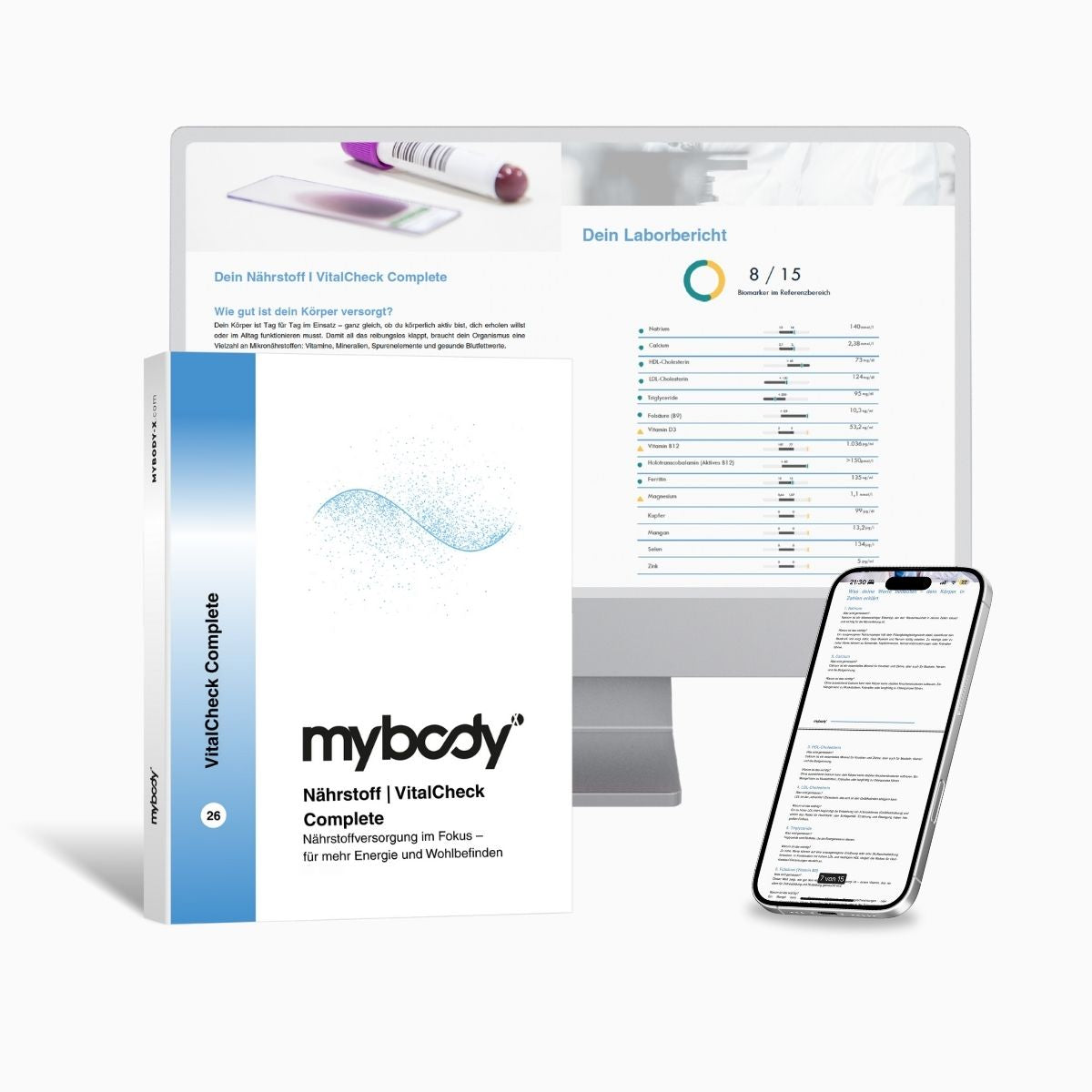
Nutrient | VitalCheck Complete
15 blood values from an at-home capillary blood sample: 25-OH vitamin D3, vitamin B12, transcobalamin, folate, and ferritin, as well as calcium, magnesium, sodium, zinc, selenium, copper, manganese, and the blood lipids HDL, LDL, and triglycerides—markers that no food diary can provide.
Price: €169.00 (instead of €199.00) · Sample type: Capillary blood (at home) · Processing time: approx. 10–15 business days · Laboratory: ISO-certified, GDPR-compliant
View the Nutrient CheckAn honest assessment: Such a test shows a snapshot of 15 markers at one point in time. Iodine and the omega-3 fatty acids EPA and DHA are not included. It replaces neither nutritional counseling nor medical evaluation, and it does not answer whether your overall dietary pattern is beneficial.
Information on price, sample type, processing time, and markers comes from the mybody® product page (as of July 2026) and may change. A self-test is not a substitute for a medical diagnosis.
Context: What a test can—and cannot—do
A blood test provides a snapshot of individual nutrients: It shows whether vitamin D, vitamin B12, folate, or ferritin levels fall within the reference range and helps prevent taking supplements without a clear reason.
What it cannot do is assess the quality of your diet. There is no laboratory value for “sufficient fiber”—that requires a food diary and professional evaluation.
Blood values are also snapshots and are influenced by factors unrelated to diet—for example, inflammation, which can raise ferritin, or the season in the case of vitamin D.
A single result never answers the question of cause either: Low ferritin may be due to diet, heavy menstrual bleeding, or a source of bleeding in the gastrointestinal tract. Determining this is a medical task.
The greatest benefit comes from using the findings as a basis for discussion—with specific numbers, your usual week's diet, and a list of supplements you take. If symptoms persist, during pregnancy, with chronic illnesses, or with highly restrictive dietary patterns, qualified nutritional counseling is the better first step.
Conclusion
Healthy eating fits into one sentence: mainly plant-based, mostly minimally processed, with good-quality fats, sufficient fiber, and little free sugar and salt. All the technical terms in the ABC fit within this basic pattern.
The DGE translates this into everyday quantities: at least five portions of vegetables and fruit daily, favor whole grains, legumes weekly, a small handful of nuts daily, fish once or twice a week, no more than 300 grams of meat and sausage, plant oils, and around 1.5 liters of calorie-free drinks.
Particular attention should be paid here to vitamin D, iodine, folate, iron, vitamin B12, and long-chain omega-3 fatty acids. With a vegan diet, the DGE considers B12 supplementation necessary; when trying to conceive, additional folic acid is recommended.
Practical tip: Start with the foods you already eat every day, add rather than ban foods, and treat lab results as supplementary information—not as a judgment on your diet.
Frequently asked questions (FAQ)
Know your values instead of guessing
The nutrient | VitalCheck Complete measures 15 blood values from a single at-home sample – including vitamin D, vitamin B12, folate and ferritin. A supplement, not a replacement.
View VitalCheck Complete All nutrient testsYou might also be interested in
→ Carbohydrates: good or bad?
Why the source matters more than the amount.
→ Healthy weight loss: what works in the long term
Realistic strategies without forbidden-food lists.
Sources
- German Nutrition Society (DGE): Reference values for nutrient intake – protein, fat and essential fatty acids, carbohydrates, fiber, vitamin D, vitamin B12, folate, iron. dge.de
- German Nutrition Society (DGE): DGE recommendations – food-based recommendations for vegetables and fruit, whole grains, legumes, nuts, dairy products, fish, meat, oils, and beverages. dge.de
- German Nutrition Society (DGE, 2025): “New reference values for iodine intake – iodine more important than ever!” – reference value of 150 µg/day for adults and information on the nutritional supply situation in Germany. dge.de
- World Health Organization (WHO): “Healthy diet” (fact sheet) – recommendations on free sugars, fat quality, salt, and fruit and vegetables. who.int
- European Food Safety Authority (EFSA): Dietary Reference Values – reference values for macronutrients, dietary fiber, and fatty acids, including EPA and DHA. efsa.europa.eu
- Robert Koch Institute (RKI, 2016): Journal of Health Monitoring – fact sheets “Vitamin D status in Germany” and “Sodium intake in Germany” based on the DEGS1 study. rki.de
- Max Rubner Institute (MRI): National Nutrition Survey II – representative survey of food consumption and nutrient intake in Germany. mri.bund.de
The reference and guideline values are based on [1], the food-based recommendations on [2], and the iodine information on [3]. Statements on free sugars, salt, and fruit and vegetables come from [4], the European reference values, including EPA and DHA, from [5], the figures on vitamin D status and sodium intake from [6], and information on dietary behavior from [7]. All values apply to healthy adults. Product information comes from the mybody® product page and may change.

mybody® Editorial & Expert Team
This article was created by the mybody® editorial and expert team, which brings together expertise in nutritional science, micronutrients, blood analysis interpretation, and nutrigenetics. Learn more about our team on our editorial and authors page.
Published on July 27, 2026 · Last updated on July 27, 2026
Medical notice: This article is intended for general information and does not replace medical advice, diagnosis, or treatment, nor individualized nutritional counseling. The reference values stated apply to healthy adults; during pregnancy, in childhood, in the case of chronic conditions, or when taking long-term medication, different recommendations may apply. If symptoms persist or before taking higher-dose supplements, consult a physician or a qualified nutrition professional.



Share now:
Gluten—is intolerance hereditary?
Stress and Cortisol: What Your Genes Reveal About Your Stress Response