
Measuring cholesterol yourself at home: what really matters
The essentials at a glance
Cholesterol can be measured at home from capillary blood, that is, from a few drops obtained by pricking the finger. What matters less is the method than comparability: the same time of day, the same conditions, and the same laboratory. A single value without context says little; two comparable values taken months apart say something.
This article describes the process in four steps and identifies the most common error at each stage. It deals exclusively with measurement. How blood lipid levels can be changed is a separate topic covered elsewhere.
First, you will read what a cholesterol value actually indicates. Then come the cases in which a medical practice is the right choice, the process at home, the four steps in detail, a comparison of the three approaches, and the limitations.
What to expect in this article
1. What a cholesterol value indicates—and what it does not
2. When measuring at home is the wrong approach
3. The four steps at a glance
4. Step 1: Set the timing
5. Step 2: Collect and submit the sample
6. Step 3: Read the values
7. Step 4: Do something with the results
8. Which approach suits which question
9. Which tests also measure blood lipids
10. Who benefits from measuring—and who does not
11. Limitations: what the measurement cannot do
12. What you can do differently starting tomorrow
Frequently asked questions
Sources
What a cholesterol value indicates—and what it does not
Before discussing methods, the basics need to be clarified. Cholesterol is not a foreign substance that the body wants to eliminate, but a building block that it produces itself.
Documented source
“Cholesterol is an important building block in all the body's tissues.”
Institute for Quality and Efficiency in Health Care (IQWiG)
Elevated cholesterol levels, as of 2025
This sentence explains why a cholesterol value should never be considered on its own. It describes an amount, not a disease, and its significance only becomes clear in the context of the other values and your own medical history.
Why there are several cholesterol values
Cholesterol is bound to transport molecules in the blood, and the direction of transport gives the values their names. LDL cholesterol carries cholesterol from the liver to the body, while HDL cholesterol takes up excess cholesterol from the body.
The IQWiG notes that excess LDL cholesterol can accumulate in the blood vessels, and that this value in particular increases the risk of cardiovascular disease (2025). That is why LDL is the focus when elevated cholesterol is discussed.
Key message
A single cholesterol value describes one point in time. It becomes meaningful only when compared with a second value obtained under the same conditions.
How common elevated values are
An elevated value is not unusual. According to a 2010 study by the Robert Koch Institute, more than half of adults have total cholesterol above the optimal level; the IQWiG repeats this figure in its information sheet (2025).
The inherited form is much less common. According to the same source, an estimated 0.3 percent of all people have familial hypercholesterolemia. This is the case in which diet and lifestyle have only a limited effect on the value and medical care is part of the treatment.
When measuring at home is the wrong approach
This chapter deliberately comes before the instructions. A self-test is a tool for personal monitoring, not a substitute for medical evaluation, and in the following cases it is the wrong order of steps.
In these cases, the measurement should be done at a medical practice
Chest pain, shortness of breath, or a feeling of tightness
occurring acutely or during exertion; this is not a reason to take a test, but to make an appointment
A personal history of cardiovascular disease
then target values and monitoring intervals should be managed by a doctor
Heart attacks occurring early in the family
a sign of an inherited condition that requires its own diagnostic evaluation
Ongoing treatment with cholesterol-lowering medication
In that case, monitoring should follow the treatment plan, not your own schedule
An already documented significantly elevated value
it should be assessed before a second measurement makes any sense
This list is not a diagnostic checklist. It describes situations in which a home measurement does not make the question any clearer, but merely postpones the answer.
The four steps at a glance
The process is straightforward. Mistakes do not happen during the prick, but before and afterward.
Set the time
Note the time, day of the week, and preparation. The second measurement should be done in exactly the same way.
Collecting the sample
Keep your hands warm, follow the instructions precisely, and return the sample immediately. Warmth is the most important point.
Reading the results
Always compare with the reference range on your own report, not with numbers from the internet.
Continue
Keep the result, schedule a date for the second measurement, and discuss any unusual values.
What you need for this
A home laboratory kit contains everything needed for collecting the sample: a lancet for the finger prick, a tube or dried blood spot card, a disinfectant wipe and plaster, as well as a pre-addressed return envelope. You do not need to buy anything else.
You will also need two things from your household: warm water and a piece of paper. The warm water helps improve circulation in the fingertip; the paper is for the information from Step 1.
Anyone using a rapid test for immediate readout also needs a meter and suitable test strips. This approach provides a number within a few minutes, but no laboratory interpretation. What this means in practice is explained in Chapter 8.
Step 1: Set the timing
The first step determines the value of the entire measurement. It takes five minutes and is nevertheless skipped most often.
Choose a time and write it down. Also note what you ate and drank the evening before and whether you did unusually much or little exercise in the preceding days. These three lines will later make the difference between a value and an observation.
Fasting or not
For cholesterol testing, fasting is no longer generally required. More important than fasting itself is that the second measurement takes place under the same conditions as the first.
In practical terms: Decide once and stick with it. If you take the first sample in the morning before breakfast and the second in the afternoon after lunch, you are comparing two different conditions, not two points in time.
The instructions in the kit take precedence over any general rule. If they specify fasting, follow that instruction because the laboratory has based its reference ranges on it.
What temporarily shifts the result
An acute infection, an episode of fever, or surgery in the preceding weeks can temporarily alter blood lipid levels. During such periods, a measurement provides a snapshot that says nothing about your normal state.
The same applies to pregnancy and short-term diets. If you have eaten significantly less for three weeks, you are measuring the effect of those three weeks, not the starting point.
Why the day of the week matters
One point that appears in no instructions but nevertheless makes a difference: The day of the week on which the sample is collected determines how long it is in transit. A return shipment sent on Thursday evening may remain in the mail until Monday.
That is why Monday through Wednesday is the practical window. The sample then reaches the laboratory within the same week, and the analysis begins without delay.
The second reason for choosing a fixed day of the week is comparability. If you take the first sample on a Tuesday morning and the second on a Sunday after a long weekend, you have changed not only the time of day but also your daily routine. Choosing a fixed weekday costs nothing and keeps another variable stable.
Step 2: Take the sample and send it in
Capillary blood means a few drops from the fingertip instead of a venipuncture. For samples returned to the laboratory, the process from the kit to the test result always follows the same sequence.
From the kit to the test result
The kit arrives
Kit shipping takes 1 to 3 business days. Read the instructions before the prick, not afterward.
Collect the sample
Wash your hands with warm water beforehand and let the hand hang down. Cold fingers are the most common reason for an insufficient blood sample.
Return it the same day
The sample should be placed in the mailbox without spanning a weekend. Monday through Wednesday is the best time.
Laboratory analysis
3 to 5 business days after the sample arrives. The result is delivered digitally, with the laboratory's reference ranges.
The second point in this series is where most samples fail. Warm hands make it much easier to collect enough blood, and too small an amount means either no result or an uncertain one in the lab.
The three most common mistakes when collecting the sample
The first is a cold hand. Anyone who pricks their finger without preparing it gets one drop and then needs a second puncture. Two minutes under warm water and a few shaking movements with the arm hanging down are enough to prevent this.
The second is squeezing. Anyone who squeezes the fingertip also presses out tissue fluid, diluting the sample. It is better to let the arm hang down and allow the drops to come out on their own.
The third is the amount. The marking on the tube or the field on the card is not a recommendation but the requirement for all values to be determined. If the sample is only half full, the lab may be able to provide only part of the profile.
All three mistakes have the same consequence: repeating the test with a new kit and a two-week delay. Avoiding them takes five minutes of preparation.
Step 3: Reading the results
The test result shows several numbers and two possible units. According to the IQWiG, cholesterol levels are given in milligrams per deciliter or millimoles per liter (2025). When comparing two test results, first check whether both use the same unit.
For context, the IQWiG provides specific ranges. A total cholesterol level below 200 mg/dl, or 5.2 mmol/l, is considered optimal; from 240 mg/dl, or above 6.2 mmol/l, the institute describes it as significantly elevated (2025).
For LDL cholesterol, the same source gives an optimal range below 100 mg/dl, equivalent to 2.6 mmol/l, and describes values from 190 mg/dl, equivalent to above 4.9 mmol/l, as severely elevated (2025).
Why your own test result is the final authority
These figures are guidelines for people without any particular preexisting conditions. Anyone who already has cardiovascular disease will be given different target values at a medical practice, and those values then apply to them.
There is also the methodological aspect. Reference ranges depend on the laboratory, method, and age, which is why the range on your own result always takes precedence over a table from an article. That is also precisely why both measurements should be performed at the same laboratory.
What else appears on the result besides cholesterol
A blood lipid profile rarely consists of just one value. In addition to total cholesterol, it generally includes LDL cholesterol, HDL cholesterol, and triglycerides—the second major blood lipid value alongside cholesterol.
Total cholesterol is the least informative of the four. It combines values that behave differently: IQWiG describes LDL cholesterol as being transported from the liver into the body, where excess amounts can accumulate in the blood vessels, while HDL cholesterol takes up excess cholesterol from the body (2025).
For personal tracking, this means that an unchanged total cholesterol level can conceal a shift between LDL and HDL. If you record only one number, you are recording the wrong one.
Triglycerides, in turn, react more strongly than cholesterol to what was eaten and drunk in the preceding hours. They are the value for which keeping the preparation the same matters most.
Step 4: Do something with the result
A result in your inbox changes nothing. What makes it useful are two actions taken immediately afterward.
First: Save the result somewhere you will be able to find it again in six months, together with the three lines from step 1. Second: Schedule the repeat measurement right away instead of making it depend on whether you remember it by then.
If a value is clearly outside the reference range, it belongs in a medical practice—and you should bring the printout with you. Bringing the result shortens the conversation and turns a vague question into a concrete one.
Chapter at a glance
The benefit of a measurement at home does not arise on the day the sample is taken, but with the second value. If you keep the time, preparation, and laboratory the same the second time, you can see a change; if you change them, you see noise. A value clearly outside the reference range should be assessed by a doctor, and the printed result should be brought to that appointment.
Which option fits which question
There are three ways to obtain a cholesterol measurement. They are not mutually exclusive, but they answer different questions. The table compares them according to the same four criteria.
| Criterion | Medical practice | At-home laboratory kit | Rapid test for immediate results |
|---|---|---|---|
| Answers the question | How high is my risk, and what follows from that? | Where do I stand in relation to other values? | Is my value roughly within the expected range? |
| Provides an interpretation | Yes, together with medical history and other factors | Laboratory reference ranges, no diagnosis | Just one number, without context |
| Time required | Appointment and waiting time, followed by a consultation about the results | Kit delivery 1–3 business days, laboratory analysis 3–5 business days | A few minutes |
| Suitable for tracking changes over time | Yes, at fixed monitoring intervals | Yes, as long as the conditions and laboratory remain the same | Limited, because it is difficult to keep the conditions consistent |
The first column is not on the left by accident. Anyone who needs an interpretation can get one at a medical practice; anyone looking for a starting point for personal monitoring will get further with the other two options.
Why a rapid test is poor at tracking changes over time
A rapid test with immediate readout has a genuine advantage: The number is available within a few minutes, without shipping or waiting. For a one-time baseline assessment, that is often sufficient.
Tracking changes over several months is more difficult. With each measurement, the ambient temperature, reading time, and test-strip batch change, and none of these three factors can be kept reliably consistent at home. Two values measured six months apart may therefore differ because of the conditions rather than because of the body.
There is also the missing context. A rapid test provides a number; a laboratory report provides the same number with a reference range, unit, and the other values alongside it. The difference becomes apparent precisely when a value is abnormal and you want to know how abnormal it is.
The recommendation follows naturally from this. If you simply want to know roughly where you stand, the quick option is a good choice. If you want to monitor a change, use a laboratory—and the same one each time.
Which tests also measure blood lipids
A cholesterol-only test rarely makes sense because the number alone provides little context. At mybody®x (MYBODY Lab GmbH), blood lipids are therefore included in two broader profiles based on capillary blood.
This article covers measurement. How blood lipid levels can be changed is explained in How quickly can triglycerides be lowered and in Lowering LDL cholesterol. The text deliberately maintains this distinction: here, the focus is on the number; there, on how it changes.
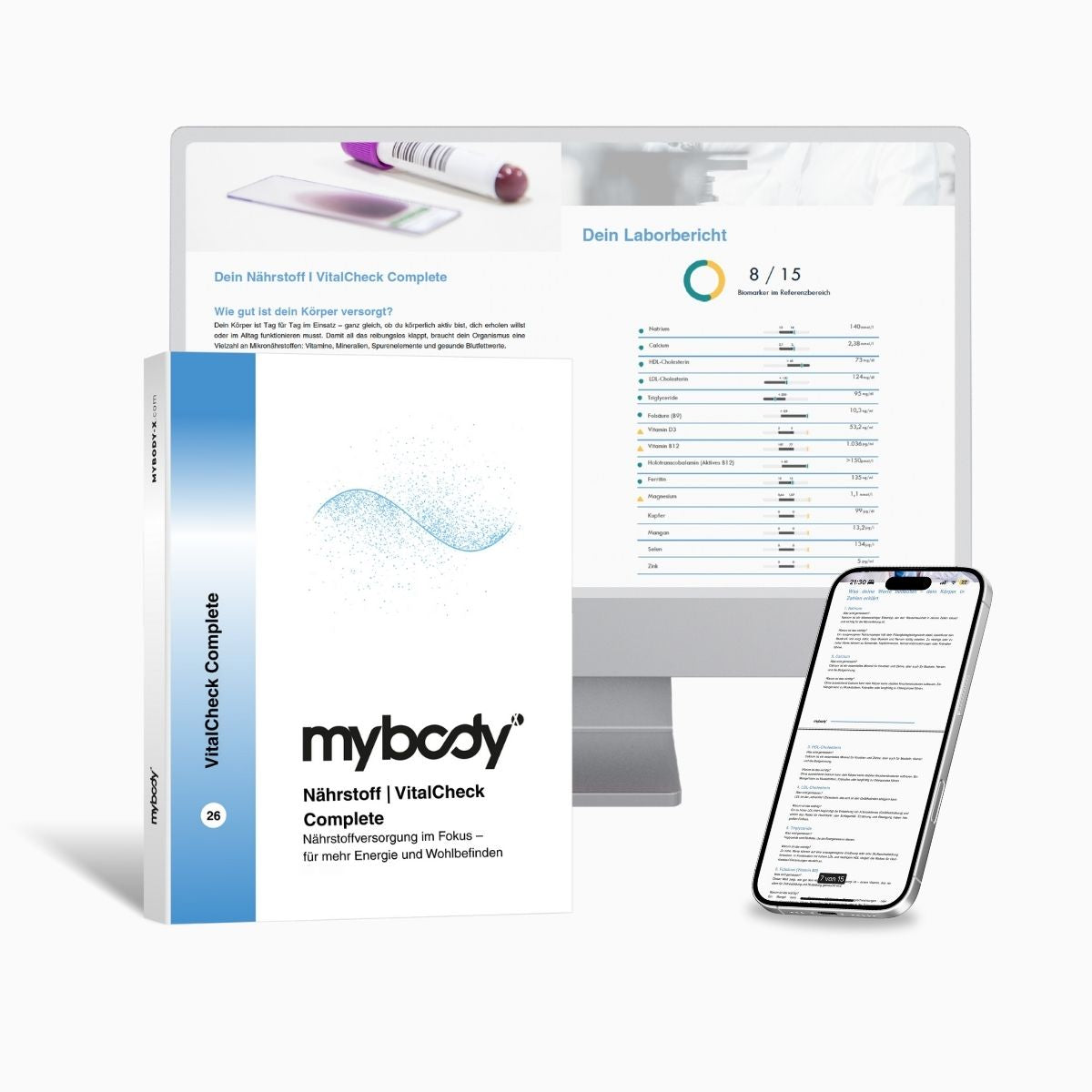
Capillary blood test
VitalCheck | Nutrient & Mineral Test Complete
Measures total cholesterol, HDL cholesterol, LDL cholesterol, and triglycerides, as well as vitamin D3, B12, folic acid, ferritin, calcium, magnesium, zinc, selenium, long-term blood sugar, CRP, and albumin, among others. What the test cannot do: It does not provide a diagnosis, calculate cardiovascular risk, or replace medical monitoring in cases of a known pre-existing condition.
Laboratory analysis 3–5 business days after receipt of the sample
Product-page information, accessed 27 August 2026
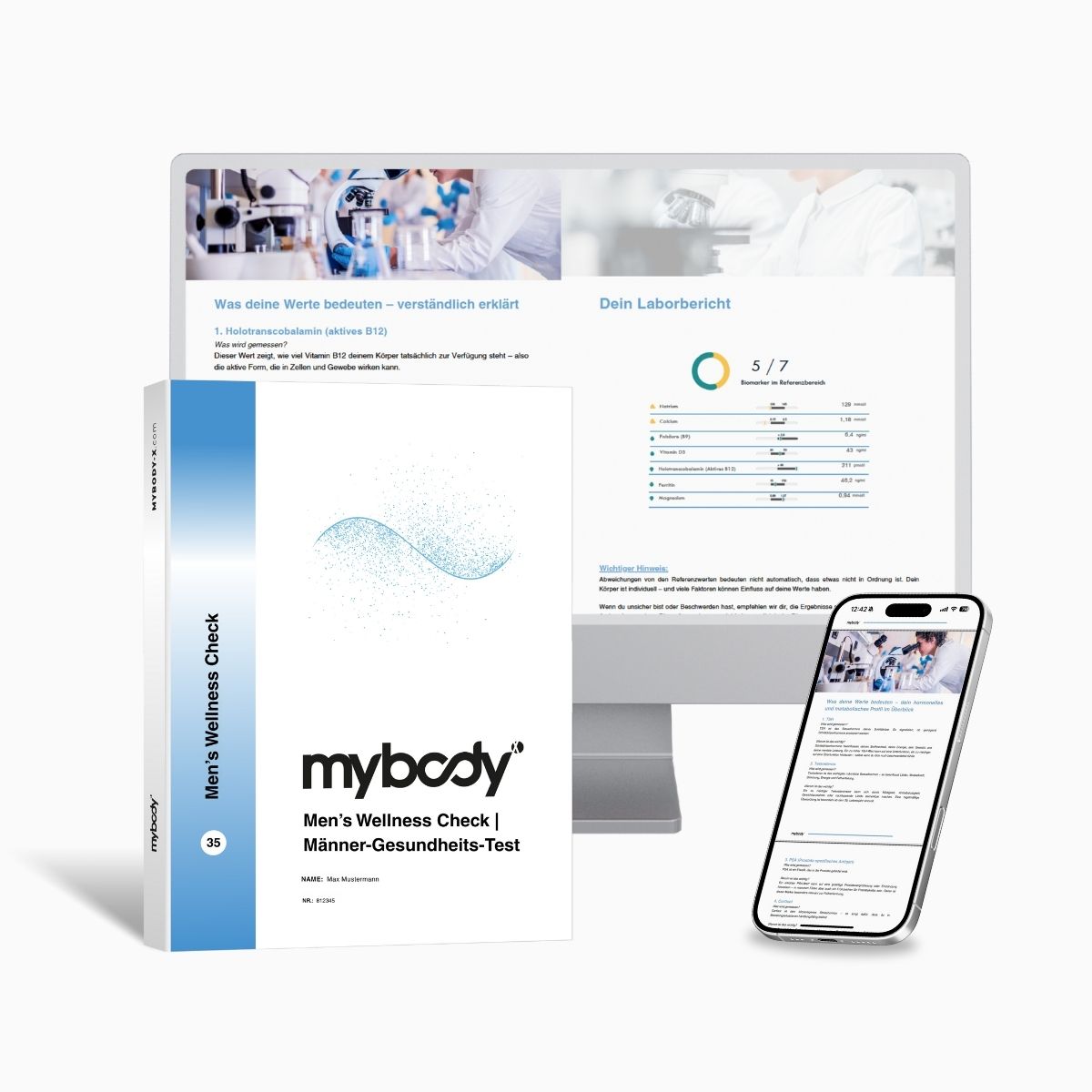
Capillary blood test
Men’s Wellness Check | Men’s Health Test
Includes total cholesterol, HDL cholesterol, LDL cholesterol, triglycerides, lipoprotein, and homocysteine, as well as testosterone, TSH, gamma-GT, cystatin C, long-term blood sugar, CRP, and PSA, among others. What the test cannot do: It is designed for men, does not provide a diagnosis, and does not replace a preventive medical examination.
Laboratory analysis 3–5 business days after receipt of the sample
Product-page information, accessed 27 August 2026
Who benefits from testing and who does not
Worthwhile for you if …
you have not known your level for years and are looking for a baseline for your own monitoring.
you are changing your diet or physical activity and want to track your progress with one result before and one after.
you want to view your blood lipids in the context of long-term blood sugar, inflammation markers, and nutrients rather than on their own.
Probably not if …
you are already being treated for elevated blood lipids. In that case, the treatment plan determines the monitoring, not a kit.
you notice any of the signs from Chapter 2. In that case, the appointment comes before the measurement.
you hope the result will tell you something about your personal cardiovascular risk. That can only be determined by considering several factors together.
Limitations: what the measurement cannot tell you
The first limitation is the most important: A cholesterol value is not a risk score. The risk of cardiovascular disease is determined by several factors together, and none of them stands alone on a lab report.
A cholesterol value is not a risk score. It is a number that needs to be interpreted in context.
A cholesterol value is not a risk score. It is a number that needs to be interpreted in context, and that context is provided by a medical practice, not a kit.
The second limitation concerns comparing methods. A value from capillary blood and a value from a venous blood draw are not directly comparable, because the sample type and method differ. If you want to monitor changes over time, stick with one method.
The third limitation is stated in the product information: These tests do not provide a diagnosis. An abnormal result is a reason to have a conversation, not a medical finding in the clinical sense.
And a fourth point that is rarely mentioned: There is no figure from a German institution that could be cited here for how much a cholesterol level changes solely as a result of a specific dietary change. That is why this article does not provide a number for it.
What you can do differently starting tomorrow
If you take away one action from this article, let it be this: Before the first measurement, decide on the time and write it down on a note together with what you had for dinner the previous evening. Three lines, no more.
The reason is unremarkable. Of everything in this article, comparability is the only factor you can control completely yourself. You cannot influence the laboratory or the method, but you can control the conditions.
At the beginning was the question of how to measure cholesterol at home. The more honest question is how to measure it the same way twice. Only then does a number become information.
Frequently asked questions
Can I reliably measure my cholesterol myself at home?
Yes, from capillary blood obtained by a finger prick and analyzed in a laboratory. Comparability is crucial: the same time of day, the same preparation, and the same laboratory. A single result describes one point in time, not a trend. A result clearly outside the reference range should be assessed by a doctor.
Do I need to fast for a cholesterol test?
Fasting is no longer generally required for cholesterol testing today. More important than fasting itself is that the second measurement takes place under the same conditions as the first. If the instructions in the kit specify this, they take precedence because the laboratory has adjusted its reference ranges accordingly.
Which cholesterol levels are considered normal?
The IQWiG considers a total cholesterol level below 200 mg/dl or 5.2 mmol/l optimal, and a level of 240 mg/dl or above, or above 6.2 mmol/l, significantly elevated. For LDL cholesterol, below 100 mg/dl or 2.6 mmol/l is considered optimal, while 190 mg/dl or above, or above 4.9 mmol/l, is considered severely elevated (2025). However, the reference ranges on your own test result are always decisive.
How often should I measure again?
For personal monitoring without any known pre-existing condition, an interval of six to twelve months is a practical guideline. Shorter intervals mainly show fluctuations. Anyone being treated for elevated blood lipids should follow the treatment plan, not an interval chosen independently.
What does an elevated result say about my risk?
On its own, not much. IQWiG states that LDL cholesterol in particular increases the risk of cardiovascular disease (2025), but personal risk results from several factors combined. Elevated levels are not an exceptional case: According to a 2010 study by the Robert Koch Institute, more than half of adults have total cholesterol above the optimal level.
Next step
A Starting Point Instead of a Guess
If you want to view your blood lipids in the context of nutrients, long-term blood sugar, and inflammation markers, these two capillary blood profiles provide a starting point. They do not replace medical evaluation.
VitalCheck Complete Men’s Wellness CheckRead more
You might also be interested in
The second blood lipid value and what can be changed about it, and over what period.
What comes after the measurement if the LDL level is above the optimal range.
Sources
- Institute for Quality and Efficiency in Health Care (IQWiG): Elevated Cholesterol Levels (as of 2025) – gesundheitsinformation.de
- Institute for Quality and Efficiency in Health Care (IQWiG): Understanding Laboratory Values Correctly (as of 2025) – gesundheitsinformation.de
The verbatim quote about cholesterol as a building material comes from source [1], as do all threshold and guideline values in mg/dl and mmol/l, the information on LDL and HDL, the figure for familial hypercholesterolemia, and the information reproduced there from the 2010 study by the Robert Koch Institute. The note that reference ranges depend on the laboratory, method, and age is based on [2]. Information on price, sample type, markers, and laboratory comes from the mybody®x product pages, accessed on August 27, 2026; processing times follow the central specification for blood tests. All sources were accessed and checked on August 27, 2026.

mybody®x Editorial & Expert Team
Blood Analysis Interpretation Laboratory Diagnostics Nutritional Science Nutrigenetics
This article was created by the mybody®x editorial and expert team. The team combines laboratory diagnostics, nutritional science, and the interpretation of blood analyses. Anyone who contributes to it is listed on the authors page.
Published on August 27, 2026 · Last updated on August 27, 2026
The content is intended for general information and does not replace medical advice, diagnosis, or treatment. Reference ranges depend on the laboratory, method, and age; the information on your report is always authoritative.




Share now:
Casein intolerance: Symptoms and which test can detect it
Blood values and the immune system: what can and cannot be measured