
Self-test vs. doctor’s visit: The difference explained clearly
The difference between a self-test and a doctor’s visit lies in three factors: testing method, result accuracy, and medical contextual assessment. A self-test, also known as a near-patient rapid test or point-of-care test, provides quick initial assessments at home. A doctor’s visit, on the other hand, combines laboratory diagnostics with a physical examination, professional evaluation, and individualized advice. Anyone who truly understands the difference between a self-test and a doctor’s visit can make better decisions about their health. Both approaches have their place. Neither completely replaces the other.
How do self-tests work compared with diagnostic testing at a doctor’s office?
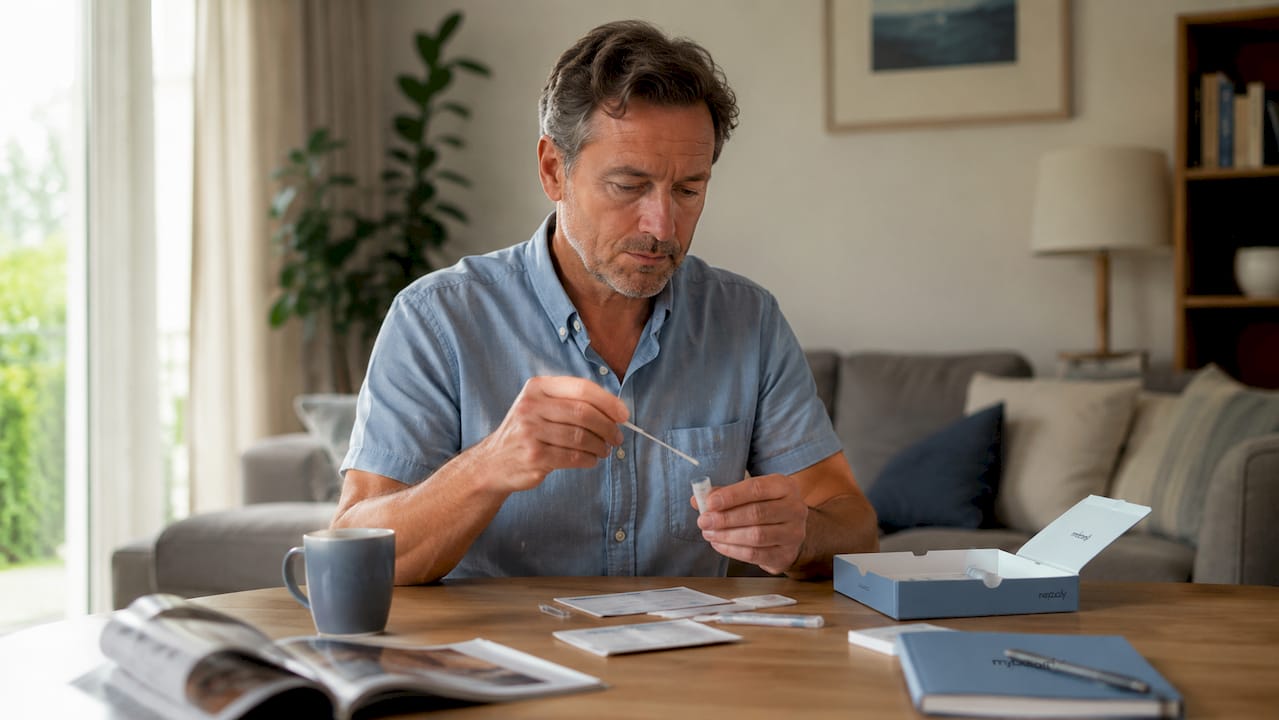
Self-tests shift sample collection and initial evaluation into the private sphere. You collect your own blood, saliva, or stool, follow the instructions, and evaluate the result based on a color reaction or a digital reader. This sounds simple. But this is precisely where the first major difference from visiting a doctor lies.
At a doctor’s office, trained medical staff collect the sample. This significantly reduces errors. Home tests shift essential sample collection and processing steps into the private sphere, which can increase the risk of errors. The chain of potential errors extends from collection and storage to evaluation.
Medical laboratory tests are performed under controlled conditions. Temperature, storage time, and equipment quality are standardized. With home tests, the result depends heavily on whether you follow the instructions correctly, store the sample properly, and evaluate the test within the specified time window.
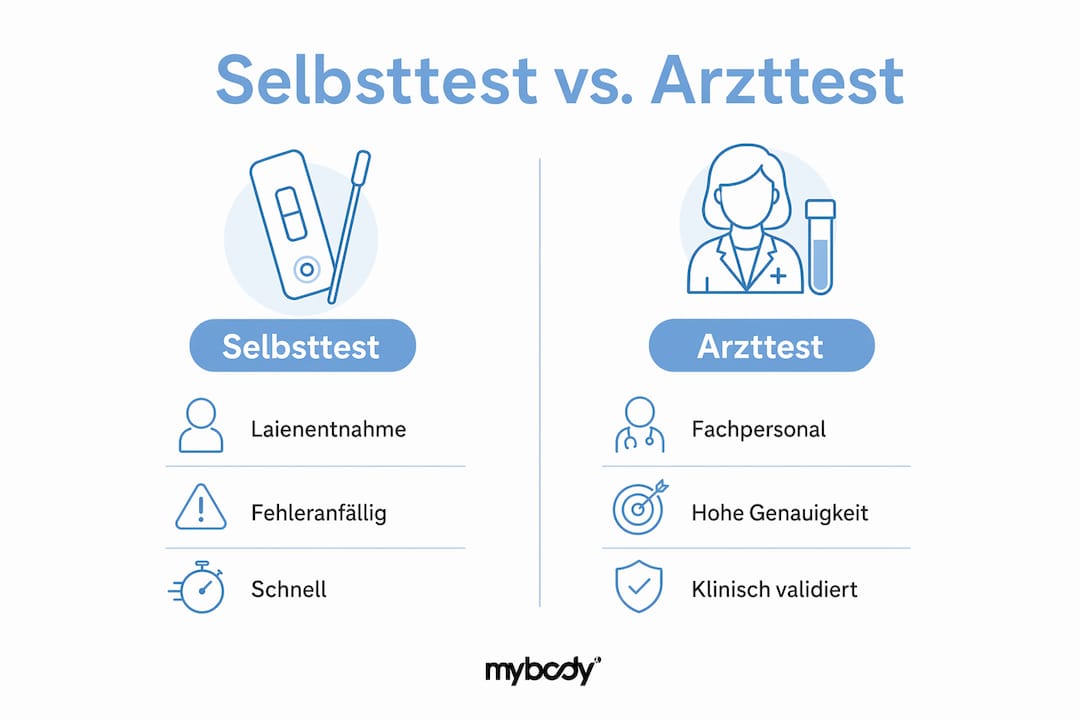
- Self-test: Sample collection by laypeople, evaluation at home, rapid results within 15–30 minutes
- Doctor-performed test: Sample collection by trained professionals, laboratory analysis, results often available after 24–72 hours
- Strength of home tests: Screening, monitoring over time, easy access
- Strength of doctor-performed tests: High measurement accuracy, assessment by a healthcare professional, follow-up treatment possible
Pro tip: Read the instructions for your self-test in full before collecting the sample. Many errors occur during the first step, not during the evaluation. Performing a blood test at home correctly is something you can learn.
Are self-tests just as accurate as tests performed by a doctor?
Self-tests often achieve high accuracy under laboratory conditions. In home use, however, their actual performance differs. Test accuracy is higher under laboratory conditions than with home tests. This is due not only to the technology but also to the environment.
A crucial, often overlooked factor is prevalence. The accuracy of a self-test is influenced not only by the testing technology but also significantly by how common the disease is in the population. For rare diseases, the risk of false-positive results increases considerably, even when the test is technically sound. This is known as the prevalence effect.
The IVD symbol on a test indicates that it is an approved in vitro diagnostic device. The IVD symbol indicates that a test may only be used as intended and by the designated user group. But beware: Not every CE marking indicates ease of use or accuracy for home use. The specific IVD classification and instructions for use should be carefully assessed.
| Criterion | Self-test | Doctor’s test |
|---|---|---|
| Sample collection | By laypeople, prone to errors | By trained professionals, standardized |
| Evaluation | Visual or simple device | Certified laboratory |
| Accuracy | Good for screening, limited for diagnosis | High, clinically validated |
| Interpretation of results | Personal responsibility | Medical assessment |
| Follow-up treatment | Not possible immediately | Possible immediately afterward |
Pro tip: A positive self-test result is not a verdict. It is a signal. Always have it confirmed by a doctor before drawing any conclusions or taking action.
When is a self-test useful, and when do you need a doctor?
Self-tests are effective screening tools. They are particularly well suited for early detection, monitoring known conditions, and checking nutrient levels or hormones without a doctor’s appointment. Home tests are effective screening tools, but they do not replace professional medical care, especially when symptoms or unclear results are present.
When you should see a doctor can be determined based on specific situations:
- Symptoms are present. Pain, fever, persistent fatigue, or other physical complaints require a medical examination. A negative self-test does not rule out illness.
- The test result is positive or contradictory. Positive results from home tests are considered screening results, not a diagnosis. Laboratory confirmation is necessary.
- The condition is subject to medical reservation. Under the German Infection Protection Act, certain infectious diseases require a doctor to make the diagnosis and provide treatment. Point-of-care rapid tests may be performed by nonprofessionals, but the legal diagnosis rests with the doctor.
- The result is unclear or you do not understand it. No self-test can explain what a borderline value means for your individual situation.
- You are asymptomatic but belong to a risk group. In this case, a self-test may be a useful first step. Medical assessment follows afterward.
Self-tests for HIV, hepatitis C, and SARS-CoV-2 are legally approved under certain conditions. However, this does not mean that a positive result does not require medical follow-up. The law permits the test. The doctor is responsible for the subsequent steps.
Advantages and limitations of self-tests compared with doctor visits
Self-tests offer real benefits. You do not need an appointment, wait, or doctor’s office hours. You can test discreetly whenever it suits you. For health-conscious people who want to regularly monitor nutrients, hormones, or gut health, this is a real advantage. Personalized analyses at home enable exactly this kind of continuous self-monitoring.
But self-tests have clear limitations. Sample collection by nonprofessionals is the biggest source of uncertainty. Errors lead to less reliable results than tests performed by medical professionals. In addition, a self-test cannot replace a physical examination. Doctor visits provide additional services such as physical examinations and professional assessment of symptoms.
What self-tests can do well:
- Quick screening without an appointment
- Monitoring known values over time
- A low-threshold entry into preventive healthcare
- Discretion for sensitive topics such as sexual health or hormones
What self-tests cannot do:
- Interpret physical symptoms
- Replace a medical diagnosis
- Initiate follow-up treatment
- Recognize complex interactions between findings
The smart way to approach the difference between self-tests and doctors is to understand both as tools, not alternatives. A laboratory test for home use provides you with data. The doctor provides the context.
Key findings
Self-tests are reliable screening tools, but they do not replace a medical diagnosis because sample quality, prevalence, and the lack of contextual assessment limit their informative value.
| Topic | Details |
|---|---|
| Accuracy comparison | Laboratory tests conducted under professional supervision are more reliable than home tests performed by laypeople. |
| When a self-test is useful | Screening, monitoring progress, and accessible preventive care without symptoms. |
| When a doctor’s visit is necessary | Always see a doctor if you have symptoms, receive a positive result, or get unclear findings. |
| Legal classification | Self-tests are permitted, but medical diagnosis remains legally reserved for doctors. |
| Combining both approaches | Self-test as the first step, doctor’s visit for confirmation and interpretation. |
What I really think after years of working with health data
Many people treat self-testing as an either-or decision. Either I test at home, or I go to the doctor. That is the wrong framework. People who regularly take self-tests and understand the results arrive at the doctor’s office better prepared. This saves time and leads to better conversations.
What I repeatedly observe is that the biggest mistakes do not happen during the test itself, but afterward. A negative result is interpreted as a free pass. A positive result causes panic, without anyone knowing the prevalence or having read the instructions in full. Both are avoidable.
The difference between a self-test and a doctor is not a matter of quality. It is a question of purpose. Self-tests are designed to provide orientation. Doctors are there to make decisions. Those who understand this use both tools correctly. And anyone who combines a medical home test with ISO-certified laboratory analysis gets the best of both worlds.
— mybody x
Labor-quality health analyses delivered directly to your home
mybody x combines the convenience of self-tests with the accuracy of certified laboratory diagnostics. You collect the sample at home, send it in, and receive a scientifically validated report with specific recommendations for nutrition, lifestyle, and prevention.
The range includes DNA metabolism tests, microbiome analyses, nutrient and mineral checks, as well as hormone and intolerance tests. More than 11,300 satisfied customers and an average rating of 4.77 stars speak for themselves. All samples are pseudonymized and destroyed after analysis. Free shipping on orders over €49, personal consultation, and a money-back guarantee if no results are delivered are included. Explore the full range at mybody-x.com and find the test that suits your situation.
FAQ
What is the main difference between a self-test and a visit to the doctor?
A self-test provides quick screening results at home, while a visit to the doctor offers clinically validated diagnostics, a physical examination, and professional assessment. Self-tests do not replace a medical diagnosis.
When should I see a doctor despite a negative self-test?
If symptoms such as fever, pain, or severe fatigue persist, you should see a doctor, even if the self-test is negative. A negative result does not reliably rule out an illness.
Are self-tests legally recognized as diagnoses?
No. Under the Infection Protection Act, the legal diagnosis of certain diseases remains reserved for doctors. Self-tests are permitted as screening tools but are not considered official diagnoses.
How reliable is a self-test really?
Reliability depends on sample quality, correct application, and the prevalence of the condition in the population. Under laboratory conditions, self-tests are often accurate; when used at home, the error rate increases due to sample collection by non-professionals.
Can a self-test completely replace a visit to the doctor?
No. Home tests are a first step in preventive healthcare, but they do not replace professional medical care, especially in the case of symptoms, positive results, or complex complaints.


Share now:
How to Boost Your Metabolism: Understand It and Put It into Practice Now
Improve your metabolism: Your honest guide without myths