

Where can you take a DNA test? The ultimate guide
Are you wondering: Where can you take a DNA test? Today, the answer is more varied than ever. You can conveniently order a DNA test from specialized online providers and take it at home, have it done at a doctor's office or specialist laboratory, buy it directly from a pharmacy, or commission an accredited facility for legal purposes.
The four main ways to get your DNA test
Deciding to take a DNA test is the first step toward understanding your body better. However, choosing the right provider can quickly feel overwhelming. Essentially, there are four established options, which differ depending on your goal, the level of convenience you want, and your budget.
Each of these options has its own advantages and disadvantages, which you should know before making a decision.
- Online providers of at-home tests: This is the most convenient and popular method for lifestyle and health analyses.
- Doctor or specialist laboratory: The traditional option for medical and diagnostic purposes and when you have specific health-related questions.
- Pharmacy: A trusted point of contact offering personal advice, often with a focus on paternity tests.
- Legally recognized tests: These are mandatory for legal proceedings and subject to strict statutory requirements.
In the following sections, we'll take a close look at each of these options. If you're already curious about how such a test works in practice, you'll find everything you need to know in our guide to the online DNA test. This way, you'll be sure to find the option that best suits your personal goals.
At-home DNA tests: the modern and convenient option
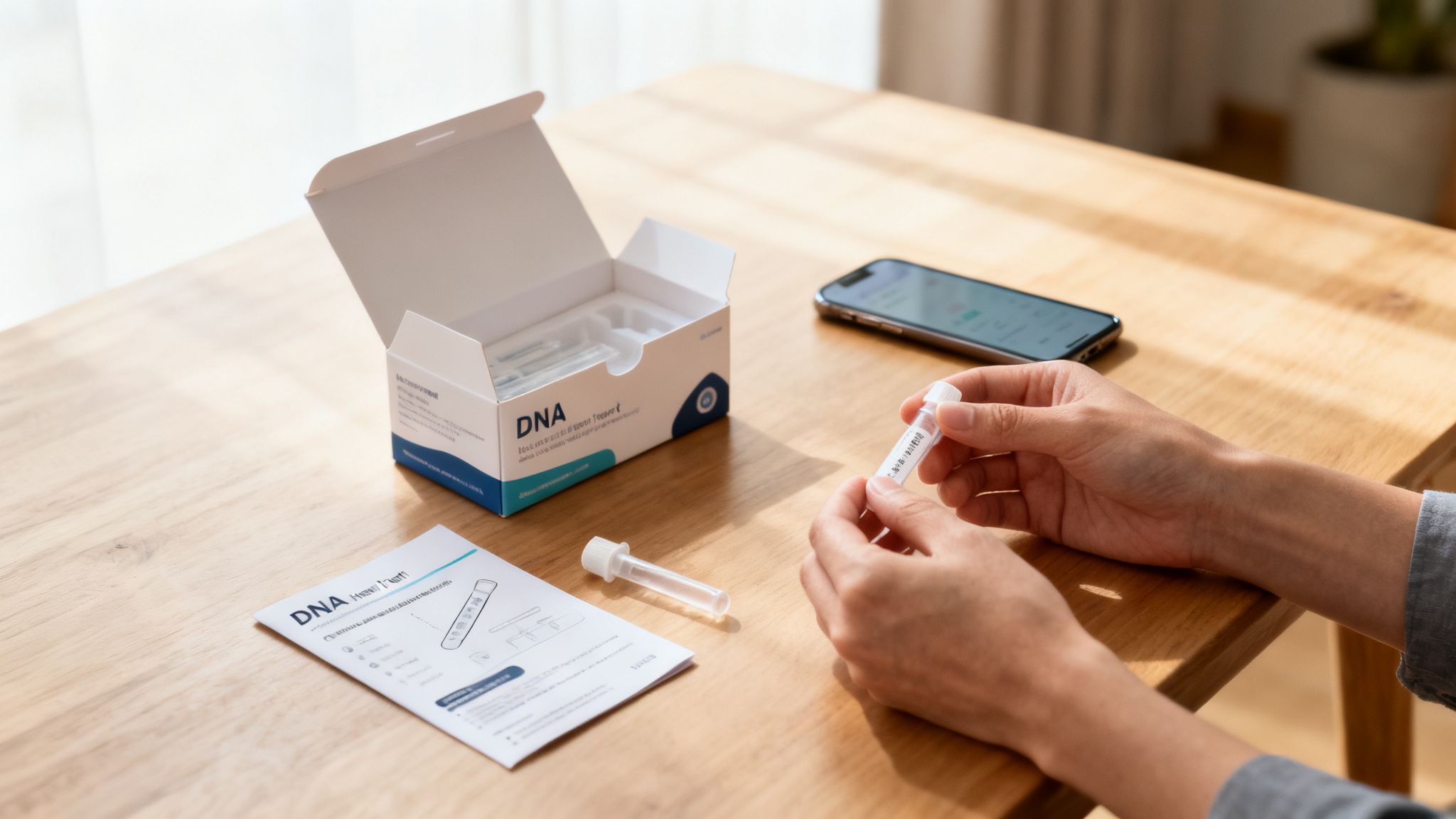
If you're wondering where you can take a DNA test, the answer today is usually: right in your own home. At-home DNA tests have become the most popular and simplest way to gain fascinating insights into your genetic predisposition.
Everything is designed for maximum convenience and discretion. You order the test kit online, have it delivered directly to your home, and collect the sample yourself—straightforward and completely painless. In most cases, a simple saliva sample is all that is needed. You then send everything back to the laboratory in the enclosed envelope.
How the process works from ordering to receiving the results
The process of taking a DNA test at home is remarkably simple and can be completed independently in just a few steps. This makes it accessible to anyone who wants to learn more about their body.
- Order online: Choose the right test for your goals on the provider's website and order the kit in just a few clicks.
- Collect your sample: Once the kit arrives, follow the simple instructions to collect a saliva sample. It only takes a few minutes.
- Activate and send: You register your kit online using a unique code to pseudonymize your sample. Then you simply send it back to the laboratory.
- Analysis & evaluation: Your DNA is analyzed in a certified laboratory. Within a few weeks, you receive your results as an easy-to-understand report via a secure online portal or app.
Would you like to know more precisely what to expect? Our article explains everything you need to know about a genetic test for home use.
What types of tests are available for home use
The variety of at-home tests is now enormous and covers a wide range of health areas. Analyses that help you optimize your own lifestyle are particularly popular.
For example, a DNA metabolism test can show you which nutrients your body processes particularly well or poorly. This insight is a powerful tool for adjusting your diet, improving your well-being, and finally achieving your personal health goals.
The market for DNA tests that help people optimize their weight loss and fitness is booming, especially in Germany. With an obesity rate of 25.7 percent among adults, this is hardly surprising, as such tests can increase weight-loss success rates by up to 30 percent. More than 11,300 customers already trust providers such as mybody®, relying on evidence-based recommendations based on analyses conducted in ISO-certified laboratories. You can read more about market developments in metabolic genetic testing here.
DNA analysis by a doctor or in a specialized medical diagnostics laboratory

When it comes to in-depth medical answers, the path usually leads to a doctor or a specialized laboratory. This option is often the only right one when it comes to diagnosing diseases, investigating a specific health concern, or analyzing hereditary diseases.
Unlike lifestyle tests for home use, which focus on prevention and self-optimization, the focus here is on medical diagnostics. The entire process is therefore firmly integrated into specialist medical care.
When is a doctor the right person to contact?
Seeing a doctor is always essential when a test is carried out for medical reasons. The results often have a direct impact on treatment and form the basis for all further care. This is not a “nice-to-have,” but absolutely crucial.
Typical reasons for a doctor-prescribed DNA analysis include:
- Diagnosing hereditary diseases: If there is suspicion of genetically determined conditions such as cystic fibrosis or Huntington’s disease.
- Pharmacogenetics: To find out how your body responds to certain medications. This allows the treatment to be tailored precisely to you.
- Prenatal diagnosis: To screen for genetic abnormalities in the unborn child if there is an increased risk.
- Clarifying familial risks: If certain types of cancer occur more frequently in your family, the genetic risk can be determined.
The crucial difference from any home test is specialist genetic counseling, both before and after the analysis. A medical geneticist explains the often complex results to you, puts them into context, and discusses the possible consequences and next steps with you in concrete terms. You are not left to deal with this alone.
The process and coverage of costs
The process is completely different from that of a home testing kit. As a rule, blood is drawn from you directly at the practice because medical analyses require a greater quantity and higher quality of DNA. The sample is then sent to an accredited, officially certified human genetics laboratory.
The cost of such tests can quickly run into the four-figure range. The key point, however, is this: If there is a clear medical indication, the costs are often covered by health insurance when prescribed by a doctor. This is a major advantage when it comes to investigating serious health concerns.
Genetic tests from the pharmacy: the familiar local point of contact
When considering taking a DNA test, many people first think of the pharmacy. No wonder, since for many of us it is the first place we turn to when it comes to health. And indeed: More and more pharmacies now keep DNA test kits in stock that you can simply take with you.
This option offers an interesting combination of the discretion of a home test and the sense of security provided by a personal point of contact. You can buy the kit immediately, avoid shipping, and ask the staff on site your initial questions directly. This builds trust and can ease any initial uncertainty.
What to expect at the pharmacy
However, the range in pharmacies is usually limited and specialized in certain areas. What you typically find there includes:
- Paternity tests: This is the classic among genetic tests from the pharmacy and is often used for an initial, private clarification.
- Lifestyle genetic tests: There are also occasional tests covering topics such as nutrition, intolerances, or micronutrient needs. However, the selection here is usually very limited.
The biggest advantage is obvious: immediate availability. If you need a test kit quickly, the pharmacy is a convenient and discreet solution. You pay for it, take it with you, and can get started right away.
The limitations of the pharmacy selection
Despite the convenient process, there are also a few disadvantages. As mentioned, the selection is very limited. You are unlikely to find specialized analyses, such as detailed tests of your metabolism or microbiome. In addition, prices for comparable tests are often higher than those offered by specialized online providers.
Advice at the pharmacy is a good starting point, but it does not replace the thorough evaluation by experts, as provided by providers such as mybody®. You can read more about why personalized health advice in connection with DNA tests from the pharmacy is so important in our related article. In short, the pharmacy is the right choice if you need a kit immediately and value initial personal advice.
Court-admissible paternity tests and their strict rules
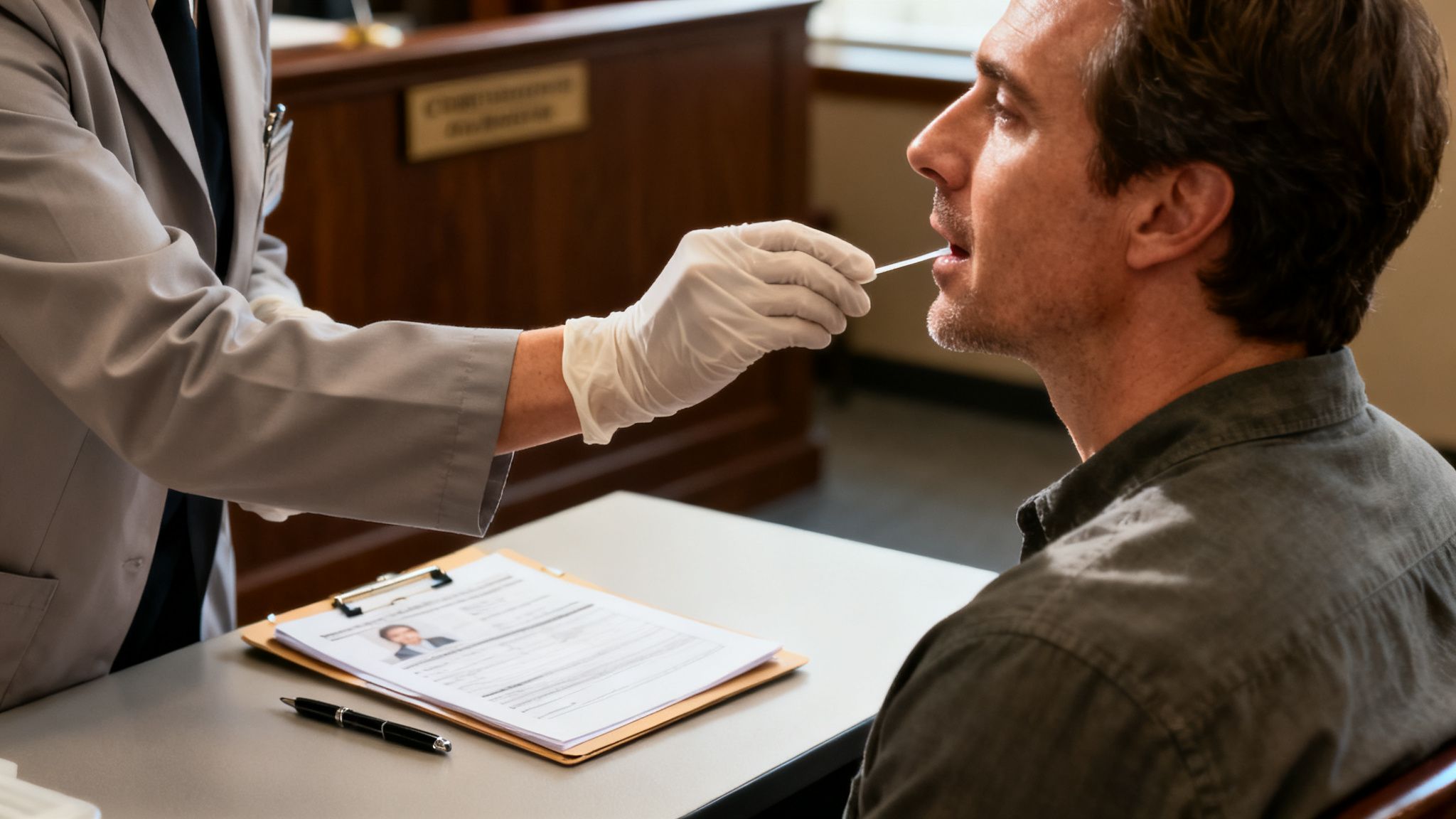
If a DNA test is intended not only to provide personal certainty but also to serve as solid evidence in court, the rules change completely. A simple home test that you carry out anonymously in private has no legal evidentiary value whatsoever.
Court-admissible paternity tests are instead subject to the strictest legal requirements. The reason is simple: manipulation must be ruled out and the identity of all parties involved must be established beyond doubt.
Documented sample collection as a core requirement
In Germany, such tests must comply with the Genetic Diagnostics Act (GenDG). One of the most important pillars of this law is documented sample collection. This means that samples must never be collected by the individuals themselves. Instead, a neutral, qualified person must supervise this step.
The entire process must be fully traceable to stand up in court. For this reason, a neutral third party is absolutely essential.
- Proof of identity: All parties involved—that is, the child, mother, and alleged father—must identify themselves to the neutral party using a valid identity document such as an identity card or passport.
- Witnessed sample collection: A witness, such as a doctor, an employee of the youth welfare office, or a notary, carries out the sample collection—usually a simple buccal swab—and documents everything in detail.
- Sealed shipping: The samples are then sealed directly by the witness and sent to the laboratory without detours. This ensures that nothing is mixed up or tampered with in transit.
Important to know: Secret paternity tests are strictly prohibited in Germany under the Genetic Diagnostics Act and are even punishable by law. A test is legal only if all persons concerned—or, in the case of minors, their legal guardians—have given their written consent.
Requirements for the laboratory
Not every laboratory is permitted to conduct a DNA test that can be used in court. The commissioned institute must be accredited according to the DIN EN ISO/IEC 17025 standard. This certification confirms that it meets the highest quality and competence standards for forensic analyses.
The cost of such a test is naturally significantly higher than that of a home test due to the extensive administrative and personnel effort involved. It is often in the range of several hundred euros. However, when legal validity in child-support matters or custody proceedings is at stake, this is the only correct and recognized approach.
How to ensure quality and trust with your DNA test
When considering where to have a DNA test carried out, it is not just about the location. The quality of the analysis and the protection of your extremely sensitive data are far more important. With the flood of providers on the market, you have to look closely to separate the wheat from the chaff. Only then can you obtain reliable results and be sure that your genetic information is in safe hands.
Choosing the right provider is a matter of trust. After all, this concerns the most intimate information your body has to offer. Therefore, pay close attention to clear quality criteria and completely transparent privacy policies.
How to recognize scientific quality
A truly reputable provider has its analyses carried out exclusively in certified specialist laboratories. The most important seal of quality in this field is ISO certification, particularly the ISO 17025 standard. This certification guarantees that a laboratory works according to strict international standards, that its processes have been reviewed, and that the results are scientifically sound and reproducible at any time.
- ISO certification: Look closely at whether the laboratory conducting the analysis is certified according to relevant ISO standards. Providers such as mybody® work exclusively with partner laboratories like these, for example, to ensure the highest level of precision.
- Scientific advisory board: Another strong sign of quality is a team of scientists, doctors, and nutrition experts. They not only interpret the test results but also present them in a way that you can understand.
- Transparent methodology: The provider should disclose which scientific methods and technologies it uses. Secrecy has no place here.
Incidentally, the accuracy of commercial DNA tests for health and the microbiome is based on scientific principles similar to those underlying the forensic analysis conducted by Germany’s Federal Criminal Police Office (BKA). While the BKA uses non-coding DNA to create unique offender profiles, ISO-certified laboratories—such as those used by mybody®—analyze relevant gene segments to, for example, optimize gut health. Since 2020, the use of such tests in Germany has doubled, which is hardly surprising given that around 35 percent of the population suffers from chronic digestive problems. Scientific validity and standardized processes are essential for meaningful results both in forensics and personalized health. If you want to explore the topic in greater depth, you can learn more about the scientific background of DNA analysis at the BKA.
How to make sure your data is truly protected
Protecting your genetic data must be the top priority. A trustworthy provider takes comprehensive measures to protect your privacy. You should pay close attention to these points:
GDPR compliance is not a nice gesture but a legal obligation for every provider operating in the EU. This means that your data may be processed only with your explicit consent and exclusively for the specified purpose.
Look for clear, easy-to-understand privacy policies that are not hidden in the fine print. Reputable companies such as mybody® also guarantee the pseudonymization of your sample. This means that the laboratory conducting the analysis receives your sample only with a code, without knowing your name or other personal information.
Another crucial point is what happens to your biological sample. A responsible provider guarantees that your sample will be destroyed after analysis. Under no circumstances may it be reused for other purposes or even sold to third parties. To find the best DNA test for you, these criteria are non-negotiable.
How to find the right DNA test for your personal goals
You now know the different places to turn for a DNA test. But how do you find the one test among all the options that is right for you and your questions? The answer lies less in the test itself and more in your personal goals.
Choosing the right DNA test is no small matter; it is an important decision for your health. To gain clarity, you should ask yourself three key questions. Your answers will lead you fairly directly to the right solution.
What is your specific goal?
The most important step first: Define your personal “why.” Are you looking for general lifestyle insights, or are you seeking a specific answer to a particular health question? The clearer your goal, the easier it will be to choose.
Here are a few practical examples:
- Example 1: Weight loss. You have already tried numerous diets, but the long-term success has failed to materialize. Your goal is to finally understand how your metabolism works so you can lose weight sustainably. In this case, a DNA metabolism test from a specialized provider such as mybody® would be ideal. It provides personalized nutrition tips tailored directly to your genetics.
- Example 2: Fitness optimization. You want to take your athletic performance to the next level and find out which training and nutrition style best suits your body. A DNA test focused on sports and recovery provides insight into whether you are genetically more predisposed to endurance or strength sports.
- Example 3: Gut health. You repeatedly struggle with digestive issues and want to get to the root of the cause. In this case, a microbiome analysis is the right approach. It examines the composition of your gut flora and enables you to take targeted measures to restore its balance.
What level of convenience and quality do you expect?
Once your goal is clear, it comes down to the practical aspects. How much effort are you willing to put in, and how important are certified standards to you? Your priorities will determine which provider is right for you.
If you value maximum convenience and want to take care of everything from home, a home testing kit is the best choice. If, on the other hand, you place the greatest importance on certified laboratory quality and comprehensive data protection in accordance with the GDPR, you should specifically look for providers that make these standards transparent and communicate them openly.
This decision tree summarizes the most important checks for quickly assessing a provider’s quality: 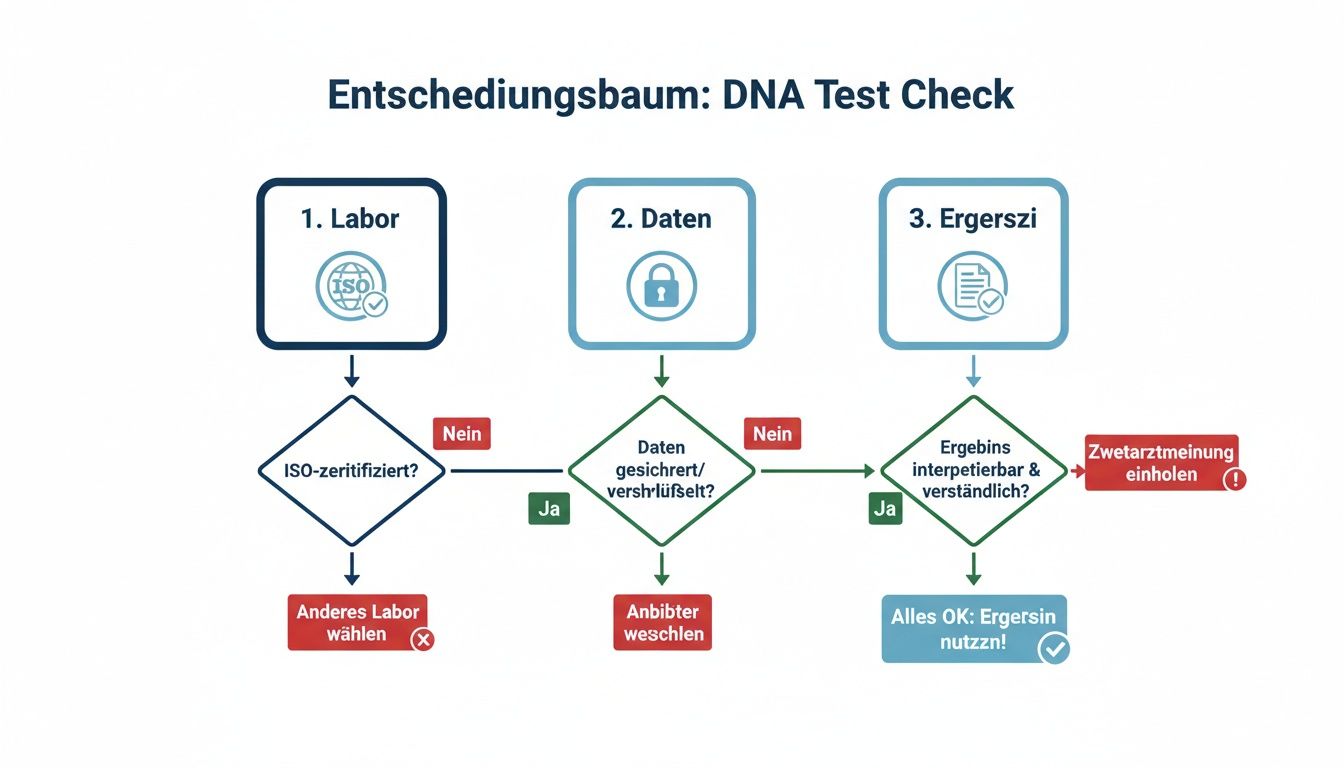
The graphic makes it clear: A trustworthy test always relies on an ISO-certified laboratory, strict data security, and, above all, easy-to-understand results.
By weighing these three criteria—purpose, convenience, and quality—you can confidently find the DNA test that ultimately delivers real added value for your health.
Still have questions? Here are the answers
Finally, we’ll answer a few questions we’re asked time and again. This will help you clear up any remaining doubts and make a confident decision for yourself.
How secure is my genetic data with an at-home DNA test?
The security of your data is our top priority. Reputable providers such as mybody® strictly comply with GDPR requirements. Your sample is pseudonymized, meaning the laboratory only receives a code and does not know your identity at all.
Checking the provider’s privacy policy on their website offers additional reassurance. Another clear mark of quality is a guarantee that your biological sample will be destroyed immediately after analysis.
How long do I have to wait for the results?
This depends somewhat on the provider and the complexity of the test. With most at-home DNA tests, however, you can expect it to take two to four weeks after your sample arrives at the laboratory.
Once everything has been analyzed, you’ll receive your results conveniently through an encrypted online portal or app. This means you can access your analysis at any time.
Can a DNA test predict diseases?
This is an important point: Lifestyle DNA tests—such as metabolism or microbiome analyses—are not medical diagnostics. They are not designed to diagnose diseases.
Instead, they provide valuable insights into your genetic predispositions. You learn how to specifically optimize your lifestyle, diet, and well-being. However, when it comes to investigating hereditary diseases, consulting a specialist is the only right course of action.
Are you ready to unlock the secrets of your body and put your health on a scientific foundation? At mybody-x.com, you’ll find the right DNA test for your goals. Start your journey toward a better you now.



Share now:
Best DNA Test: Find the right genetic test for your health
Maybe you’re not lacking discipline—but nutrients.