
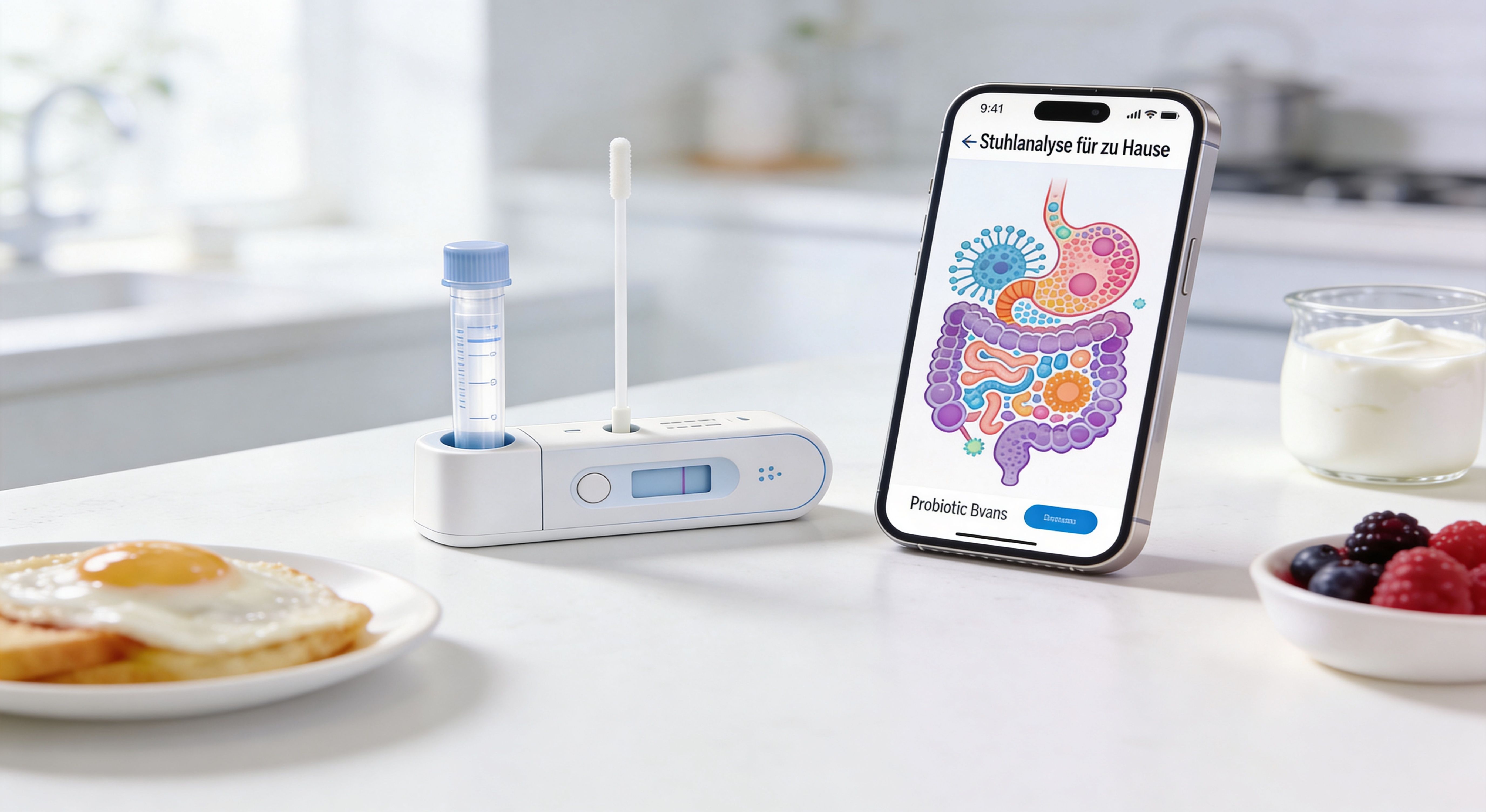
Online stool analysis: Test your gut health
You may be sitting there right now with an uneasy feeling in your stomach. Not only physically, but mentally too. You eat more consciously than you used to, try eliminating this and that, pay attention to your sleep, and perhaps even to stress. And yet bloating, a feeling of fullness, irregular bowel movements, fatigue, or skin issues keep coming back.
If this sounds familiar, it is not a sign that you are “too sensitive.” It is often more a sign that your body has been giving you clues for a long time, but they have not yet been properly interpreted. That is precisely why more and more people are searching for an online stool analysis. Not simply out of curiosity, but because they want to move from guessing to understanding.
Many people start with Google, forums, or nutrition tips from social media. That is understandable. But when it comes to the gut, this often leads to an endless cycle of eliminating foods, trying things out, and hoping. A structured look at the microbiome can help here, provided the test is carried out properly and evaluated reliably.
Why your gut feeling is often right
It rarely starts dramatically. More often, it develops gradually. After eating, your stomach feels tight. In the morning, you already feel tired. Your skin acts up, even though you are “actually doing everything right.” Many people get used to it and convince themselves that it is normal. But it does not necessarily have to be.

When symptoms seem vague
The gut is not a silent bystander. It responds to diet, sleep, medication, infections, and stress. The tricky thing is that its signals often seem vague. You may simply notice that you are no longer as resilient as you used to be, or that certain meals suddenly do not sit “quite right.”
That is precisely why intestinal issues often go undetected for a long time. People look for the cause in individual foods, hormones, or everyday stress. All of these can play a role. But the gut is often part of the bigger picture.
An important thought: Diffuse symptoms are not automatically imagined. They are often simply harder to interpret than a clear laboratory result.
In Germany, according to BIOMES on the prevalence of irritable bowel syndrome, around 17 percent of the population suffer from irritable bowel syndrome, which amounts to approximately 14 million people affected. Symptoms such as abdominal cramps and bloating drive many people to look for solutions such as home tests.
Why trial and error is so exhausting
Perhaps you know this pattern:
- First attempt You cut out dairy products and hope for some peace in your stomach.
- Next step Then you try going gluten-free because someone you know had a good experience with it.
- After that You buy probiotics, enzymes, or bitters without knowing exactly whether they suit your problem.
- Result Sometimes it gets better briefly, then it doesn't again.
This is not a personal failure. It simply shows that blanket advice is rarely precise enough. The gut is individual. What helps one person may do little for another.
Your body is sending you a signal for a reason
Bloating, fatigue, discomfort after certain meals, or changing bowel movements can indicate an imbalance in the gut environment. On their own, they do not prove anything. But they are a good reason to take a closer look instead of continuing to navigate through the fog.
If you are already looking for answers, you are already well on the right track. A targeted test simply makes this path more precise.
Your gut microbiome explained simply
You can imagine your gut microbiome as a living garden. Many different microorganisms grow in this garden. Some support a stable balance. Others can become problematic if they become too dominant or if overall diversity decreases.

The garden in your belly
When a garden is well cared for, many plants grow side by side. They keep each other in balance. It is similar in the gut. Diversity is a good sign because different bacteria perform different tasks.
But if a garden becomes one-sided, the balance can tip. This is often referred to as dysbiosis. That does not automatically mean illness. For now, it simply describes a composition that may have become unbalanced.
This simple image can help with orientation:
| Area | Visual explanation | Why it matters |
|---|---|---|
| Good bacteria | Beneficial plants in the garden | They support a stable environment |
| Fewer desirable microbes | Weeds that take up too much space | They can disrupt the balance |
| Diversity | Many different plant species | A diverse garden is usually more resilient |
| Gut barrier | The garden fence | It sensibly separates what should stay out |
Anyone who would like to explore the topic in greater depth will find what the microbiome actually is a good introduction to the basics.
What Modern Tests Can Detect Today
A simple online stool analysis does not just take a superficial look at “good” and “bad” bacteria. Modern methods can work much more precisely. According to an overview of NGS-based gut diagnostics, modern stool analyses based on next-generation sequencing can identify more than 10,000 different bacterial species. This exceeds conventional methods by a factor of 100 in this respect. Markers such as zonulin can also be measured. A value of over 50 ng/ml may indicate leaky gut.
This may sound technical, but it is useful in everyday life. It can show not only that something is out of balance, but often also where you could start making changes.
A diary shows you when symptoms occur. A laboratory analysis gives you a better idea of what might be contributing in the background.
A Common Misconception
Many people believe that the microbiome simply consists of “good” and “bad” bacteria. It is not that simple. Some bacteria are not categorically good or bad. It is about the interaction, the quantity, and the context.
That is why it makes sense not to read test results in isolation. A single value is rarely the whole story. Only the overall picture makes an analysis truly useful.
Which gut type are you?
Monday morning, coffee on an empty stomach, then a healthy lunch later. And yet your stomach starts acting up again. Maybe with pressure, maybe with bloating, or perhaps just with that vague feeling that something is wrong. This is often where the guesswork begins.
Many people then look for the one culprit. Gluten. Dairy. Stress. Sugar. That sounds understandable, but it often falls short. The gut functions more like an orchestra than a single switch. When one instrument gets out of rhythm, you hear the entire piece differently. That is precisely why broad gut profiles can be useful as a first point of reference. They do not replace a diagnosis. But they can help you classify symptoms more effectively and see through common gut myths.

The Sensitive Reactive Gut
You eat something and notice it shortly afterward. Your stomach feels tight, your digestion gets thrown off, and sometimes skin issues or a general feeling of discomfort appear as well. Many people then eliminate more and more foods from their diet.
That is understandable. It often just leads in the wrong direction. Not every rapid symptom automatically means that the food in question is the core problem. Sometimes an irritated system simply reacts more strongly than usual to many stimuli. Then useful observation quickly turns into an exhausting elimination game without a clear direction.
The stressed pace-setter
Sometimes sluggish, sometimes hectic. For a few days everything seems calm, then little sleep, a packed schedule, or irregular meals are enough to throw the gut out of rhythm.
A common myth persists here: If stress is involved, it must be “psychological.” That's not true. The gut and nervous system are in close communication. Stress is therefore not an imagined trigger; it can have physically noticeable effects. Anyone who recognizes this pattern doesn't need blame, but greater clarity about their own starting point.
The quietly exhausted gut
This type is easy to overlook. No severe pain, no dramatic course. Instead, fatigue, a feeling of fullness, bloating, or the sense that after eating you're more slowed down than strengthened.
This is precisely when the gut is often overlooked. Many people first look at sleep, hormones, or their daily workload. All of these can play a role. At the same time, it's worth taking a closer look at the gut when digestion and energy haven't felt quite right for a while.
The gut doesn't have to be loud to be out of balance.
The searcher overwhelmed by too many tips
Perhaps this is where you recognize yourself most. You've already read or tried a lot. Histamine, gluten, FODMAPs, probiotics, bitter compounds, leaky gut. Every approach sounds convincing. Taken together, they often create more confusion than clarity.
This is exactly where health can quickly turn into guesswork. And guesswork takes energy. A certified test can help you assess your own situation more precisely instead of constantly imposing new theories on everyday life. If you would like to know in advance what a home test involves in practice, the article on the at-home gut test provides a helpful overview.
A quick self-check can provide an initial orientation:
- You don't always react the same way to the same foods. In that case, more is often involved than the food itself.
- Your symptoms change throughout the week. That suggests patterns and connections rather than a single trigger.
- You've already tried several things, but without a clear result. In that case, data often offer more than the next blanket tip.
- You want to make targeted improvements instead of continuing to experiment. In that case, moving from guesswork to knowledge is usually worthwhile.
One more point that many people overlook: If you order a test online, also pay attention to the website's credibility. The article How to Recognize Expired SSL Certificates on Websites shows you how to identify trustworthy sites.
The honest answer is this: Self-observation is a good starting point. It is often not enough for a precise assessment. Anyone who wants to leave gut myths behind and work specifically on their own problem areas will usually move from guessing to knowing more quickly with a structured analysis.
This is how simple and safe an online stool analysis is
Many people hesitate about ordering an online stool analysis not because of the subject of gut health, but because of the thought of collecting the sample. Understandable. In practice, however, the process is usually much simpler than you might think. What matters is less the difficulty of collecting the sample than the quality behind it.

This is how the process works at home
Usually, you order a test kit, collect the sample at home according to the instructions, and send it to the laboratory. The main advantage is privacy. You do not need an appointment or to wait in a doctor's office, and you can choose the right time yourself.
Anyone who wants to see the exact process step by step can find practical guidance in the article on the at-home stool test.
To keep the process relaxed, a few basic rules can help:
- Read the instructions first. It may sound obvious, but it prevents most uncertainties.
- Collect the sample carefully. Working cleanly makes all the difference.
- Send the sample promptly. This ensures that the material arrives at the laboratory in good condition.
- Do not interpret the result in isolation. Good providers offer context, not just raw data.
Why laboratory quality matters more than a website's attractive design
This is where reputable diagnostics separate themselves from marketing. According to the Science Media Center on the significance of commercial microbiome tests, Direct-to-Consumer tests show differences of up to 70 percent between providers. Experts therefore recommend choosing only providers with ISO 15189-certified laboratories. In Germany, according to the same assessment, around 20 percent of providers meet this standard.
This is the point at which many readers first understand why not every online test is equally valuable. A sleek dashboard is no substitute for reproducible laboratory quality.
Practical rule: Do not buy a test before checking which laboratory performs the analysis and which quality standard it follows.
Data protection is not a side issue
When it comes to health data, it is not just about convenience but also about trust. Therefore, look for clear information on GDPR-compliant processing and comprehensible security standards. If you are generally unsure whether a website appears technically trustworthy, the short guide on recognizing expired SSL certificates on websites is helpful. This does not replace a professional assessment, but it sharpens your awareness of digital security.
One specific option on the market is mybody x Gesundheit. According to the company information provided, the provider works with ISO-certified laboratories in Germany and communicates GDPR and ISO 27001 standards for handling sensitive health data. Such criteria are more important for an online stool analysis than discounts or lifestyle promises.
From test result to optimized well-being
A finding is useful only if you can act more clearly afterward than before. This is precisely what determines whether an online stool analysis truly benefits you or whether you are merely collecting new technical terms.
The broader trend suggests that more and more people are taking a more data-driven approach to their everyday health. According to SRF's report on the boom in at-home gut microbiome tests, the global market for at-home gut microbiome tests reached around 3.83 billion US dollars in 2024 and is expected to grow at an annual rate of around 16 percent through 2032. This is driven primarily by the desire to understand one's own health proactively and from home.
What a good report should deliver
A good report does not overwhelm you. It does not simply list bacterial names; it helps you understand connections. For example:
- How diverse your microbiome currently is
- Where noticeable imbalances may exist
- Which markers provide additional clues
- Which next steps seem sensible in everyday life
The key is the translation. A value alone does not change anything. Only when it leads to clear decisions does the analysis provide real value.
From data to everyday decisions
Let's take a typical example. If a report indicates a low presence of certain beneficial bacteria, the next step could be to deliberately incorporate prebiotic foods rather than simply buying any probiotic. If a marker indicates a compromised gut barrier, the priority could initially be reducing irritants, structuring meals, and following a tolerable diet.
The difference is crucial: You are no longer following the principle that “more is better,” but working with a clear direction.
Anyone who wants to take a deeper dive into practical steps afterward will find useful, everyday suggestions in the article building a healthy gut flora.
The real added value lies in the interpretation
Many people don't fail because of a lack of knowledge, but because of implementation. They read a report and ask themselves: Should I increase my fiber intake, eliminate certain foods, try probiotics, or wait for now?
A good coach or well-founded support can make all the difference here. Not because you are incapable, but because health data can quickly lead you in the wrong direction without context.
A well-chosen test not only saves you time. It can also spare you unnecessary detours, frustration, and contradictory self-experiments.
And sometimes it pays to look beyond the obvious. Anyone generally interested in how nutrition can support healing processes in the body will find a good example in these tips for healthy scar healing, which show how nutrition and regeneration are connected. The topic is different, but the logic is similar: provide targeted support instead of optimizing blindly.
Frequently asked questions about online stool analysis
Isn't the result just a snapshot?
Yes. This is a reasonable question, especially if you want to avoid drawing too many conclusions from a single finding. In its article on stool samples and gut bacteria, the German Allergy and Asthma Association explains that a single sample can only provide a limited picture of a dynamic microbiome.
The point, then, is not to try to read an entire life story from a single sample. The value lies in identifying patterns that fit your symptoms, diet, and everyday life. That's why good providers interpret results cautiously, work with ISO-certified laboratories, and clearly explain what a finding can and cannot tell you.
A test is no substitute for the bigger picture. It provides a starting point that turns assumptions into verifiable indications.
Can't I optimize my gut without a test?
Yes, and often it makes sense to start with that. Regular meals, well-tolerated fiber, sufficient sleep, and less dietary chaos already help many people significantly.
Things become difficult when gut myths are added to the mix. People then buy probiotics at random, eliminate foods, or try internet tips that do not match their own pattern. This is exactly where self-help can easily turn into guesswork.
A stool analysis is therefore not a must. For many people, it is the step from going with their gut feeling to taking better-informed action.
Does an online stool analysis replace a doctor's visit?
No. Severe, new, persistent, or unclear symptoms require medical evaluation. Blood in the stool, severe pain, unintentional weight changes, or other warning signs should not be self-monitored but require medical attention.
The benefit of a test usually lies elsewhere. It can help you understand your gut environment in a more structured way and address changes more deliberately when acute medical evaluation is not the priority.
Who can benefit most from such a test?
It is often a good fit for people who have been wondering for weeks or months why their stomach will not settle down. Those who have already tried many things but still cannot find a clear path also often benefit from greater guidance.
These situations are typical:
- Recurring digestive problems without a clear explanation
- Fatigue or vague discomfort suspected to be related to digestion
- Frustration after many self-directed attempts with diets or dietary supplements
- A desire for data-based prevention instead of more guesswork
How can I recognize a reputable provider?
Above all, restraint. A reputable provider will not promise that a single stool sample explains every symptom. Instead, they show you how the analysis was carried out, how data protection is handled, and where the limits of its significance lie.
Clear presentation is also helpful. The microbiome is not a school grading system with “good” or “bad”; it is more like an ecosystem in a garden. What matters is not whether a single value stands out somewhere, but whether the overall picture fits your symptoms and goals.
So an effective online stool analysis does not create more fear. It helps you separate myths from facts and choose the next step more clearly.
If you no longer want to manage your digestive system based on guesswork, a properly evaluated test can be a sensible next step. mybody x Gesundheit offers suitable testing and health solutions for this purpose. This helps you move away from constantly trying things out and closer to what your gut actually needs.



Share now:
Top 10: Fiber-Rich Foods for Gut Health
Online Gut Flora Test: Your Path to Better Health